
Tom Delay

The porking of the energy bill

How $1.5 billion was slipped into legislation in the dark of night for an energy industry outfit in -- where else -- Tom DeLay's hometown.

  • more
    • All Share Services

Topics:

The porking of the energy bill

House Majority Leader Tom DeLay likes to joke that big government “died with disco.” But in recent years, DeLay has done what he can to keep up the groove, at least for projects that involve his hometown, Sugar Land, Texas. He has helped funnel millions of taxpayer dollars to the nearby Johnson Space Center and the M.D. Anderson Cancer Center. And he isn’t done yet. “He’s looking to build a new gimmick to act as a sponge for federal pork,” says Keith Ashdown, vice president of Taxpayers for Common Sense.

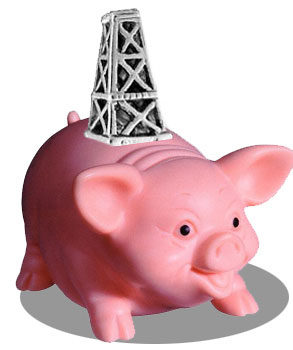
At some point early Tuesday morning, DeLay appears to have found just such a thing. In an 11th-hour deal, House and Senate leaders inserted language into the energy bill that could funnel as much as $1.5 billion through a Sugar Land nonprofit to fund research and development for “ultra-deepwater and unconventional” natural gas drilling. The deal has been in the works for years — versions of the proposal passed the House in several bills that did not become law — but rank-and-file Democrats in the House have cried foul over the process.

“Members of the conference committee had no opportunity to consider or reject this measure,” complained Rep. Henry Waxman, D-Calif., in a letter to House Speaker J. Dennis Hastert, R-Ill., on Wednesday. That is because the ultra-deep program appeared in the final version of the energy bill only after the last meeting for amendments had been gaveled to a close.

House Democrats knew something was afoot on Monday night. Around 7 p.m., they received an e-mail with the ultra-deep language, hours after the deadline for final amendments. “I just got this thing on my BlackBerry,” said one Democratic aide who worked on the bill. “I was like, What the heck is this?” The e-mail was not mentioned by House and Senate negotiators as they worked well into the night to hammer out final changes. Nonetheless, by the following afternoon, ultra-deep had found its way into the bill. “It just got added sometime between 3 a.m. Tuesday and 12 noon,” the aide said.

As it turns out, the Democratic and Republican leaders of the House and Senate energy committees, a group called “the big four,” had approved the language at the last minute. Fingers still pointed to DeLay as a driver for the program. “This is something that Mr. DeLay obviously has been interested in for a while,” said Bill Wicker, a spokesman for Sen. Jeff Bingaman, D-N.M., one of the big four. “He has done a pretty effective job of keeping his fingerprints off of things.”

The idea for an ultra-deep-research fund dates back to 1999, when the National Petroleum Council, an Energy Department advisory group, concluded that the nation needed better technology to seek out hard-to-reach gas deposits. A little-known nonprofit called the Gas Technology Institute, which is made up of more than 350 natural-gas-related companies and consultants, decided to begin lobbying for the money. Between 2002 and 2004, they spent $580,000 on lobbyist C. Kyle Simpson, a former Energy Department official, to work the issue on Capitol Hill.

According to a 2003 tax filing, the GTI board of directors includes the top executives of more than a dozen gas companies, including Noble Energy, the KeySpan Corp. and ChevronTexaco. But Melanie Kenderdine, a former Energy Department official who works at GTI, says the real beneficiaries of the ultra-deep program will be consumers. “Far and away the most effective way to increase supply and reduce prices is to invest in technology,” she said. “That’s where the public interest comes in.”

Sugar Land, Texas, enters the picture because a GTI offshoot called Research Partnership to Secure Energy for America (RPSEA), is the leading contender to win the contract to administer the new program. RPSEA members include giant gas-drilling companies like Halliburton and Schlumberger. Kenderdine said RPSEA moved to Sugar Land because the group was offered a rent rebate, not because DeLay calls it home. DeLay’s office declined to describe his involvement in the last-minute maneuvers. “Mr. DeLay is always up to date on legislation,” said Ben Porritt, a DeLay spokesman.

Critics note that DeLay is not the only pork-hungry politician to exploit the energy bill. Among the other big-ticket items are $80 million for a coal plant in Alaska, $1.25 billion for a hydrogen-producing nuclear reactor in Idaho, and $1 billion in new tax breaks for companies that own natural gas pipelines. “There is not enough policy in this bill to justify all the pork,” says Navin Nayak, an environmental advocate for the U.S. Public Interest Research Group. “It’s embarrassing.”

On the House floor Thursday, Rep. Edward Markey, D-Mass., took the microphone to protest what he saw as a giant giveaway of taxpayer money. He stood next to an oversize poster of an oil rig resting on a photocopy of a Social Security card. “What the Republicans are doing is erecting a huge oil rig on top of the Social Security Trust Fund,” Markey declared.

But his protest was just bluster. The fight is over. The bill is expected to reach the president’s desk within days. “We thank Mr. Markey for the use of his chart, once again,” quipped Rep. Joe Barton, R-Texas, one of the big four, when Markey ran out of time.

Continue Reading Close

Michael Scherer is Salon's Washington correspondent. Read his other articles here.

John Edwards’ creepy mug shot

The disgraced senator flashes an unnerving grin -- just like Tom DeLay

  • more
    • All Share Services

Topics: , ,

John Edwards' creepy mug shotEdwards sports a cold, dead smile in his mugshot

If the pictures of Anthony Weiner and (allegedly) a sunbathing Newt Gingrich weren’t too much for you, here’s another unsettling image: CNN’s Ed Hornick has posted John Edwards’ mug shot. Edwards, who faces felony charges for allegedly using over $1 million of campaign cash to hide his extramarital affair and child, went for the unnerving smile with accompanying cold, dead eyes for his photo:

The image is reminiscent of Tom DeLay from the Republican former House majority leader’s mug shot. (DeLay was ultimately convicted on conspiracy and money-laundering charges.)

We wonder whether the smiles here are meant to convey confidence or an image of innocence. If so, neither man succeeded.

Natasha Lennard covers the Occupy movement for Salon. A British-born, Brooklyn-based journalist, she has been covering Occupy Wall Street since before the first sleeping bag was unrolled in Zuccotti Park. One of the first journalists arrested at an Occupy action, she has managed to enrage Andrew Breitbart, Rush Limbaugh and Glenn Beck. You can follow her on Twitter (@natashalennard), and email her any Occupy updates/videos/ideas to natasha.lennard@gmail.com

Meet Patrick McHenry, the rudest, most shameless College Republican in Congress

Of course he was unfair to Elizabeth Warren: He was trained by the most cutthroat political organization around

  • more
    • All Share Services

Topics: , , , , , , ,

Meet Patrick McHenry, the rudest, most shameless College Republican in CongressPatrick McHenry

Rep. Patrick McHenry (R-Countrywide) called Elizabeth Warren a liar at the conclusion of a House Oversight subcommittee hearing that had already consisted mainly of Republican members of Congress getting very basic information about Warren’s Consumer Financial Protection Bureau completely wrong.

McHenry has been one of the most completely shameless of House Republicans since his arrival in Congress, in 2005, when he immediately and publicly endorsed Tom DeLay’s brilliant plan to exempt himself from ethics rules as his connections to Jack Abramoff began to end his career. But he was born to be cheerfully corrupt: He’s a product of the College Republicans, an organization that trains little Lee Atwaters, Karl Roves and Grover Norquists in the arts of scorched-earth campaigning and wholly irresponsible “governing” on behalf of the monied interests that bought you your job. The ethos is win by any means necessary, legal or quasi-legal (or worse, as long as you never get caught), and McHenry was very good at that, according to Benjamin Wallace-Wells’ memorable profile of the then-freshman in the Washington Monthly.

After the College Republicans, and a failed state legislature race, McHenry moved on to truly insidious conservative astroturfing/push-polling/communications firm DCI, then worked for Rove, then took a political appointment in the Bush administration, then moved to the district he now represents, where he started a real estate company that did not actually buy or sell any real estate, so that he could run for Congress as “a small businessman.”

Once in the United States House of Representatives, McHenry personally intervened in a wild and bloody College Republican National Committee chair election, on behalf of a personal friend of his who’d become slightly toxic after he sent fundraising letters attempting to trick “elderly people with dementia” into donating to the CRNC. And he was successful! The horrible kid won, against all odds:

In other phone calls, McHenry was more blunt: “He told me, and several of my friends that we were done in politics if we didn’t support him,” another College Republican chapter president told me. (McHenry has admitted that he and Deans made the calls but denied that they threatened anyone’s career). Over the course of two weeks, after a couple of a dozen calls, McHenry prevailed upon those in the North Carolina delegation to change their votes, removing three votes from Davidson’s column and putting them in Gourley’s. Gourley ended up winning by six votes; had North Carolina voted the other way, Davidson might have won.

Another of McHenry’s first acts in Congress, Wallace-Wells writes, was to champion a bill that was specifically written to rip off a large portion of his constituents, by making it “much harder for government to regulate or block the conversion of credit unions into banks …” He is a close ally of major consumer financial institutions with a plum assignment to the Committee on Financial Services, which is great for raising money.

It’s only natural that Elizabeth Warren, whose mission is to protect consumers from unethical and predatory practices by these institutions, is Patrick McHenry’s enemy. You can complain on his Facebook wall all you like, but the Republican from North Carolina is incapable of feeling embarrassment.

And his treatment of Warren will only make him a bigger conservative hero and an even more attractive investment opportunity for major banks.

Continue Reading Close
Alex Pareene

Alex Pareene writes about politics for Salon and is the author of "The Rude Guide to Mitt." Email him at apareene@salon.com and follow him on Twitter @pareene

The end of Tom DeLay

And why he'll probably never spend a day in prison

  • more
    • All Share Services

Topics: , , ,

The end of Tom DeLayTom Delay

On Monday, Tom DeLay was sentenced to three years in prison on two felony charges, conspiracy and money laundering, in a campaign finance corruption case that had dragged on for years.

The sentencing of DeLay, once one of the most powerful Republicans in Washington and the majority leader of the House of Representatives, was largely ignored because of the aftermath of the mass shooting in Arizona.

But it’s an extraordinary story — and one that’s not quite over. When he was indicted in Texas in 2005, DeLay’s political career sustained a fatal blow. He was forced to step down from his House leadership position and, in 2006, he resigned from Congress. 

The charges arose after DeLay set up a PAC to funnel corporate money, which is barred in Texas elections, to candidates for the state legislature. The group raised $190,000 and funneled it through the national Republican Party, which then distributed the money to several state-level candidates in Texas.

To learn more about the case that brought DeLay down, I spoke with Lou Dubose, who co-authored “The Hammer,” a biography of DeLay. The former editor of the Texas Observer and the current editor of the Washington Spectator newsletter, Dubose covered the trial gavel to gavel in Austin. He was in the courtroom on Monday when DeLay gave a lengthy presentencing speech accusing prosecutors of having political motivations and claiming he had $10 million in legal bills. 

I asked Dubose whether DeLay, who is planning an appeal, will ever see the inside of a jail cell, and whether the former majority leader appears humbled by the ordeal of the trial.  The conversation has been edited for length and clarity.

Did you ever think that you would see this happen?

I really didn’t. This was a working class jury, and I think that made a huge difference.

What was the dynamic with the jury — why did that make a difference?

Gary Cobb, the assistant DA who tried the case, really dragged out the $50,000 checks and the flights on corporate jets with the same persons who had written the checks to DeLay’s PAC. The sort of life that Tom DeLay lived at the expense of the corporate lobby — I think that really made an impact. By their clothes and what we know about them, it was a real working-class jury.

Oddly enough, Tom DeLay spent the entire duration of the three-week trial in a motor home rather than the Four Seasons. He drove his motor coach over here and checked into a motor home park in south Austin, a long way from where he was playing golf at Saint Andrews in Scotland. Then there was also the fact of the way the DeLays dressed, the fact that Reverend Rick Scarborough was sitting behind them. There was a lot of bling there that these people on the jury didn’t have.

Was it possible to tell where the $190,000 ended up? Did it just go to the state GOP?

The money came back, and it went to the candidates in Texas for whom it was designated. The backstory, of course, is that the Republicans controlled everything in Texas but the statehouse. Therefore they could not control redistricting. So DeLay set this organization up in 2001 for the 2002 election and they had to win a majority in the house. They moved this $190,000 up to D.C. because they were specifically raising corporate money, which was easier to raise. They sent it to Washington with specific instructions to send it back to these designated candidates. The candidates got the checks in the exact amount of $190,000.

And DeLay personally raised the money?

Well, that was the question. He stayed in the background but the state proved that he was aware that that transaction had happened. He was probably involved in directing it, although they didn’t have direct testimony on that. They put the three men who did the money-laundering in a room together in Sugar Land, Texas, in DeLay’s district, before the transaction was made.

Remarkably, at one point in the trial, DeLay went out and talked to Laylan Copelin of the Austin American-Statesman, who is a really terrific reporter. And Laylan asked him if he could have stopped the transaction. And DeLay said, “I could have stopped it, but why would I?”

And that was used in the trial?

In the middle of the trial, the state called Laylan Copelin as a witness — really bizarre. He’d been sitting there most of the trial; two weeks into the trial they call him as a witness because of what DeLay had said. His story ran, and two days later he was on the stand testifying as to what he had been told.

So I think DeLay proved to be a terrible client for a storied criminal defense attorney, Dick DeGuerin. That said, the state did an incredible job putting on a case that had to be by nature largely circumstantial.

Do you think he will ever spend a day in jail?

No. Simply because the Court of Criminal Appeals is an elected court, it’s all Republican, it’s highly political. It’s known as a prosecutors’ court, but in this case I would bet that they’re going to rule for the defendant. The Third Court of Appeals, where the appeal will start, is also a Republican court.

What are the issues in the appeal?

These courts are going to have to find a creative way of setting Tom DeLay free. One argument that they once made that they might try to revive is that money-laundering didn’t apply to checks, it applied to cash. This involved checks. The problem with that at the appellate level is that there have been a number of convictions based on money laundering with checks. So are you going to overturn all these prior convictions in order to save Tom DeLay?

What is DeLay doing these days?

You know, nothing. He is struggling to remain relevant. DeLay was always the star at CPAC, the annual conservative conference in Washington. But he hasn’t been allowed to speak there. Two years ago at CPAC, he was trolling for interviews. At the last CPAC convention, he was shunned.

He’s become a pariah to the Republican Party, and I don’t quite understand why. The true believers hold him responsible, rightly, for the Bush Medicare prescription drug bill, which DeLay pushed through. But he’s of no use to them anymore, and he’s not wanted. So most of what he does is struggle to remain relevant, and he’s not. Dick DeGuerin, in his closing argument, said “This prosecution has rendered my client unemployable.” And to my knowledge, he’s not employed.

His media statements have been defiant, but has he changed?

I don’t think so. That’s what’s remarkable. This is the same Tom DeLay that I saw every day for a year and a half when I followed him in Washington. It seemed to me that it never occurred to him that he no longer had the power that he once exercised. He had no regrets — he’s the same guy, except that he’s driving in a motor home instead of sleeping in the Four Seasons.

Continue Reading Close
Justin Elliott

Justin Elliott is a reporter for ProPublica. You can follow him on Twitter @ElliottJustin

Tom DeLay sentenced to 3 years in prison

Former U.S. House majority leader was convicted of money laundering and conspiracy

  • more
    • All Share Services

Topics:

Tom DeLay sentenced to 3 years in prisonFILE - In this Oct. 26, 2010 file photo, former House Majority Leader Tom DeLay arrives at the Travis County courthouse in Austin, Texas, for jury selection in his corruption trial. Delay will be back in court on Monday, Jan. 10. 2011, for the sentencing phase of his trial after his Nov. 24 conviction on charges of money laundering and conspiracy to commit money laundering in a scheme to illegally funnel corporate money to Texas candidates in 2002. (AP Photo/Jack Plunkett, File)(Credit: AP)

A judge has ordered U.S. House Majority Leader Tom DeLay to serve three years in prison for his role in a scheme to illegally funnel corporate money to Texas candidates in 2002.

The sentence comes after a jury in November convicted DeLay on charges of money laundering and conspiracy to commit money laundering. DeLay was once one of the most powerful men in U.S. politics, ascending to the No. 2 job in the House of Representatives.

The former Houston-area congressman had faced up to life in prison. His attorneys asked for probation.

Senior Judge Pat Priest issued his ruling after a brief sentencing hearing on Monday in which former U.S. House Speaker Dennis Hastert testified on DeLay’s behalf.

Priest declined to hear testimony from the state’s only witness.

THIS IS A BREAKING NEWS UPDATE. Check back soon for further information. AP’s earlier story is below.

Jury convicts Tom DeLay in money-laundering trial

DeLay maintains his innocence and plans to appeal the verdict it took 19 hours to reach

  • more
    • All Share Services

Topics: ,

Former U.S. House Majority Leader Tom DeLay — once one of the most powerful and feared Republicans in Congress — was convicted Wednesday on charges he illegally funneled corporate money to Texas candidates in 2002.

Jurors deliberated for 19 hours before returning guilty verdicts against DeLay on charges of money laundering and conspiracy to commit money laundering. He faces up to life in prison on the money laundering charge.

After the verdicts were read, DeLay hugged his daughter, Danielle, and his wife, Christine. His lead attorney, Dick DeGuerin, said they planned to appeal the verdict.

“This is an abuse of power. It’s a miscarriage of justice, and I still maintain that I am innocent. The criminalization of politics undermines our very system and I’m very disappointed in the outcome,” DeLay told reporters outside the courtroom. He remains free on bond, and his sentencing was tentatively set to begin on Dec. 20.

Prosecutors said DeLay, who once held the No. 2 job in the House of Representatives and whose heavy-handed style earned him the nickname “the Hammer,” used his political action committee to illegally channel $190,000 in corporate donations into 2002 Texas legislative races through a money swap.

DeLay and his attorneys maintained the former Houston-area congressman did nothing wrong as no corporate funds went to Texas candidates and the money swap was legal.

The verdict came after a three-week trial in which prosecutors presented more than 30 witnesses and volumes of e-mails and other documents. DeLay’s attorneys presented five witnesses.

Prosecutors said DeLay conspired with two associates, John Colyandro and Jim Ellis, to use his Texas-based PAC to send $190,000 in corporate money to an arm of the Washington-based Republican National Committee, or RNC. The RNC then sent the same amount to seven Texas House candidates. Under Texas law, corporate money can’t go directly to political campaigns.

Prosecutors claim the money helped Republicans take control of the Texas House. That enabled the GOP majority to push through a Delay-engineered congressional redistricting plan that sent more Texas Republicans to Congress in 2004 — and strengthened DeLay’s political power.

DeLay’s attorneys argued the money swap resulted in the seven candidates getting donations from individuals, which they could legally use in Texas.

They also said DeLay only lent his name to the PAC and had little involvement in how it was run. Prosecutors, who presented mostly circumstantial evidence, didn’t prove he committed a crime, they said.

DeLay has chosen to have Senior Judge Pat Priest sentence him. He faces five years to life in prison on the money laundering charge and two to 20 years on the conspiracy charge. He also would be eligible for probation.

The 2005 criminal charges in Texas, as well as a separate federal investigation of DeLay’s ties to disgraced former lobbyist Jack Abramoff, ended his 22-year political career representing suburban Houston. The Justice Department probe into DeLay’s ties to Abramoff ended without any charges filed against DeLay.

Ellis and Colyandro, who face lesser charges, will be tried later.

Except for a 2009 appearance on ABC’s hit television show “Dancing With the Stars,” DeLay has been out of the spotlight since resigning from Congress in 2006. He now runs a consulting firm based in the Houston suburb of Sugar Land.

Continue Reading Close

Page 1 of 35 in Tom Delay