
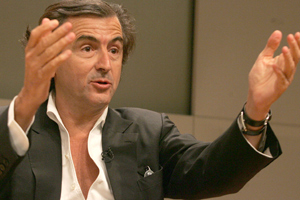

In the United States, Bernard-Henri Lévy is best known for his book “Who Killed Daniel Pearl,” investigating the 2002 murder of the Wall Street Journal reporter on assignment in Pakistan. In France, however, BHL (as he is called) is known more for himself: a flamboyant, courageous, infuriating, charismatic and highly unpredictable writer, who in his checkered career has also played the role of philosopher, filmmaker, diplomatic envoy, war reporter and political activist. He is a celebrity intellectual, a driven enemy of orthodoxy who is regularly compared to Camus and Malraux.
Besides his book on Daniel Pearl, Lévy has also written an in-depth study of Sartre, and a book on Africa’s forgotten wars, ambitiously titled “War, Evil, and the End of History.” His untranslated works number 30, and he has written countless articles, columns and essays. He is among the most recognized and outspoken public figures in France, appearing regularly as a commentator on French television programs, and clashing frequently with other public figures, as when he traded blows in the fall of 2003 with the Muslim intellectual Tariq Ramadan, who had accused Lévy (along with a handful of other French Jewish intellectuals) of “communitarian politics” and a pro-Israel bias, a charge that Lévy characterized as “anti-Semitic.”
But Lévy is by no means just another pundit. He is a deep believer in action, and has visited war zones all over the world in the course of reporting, often at the behest of his government. In 1983 he helped found one of Frances premier anti-racism organizations, SOS Racisme, and he continues to speak out on racial issues in France and abroad. His iconoclasm reaches back to the early ’70s, when he led a movement of intellectuals in denouncing Marxism, the dominant ideology in France at the time.
“I am a writer,” Lévy says, and by this one is meant to understand that he is beholden to no one. It is perhaps not surprising, then, how much ire Lévy provokes in his own country, along with the adulation. He has been called a provocateur, an intellectual impostor, an egoist and a self-promoter, but what seems to elicit the fiercest reaction is his vehement anti-anti-Americanism. At a time when anti-Americanism is highly fashionable in Europe, Lévy, while no fan of George W. Bush, has consistently bucked the trend. “Anti-Americanism is a horror,” he was quoted as saying in the L.A. Times last year. “It is a magnet of the worst. In the entire world, and in France in particular, everything that is the worst in people’s heads comes together around anti-Americanism: racism, nationalism, chauvinism, anti-Semitism.”
Lévy’s interest in America falls squarely within the tradition of Alexis de Tocqueville, who toured the country in the early 1830s, reporting his findings in the classic “Democracy in America.” Given this, it seems natural that he undertook to update Tocquevilles observations with a series of new reports on America. The result, a series of essays on everything from Mount Rushmore to a San Francisco sex club, ran in the Atlantic in 2005, and has now been compiled into a book, “American Vertigo.”
Salon met with Lévy in the plush dining room of the Carlyle Hotel, on New Yorks Upper East Side. In appearance Lévy bears a remarkable resemblance to Robert DeNiro — the same small, canny eyes, thin lips and sharp nose — but, being French, the style of his swagger is roughly diametrical to that which one associates with the actor. He wore a dark jacket (required attire) and, somewhat unnervingly, a white shirt open to the fifth button, exposing his bare chest. Lunch began with split pea soup, fettuccine with white truffles (no garlic, please), and a Diet Coke.
Where did the idea for this project come from?
It was actually not my idea. It was the Atlantics. And, to be honest, I said no at first. It seemed too big for me, too difficult. How could I pretend, first of all, that I could get a grasp on a country as huge as this, even if I took a whole year? Second, as I said to Cullen Murphy, the editor of the Atlantic at the time, of course I like going into the field, but generally I prefer the battlefield. Ive done a book on forgotten African wars, another on Daniel Pearl. America, I said, this is not my thing. I like to smell the perfume of war — how do you say?
Gunpowder.
Well, tragedy, anyway. But Cullen Murphy said, America is a battlefield, too, you know, so you should feel comfortable. What made me accept in the end was the feeling that right now this country is in the middle of an identity crisis. So, I stopped everything. For one year I didnt do anything else. I devoted myself completely to this.
The journey across America is something that most U.S. citizens make at some point, either when theyre young and footloose or when theyre old and behind the wheel of an R.V. Its like a rite of passage. And you went through that rite of passage. Do you feel changed in any way?
Maybe a little more American. I was very fond of this country before, and I am even more so now. The experience of traveling across this country gives you a new relationship to space, time, territory, and to yourself. It gave me a different sense of what it means to have roots, and to be uprooted. It changes the way you think about things on a fundamental level. Its the only experience of this sort I know, and Ive traveled a lot. Ive crossed Africa, Ive crossed Asia, and many countries in Europe, but crossing America is like nothing I know. Its a metaphysical experience.
What was it like traveling across a country in which France has been so vilified? Did you encounter any antagonism?
This vilification was something created by the far right, right before the war in Iraq, when there was such vitriol between France and America. But when I left DC and went deep into the country, meeting average American people — coal miners, Native Americans, homeless people, workers, farmers, whatever — I never met a single man or woman in whom I saw the slightest evidence of a hatred of France, or of me because of being French. To the contrary.
Do you feel that it’s a misperception that you have to correct? Do you consider yourself an emissary for your country?
I am an emissary of nobody. No country, no group, nothing. I am on my own. I’m not answerable to anybody. The great Irish writer James Joyce said that he did not write in English, he wrote in Unglish. I’m UnFrench.
What surprised you the most in your journey?
I was surprised every step. This country has the genius to contradict its own clichi. Maybe because the pace here is so quick, and everything is constantly changing.
But did anything in particular stand out?
Many things. For example, the extent to which creationism is again spreading. This shocked me. The way in which a large part of America and most of the political class accepts or at least does not dare protest the death penalty. For me, the death penalty is a crucial issue. And when I see that death penalty problem is “improving” because this year only 475 were executed, instead of 572, I’m shocked. You should have no executions, not 10 percent less.
Why is this such a crucial issue?
No one has the right to take the life of another. No crime, no feeling of revenge, justifies that. Society has a right and a duty to isolate men and women who have caused harm, and may cause harm again, but to take their lives is unnecessary, unuseful and blasphemous. If you believe in God, life belongs to God. If you don’t believe in God, life belongs to oneself. It does not belong to the state. I visited death rows at a number of jails. There was a cruelty there, a cold violence which sets a terrible example for the rest of society. When the state leads with this example, then the citizen follows.
What are French prisons like?
Also bad. But there’s no death penalty, and that changes everything. And there are less people in prison for minor crimes. In America most of the people in prison are poor minorities, guilty of relatively minor crimes. Sometimes you get the feeling that jails are one of the ways this country deals with social pressures. This exists in France too, but to a lesser extent.
In your book you say that Guantánamo is a fundamental part of the prison system — not an exception to it. What do you mean by that?
All the prisons I saw seemed to have something terrible in common with Guantánamo. An institutionalization of humiliation. It is possible to isolate prisoners without humiliating them, but for some reason in America the prisoners must be humiliated.
Are you surprised at the lack of outrage about Guantánamo?
There are two topics on which the left in America has not fulfilled its duty: torture and Guantánamo. There was even a recent discussion in Dissent magazine, which is a magazine I feel close to, about circumstances in which torture might be used. I find this hard to accept. It must be a moral and political principle: There is no circumstance in which torture can be allowed. It took forever for this scandal at Guantánamo to come to light. And it was politicians like Jimmy Carter who were the first to demand that the facility be closed. It should have been the intellectuals, even intellectuals in favor of the war. This sort of thing is not a question of right or left, conservative or Democrat. It should have been a bipartisan issue. I would have liked to see [Francis] Fukuyama alongside Lewis Lapham, Christopher Hitchens alongside Bob Silvers, demanding the closing of Guantánamo. It’s a scandal. Like the death penalty, it’s a virus in the program of democracy.
Seeing it with my own eyes, Guantánamo was unbearable. It goes far beyond what’s necessary to ensure security. I understand that some terrorists may need to be jailed, of course — but not humiliated, not deprived of their rights. Every criminal has a right to a defense. This is a basic tenet of democracy, and when you begin to play with these elementary rules, it’s like you’ve got a worm in the apple. I was deeply surprised not to see a bigger protest from intellectuals in America.
What do you think has been holding American intellectuals back?
Intimidation. In the two years after Sept. 11 and in the months following the defeat of Kerry, it was as if the American left and America in general had been hit on the head. They’ve been much too influenced by the propaganda of the other camp. Very few dared to say that they were against the war, for example. I was in America at that time, and I was surprised to see what a big event it was when Senator Kennedy said for the first time that the war was a bad idea. People said, What courage! But it should have been said immediately! I attended the Democratic convention for the Kerry nomination. There were big people there, like Barack Obama, who is a great guy. Hillary Clinton spoke, Bill Clinton spoke. But no one, not one of them, expressed anything radically different about the war, or the slightest word about Guantánamo.
Should American intellectuals be held accountable for their failure to speak out? Do they have a duty?
They have a duty.
And they are not fulfilling it?
Sometimes they do. When Sontag went to Sarajevo, when Fukuyama and [Washington Post columnist] Charles Krauthammer discuss the war on terror, they do their duty, obviously. When Christopher Hitchens writes what he thinks, he does his duty. You cannot generalize. I think on Guantánamo there was not enough disgust expressed by intellectuals. I think they will now, though. In France, during the Algerian War, it took time for the French intellectuals to protest against torture. It is not so easy to go against what is presented as “the best interest of the country.” It is not so easy for an intellectual to risk looking like a traitor. This is the kind of blackmail that the state always engages in. If you speak about torture in Algeria you are a traitor. You put your own nation in danger. If you say that you are against the war in Vietnam, you are a traitor, you are with the Viet Cong, and so on.
I saw Jane Fonda in Paris recently, on a TV program. She said that the only thing she’s ashamed of is that famous photo of her with a group of Viet Cong. I don’t understand why. Why should this photo stand out as a special crime? She was not completely wrong. She was wrong not to also attack the Communist regime, but she was right to condemn the American intervention in Vietnam. So why should she, 40 years after, beat her breast? I can’t think of an example of an intellectual figure in France saying something like this. If she thinks it was right to be militant against the war, and thinks so still, this photo is no crime. On the contrary, it’s great. It means that she went to the end of her ideas. She was taking a risk, a physical risk, and this is the best an intellectual can do, in the interest of expressing something.
Here’s what surprises me about the American intelligentsia. I can imagine that an intellectual may decide to support the foreign policy of his president if he thinks he’s right. When Chirac decided to bomb Serbian positions in Sarajevo, I said bravo, Chirac. Bravo. But I said bravo to this and to this only. I did not feel obliged, having taken tea with him, so to speak, to take everything else on the menu, as well. The thing about American intellectuals that so surprises me is the way they always take the entire menu. They endorse the foreign policy so they feel obliged to endorse the attacks against the private life of Bill Clinton, the defense of the death penalty, the sale of firearms, and so on.
I had this conversation with Bill Kristol [the editor of the Weekly Standard]. When I met him I saw the most recent issue of the Weekly Standard in the waiting room and there was a truly disgusting article in there about Clinton and his girlfriends. And I asked Kristol why, of course. Bill Kristol doesn’t care about the sexual life of Bill Clinton. But my sense was that he felt that his endorsement of the war in Iraq also obliged him to endorse the attacks on Clinton. This I don’t understand. And maybe I’m wrong, maybe Kristol really, deeply thinks that Clinton is a bastard, and that a blow job is a crime. Maybe. But I don’t think so. There’s this idea that the world is black and white, and if you go with black then everything has to be black — very strange, in a country that is supposed to be so pragmatic. In France we are supposed to be the country of ideologies, and you’re supposed to be the country of pragmatism. And the reverse seems to be true. American intellectuals have this strange need to ally themselves with a single side. I believe that it is the duty of intellectuals to allow and make room for complexity, to ally with no one, and to move freely across all borders, political or otherwise.
That’s part of what makes Hitchens such a fascinating character.
Hitchens is one of those I respect in this country, one of the intellectuals who are closest to my idea of what an intellectual should be. I have a lot of friends who came out in favor of the war. I understand why. I myself hesitated to decide. Finally I was against. My line was that the war in Iraq was morally right and politically wrong. I said this six months before the war started, and I did not change my mind. Morally right, because it’s always right to overthrow a dictator, one of the bloodiest regimes in the world, but politically wrong because I knew it would produce more chaos, more terrorism. It would make the world even less safe than it was.
Still, I understood those who took the opposite view. What I don’t understand is why you cannot at the same time denounce economic disparity, the anti-abortion movement, religious fundamentalism, the widespread domestic availability of firearms, and so on. An intellectual is someone who is able to count past two. And even three, sometimes. The intellectuals we’re talking about seem only to be able to able to count to one. One — finished. No, please! I want to say. Let’s count to two! I am in favor of the war in Iraq, but I am against economic disparity. I am in favor of prisons to protect the general population, but I am against the death penalty.
Your regard for Hitchens aside, in your book you’re pretty rough on the neocons. You describe them as “murderers, despots, enemies of the human race, slaughterers of the children of civil, doctor strangeloves…” Or is this sarcasm?
Yes, I’m just making fun of the way the French press describes them. They are demonized, which they don’t deserve. I far prefer the neoconservatives, like Kristol, to someone like Pat Buchanan, who is fascist. I far prefer the neoconservative idea of spreading democracy all over the world, to Buchanan, who says that people in the rest of the world don’t deserve democracy.
You like them because they’re thoughtful.
Because they are democrats. Because they believe in democracy. They believe in a naive way. They believe sometimes in an absurd way. But I much prefer a neoconservative who believes in democracy to an isolationist who believes in America only. I was very shocked when I saw the Michael Moore film “Fahrenheit 9/11.” I agreed with him on one point, that the war was a bad idea. But I was shocked by the way he expressed it. The core of his argument was that we have no reason to be interfering in this area of the world. As James Baker said, We don’t have a dog in this fight. I think that we do have a dog in this fight. We have something to lose in Iraq. I feel brotherhood, as I have felt all my life, for the Afghan, the Bosnian, and for the Iraqi. But in his movie Moore simply suggests that it is not our affair.
How much of this isolationist attitude, do you think, can be traced to the fact that we’ve never experienced totalitarianism on our own soil?
It definitely has something to do with it. In Europe we have had the horrible privilege of knowing the two totalitarianisms of the 20th century. We know them from inside. We went to the end of the darkness. And so in our minds all the little lights start going off when the beast comes around again.
So it should be the job of intellectuals to keep this darkness in mind?
I think so, to keep the darkness in mind, yes. [Philip] Gourevitch did that, for example, in his book on Rwanda.
Your remarks on isolationism remind me of what you say in your book about so-called American imperialism. You seem doubtful that there is such a thing.
Look at your army in Iraq. Look at your army in Vietnam, 40 years ago. Is this an imperialist army? This is the myth, the myth of American empire. Where are your positions? Where are your conquests? Where are your successes abroad? Even in Latin America you went from failure to failure for 40 years. Each time you tried to act as an imperialist you failed. No, European countries are colonialist. We know how to do it. England, France, even Germany. America, no.
So you think that the American left gets distracted by the idea that we’re this terrible, imperialist power?
Of course, yes. They should be a little less obsessed with your so-called imperialism and little more obsessed with the death penalty, with the sale of handguns, with creationism. To me, this sort of thing is much more important than worrying about so-called imperialism.
You mentioned you had the pleasure of meeting Obama and Hillary Clinton at the Democratic convention. What is your sense of them? Do you think they are strong enough to get the left back on its feet?
No, they are not strong enough. But no political figure is ever strong enough. Political leaders are what they are. Obama and Hillary Clinton are brilliant, charismatic, but they will be exactly what the left will make them be. As long as the Democrats speak money, instead of ideas, as long as they are afraid of their own shadows, they will lose. And as brilliant a leader as Obama or Hillary is, they cannot win with such a party behind them.
It was a shame to see people on the left, in the last days of the election, trying to adopt the platform of the National Rifle Association. They should have said, No — vote against us if you want but we are against the sale of firearms. Instead of, Me too, I’m a hunter! I like weapons! The right expresses itself in America. The left does not. It is a pity.
What does the United States mean to you, and to France? Why is it important?
The reality of the United States means the possibility of Europe. The fact that America exists means that Europe, the European Union, which I strongly support, is not a dream. It’s possible. You are the proof of Europe. The existence of America proves that Europe is possible.
How so?
The existence of America proves that people coming from different origins can come together to form a political entity. And this is our dream in Europe today. From Stockholm to Napoli to Paris or London. Some of us in Europe are seized by despair. We fear we are too different to form a unique political body. And what prevents me from despairing is the very reality of America. If it is possible to form a union from Seattle to Savannah, from Miami to Detroit, for Europeans all hopes are justified.
What’s next for you, now that your tour of America is done?
A big book tour.
Across America? You just got back.
I’m going around again. It’s like the American fixation with nostalgia, where something barely ends before it’s being longed for. So, yes, another trip across America, with a short delay for nostalgia. I will go back to Savannah, back to Chicago, with nostalgia.
