
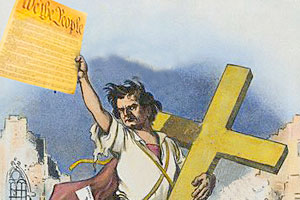

A hundred years ago, it would have been hard to find an American in any field of endeavor who was better known, or more widely loved, than William Jennings Bryan. By 1906, Bryan had already lost two presidential elections, with one more defeat to go. In fact, that’s one way of summarizing Bryan’s peculiar legacy: Among major-party candidates in American political history, he’s the all-time champion loser. Then as now, Bryan cut a much grander figure on the national stage than the men who defeated him: William McKinley in 1896 and 1900, William Howard Taft in 1908. McKinley was assassinated by an anarchist; Taft was enormously fat. Who among us knows, or cares to know, more than that? Bryan, although he retains only a flickering shadow of his former fame, still hovers over the early 20th century like a frock-coated ghost, Holy Bible in one hand and United States Constitution in the other. If we have come to believe, in the eight decades since Bryan’s death, that those two documents are at war — or rather, that one must be subservient to the other — he never saw it that way.
Bryan was the most famous American orator at the turn of the last century, simultaneously the nation’s leading populist politician and its leading evangelist. In his own time, he was very much identified as a man of the left, even a radical. Historian Michael Kazin, in his new Bryan biography, “A Godly Hero,” calls him a “Christian liberal,” and that label will do as well as any. But the problem with Bryan is that his politics don’t make much sense in 21st century terms, and that the “prairie populism” he personified is now identified so strongly with the right. It doesn’t help that Bryan is mainly known today for a sideshow act performed at the very end of his life, when he helped prosecute a Tennessee schoolteacher for half-heartedly leading a lesson about evolution.
In a hymnlike poem thumping with faux-jazz rhythms, written in 1919 when Bryan had faded from the political scene but had not yet become a laughingstock of the educated classes, Vachel Lindsay fulsomely sang the three-time loser’s praises and mocked his various nemeses. “I brag and chant of Bryan, Bryan, Bryan/ Candidate for president who sketched a silver Zion,” he wrote. (We’ll get to that whole gold-and-silver business in due course.)
For Lindsay, Bryan was “the one American poet who could sing outdoors,” a big-hearted democrat (both upper-case and lower) who led the oppressed and unwashed masses of the recently annexed Great Plains and Western states against the “elephant plutocrats” of the Eastern money establishment, “the dour and old, the mean and cold.” In an especially memorable passage, Lindsay recalled Bryan’s 1896 campaign, which electrified the torpid landscape of American electoral politics, as a violent confrontation, almost a new civil war: “Prairie avenger, mountain lion,/ Bryan, Bryan, Bryan, Bryan,/ Gigantic troubadour, speaking like a siege gun,/ Smashing Plymouth Rock with his boulders from the West.”
Kazin, a Georgetown professor who has previously written an important history of populism, labors valiantly to rehabilitate Lindsay’s doomed troubadour for contemporary readers, to provide us with a more generous understanding of why so many working-class and middle-class Americans followed Bryan so passionately. It’s a tough job, but I suppose somebody has to do it. Ever since the tragicomedy of the Scopes “monkey trial” in the summer of 1925 — when Bryan was publicly humiliated by Clarence Darrow, and died only days later — the man once known as “the Great Commoner” has been remembered principally as a bulwark of fundamentalism, ignorance and intolerance. H.L. Mencken memorialized him as “the idol of Morondom,” and the label has pretty well stuck.
As Kazin makes clear, this is manifestly unfair both to Bryan and the millions who loved him. Kazin is also correct that contemporary Americans on both the left and the right largely misunderstand Bryan’s legacy. His name is attached to a fundamentalist college in Dayton, Tenn. (site of the Scopes trial), and he is listed as a formative influence on the foundation of the Christian Coalition. But the flesh-and-blood Bryan would have found little agreement with such institutions and their leaders, outside of theological matters — and even there, he was not what we would today call a fundamentalist. (Like many mainline Christians, he believed that the Bible was true and holy, but not always to be taken literally.)
Bryan’s politics were resolutely anti-corporate (bordering on anti-capitalist) and anti-imperialist. He was an early supporter of labor unions, women’s rights, progressive taxation and the federal government’s central role in safeguarding the poor, the old and the sick. By driving out the high-tariff, low-tax conservatives who had dominated the Democratic Party since the Civil War, Bryan set his party on a fateful course: It became, more or less officially, the party of income redistribution, of big government, of “the working man.” Bryanism pointed the way toward Franklin D. Roosevelt’s New Deal, Lyndon B. Johnson’s Great Society and, at least arguably, the bewildering, half-repudiated, middle-of-the-road liberalism of today’s Democrats.
Even as he focuses on Bryan’s indisputable credentials as an early avatar of progressivism, and proposes him as a possible model for a future Christian left, Kazin to some extent misses the larger point of the Commoner’s career. Yes indeed, Bryan is a more complicated and paradoxical figure than the yahoo caricatures perpetuated by snob sophisticates like Mencken and John Reed make him out to be. But to suggest that Bryan’s overall influence on American political history was positive is quite another matter.
There are many reasons why Bryan would have made a poor president — even Kazin seems grateful he was never elected — and it may be specious to suggest that the lack of personal drama or internal conflict is among them. But no biographer has done much to explicate Bryan as a man; few of his personal papers survive, and there is no hint of scandal or trauma in his private life. Unlike Washington or Jefferson or Lincoln or virtually any other major American historical figure, Bryan seems to have been an incurious person with little capacity for introspection and almost no intellectual breadth.
He knew the Bible, he knew and loved the social novels of Dickens and Victor Hugo, and he knew the smattering of classics that a 19th century middle-class education in small-town Illinois afforded. Beyond that, Bryan never read much or learned much. Although he traveled around the world (and was greatly impressed by the proto-welfare states emerging in Western Europe), his impressions were largely superficial, and colored by xenophobic and racist assumptions. He gave the same speeches year after year, over and over again. Kazin estimates that Bryan’s best-known addresses, “The Value of an Idea” and “The Prince of Peace,” were each delivered at least 1,500 times, and that nearly half of all Americans had personally heard him give one or the other.
In part, this reflects Bryan’s supreme self-confidence and his genuine belief in his creed, which, as Kazin writes, “married democracy and pietism in a romantic gospel that borrowed equally from Jefferson and Jesus.” This in turn echoed the widespread optimism of a young country suffused with both Protestant evangelicalism and republican ideology, where equality before the law and before the Creator were seen as interchangeable, and the growing inequality between rich and poor was understood by many as sinful.
It would be more accurate to observe, of course, that only some people were seen as equals before God and the law, and that only inequality of wealth among light-skinned men of European ancestry was understood to be sinful. Throughout his 30 years in public life posing as the champion of the oppressed, Bryan made virtually no mention of the 9 million or so American citizens whose parents had been in chains a generation earlier, and who, more recently, had been systematically disenfranchised by Jim Crow laws throughout the South at the end of Reconstruction.
Kazin does not avoid this topic entirely, citing it as Bryan’s “one great flaw,” but he seems determined to defuse it, if possible. He adds, rather lamely, that no other Democrat objected to white supremacy in the South until at least the late 1930s, and that Bryan never expressed any of the overtly racist rhetoric that was common currency in Democratic politics. Are we supposed to be comforted by the idea that the Great Commoner was a stupid or unconscious hypocrite, rather than an intelligent, self-tormented one like his slaveowner hero Thomas Jefferson?
As far as that goes, it seems more plausible that Bryan was simply recognizing ugly political reality — an inverted version of the same political reality that bedevils the Democratic Party today. If invited into Bryan’s coalition, African-Americans would surely have embraced his positions on economic and political issues (some prominent Northern blacks, W.E.B. Du Bois among them, supported him despite his silence on racial issues). Many were evangelical Christians with visions of a social gospel close to Bryan’s own; even a token gesture of friendship might have made him the most popular white politician in black America since Lincoln (not a tall order, admittedly).
But no Democrat could be elected president in those years without carrying all 11 states of the defeated Confederacy, just as no Republican can win today without carrying all, or almost all, those states. Bryan carried them in all three of his campaigns, as did Grover Cleveland and Woodrow Wilson, the Democratic presidents elected before and after him. Reaching out to black voters in any form would have destroyed the fragile alliance between white Southern Democrats and big-city Northern Democrats (as in fact happened, many years later), and severely endangered the party’s survival.
Racial exclusion and white supremacy lay at the heart of American democracy, poisoning its discourse in all directions and going essentially unchallenged within either major party. Almost the sole exception to this rule was Wisconsin Gov. and Sen. Robert La Follette, the legendary Republican progressive who offered almost all of Bryan’s political agenda in a more coherent form, without the moral compromises or egregious blind spots. (Perhaps not coincidentally, he was nowhere near as popular.)
Even if we agree with Kazin that Bryan was innocent of conscious racism, just as his diatribes against the bankers of New York and London who oppressed agrarian America were not consciously anti-Semitic, he was perfectly happy to channel such sentiments. Kazin reports that after each of Bryan’s electoral defeats, his mailbox filled up with hundreds of letters from true believers alleging sinister anti-democratic conspiracies orchestrated by Catholics or Jews. His core followers were always Midwestern Protestants, but as time passed, they became less optimistic and less tolerant, more likely to look to their hero as a preserver of Christian tradition than as the herald of a more just future society.
As the histrionic imagery of Lindsay’s poem perhaps inadvertently captures, there was always an undercurrent of regional and class hostility beneath Bryan’s ebullient rhetoric, and the target of his populist anger was often ambiguous. Shortly after his election to Congress from Nebraska in 1890 (the only elective office he would ever hold), Bryan sounded a keynote theme of his career, telling a Kansas City audience: “We simply say to the East, take your hands out of our pockets and keep them out.”
Officially, he was discussing the gold standard, an issue that’s barely comprehensible today, but let’s assume for the purpose of argument that his position made sense at the time. (The gold standard was seen as deflationary, which tended to benefit banks and other major creditors; “free silver,” which Bryan supported, would presumably loosen the money supply and benefit farmers and small merchants.) As Thomas Frank has observed, Bryan’s anti-elitist rhetoric — with its implied subtext that people who live in East Coast cities are somehow not real Americans — may have expressed a left-leaning version of populism in the 1890s, but it sounds an awful lot like the right-wing populism of today.
Bryan was acclaimed by admirers and enemies alike as the greatest public speaker of his day and perhaps the greatest the republic had ever seen. Not much of this can be detected in transcripts of his speeches — which profess pedestrian themes, in the overly flowery language of the time — or in such primitive audio recordings as exist. (In the best of those, you can catch an inkling: a mellifluous tenor voice, superb breath control and a wavelike cadence building slowly toward climax.) Bryan’s appeal evidently stemmed from his charisma, his delivery, his frank appeal to the listener’s emotions and his powers of persuasion, and not from what he actually said or the issues he nominally trumpeted.
After all, the most famous speech of Bryan’s career, the “Cross of Gold” address that galvanized the 1896 Democratic convention, came as no surprise to the audience packed into the Chicago Coliseum. The doctrine of free silver, or “bimetallism,” was the only real issue of Bryan’s campaign, and he had already shaped it into an emblem of all the injustices perpetrated by the powerful against the powerless. As Kazin observes, “Bryan never forgot that he was speaking to a gathering dominated by people … who agreed with him. What they craved was a memorable statement of what they already believed.”
When Bryan mounted the platform after a day of contentious debate, he launched into an extended paean to the common man, proclaiming that wage laborers, farmers, miners and small merchants were as important to the economy as “the few financial magnates who, in a back room, corner the money of the world.” He indulged in biblical quotations, classical and historical references that may have gratified his listeners but probably also whizzed over their heads, and paid obligatory homage to the greatness of his country and the revolutionary spirit of 1776.
Then he moved in for the kill. “Having behind us the producing masses of this nation and the world,” he said, stretching his fingers along his forehead, “we will answer [the Republican financiers’] demand for a gold standard by saying to them: You shall not press down upon the brow of labor this crown of thorns, you shall not crucify mankind upon a cross of gold.” Then Bryan stepped back from the podium and stuck out his arms horizontally from his sides, holding a crucifixion pose for several seconds. A “painful” silence fell, Kazin reports, and then the crowd exploded.
It was obviously great theater at the time. Bryan, a Nebraska outsider who was just 36, won the Democratic nomination the next day, and became the party’s leading figure through the next five election cycles. But in historical hindsight, it looks more than a little ridiculous.
Those critics who thought Bryan was blaspheming had a point: Was he really comparing the difficulties caused by a debatable monetary policy to the most potent symbol of human suffering the Christian faith could offer? Wasn’t he even comparing himself to Jesus by mimicking his pose? And given the popular view that the Jews had killed Christ, and the fact that the biggest international bankers, many of them Jewish, were among Bryan’s targets, wasn’t there, at the very least, a troubling potential subtext here?
Kazin tells us that on the day of Bryan’s triumph, Illinois Gov. John Peter Altgeld, another populist lionized by Vachel Lindsay, told his friend Clarence Darrow (the same lawyer who would oppose Bryan almost 30 years later in Tennessee), “I have been thinking over Bryan’s speech. What did he say, anyhow?”
Kazin doesn’t quite answer this question, but one way of approaching it is to say that in the speech Bryan had harnessed an inchoate desire for change, as populists always do. He had captured a general sense of aggrievement and yoked it to a hot issue people thought they cared deeply about (they didn’t, as things turned out) and to deeply rooted totems of belief: the greatness and goodness of America, the passion of Jesus Christ.
By Bryan’s next campaign in 1900, bimetallism was a dead issue and he ran as an anti-imperialist, opposed to the U.S. annexation of the Philippines in the wake of the Spanish-American War. In characteristic fashion, he argued simultaneously that this was unfair to the Filipinos, who wanted independence, and that America did not need a new “race problem” to go with our old one.
He took the 1904 election off — just as well, since Teddy Roosevelt had stolen a page from the populist playbook and would have been unbeatable — and returned to the fray in 1908. By then the Philippine crisis was long over and Bryan became an arch-reformer, running to control the power of the “trusts,” as major corporate entities were then known. There is no reason to doubt his sincerity on any of these issues, or others he embraced, and on many of them he was ahead of his time.
But the pose Bryan struck on that Chicago podium in July of 1896 was not coincidental. Like all successful populist politicians, he had the gift of tapping into public anxiety and distress and channeling it to his advantage. It looks from this distance as if his real cause was not the elevation of the working man or the moral purification of America, although he believed in those things, but rather the Christ-like glorification of William Jennings Bryan.
Bryan’s contemporaries were sharply divided about him; long before Mencken turned on him in Tennessee, plenty of people viewed him as a phony. “What a thorough paced hypocrite and demagogue he is,” wrote Teddy Roosevelt to a friend, “and what a small man.” Famed journalist William Allen White saw in Bryan the “breezy amiability” of a St. Louis shoe salesman, and warned Americans, “There is really no more reason for electing an orator to office than for electing a fiddler. Both talents rouse the emotions.” (White presumably could not have imagined an American future in which a retired film actor would be elected to major office, not once but several times.)
Novelist Willa Cather, a fellow Midwesterner who followed Bryan’s career closely, was in some ways more sympathetic. She had only scorn for his intellectual abilities, but she saw in him the qualities of their native region, “its newness and vigor, its magnitude and monotony, its richness and lack of variety … its high seriousness and self-confidence, its egotism and its nobility.” What really interested her about Bryan was what the rise of such a pious, earnest and altogether anachronistic figure said about Americans. “It is an interesting study in reactions,” she wrote, “that the most practical, and prosaic, and purely commercial people on the planet should be dazzled and half convinced by a purely picturesque figure — a knight on horseback.”
Kazin accepts the value of these insights, but still believes that White and Cather “too easily dismissed [Bryan’s] critique of the emerging corporate, imperial order.” This may be true, but Bryan’s limitations became more obvious late in his career. He lent his prodigious influence to Woodrow Wilson’s campaign in 1912, even though the two men had never liked each other, and his egotism led him to two awkward years as Wilson’s secretary of state, increasingly unhappy with America’s gradual entanglement in the Great War. (Kazin thinks Bryan was right about that one.)
The final causes of Bryan’s career were his most moralistic and sanctimonious: the banning of alcohol (he was a lifetime teetotaler) and the squelching of evolutionism. Prohibition, as Kazin reminds us, was a radical populist cause, even a socialist one — a way of saving the working man and his family from the depredations of big capital, as embodied in the brewer, the distiller and the saloonkeeper.
Like Thomas Frank, Kazin mounts an effective argument that Bryan saw the teaching of Darwinian evolution not as a matter of theological error but of social justice. For him, abandoning biblical teaching was a gateway to social Darwinism and eugenics. If children were taught that all was animal brutality and we were just apes wearing clothes, morality would evaporate and the poor, the ill and the undesirable would be wiped out by tyrants. Perhaps it could be said that Bryan was anticipating horrors yet to come, but by the time he died in Tennessee he seemed to have become a scold and a puritan, a fragment of the 19th century trapped in a world of electric light and motorcars.
Bryan came close to being elected president only in his first campaign, the revolutionary autumn of 1896, when Kazin calculates that 20,000 votes spread across six close states would have given him an Electoral College victory. He never had the money or the organization to compete on equal terms with Republicans in the vote-rich Northeast, the region he so pointedly disdained. But as I said earlier, his repeated defeats made him much more famous than the men who were actually elected, and he transformed American politics in ways that would not become clear for years to come.
Bryan inaugurated an era in which style and sentiment would trump substance, personal charisma would trump intellect or ideas, and pious moralizing would trump social consciousness. Politicians of the Gilded Age had remained aloof from the public, relying on printed broadsides, entrenched partisan loyalties and local organization. Bryan invented the glad-handing, “happy warrior” style of the modern political campaign, crisscrossing the country tirelessly by rail and delivering countless speeches to crowds large and small. (It has often been observed that if radio or television had existed in Bryan’s day, he would have beaten the drab McKinley or pretty much anyone else.)
He convinced his followers that he was for the little guy and for Christian virtue, and that they came to the same thing in the end. But beyond a general constellation of issues that varied only slightly during his 30 years in public life, neither Bryan nor his believers worried much about ideological consistency. At various times and for various reasons, Bryan made common cause with the Socialist Party, the American Federation of Labor, biblical fundamentalists and the Ku Klux Klan.
Kazin may not intend this, but as he fleshes out his fascinating portrait, Bryan comes to seem the central influence on 20th century American populist politics of all persuasions. His descendants are scattered across the ideological map: FDR and LBJ, and maybe even George McGovern and Paul Wellstone, lie in one direction. Huey Long, George Wallace and Pat Buchanan lie in another. Ronald Reagan, Bill Clinton and George W. Bush, different as they may be, are all Bryan’s grandchildren.
On the last page of “A Godly Hero,” Kazin describes Bryan as a sincere, warm and passionate man who engaged the public’s yearning “for a society run by and for ordinary people who lead virtuous lives.” Well, OK — but who gets to decide what “ordinary” and “virtuous” mean? Kazin seems less troubled by Bryan’s hypocrisy than he might be, and the political realm Bryan bequeathed to us is one where hypocrites thrive, and indeed one that makes honest people become hypocrites. Anytime you see a politician proclaiming himself an outsider and a champion of the common man (often in contravention of all logic), wrapping himself simultaneously in the flag and the mantle of Jesus, you see the solemn ghost of William Jennings Bryan, arms spread in that crucifixion pose for all eternity.
