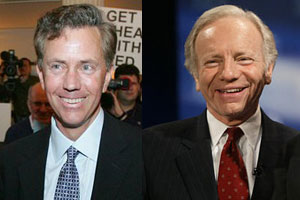

Howard Dean

The war Lieberman didn’t want

Despised by Democratic liberals for his unrepentant support of the Iraq war, Joe Lieberman is facing a tough fight from antiwar newcomer Ned Lamont.

  • more
    • All Share Services

The war Lieberman didn't want

When Joe Lieberman bowed out of the 2004 Democratic presidential race, he took the stage to the sound of an unrepentant Frank Sinatra singing “My Way.” Now as the three-term Connecticut senator faces a suddenly vexing August primary challenge from antiwar businessman Ned Lamont, Lieberman is again channeling his inner Sinatra.

“I’m going to be the kind of senator that I believe it is my responsibility to be,” the hawkish Lieberman said to me last week at the start of a soliloquy that ranged from portentous to fatalistic. “If that doesn’t work politically, so be it. Life and service will go on.”

Moments later, as a staffer drove us through the blue-collar suburbs of New Haven, Lieberman invoked Old Blue Eyes: “I don’t want to be too self-psychoanalytical about it,” he said. “But to quote the great philosopher Frank Sinatra, I’m going to do it my way.” Then Lieberman quoted his political theme song with word-for-word precision: “For what is a man, what has he got? If not himself, then he has naught.”

How has Lieberman gone in six years from being the first Jewish vice-presidential nominee to a senator brooding about the possible final curtain of his political career? When Lamont formally declared his candidacy a little more than two weeks ago, he sneered, “I doubt that anybody will call me ‘George Bush’s favorite Democrat.’” That sobriquet, which bitterly galls Lieberman, is rooted in the senator’s early and still unabashed support for the Iraq war.

As a punching bag for left-wing activists, Lieberman somehow ranks up there with Tom DeLay and Dick Cheney. Yet according to the National Journal’s 2005 Senate vote rankings, Lieberman’s centrist record is on par with that of West Virginia’s Robert Byrd, the octogenarian war critic lionized by the blogosphere.

Other Democrats are forgiven their ideological transgressions, but never Lieberman. In Pennsylvania, Senate challenger Bob Casey has overwhelming party support even though he is antiabortion and supported Samuel Alito for the Supreme Court. (Lieberman, in contrast, is pro-choice and voted against Alito.) It is almost forgotten that California Sen. Dianne Feinstein supported all of Bush’s deficit-creating 2001 tax cuts. (Lieberman voted against them.) And Hillary Clinton, the winter-book favorite for the 2008 nomination, has not exactly been marching in antiwar demonstrations.

There is no simple explanation for why Joe-mentum (what Lieberman hoped for in the New Hampshire primary where he finished a dismal fifth) has turned into Joe-mad-at-him. Part of it may be that Lieberman’s greatest strength (the self-righteous independence that propelled him onto the 2000 ticket when Al Gore wanted to signal his distaste for Bill Clinton’s sexual transgressions) is also his greatest weakness. For some activists, memories of that 2000 campaign die hard, from Lieberman’s sputtering debate performance against Cheney to off-message comments about the Florida recount.

George W. Bush and Co. also appear to be working overtime to undermine Lieberman’s Democratic credentials. Republicans, apparently without Lieberman’s complicity, have floated the senator’s name as a possible replacement for Donald Rumsfeld at the Pentagon. Then Bush himself, after this year’s State of the Union address, grabbed Lieberman in what appeared to be something between a manly embrace and a sloppy kiss. For his part, Lieberman insisted, as he ruled out an independent campaign for the Senate, “I am a Democrat. I believe in the Democratic Party. I believe in the vision of JFK and, I must say, the vision of Bill Clinton.”

But what rankles liberals the most is Lieberman’s refusal, even now, to give ground on the war. Appearing on “Face the State,” a half-hour interview show that aired on Hartford television (WFSB) last Sunday, Lieberman said about Iraq, “I’ve been there four times now. I can tell you that about two-thirds of Iraq is pretty peaceful. Around the Sunni Triangle, around Baghdad, that’s the worst part. And that’s getting better.”

Such an optimistic, glass-half-full view of Iraq is not shared by most Democrats in Lieberman’s home state. This partially explains one of the oddest survey results of the 2006 campaign season: According to a mid-February Quinnipiac University poll, Lieberman has a higher approval rating among Connecticut Republicans (71 percent) than Democrats (57 percent). Still, most Democratic senators with overall 63 percent approval and no serious Republican opponent would be tempted to prematurely break out the election-night champagne.

Instead, Lieberman is facing his most daunting political challenge since he upended maverick Republican Sen. Lowell Weicker in 1988. Lamont — a Greenwich cable-television entrepreneur who is the well-born great-grandson of J.P. Morgan’s business partner — impetuously entered the race when he could not find an elected official to take on Lieberman over the war. As Lamont, who may invest as much as $500,000 of his own money in the contest, put it to me modestly, “I wasn’t my own first choice.”

The candidate and I were chatting on a recent Saturday evening in a Starbucks in downtown Westport as Lamont waited to participate in a peace vigil. This is the heart of affluent Fairfield County and the epicenter of antiwar sentiment, but Lamont, dressed in a blue V-neck sweater over a flannel shirt, went unrecognized in the crowded coffee shop. “If you want to know my journey about why I felt this country was going off its moorings,” Lamont said, still growing accustomed to candidate-speak, “it was three substantive things for me. Terri Schiavo, the ‘bridge to nowhere’” — a reference to an infamous Alaskan boondoggle in a Senate appropriations bill — “and then the war.”

At this moment, even though Lamont had not raised his voice as he discussed his animating passions, a towheaded 3-year-old at the next table began shouting, “Hey, hey, no talking.” For a minute or so, Lamont tried to stick to his narrative, which only provoked the child to bellow, “Hey, no talking loud.” Finally, the candidate paused to joke that maybe the day’s headline should read, “Lamont’s Message Fails to Resonate With Younger Voters.”

Lamont’s announcement speech was studded with Howard Dean-like rhetoric (“You’re not losing a senator, you’re gaining a Democrat”), but it became clear during our interview that he should not be cubbyholed as a hardcore Deaniac. Lamont ruefully confessed that his favorite for the 2004 nomination was Bob Graham, the soft-spoken, antiwar Florida senator who dropped out before the Iowa caucuses. In his ideologically free-form efforts to find a candidate who could defeat Bush, Lamont even donated $500 to Lieberman’s presidential efforts.

The national party establishment is expected to rally around Lieberman, but Lamont at least has Jim Dean, the brother of a fellow named Howard, in his camp. “I think it’s good for the party, no matter how many votes Ned gets. He’s getting people fired up,” said Jim Dean, who heads Democracy for America, the grass-roots organization that his brother founded before becoming Democratic Party chairman.

While Lamont probably will raise enough money to wage a competitive campaign, he is, beyond his own contributions, heavily dependent on Internet fundraising. Tom Swan, Lamont’s campaign manager, said, “I hope we’re the first campaign in this country that can take full advantage of the net roots.” The activist Web site ActBlue claims to have raised $141,000 for Lamont from 2,400 donors. At the same time, left-of-center blogs regularly voice their overly personalized scorn for Lieberman. A brief moment of peevishness from the senator in a radio interview provoked this recent posting from Firedoglake: “I thought we would be a lot further along in the campaign process before Holy Joe wigged out, but it seems we’ve gotten deep under his skin.”

Normally, none of this would be enough to give a little-known candidate like Lamont much hope in a state where registered Democrats declared by a 61-30 percent margin in the Quinnipiac poll that Lieberman deserves to be reelected. But Connecticut, once dominated by a formidable Democratic organization, has scant history of contested primaries. In fact, until recently a challenger had to win 15 percent of the vote at the state party convention to even be allowed on the primary ballot. Both the Lieberman and Lamont campaigns anticipate a low-turnout primary at the height of the August vacation season in which intensity of support may matter more than statewide polling numbers.

Even though Lamont plans to get on the ballot through petitions, the state party convention at the end of May could turn the national spotlight on the Lieberman primary challenge. Although the endorsement vote at the convention is largely symbolic, Lamont could conceivably win the backing of one-third of the 1,608 delegates — a seismic rumble that would transform a contest in which the conventional wisdom is still that the incumbent will win in a walk. That is why Lieberman is now spending his spare hours phoning local Democratic chairmen and -women, while his challenger has appeared before two dozen town committees.

“I’m going to towns that haven’t seen a senator in decades,” Lamont boasted. When I asked whether this was also an implicit criticism of Connecticut’s popular Democratic senior senator, Christopher Dodd, Lamont refused to back down. “It’s a criticism of the system,” he replied. “These guys haven’t been challenged in years.”

There is an element of truth to Lamont’s jibe. Lieberman did not even really campaign for reelection here in 2000, since he was simultaneously running for vice president. When the senator appeared on “Face the State” last weekend, host Al Terzi pointedly noted that it had been 11 months since Lieberman had last appeared on the program. A small moment, but emblematic of the feeling that Lieberman, like many veteran senators, has taken his home-state constituency for granted.

Until now, Connecticut Democrats have accepted Lieberman’s hawkish views and independent gestures as part of the whole package. Clyde McKee, a political science professor at Trinity College in Hartford, expressed the traditional view of Lieberman when he said, “I think that Democrats who don’t like his positions would say that he has integrity.” But if Democrats get the feeling that Lieberman no longer even bothers to hear them out, their tolerance for his deviance from liberal orthodoxy could rapidly erode.

That is what Lieberman is now running hard to prevent — even scorning the political gospel that an incumbent senator should ignore his primary opponent. “We decided to engage this guy early because the senator takes this race seriously,” said Sean Smith, Lieberman’s campaign manager. As a Lieberman fundraising e-mail that went out Tuesday put it, “This campaign is sure to be a tough one; my opponent has not been shy about misrepresenting my record, and has made it clear that to try to build himself up he has no problem trying to tear me down.” Also this week Lieberman, who had about $4 million in campaign funds at the beginning of the year, has just begun a statewide radio buy with a soft-spoken commercial stressing his environmental record.

Yet even as he tries to extinguish the political fires of 2006, Lieberman makes no secret of his longing for an era when political passions smoldered rather than sizzled. When I asked the Connecticut senator why he has become such a lightning rod, Lieberman said, “It is something that speaks to this moment in our politics, which is very partisan and very much are you with us 100 percent or are you not with us? And there’s a lot of — I can’t think of a softer word than hatred. In the Democratic Party there are a lot of people who have the same kind of hatred — which I find is self-defeating and almost certainly wrong — towards Bush that a lot of Republicans had toward Clinton.”

Thursday night Joe Lieberman will be in an honored place at the Connecticut Democratic Party’s annual fundraising dinner in Hartford with his Senate colleague Barack Obama as the guest speaker. Ned Lamont, who will be seated at the same table with Jim Dean, expects to be somewhere in the rafters. But Lamont’s shadow will not be far from Lieberman, the senator who, with a few breaks during a recount in Florida, might right now be the sitting vice president of the United States.

Continue Reading Close

Walter Shapiro is Salon's Washington bureau chief. A complete listing of his articles is here.

Howard Dean responds to Salon

And we respond to his spokeswoman's dismissal of our story about Dean's paid advocacy work

  • more
    • All Share Services

Howard Dean responds to SalonHoward Dean

Howard Dean’s spokeswoman, Karen Finney, has responded to my story on Dean’s turn into paid advocacy work, accusing me of engaging in “lazy journalism.”  I think the adjective is not accurate.

Salon has nothing personal against Dean. But we felt that a liberal champion’s reliance on paid advocacy work reveals something significant about our political culture, and possibly about Dean himself. Finney’s statement is presented here in its entirety, along with my responses.

While there may be fair criticisms to be made, its a sham that Justin knowingly ignored a number of relevant facts because they didn’t fit the premise of the story he wanted to write. Criticism of one’s positions or activities is one thing, lazy journalism is quite another.

On the issue of biologics, one that he’s known and had an opinion on long before he was DNC Chairman. For example, Justin did not mention Gov. Dean spent most of his time during the healthcare debate working with DFA and other grassroots organizations advocating for the public option as one of the most outspoken advocates. During that debate he was very transparent about his position on and support for biologics legislation sponsored by Reps. Anna Eshoo (D-Calif.), Jay Inslee (D-Wash.) and Joe Barton (R-Texas) in the House (H.R. 1548) and in The Biologics Price Competition and Innovation Act introduced by Sens. Edward Kennedy (D-Mass.) and Mike Enzi (R-Wyo.).

Here’s the rest of what he said at the time about a commonsense and fair approach:

“A commonsense and fair approach, similar to the process and timeline currently in place for generic versions of chemical-based medicines, would allow the original developer of the biologic to protect the proprietary data used to develop the medicine for at least 12 years. A shorter exclusivity period would prematurely rob biotech innovators of their intellectual property and destroy incentives to develop new cures. Most firms would be unable to recoup their investments in new medicines, which ordinarily top $1 billion and involve 15 years of research and development. If we discourage investment, we jeopardize the development of the next generation of breakthrough medicines and cures.”

On the issue of the MEK, he is not a paid advocate. He was paid for a handful of speeches, but has not been paid for his advocacy. His focus has been on the human rights issues. In an op-ed on Huffington Post he outlined some of the facts he felt had been ignored in recent articles, but his key point is that there are 3400 unarmed men, women and children currently in Camp Ashraf who should not be left for slaughter after having been promised they would be protected. Here’s an excerpt:

“There are key facts, which have been obscured, omitted or ignored in recent articles written about these 3,400 unarmed people. First, a lot has changed since the MEK was classified as a terrorist organization in 1997. In recent testimony to Congress by Martin Indyk, former U.S. Ambassador to Israel and Assistant Secretary of State for Near East Affairs under Clinton, it was revealed that the motivation behind the ’97 classification was to help open a dialogue with the ruling party of Iran.

Second, in July 2010, the U.S. Appeals Court in Washington DC ruled that the group was actually not given due process in 1997 and ordered the State Dept. to reevaluate the terrorist designation. Notably the governments of France, Britain and the EU have already ruled that the MEK is not a terrorist organization. Currently the only two nations that remain in agreement on what is now a discredited classification are America and Iran.

Third, in 2003 the U.S. military peacefully disarmed the inhabitants of Camp Ashraf. American FBI agents visited Ashraf and questioned all of the 3,400 residents. None were found to be associated with terrorists or terrorism. The US military made a promise in writing that each resident would be protected against outside threats.

Fourth, in 2009, and again in 2011, American troops were ordered to leave the vicinity of Ashraf by the Iraqi Government — then led by Prime Minister Maliki. Iraqi troops went into Ashraf and killed 47 unarmed civilians in cold blood. Most of the hundreds who were wounded were denied medical care as American troops stood idly by just a few miles away.

Fifth, while the residents of Ashraf are currently asking to be re-located to other countries, the plan currently being pushed by Lawrence Butler from the US State would instead relocate them to another area in Iraq and “guarantee” their safety. Yet neither the American or Iraqi governments have thus far kept their word to the residents of Ashraf.

“America gave its word to the MEK that we would protect them. We believe that allowing 3,400 people to be murdered in cold blood and breaking that promise is wrong. We believe that in the end this debate is about America, not the people in Ashraf. America is a country that values freedom and the rule of law. We must keep our word and help the people of Ashraf get out of Iraq. We must support those who peacefully and through democratic means fight for their freedom. If we fail and again stand by as 3,400 unarmed men, women and children, in Ashraf are murdered by the Iranian Government or its Iraqi proxies, we diminish ourselves as a great nation. Its time for America to keep its word to the people in Ashraf.”

My response:

On the issue of biologics, Finney contends Dean has “known and had an opinion on long before he was DNC Chairman.” Finney said as much on background to me, but in my reporting I found no evidence that Dean had weighed in on biologics before 2009, when he joined the D.C. lobby shop McKenna Long and Aldridge. McKenna works for the biotech industry’s trade group. 

Finney did not allude to the facts she presents here when I originally emailed with her. If she had, I would have reported them. Since it’s always possible that I missed something, yesterday I invited Finney to provide a citation for Dean’s involvement on the issue before he was a paid advocate for the industry. She declined to do so.

Remember, the issue here was how long a certain class of drugs — biologics or biopharmaceuticals — would be protected from cheaper generic competitors. Consumer groups wanted a shorter period (five years) while Dean and the industry wanted 12 years of protection. So it’s worth noting that back in 2002, Dean was active in a similar debate — but back then he was arguing in favor of generic competition against brand-name drugs.

“It’s unconscionable how they’re exploiting patent-extension loopholes,” Dean told Forbes, speaking of Big Pharma. He actually founded a coalition to lobby Congress to make it easier for generics to enter the market sooner, thereby lowering prices for consumers.

It is true that the biologics industry is different from the traditional pharmaceutical industry but the fundamental issue is the same. By taking money from the industry, Dean has created the appearance of a conflict of interest.

When it comes to the MEK, Finney argues that “he is not a paid advocate. He was paid for a handful of speeches, but has not been paid for his advocacy.” That seems like a distinction without a difference.

Dean has publicly acknowledged he had never even heard of the MEK until his agent was contacted with a paid speaking opportunity for the group in Paris. (And, remember, the group is known for paying astronomical speaking fees.)

Finney also quotes Dean’s HuffPost column on the MEK and Camp Ashraf. A couple of notes here: First, Dean has misrepresented Martin Indyk’s comments on the MEK, as Indyk himself pointed out in a comment on HuffPost.

The full passage from Indyk’s book on the MEK is both a succinct argument for why the group should be classified as a terrorist group and a refutation of the idea that it was added to the terrorism list purely as (in Dean’s characterization) a way to “open a dialogue with the ruling party of Iran”:

[The MEK] in its early actions had killed Americans. After its expulsion from Iran, Saddam had provided it training bases in Iraq and logistic support for terrorist attacks in major Iranian cities. The MEK returned the favor by helping Saddam crush the Shiite revolt in southern Iraq after the Gulf War. The MEK clearly deserved to be on the terrorism list, but as an anti-Irani­an organizati­on it had managed to gain support from some influentia­l congressme­n through the sophistica­ted political operations of its front organizati­on, the National Council of Resistance of Iran … He­re was one instance when Clinton could show that he applied the same standards to groups that used terrorism against our foes as well as our friends. We hoped it would be perceived in Tehran as a goodwill gesture.

I won’t quibble here with the broad strokes of Dean’s explanation of the situation at Camp Ashraf, where several thousand MEK members are holed up in Iraq. Finney asserts that Dean’s “focus has been on the human rights issues.”

In fact, his advocacy for the MEK has gone well beyond the question of human rights of the residents of Ashraf. Dean has at least twice argued publicly that Maryam Rajavi, one of the longtime leaders of the MEK, should be recognized as the president of the nation of Iran. That’s a remarkable position that is rarely heard even among MEK’s strongest supporters.

Finally, there are two areas in which Dean could be more transparent. As I noted in the story, he sits on the board of advisors of a venture capital fund, Vatera Health Partners, that invests in biopharmaceuticals. But neither Finney nor Vatera responded to my inquiries about when he took the position.

Why does it matter? Because Dean was doing public advocacy for the industry during the healthcare fight in 2009, and, if he was on Vatera’s board back then, that means he had a personal financial stake in the industry, a time when he was seeking to shape his future. I’m not saying he did. I’m saying he should disclose whether he did.

More important, Dean has declined to reveal whom he has worked for in his capacity as a senior strategic advisor at McKenna Long and Aldridge. It is possible that my story, which covered only advocacy work that has occurred in the public domain, understates Dean’s paid advocacy positions.

Continue Reading Close
Justin Elliott

Justin Elliott is a reporter for ProPublica. You can follow him on Twitter @ElliottJustin

The seduction of Howard Dean

The liberal firebrand succumbs to Washington's money culture

  • more
    • All Share Services

The seduction of Howard DeanHoward Dean

Howard Dean has long cultivated an image as the plainspoken doctor who speaks for the left wing of the Democratic Party, a role he still plays as a pugnacious pundit on TV. But since his term as chairman of the Democratic National Committee ended in January 2009, Dr. Dean has taken on a less-noticed role: paid advocate for interest groups that would find few fans among the progressive voters once energized by Dean’s 2004 presidential bid.

Dean may not be the worst of the “buckrakers,” those prototypical capital characters who exploit their name and connections without regard for principle. But his recent political forays seem to have diverged from his trailblazing left-liberal past.

As senior strategic advisor at McKenna Long & Aldridge, a heavyweight Washington lobbying firm, Dean played a prominent role representing the biotech industry during the healthcare bill debate, staking out a position on biopharmaceutical drugs that was decried by consumer groups.

“Gov. Dean was very helpful to us,” biotech CEO Jim Greenwood told a trade publication “As a physician clearly focused on healthcare, a Democrat leader and clearly to left of center, his efforts were impactful.” Greenwood is the head of the Biotechnology Industry Organization (BIO), a trade group that lobbies for the industry in Washington.

Dean is also currently one of the most prominent paid voices in a public-relations campaign on behalf of the Mujahedin-e Khalq (MEK), an obscure and controversial Iranian militant group that is aggressively lobbying the Obama administration to remove it from the official list of terrorist organizations.

Dean arrived in the comfortable K Street offices of McKenna Long & Aldridge shortly after his term as DNC chair ended in January 2009. He had been passed over by President Obama for the secretary of health and human services Cabinet post, and he needed a paying job.

In announcing his appointment, the firm said Dean would “provide guidance to clients, particularly in the areas of healthcare and alternative energy resources.”

Dean has been careful not to register as a lobbyist, a designation that would prompt legal disclosure requirements. Both McKenna and the governor’s spokeswoman declined to reveal which clients he has worked for.

Dean took on a very public role during the 2009 healthcare reform battle, specifically going to bat for the biotech industry — whose trade association is a client of McKenna.  

At stake was how the government would regulate a growing class of drugs called biologics or biopharmaceuticals and their generic competitors. The industry argued for a longer period — at least 12 years — in which expensive brand-name biologics would face no competition from less costly generics. Consumer groups argued that, to keep costs down, the period of exclusivity should be just five years.

Dean jumped into the fight on the side of the industry, writing an Op-Ed in the Hill in 2009 arguing that a “commonsense and fair approach” would be to bar generics for “at least 12 years.”

“If we discourage investment, we jeopardize the development of the next generation of breakthrough medicines and cures,” he wrote, echoing a key industry talking point.

Liberal admirers were disappointed.

“It was devastating to have him involved because of his reputation,” says James Love, director of Knowledge Ecology International, a public interest group that fought for a shorter period of exclusivity. “He’s considered to be independent of industry and on the left, so it was really shocking to us when we first saw this. But there it was.”

Greenwood, the trade group CEO, said at the time that Dean’s work had involved talking to members of Congress about the issue. Dean never registered as a lobbyist, a legal category that involves spending at least 20 percent of one’s time for a client lobbying lawmakers or government officials.

One common dodge on K Street is for former elected officials to work for lobbying firms without actually registering as lobbyists. At McKenna, for example, former Sen. Zell Miller, the conservative Democrat from Georgia, and former Colorado Rep. David Skaggs hold the same title as Dean: “senior strategic advisor and independent consultant.”

Dean is not exclusive in his services. He currently serves on the board of advisors at Vatera Health Partners, a New York-based venture capital fund whose mission is “to support and grow emerging biopharmaceutical companies.”

It’s not clear from the public record how long he has served in the position. But his presence on the Vatera board indicates that he has a personal financial stake in the biopharmaceutical industry.

At the time of the biologics fight on Capitol Hill — which the industry won — Dean told Time that “I wouldn’t do this if I didn’t believe it.”

Dean has invoked the same argument when it comes to his work in support of the MEK, the Iranian militant group. Dean and other luminaries from across the political spectrum have been paid vast sums of money by the group — as much as $20,000 for a 10-minute speech — to appear at events pushing the Obama administration to remove the MEK from the official list of terrorist organizations. 

Dean himself has acknowledged being paid but has not disclosed specific sums.

Critics of the MEK, including the State Department, say the group displays cult-like qualities; it has been led by the same husband-and-wife couple, Masoud and Maryam Rajavi, for decades. They also point to the fact that it killed Americans in Iran in the 1970s and the lack of support for the group among the people of Iran. Among the most enthusiastic supporters of delisting MEK have been neoconservative strategists who believe the group can help destabilize the Iranian regime.

Dean, for his part, has been distinguished by his particularly aggressive advocacy for the MEK. Not only has he argued for delisting MEK in print and in speaking appearances, he has also said that Maryam Rajavi should be recognized as the president of Iran. The Christian Science Monitor reported on a recent trip by Dean to Berlin:

“Madame Rajavi does not sound like a terrorist to me; she sounds like a president,” Mr. Dean said, gesturing toward the MEK leader from the dais. “And her organization should not be listed as a terrorist organization. We should be recognizing her as the president of Iran.”

While Dean has passionately argued he is on the right side of the MEK issue, he acknowledged to the Washington Times that he got involved through his agent.

“I got asked by my agent to go over to Paris to speak to a group I knew nothing about. I spent a lot of time on the Internet learning about them, and then I met them,” he told the paper.

Dean spokeswoman Karen Finney said that, besides paid advocacy work, the former governor spends his time on a range of other activities, including appearing as a paid contributor to CNBC; traveling as a board member for the National Democratic Institute, which promotes democracy around the world; giving paid speeches; teaching a class at Hofstra University; and serving on the board of Extendicare, a Canadian long-term care company. Finney said he also continues to do some work for Democracy for America, a political action committee Dean founded that is run by his brother, Jim.

Whom else does Dean work for as a paid advocate?

In January, he waded into another high-stakes healthcare fight, this one being waged in New York state between foreign medical schools and their American competitors. The issue was whether foreign-trained doctors would have access to hospitals in New York for their residencies. Dean wrote an Op-Ed in the Albany Times-Union, “N.Y. needs its foreign-trained doctors,” that repeated talking points of foreign medical schools, which, Dean’s bio blurb noted, are clients of McKenna Long & Aldridge.

While the firm won’t say whom Dean has worked for, his bio page on McKenna’s website offers some clues.

“Respected for his fiscally moderate policies as Governor, he understands first-hand the severe budget constraints that are challenging state and municipal governments,” it reads. “With an extensive set of contacts nationally, Governor Dean is uniquely positioned to develop partnerships between industry stakeholders and local governments.”

Dean is indeed uniquely positioned: Between his former followers and his current clients, between his idealist liberal past and the cynical culture of K Street, between independence and cooptation.

UPDATE: Read Howard Dean’s response to Salon here.

Continue Reading Close
Justin Elliott

Justin Elliott is a reporter for ProPublica. You can follow him on Twitter @ElliottJustin

Today’s most inane 2012 speculation

Politico's Roger Simon imagines Howard Dean challenging the president

  • more
    • All Share Services

Today's most inane 2012 speculationGovernor Howard Dean, physician and former chairman of the Democratic National Committee, speaks during the "American Technophile: "How Technology is changing Politics, Governance & Healthcare" panel at the Fortune Tech Brainstorm 2009 in Pasadena, California July 22, 2009. REUTERS/Phil McCarten (UNITED STATES BUSINESS)(Credit: © Phil Mccarten / Reuters)

Will Howard Dean challenge Barack Obama in 2012? Politico columnist Roger Simon, who drew Dean from a hat full of cards that he’d written the names of various Democrats on, says probably!

First, Simon lays out the history: Reagan and Clinton were only reelected because they did not face serious primary challenges. But Jesse Jackson almost ran against Clinton, and he would’ve made Clinton lose, because of Whitewater, NAFTA and Troopergate. Thankfully, Rahm Emanuel and Harold Ickes made Jackson not run, thus saving Clinton from being Jimmy Carter.

But will Howard Dean seriously be Obama’s Ted Kennedy? The Speculative 2012 Primary Challenge Column Hat does not lie. Howard Dean is going to run against Obama and lose to the Palin/O’Donnell ticket. Simon proves this with facts:

  • Howard Dean sounded defiant on the phone.
  • “Obama’s people have long been thinking — grimly — about Dean.”
  • “Some of the most influential members of Team Obama do not like or trust Dean and have long feared he would challenge Obama for the presidency if only given an opportunity.”
  • Howard Dean has run for president before!
  • “Young people” and “liberals” like Howard Dean, because of “his pioneering use of the Internet as a political tool.”
  • Obama wants to compromise, which will make the left mad.
  • Howard Dean hates Barack Obama because he did not get a Cabinet position.
  • Howard Dean himself said no one should challenge Obama in 2012 but on the other hand he also said something mildly critical of the White House.

Bam. QED.

Congratulations to Roger Simon for writing a column about the 2012 race that somehow manages to be even dumber than the hundreds of columns about Michael Bloomberg and Sarah Palin.

Continue Reading Close
Alex Pareene

Alex Pareene writes about politics for Salon and is the author of "The Rude Guide to Mitt." Email him at apareene@salon.com and follow him on Twitter @pareene

Harry Reid and Howard Dean: Fox News enablers

This is what happens when Democrats cave in to right-wing fear campaigns

  • more
    • All Share Services

Harry Reid and Howard Dean: Fox News enablersGovernor Howard Dean, physician and former chairman of the Democratic National Committee, speaks during the "American Technophile: "How Technology is changing Politics, Governance & Healthcare" panel at the Fortune Tech Brainstorm 2009 in Pasadena, California July 22, 2009. REUTERS/Phil McCarten (UNITED STATES BUSINESS)(Credit: © Phil Mccarten / Reuters)

Harry Reid and Howard Dean had their reasons for coming out against the Park51 project in lower Manhattan last week. Well, at least Reid, who is locked in a tight reelection campaign in Nevada, did. Dean’s motives are a little harder to discern.

But whatever they hoped to accomplish, one thing is indisputable: Reid and Dean both did an enormous favor to the right-wing fear-mongers who have been pushing the “ground zero mosque” hysteria, equipping them with a compelling talking point for the cable news circuit. Here’s a sampling of how Reid and Dean have been invoked in the past few days, often (but not always) on Fox News:

Rick Santorum (“On the Record With Greta Van Susteren,” Aug. 23):

I suspect Howard Dean and others have been saying this to the Obama administration for quite some time that the arrogance and the dismissiveness of the American public’s opinion on a whole variety of things, including this one, is starting to corrode not just support for him but for the Democratic Party generally and is hurting candidates across this country.

And that’s why you see Harry Reid stepping out and saying what he said. They are walking away from him because he doesn’t seem to care what America thinks, and that is not good news for Democratic candidates across the country. 

Rich Lowry (“Fox News Watch,” Aug. 21)

I think what’s complicated the simple media narrative here, which would ordinarily be, and to some extent, has been that everyone opposed to the project at this particular place must be a bigot, as the fact that President Obama pointedly refused to endorse the wisdom of that location. And you had Harry Reid and Howard Dean coming out and saying they don’t think it’s a good idea to be there. So that’s really complicated. 

Bill O’Reilly (“The O’Reilly Factor,” Aug. 19):

Now, if you’re keeping score, it is Senator Harry Reid and Howard Dean against the mosque. Speaker Nancy Pelosi and the president okay with it. That is a Civil War within the Democratic Party, no matter how they try to spin it. 

Chris Wallace (“The O’Reilly Factor,” Aug. 19):

I think the issue will be a sense that the president and a lot of Democrats, including Nancy Pelosi, we need to discuss what she said this week, that they are out of touch with the mainstream. They’re out of touch with the prevailing opinion in this country.

I mean, you had Nancy Pelosi on Tuesday say that we need to look into the funding of the opposition to the mosque. I mean, to the best of my knowledge, we’re talking about Americans who are exercising their First Amendment right of free speech to say they don’t like the mosque. They think it is as Howard Dean said an affront. 

Clifford May (National Review, Aug. 26):

Mr. Horowitz informs us that the planned Islamic center has become “the prime target of national conservatives who, after years of disparaging New York as a hotbed of liberal activity, are defending New York against a mosque that will rise two city blocks from Ground Zero.”

The hypocrisy! Have they no shame?

Mr. Horowitz was no doubt so busy reporting this big story that he missed the bulletins about Senate majority leader Harry Reid and former Democratic National Committee chairman Howard Dean — no nasty national conservatives, they — also opposing the Ground Zero Islamic project. 

NYC blogger and construction worker Andy Sullivan (CNN, Aug. 20):

ANDY SULLIVAN: Well, I’m familiar about what he said. And it’s kind of profound, actually, Howard Dean, very much the Democrat liberal, being on the side of moving the mosque. I find that pretty moving.

DON LEMON: What’s your response to those who have said that — who think this is a left-vs.-right issue or a conservative-vs.-Democrat issue?

SULLIVAN: Oh, I completely disagree. Just look at — you have got the top Democratic guy, Harry Reid, saying it’s not a good idea to put it there.

And then you have Obama saying, they should have the right to put it there. So, I think this goes beyond left-right, Democratic- Republican lines. 

James Pinkerton (“Fox News Watch,” Aug. 21)

Let’s just focus on the pundit sector. There’s been a chance for them to demonstrate their moral superiority over the average American by taking this enlightened multicultural position. Now that’s fine for the Democrats until they notice that Obama and Harry Reid and Howard Dean were not on board. And now, they’re slamming them too. So they’re living in their little isolated world — ivory tower, where they reign. 

Unknown reply to Juan Williams (“Fox News Watch,” Aug. 21)

WILLIAMS: You can speak out against it if you like, but what I’m saying is the opposition, Chris, is coming from one place, the right wing in the country. It’s coming from Sarah Palin. It’s coming from Newt Gingrich.

(UNKNOWN): And Howard Dean and Harry Reid. 

Rick Lazio (“Hardball,” Aug. 24)

MATTHEWS: You said this is an issue of security. Well, they don’t agree with you.

LAZIO: How about Howard Dean? How about Harry Reid?


Continue Reading Close
Steve Kornacki

Steve Kornacki writes about politics for Salon. Reach him by email at SKornacki@salon.com and follow him on Twitter @SteveKornacki

Heroes, villains and cowards of the so-called “ground zero mosque”

Who's defended religious liberty, who's been too scared to, and who truly hates our founding principles?

  • more
    • All Share Services

Heroes, villains and cowards of the so-called Top left, clockwise: Mayor Michael Bloomberg, Sarah Palin, Newt Gingrich, Sen. Chuck Schumer, Sen. Harry Reid, President Obama

The bizarre, ginned-up controversy surrounding the Park51 project — a proposed Islamic community center, like the 92nd Street Y, including a space for worship, to be built at the site of an old Burlington Coat Factory (which is a store, not a factory) on Park Place in lower Manhattan, near, but not in sight of, the site of the World Trade Center — has exposed not just the blatant Islamophobia (and cheerful willingness to exploit bigotry) of many luminaries of the right, but also the cowardice of many supposed liberals. Just so we know where we stand, and using, as criteria for placement, my own inexact impressions of their public statements, I present the official War Room lists of “ground zero mosque” heroes, villains and cowards.

Heroes

It’s not a particularly hard case to make: The Constitution guarantees the right of the Cordoba Initiative to construct a house of worship on private land without any interference from the government, “Muslims” as a whole did not attack “us” on 9/11, Feisal Abdul Rauf is a well-respected, progressive imam with a history of performing outreach for the Bush administration, and even if the project was a “ground zero mosque,” celebrating its construction would demonstrate an admirable commitment to the founding ideals that we are supposedly fighting for Over There. At a time when Islamophobia appears to be on the rise, in part because xenophobia always tends to get louder during periods of economic uncertainty, liberals and progressives should be forcefully making the case for tolerance and liberty. But only a couple have bothered. Still, we should celebrate them!

Rep. Jerry Nadler, whose district actually includes ground zero, has been a loud and unflinching supporter of the project. He makes the case well, and without tossing in wishy-washy qualifications:

Mayor Michael Bloomberg’s speech in support of the Park51 project has been rightly celebrated as a courageous moral and intellectual defense of religious freedom.

Outside of New York, Sen. Russ Feingold accused mosque opponents of “gutter politics” and affirmed his support for “freedom of religion,” the simple answer that all Democratic politicians and candidates should give. Minnesota’s Al Franken also attacked opponents, and even cracked a joke.

I think the best response for a non-New York politician to give is probably Sherrod Brown’s. Brown said, first of all, that it’s a local, New York issue, which it is, and also said, “We’re not at war with a religion,” which is the sort of thing that needs to be said, constantly, by people with consciences, in order to rebut assholes like Gingrich.

Pennsylvania candidate Joe Sestak has been accused of “dodging” the question, but his answer seems straightforward to me: He believes it’s a New York issue and he supports the Constitution. (He has received the endorsement of Michael Bloomberg.)

Some perhaps surprising heroes include Grover Norquist, who makes the political case for supporting the project, and Ted Olson, a longtime Republican attorney whose wife died on 9/11. Olson forthrightly said, “We don’t want to turn an act of hate against us by extremists into an act of intolerance for people of religious faith.”

Cowards

The coward’s usual formulation of wishy-washy nonsupport is to proclaim that “they have a right to build it, but …” While I’d argue that even if you don’t feel like issuing a spirited defense of the specific project being debated, you can simply stop at “they have a right to build it” and retain some dignity, these politicians seem to think that they have to balance their respect for the Constitution with a healthy dose of skepticism about Muslims and acknowledged sympathy for hysterical opponents whipped up into a frenzy by lying propagandists.

Harry Reid decided to point out that while the First Amendment protects the rights of religious minorities to practice their religion, that doesn’t mean that they should practice it where it might upset someone.

Howard Dean, too, thinks that religious minorities should respect the wishes of majorities of Americans and not go around building houses of worship in places where Americans don’t want them. (Memo to Gov. Dean: One of the reasons so many Americans polled about the subject are opposed to it is because right-wing liars defined the entire debate from Day One. If you’d polled everyone in the nation back in, say, March, and asked, “Should there be an Islamic community center with a pool and an auditorium in lower Manhattan near City Hall and, yes, the WTC site?” I’m guessing it would’ve been a three-way split between support, oppose and don’t give a shit. And even if “oppose” had still won that theoretical poll, it still wouldn’t have been a good reason for the organizers to be more “sensitive” and find a new building.)

Some New York Democrats are just completely punting on the issue. Anthony Weiner refused to say anything about it for weeks, then issued a baffling letter that says nothing. Chuck Schumer, a man who stands no chance of losing reelection, and from whom a defense of religious liberties would’ve been celebrated and important, will only say he isn’t opposed to the project.

Villains

They are mostly the obvious ones: Sarah Palin, Newt Gingrich, Rudy Giuliani — all Republicans with a history of exploiting racial and ethnic tensions and resentments without regard for the consequences.

New York Democrats John Hall, Tim Bishop, Mike McMahon and Mike Arcuri all decided their best shot at reelection was joining the chorus against the project. Cowardice may have inspired them, but Arcuri’s move, in particular, seems more villainous.

Rand Paul, supposed libertarian, thinks Muslims should give money to 9/11 memorials, presumably because of collective guilt, rather than construct community centers in their communities. (His opponent, Jack Conway, is a simple coward.)

Supposed Democrat Jeff Greene proved his independence from the party bigwigs by being grossly bigoted in the name of sensitivity to 9/11 victims he invented, in his head, while mangling the geography of lower Manhattan.:

The proposed $100 million Muslim center offered one such contrast. Greene echoed President Barack Obama’s recent defense of religious freedom but said, “When those families go to mourn their losses, they shouldn’t be looking at a mosque right there.”

(His opponent, Kendrick Meek, merely said he wouldn’t “step in front of a decision that’s already been made in New York City,” which is halfway between cowardly and acceptable.)

The Confused, and Confusing

I think New York politicians have a responsibility to defend the project itself, while I’ll let most non-New Yorkers off the hook for stopping at a defense of the principles involved (as long as they don’t add a Reid-ian “but …”) and an acknowledgment that it’s a “New York issue.” But what about New Jersey politicians?

Well, who can even say where Chris Christie stands. The Republican New Jersey governor was celebrated for seeming to support the mosque, but his statement was actually just a defense of how independent and awesome Chris Christie is with a stupid and nonsensical “pox on both houses” line thrown in.

New Jersey Sen. Robert Menendez supports the Constitution, but then changes the subject to jobs, the economy, etc.

Back in New York, Carolyn Maloney and her primary opponent, Reshma Saujani, both signaled their support for the project, but Saujani (a born panderer) supports it super hard, and claims Maloney only kinda supports it. I’m not convinced by Saujani’s argument, but you can read Maloney’s statement for yourself.

I might need to invent a separate “I think he actually means well but what the hell” category for Gov. David Paterson, who is, I think, trying very hard to be a peacemaker, as part of his “fuck it, I’m out of office soon anyway” tour ’10. But his claims that he will give state land to the developers (which would be constitutionally iffy) and his repeated insistence that he’s meeting with Cordoba Initiative representatives about moving the site (which they keep disputing) are just serving to support the idea that there’s some compelling reason why they should move.

Kristen Gillibrand’s support for the project seems halfhearted and overly cautious, but it’s there.

And, yes, then there’s the president. Had he stopped at his Friday night statement, a simple defense of religious liberty, I’d happily put him in the heroes category. But his Saturday non-clarification, stressing the fact that he doesn’t explicitly support the project, completely muddied the issue. Was it a walk-back? Sort of! But also not quite! His response is a Rorschach test, and interpretations of it necessarily depend on impressions of the president himself.

The heroes list is depressingly short, the cowards and villains lists populated with people I wish weren’t included, and while I understand that defending the project could be interpreted as “politicizing” the issue, I’m still depressed at how few “progressive” leaders are unable to mount simple, surprisingly necessary defenses of the fundamental rights of Americans to worship, or not, as they see fit.

Continue Reading Close
Alex Pareene

Alex Pareene writes about politics for Salon and is the author of "The Rude Guide to Mitt." Email him at apareene@salon.com and follow him on Twitter @pareene

Page 1 of 32 in Howard Dean