
White House

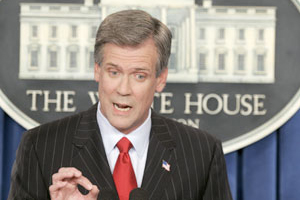
The tears of Snow

The first TV briefing by Bush's new press secretary was a weepy triumph -- but is it too late for style points to matter?

  • more
    • All Share Services

The tears of Snow

Tony Snow, the president’s new press secretary, wants you to know that he has feelings, he hurts, and he needs a coffee cup to get through his day. He is, in other words, a human being, and that makes him a dramatic departure from his predecessor, Scott McClellan, the doughy master of equivocation and non sequitur who behaved most days like a misfiring automaton, barely betraying any light behind his eyes.

Snow is different. Not 30 minutes into his first televised White House press briefing, the man was choking back tears. A television reporter asked why he was wearing a yellow Lance Armstrong bracelet, which flashed each time Snow reached for his paper coffee cup on the podium. “Because I had cancer last year,” Snow said. And then he lost his breath. “It’s going to sound stupid, and I will be personal here but, um…”

His eyes were suddenly wet and bloodshot. He fumbled and stammered and grabbed at the podium for the next 60 seconds, an impossibly long time in a cramped room filled to the brim with about two dozen television cameras and well over 100 journalists. The still photographers fluttered to life, zooming in for a close-up, waiting for an actual tear to drop.

“I’m having my Ed Muskie moment,” Snow said, referring to the 1972 Democratic presidential candidate who appeared to have cried on the campaign trail. “I lost my mother due to cancer when I was 17,” Snow continued. “The same thing, colon cancer.”

Tears had been fatal for candidate Muskie, the Democratic front-runner who never got the nomination after appearing emotionally unstable. But for press secretary Snow, the tears were golden, appearing as anything but forced or phony — a revolutionary act of sincerity from a discredited pulpit. They were, by all rights, the involuntary expression of a real man who feels blessed to be alive and honored to serve his country in the impossible job of selling George W. Bush, a president with a 32 percent approval rating.

“I don’t see it as a personal sacrifice to answer a call from the president of the United States to come and serve,” said Snow, the 50-year-old native of Ohio, channeling dialogue from Aaron Sorkin’s “West Wing.” “That’s one that still gives me chills. I mean, I go to the end of that lawn, I look back at the pillars and think, ‘Man, I’m working here.’”

By the end of the briefing, 40 minutes later, the reviews were raves. Snow had apparently passed his initiation rite. Members of the press corps were thankful for warm blood. As they packed up their notebooks, they were visibly giddy, offering approbations like, “That was A-1″ and “It’s going to be fun.” Even Helen Thomas, the briefing room’s matron saint and the press secretary’s principal scourge, admitted to being moved by the new guy. “I thought he had a lot of charm,” she was overheard saying loudly. “But he didn’t answer the questions.”

There, of course, is the rub. Snow, true to his name, is no model of transparency. “Al-Qaida doesn’t believe in transparency,” Snow quipped at one point. In a matter of minutes, he refused to discuss recent reports on phone company data mining; White House relations with Arnold Schwarzenegger; the president’s views on contraception; or Karl Rove’s plans to resign if indicted.

But then no press secretary, including the sainted Mike McCurry of the Clinton years, has ever been close to candid with the American people. The press secretary’s job has always been far more duplicitous, and the press briefing has always been a complicated dance of competing interests. Reporters gather impressions and string from press briefings — a stray fact here or there, a hint at what makes the White House uncomfortable to talk about. The briefings have never been about frank discussions.

Even by these low standards, however, McClellan was a disaster, a fate that Snow is unlikely to match. When McClellan took the job in July 2003, the war in Iraq appeared to be winding down and the president still enjoyed a 58 percent approval rating. The administration policy of demonizing the press as unpatriotic liberal elites was still in full swing. The conservative movement and the movement’s popular leaders on talk radio were squarely on board. McClellan, who was never equipped for prime time in any era, was used less as a spokesman than a stooge — a flack who would not, or could not, do anything more than lecture the press on its own craven distortions.

Snow begins his job in a completely different environment. The president’s poll numbers have tanked, the conservative movement has splintered, and right-wing talk radio hosts, Snow included, have turned against the administration on spending and immigration. The institutional press, meanwhile, has reclaimed lost territory as the credibility of the president and Congress slide lower and lower with each news cycle. Snow has not arrived to make war on the media, like his predecessor. He comes to ease tensions, to possibly chart a path to an ever-elusive peace.

Unlike McClellan, Snow speaks lucid sentences with passion. A former speechwriter from the first Bush White House in the 1980s, he is comfortable with common vernacular and colorful language. “I don’t want to hug the tar baby of trying to comment on the program,” Snow said at one point in the briefing, an antiquated, and racially perilous, reference to African-American folklore. A reporter seated on my right spoke for the crowd, exclaiming under his breath, “He said, ‘Hug the tar baby.’ My god.” Snow also looks good on television, with a long jaw, a deep brow and the soft smile of a church pastor.

What’s more, Snow has, for now, credibility among the president’s core supporters, the Fox News conservatives. Even before McClellan involuntarily peddled falsehoods about the White House’s involvement in the Valerie Plame scandal, it was hard to take him for anything more than an acolyte and tool of the president. But in the past, Snow has called the president an “embarrassment” and his domestic policy “listless.” “When it comes to federal spending, George W. Bush is the boy who can’t say no,” Snow wrote in a 2003 newspaper column.

President Bush is never going to win back the support of his liberal detractors, who are outraged by the war in Iraq, the assault on the environment and the huge tax breaks for the wealthy. But the White House can still win back the support of the GOP faithful with blunt talk and a clear message. With just six months until the 2006 midterms, a grown man who can cry may be just what the president needs.

Continue Reading Close

Michael Scherer is Salon's Washington correspondent. Read his other articles here.

Who will drones target? Who in the US will decide?

A new procedure puts the White House squarely in control of who will be targeted by drone attacks

  • more
    • All Share Services

Who will drones target? Who in the US will decide?FILE - In this Sept. 7, 2011 file photo, White House counterterrorism adviser John Brennan speaks in Washington. The Pentagon is likely to be largely sidelined from decisions on which terror leaders are targeted for drone attacks. The plan, aimed at streamlining the counterterror war, would concentrate the power to strike with lethal U.S. force outside war zones within one small team at the White House. (AP Photo/Susan Walsh, File)(Credit: AP)

WASHINGTON (AP) — White House counterterror chief John Brennan has seized the lead in choosing which terrorists will be targeted for drone attacks or raids, establishing a new procedure for both military and CIA targets.

The effort concentrates power over the use of lethal U.S. force outside war zones within one small team at the White House.

The process, which is about a month old, means Brennan’s staff consults with the State Department and other agencies as to who should go on the target list, making the Pentagon’s role less relevant, according to two current and three former U.S. officials aware of the evolution in how the government goes after terrorists.

In describing Brennan’s arrangement to The Associated Press, the officials provided the first detailed description of the military’s previous review process that set a schedule for killing or capturing terror leaders around the Arab world and beyond. They spoke on condition of anonymity because U.S. officials are not allowed to publicly describe the classified targeting program.

One senior administration official argues that Brennan’s move adds another layer of review that augments rather than detracts from the Pentagon’s role. The Pentagon can still carry out its own internal procedures to make recommendations to the secretary of defense, the official said.

The CIA keeps its own list of targets, though it overlaps with the Pentagon’s. It never included the large number of interagency players the Pentagon brought to the table for its debates

Brennan’s effort gives him greater input earlier in the process, before making final recommendation to President Barack Obama. Officials outside the White House expressed concern that drawing more of the decision-making process to Brennan’s office could turn it into a pseudo military headquarters, entrusting the fate of al-Qaida targets to a small number of senior officials.

Under the new plan, Brennan’s staff compiles the potential target list and runs the names past agencies such as the State Department at a weekly White House meeting, the officials said.

Previously, targets were first discussed in meetings run by the chairman of the Joint Chiefs of Staff, Adm. Mike Mullen at the time, with Brennan being just one of the voices in the debate. Brennan ultimately would make the case to the president, but a larger number of officials would end up drawn into the discussion.

The new Joint Chiefs chairman, Gen. Martin Dempsey, has been more focused on shrinking the U.S. military as the Afghan war winds down and less on the covert wars overseas.

With Dempsey less involved, there is an even greater need to draw together different agencies’ viewpoints, some in the administration believe, showing the American public that al-Qaida targets are chosen only after painstaking and exhaustive debate. This could be especially true in an election year, when drone strikes can be politically sensitive.

Some of the officials carrying out the policy are equally leery of “how easy it has become to kill someone,” one said. The U.S. is targeting al-Qaida operatives for reasons such as being heard in an intercepted conversation plotting to attack a U.S. ambassador overseas, the official said. Stateside, that conversation could trigger an investigation by the Secret Service or FBI.

The CIA and the Pentagon did not respond to requests for comment.

Drone strikes are highly controversial in Pakistan, too. Obama met briefly on the sidelines of the NATO summit in Chicago on Monday with Pakistani President Asif Ali Zardari and Afghan President Hamid Karzai.

Pakistan has closed key transit routes used by NATO to send supplies to troops in Afghanistan in response to a U.S. airstrike that killed two dozen Pakistani soldiers.

An example of a recent Pentagon-led drone strike was the fatal attack in January on al-Qaida commander Bilal al-Berjawi in Somalia. U.S. intelligence and military forces had been watching him for days. When his car reached the outskirts of Mogadishu, the drones fired a volley of missiles, obliterating his vehicle and killing him instantly. The drones belonged to the elite U.S. Joint Special Operations Command. The British-Lebanese citizen al-Berjawi ended up on the JSOC list after a studied debate run by the Pentagon.

The Defense Department’s list of potential drone or raid targets is about two dozen names long, the officials said. The previous process for vetting them, now mostly defunct, was established by Mullen early in the Obama administration, with a major revamp in the spring of 2011, two officials said.

Drone attacks were split between JSOC and the CIA. By law, the CIA can target only al-Qaida operatives or affiliates who directly threaten the U.S. JSOC has a little more leeway, allowed by statue to target members of the larger al-Qaida network.

Under the old Pentagon-run review, the first step was to gather evidence on a potential target. That person’s case would be discussed over an interagency secure video teleconference, involving the National Counterterrorism Center and the State Department, among other agencies. Among the data taken into consideration: Is the target a member of al-Qaida or its affiliates; is he engaged in activities aimed at the U.S. overseas or at home?

If a target isn’t captured or killed within 30 days after he is chosen, his case must be reviewed to see if he’s still a threat.

The CIA’s process is more insular. Only a select number of high-ranking staff can preside over the debates run by the agency’s Covert Action Review Group, which then passes the list to the CIA’s Counterterrorism Center to carry out the drone strikes. The Director of National Intelligence, Jim Clapper, is briefed on those actions, one official said.

Al-Berjawi’s name was technically on both lists — the Pentagon’s, and the CIA’s. In areas where both JSOC and the CIA operate, the military task force commander and CIA chief of station confer, together with representatives of U.S. law enforcement, on how best to hit the target. If it’s deemed possible to grab the target, for interrogation or simply to gather DNA to prove the identity of a deceased person, a special operations team is sent, as in the case of the 2009 Navy SEAL raid against al-Qaida commander Saleh Ali Saleh Nabhan. Nabhan’s convoy was attacked by helicopter gunships, after which the raiders landed and took his body for identification, before burying him at sea.

But if the al-Qaida operative is in transit from Somalia to Yemen by boat, for instance, U.S. security officials might opt to use the Navy to intercept and the FBI to arrest him, officials said.

Human rights and civil liberties groups have argued for the White House to make public the legal process by which names end up on the targeting lists.

“We continue to believe, based on the information available, that the (drone) program itself is not just unlawful but dangerous,” said Hina Shamsi, director of the ACLU National Security Project. “It is dangerous to characterize the entire planet as a battlefield.”

Shrinking the pool of people deciding who goes on the capture/kill list means fewer people to hold accountable, said Mieke Eoyang from Third Way, a centrist Democratic think tank.

“As a general principle, if people think someone is checking their work, they are more careful,” Eoyang said. “Small groups can fall victim to group-think.”

Brennan gave a landmark speech last month describing the Obama administration’s legal reasoning behind the drone program. He said the choice of targets is weighed by whether capture is possible vs. the level of threat the person presents to Americans. He argued such targets are not civilians, but akin to targeting Japanese or German commanders in World War II.

Continue Reading Close

The politicization of the Secret Service scandal

What was once one of the right's favorite government agencies becomes a symbol of waste and moral degradation

  • more
    • All Share Services

The politicization of the Secret Service scandalPresident Obama, surrounded by members of the Secret Service, upon his arrival in San Diego, Sept. 26, 2011. (Credit: AP/Pablo Martinez Monsivais)

It’s hard to work up much outrage about the Secret Service prostitution scandal, in which 11 members of the president’s elite protective service and various military personnel were found to have picked up escorts in Colombia, where they were doing advance work for the president’s visit. I guess it is probably not a good idea for the people in charge of protecting the president to leave themselves vulnerable to sexual blackmail, but on the other hand we do not live in a John Le Carré novel or “24″ episode, and I don’t think the threat of a honey-trap assassination conspiracy plot is very credible. If members of the Secret Service want to get drunk and hire escorts after work, that is their business. (As Melissa Gira Grant says, the only actual scandal here — and the reason this became an international incident — is that all these guys tried to bilk one of the women out of the money she was owed.)

But the predictable Washington mixture of prurient interest and moral posturing has turned this incident into grist for the scandals-and-investigations mill. And now we have the attempts at somehow making this a winning partisan issue for Republicans. Chuck Grassley, the senator from Iowa who triumphed over adversity and became the ranking Republican on the Senate Judiciary Committee despite being functionally illiterate, would like to know whether any White House staff also slept with escorts that evening. No one has made the claim, but Grassley’s asking just in case. (For a live peek at a future paranoid right-wing myth in its embryonic stage, read the comments on that Washington Times story: “I can just hear those paper shredders going a mile a minute in the white house, and the document forgers are being called in, you know the same ones that did the birth certificate.”) Grassley was on Fox last night to make sure viewers repeatedly heard baseless speculation as to the involvement of White House staff.

Rep. Pete King, Long Island Republican and stalwart publicity monger, has sent Secret Service Director Mark Sullivan a list of 50 questions about the scandal in order to make it appear that he is very seriously investigating this very serious incident.

For those outside Congress, for whom insinuating escort patronage by unnamed White House staff seems a bit of a reach, the game is to attempt to use the scandal to prove some point the fecklessness of Obama as a leader and his shameful failure to make everyone in Washington stop being so awful and wasteful all the time.

NRO’s Mark Steyn, after praising the fiscal discipline of the agent who attempted to bilk his escort (ugh), suggests that the moral of the story is that we pay too much for presidential security, and that all those agents and fancy bullet-proof Suburbans are wastes of taxpayer funds and evidence of broke post-Imperial America’s profligacy. Sarah Palin, who had every right to be personally aggrieved for once, after it was reported that the agent at the center of the scandal wrote gross sexist things about her on Facebook, was among the first to declare that the problem was with the “culture” Obama has created at the White House. (Karl Rove, smarter than most of these people, suggested that politicizing a Secret Service scandal was dumb and counterproductive. Secret Service Director Mark Sullivan, coincidentally, was elevated to his position under George W. Bush.)

The makeup of the Secret Service, obviously, has very little connection to the political party of the person occupying the White House. Like most American law enforcement agencies, it’s primarily white and overwhelmingly male, and, historically, the culture of the agency has had more than a whiff of machismo. These are not exactly the sort of public sector employees right-wingers get off on demonizing.

In fact, the right has had for years a sort of Clint Eastwood-inspired fantasy of the Secret Service agent as folk hero. Decent, hard-working men putting their lives on the line to protect a bunch of elitist ingrates. That ingratiating phony Bill Clinton and his frigid, hectoring monster of a wife weren’t deserving of such stolid, unflinching loyalty and service.

The fullest expression of this fantasy is in this classic chain email that made its way to every inbox in the nation during the second president Bush’s first term. According to this email, attributed to the unnamed author’s former neighbor, the president’s security detail was constantly disrespected by those awful Clintons and their terrible staff. Hillary Clinton was “arrogant and orally abusive.” “She forbade her daughter, Chelsea, from exchanging pleasantries with” agents. “Al Gore resented Bill Clinton and thought he was to centrist. He despised all republicans.” Agents prayed for Bush to win the election, and their reward was the joy they all felt in the presence of President Bush and his amazing, wonderful wife.

This nonsense has its roots in fake anti-Hillary attacks, attributed to imaginary Secret Service members, that Republican operatives spread to sympathetic media voices starting more or less the day Bill took office. Former Secret Service agents do plenty of gossiping and bitching, most frequently to Ronald Kessler, but their complaints don’t tend to track quite so directly to right-wing fantasy narratives.

But a popular trope is of the upstanding agents blanching at being asked to look the other way as libidinous Democratic presidents — Kennedy, Johnson, and Clinton — womanized. (Clinton was said to have threatened to fire agents who stymied his attempts to have trysts with Monica Lewinsky, though the agent who made the claim admitted to having invented it.) The pat moralism of the conservative Secret Service fantasy makes the agency’s lurid misadventure a bit funnier. It also explains why various people have to somehow convince themselves that the Obama administration somehow degraded the agency, through a lack of “management skills” or the widespread embrace of sexual deviance that is the logical end result of repealing the military’s ban on out gays and lesbians.

Continue Reading Close
Alex Pareene

Alex Pareene writes about politics for Salon and is the author of "The Rude Guide to Mitt." Email him at apareene@salon.com and follow him on Twitter @pareene

The audacity of weakness

Another embarrassing fail betrays a White House in a bubble

  • more
    • All Share Services

The audacity of weaknessHouse Speaker John Boehner of Ohio speaks during a news conference on Capitol Hill in Washington, Thursday, July 28, 2011. (AP Photo/J. Scott Applewhite)(Credit: J. Scott Applewhite)

Here was the headline on Yahoo News tonight: “Obama bows to Boehner on jobs speech.”

Bows to Boehner: I can tell you what any progressive who has been paying attention thought, “Oh boy, here we go again.”

President Obama has now changed the day of his address to Congress to accommodate the Republicans. They were having a GOP presidential debate on the original date he picked. So, Boehner told him to move his speech. He is the president for Christ’s sake. Of course, they should have accommodated him, not the other way around. But as usual, President Obama bowed.

So, this leads to the eternal question of whether Obama is just weak or if he is a brilliant strategist who has been playing rope-a-dope all along. I am so silly that I still had hope. My hope this morning was that Obama was laying a trap for the Republicans. He picks a day for his speech that is the same as the GOP debate. Then if Boehner says he won’t let him give the speech on that day, he seems so petty and harsh.

That way, either the president gives his big speech on jobs and bigfoots the Republican contenders or the Republicans look disrespectful and petulant for turning down the president. Well, if you’re playing rope-a-dope, that’s not a bad maneuver. But it turns out that’s not what he was doing at all. He just stumbled into this problem and then stumbled out when he let Boehner dictate when he could and could not have his speech. That looks so sad.

You see, if you’re playing rope-a-dope, at some point you have to actually swing. When your opponent has worn himself out knocking you around the ring, you counter-attack. But that counter-attack is never coming. We’re holding our collective breaths in vain.

Why is this definitely not rope-a-dope? Because Obama hates risk. Even his most ardent supporters will tell you that he does not like to take big risks. He thinks it is imprudent. They see that as one of his strengths. McCain was a wild gambler, Obama was a cautious and smart poker player. That’s why he won the election.

But would a man who dislikes risk that much risk his entire presidency on a strategy where he gets pummeled for three straight years and then finally comes out swinging at the very end? No way. That’s a tremendous amount of risk. I don’t mind taking plenty of risks, and I wouldn’t do anything half that crazy.

No, the answer is much simpler. He doesn’t realize he’s getting pummeled. He thinks this is all still a genius strategy to capture centrists by compromising on every single little thing. He is not trying to put on an appearance of weakness to lull his opponent into a false sense of complacency. He doesn’t even realize he is being weak. He’s the one with the false sense of complacency. As he’s getting knocked around the ring, he thinks he’s winning.

These guys in the Obama camp are in for a horrible, rude awakening. Sometime in the next year, they are going to blink and realize they are lying flat on their back on the canvas. Then as they finally stumble up, they’ll realize they should have started fighting 11 rounds ago. Then a panic will set in, but I’m afraid it will be too late by then.

Here is what all voters, and especially independents, despise and disdain in a politician — weakness. Nobody wants to see their leader get beat to a pulp every night and then bow his head again.

There is no secret, brilliant strategy. This White House is in a bubble. They think they’re winning when the roof is about to cave in. 

Cenk Uygur is the host of “The Young Turks” online news talk show.

Continue Reading Close

Obama to tap Alan Krueger for economic post

President picks labor economist to head Council of Economic Advisers

  • more
    • All Share Services

Obama to tap Alan Krueger for economic postPresident Barack Obama exits Air Force One at Andrews Air Force Base, MD, Friday, Aug. 26, 2011. The President cut short his Martha's Vineyard vacation by one day to return ahead of of Hurricane Irene. Urging everyone in Hurricane Irene's path to get ready, President Barack Obama decided to cut his vacation short Friday and return to the White House for a storm he described as potentially historic. (AP Photo/Cliff Owen)(Credit: AP)

A White House official says President Barack Obama will name labor economist Alan Krueger to a top administration post.

Obama will nominate Krueger to head the White House Council of Economic Advisers. If confirmed by the Senate, he would replace Austan Goolsbee, who left the administration earlier this month.

The official spoke on the condition of anonymity in order to speak ahead of Obama’s official announcement on Monday.

Krueger’s appointment was first reported by the Wall Street Journal.

Politico commenters weigh in on the White House’s historic civil rights painting

Norman Rockwell's "The Problem We All Live With" now hangs at the White House, upsetting... certain kinds of people

  • more
    • All Share Services

Politico commenters weigh in on the White House's historic civil rights painting

Politico recently switched the commenting system on its blogs to one requiring a Facebook account, in order to encourage more polite discussion and discourage trolling and racism. Thankfully for fans of awful comments, they did not make the switch on the articles, a completely meaningless distinction in 2011 but one that allows us to sample the responses of the Politico commentariat to this story, about Barack Obama hanging a famous painting in the White House. The painting is Norman Rockwell’s “The Problem We All Live With,” and it depicts “U.S. marshals escorting Ruby Bridges, a 6-year-old African-American girl, into a New Orleans elementary school in 1960 as court-ordered integration met with an angry and defiant response from the white community.”

Here, in no particular order, are some of my “favorite” Politico comments on the story.

“J.O.B.S.” writes:

MITT ROMNEY’s father, Governor George Romney of Michigan, marched several times with Dr. Martin Luther King Jr. MLK’s history of his being a Christian conservative is carried on today by his brother’s daughter, Dr. Aveda King. Dr. Martin Luther King Jr wanted Gov. George Romney to be the POTUS and not Nixon.

Christian conservative Martin Luther King would definitely have voted for Mitt Romney over Barack Obama. I am positive of this fact.

“velvet steel” says:

“His speech Sunday dedicating a memorial to Dr. Martin Luther King Jr. near the National Mall”

Oh you mean the “Monument of Greed”?

No other family of anyone featured on the mall was ever PAID any money for their likeness or words. Only the “King family”. In fact they were paid nearly a million dollars.

Pretty humerous since the “Monument of Greed” was “Made in China” and they ended up making him look slightly Chinese.

What another utter DISGRACE that this administration has set upon America. Couldn’t get the statue right and then to find out that it’s all about GREED and how to make a BUCK.

Pretty humerous indeed.

“TTSSYF” says:

So many blacks love to wallow in the past. It provides an excuse for their on-going failure as a group to advance in our society, and it serves as a tool with which to continuously bludgeon whites. They’re addicted to feelings of outrage and resentment and thus obsess about events and conditions of 50 years ago or more. I’m convinced most of them WISH it were still 1965 so they could have an excuse to riot. It’s apparently much easier (and safer) to sit around and whine and complain about all of the so-called injustice or “institutional” racism that is supposedly holding them back than it is to apply themselves and be confronted with the possibility of failing on their own merits or lack thereof.

Yep, black people definitely still wish it was 1965. Things were great for them in 1965! That’s what the rioting was about, all of the fun they were having pretending to feel oppressed.

“matt22″ has a certain word that he clearly really, really wants to say:

51 years ago. things have changed a lot..

just uttering the word ‘n****r can get a white man fired from his job for creating a “hostile work environment”, along with getting charged with a hate crime.

if you are black, you can scream it from the rooftops and it’s ok.

Pigressives want to keep race issues on everybody’s minds. they want every year to be like 1965. White guilt got Obama elected in 2008, why not try again in 2012?

It’s just not fair, that white people are no longer allowed to use racial slurs at work. (This is why Pigressives, like black people, wish it was still 1965.)

“CatoTheElder” has a great recommendation:

Why not a painting of Rev Wright preaching “God damn America”? That would truly resonate with Barack Hussein Obama.

Yes, I am sure it would, but where would one even get a painting of Reverend Wright preaching “God damn America,” and how would anyone who saw the painting know what Reverend Wright was supposed to be saying? Would there be a little caption, or a word bubble? Because then it sounds more like a “cartoon.”

Of course, it’s mean to pick on barely literate commenters. Sure, they’re representative of a toxic right-wing blogosphere devoted in large part to hatred, pseudohistory, misinformation and paranoia, but the pros are really much better at writing this sort of shit without accidentally wishing out loud that it was still OK to say “nigger.”

Continue Reading Close
Alex Pareene

Alex Pareene writes about politics for Salon and is the author of "The Rude Guide to Mitt." Email him at apareene@salon.com and follow him on Twitter @pareene

Page 1 of 36 in White House