
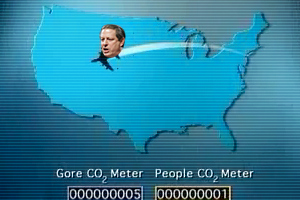

To the tune of the Allman Brothers Band’s “Ramblin Man,” Al Gore’s face rides a cartoon airplane across a map of the United States. As he zips from coast to coast in a Web video clip titled “Al Gore: An Inconvenient Story,” a ticker at the bottom of the screen displays his rapidly rising CO2 emissions next to the comparatively modest emissions of everyday folk. The climate-change Paul Revere’s steed is an airplane, powered by fossil fuels. The implication: Gore’s sure spewing a lot of carbon dioxide as he travels the land spreading the word about global warming.
Produced by the industry flacks at the Competitive Enterprise Institute, which is funded in part by Exxon-Mobil, the clip dismisses Gore as a hypocrite, leading a carbon-intensive lifestyle while scolding us plebes that we should strive to reduce our own carbon footprints. Of course, nowhere does this oil-industry-funded propaganda mention that Gore used carbon offsets to mitigate the global warming impact of his travel for “An Inconvenient Truth,” that Gore pledged to make the documentary carbon-neutral.
The Web clip is just one bit of the skeptic zaniness that has greeted the release of Gore’s film. On Fox News, another Exxon-Mobil-funded pundit, Sterling Burnett, compared watching “An Inconvenient Truth” to learn about global warming to watching Joseph Goebbels’ Nazi propaganda to learn about Nazi Germany. Over at the New York Post, a reviewer baldly asserted that “there is widespread disagreement about whether humans are causing global warming,” a false statement that even oilman-in-chief President Bush doesn’t accept anymore. Meanwhile, the College Republican National Committee encouraged skeptical students to throw global warming beach parties. Global warming? Break out the bikinis!
Ideological blowback or no, “An Inconvenient Truth” is drowning plenty of competition at the box office. Last weekend, playing at only 77 theaters around the country, it was the ninth most popular film, and took in more money per screen than any other film showing, with many screenings in liberal cities like San Francisco and Boston sold out. The film opens more widely this weekend.
Yet global warming skeptics continue to infiltrate media outlets as mainstream and reputable as PBS’“The NewsHour” with Jim Lehrer, which failed to acknowledge the industry ties of the Competitive Enterprise Institute, while giving the group a free pass to call Gore’s film “alarmist.” One of the most widely read critiques of the science in the film has come from longtime climate-change skeptic Robert C. Balling Jr., a professor of climatology at Arizona State University, who has received more than $400,000 from the coal and oil industries, according to the Center for Media and Democracy. On the industry-backed Web site Tech Central Station, Balling posted a purported fact-check of the film titled “Inconvenient Truths Indeed,” which charges that the movie is “not the most accurate depiction of the state of global warming science,” casting doubts on its claims about melting glaciers and intensifying hurricanes. The article has made the rounds of the right-wing blogosphere as a takedown of Gore, and the Philadelphia Daily News published it as an Op-Ed without any acknowledgement of Balling’s well-documented ties to industry.
Balling’s critique inspired this dismissive reaction from one climate scientist: “Some people believe the earth is flat, too.” That’s Eric Steig, an isotope geochemist at the University of Washington, who is one of the co-founders of the Real Climate Web site, where working climate scientists provide commentary and context about the news in their now-hot field. Steig e-mailed his reaction from Greenland, where he’s conducting field research on the ice. He’d posted his own largely favorable review of “An Inconvenient Truth” on the Real Climate site before he left.
Judd Legum, research director at the Center for American Progress, a liberal think tank, has rebutted each of Balling’s claims on the Think Progress Web site. For instance, some of the most dramatic images in the film show the rapid retreat of glaciers all over the world, including the melting snows of Mt. Kilimanjaro. Balling contends the snowpack retreat on Kilimanjaro is caused by declining atmospheric moisture, which has been going on for more than 100 years, not global warming. Legum counters that scientists have shown that the Kilimanjaro glacier previously survived a 300-year drought and its retreat cannot be fully accounted for by changes in atmospheric moisture, especially the shrinking that has occurred in recent decades. Besides, focusing on that one example overshadows the larger point that glaciers all over the world are disappearing.
Steig confirmed the facts in Legum’s rebuttal. “All those points are accurate,” he wrote in an e-mail. “Some of them could probably have been stronger; that is, Balling is even more wrong that Legum indicates.”
Climate scientists who have seen Gore’s film say on the whole it presents a scientifically valid view of global warming and does a good job of presenting what’s likely to occur if human-induced greenhouse gas emissions continue unabated. Dr. Gavin Schmidt, a climate modeler for NASA, was pleased the film didn’t say: “You’re all going to die, woo-hoo.” Schmidt, who stressed that his views are his own, not NASA’s, says the movie plays it relatively safe by saying, “These are the things that have happened so far. These are the things that are likely to happen should we continue on the trajectory we’re on, and these are the moral consequences of it.”
Scientists express surprise that Gore could present the science in an accurate way without putting everyone in the audience to sleep. “Such an amount of relatively hard science could have been extremely dull, and I’ve been to a lot of presentations on similar stuff that were very dull,” says Schmidt. “Where there was solid science, he presented it solidly without going into nuts and bolts, and where there were issues that are still a matter of some debate, he was careful not to go down definitively on one side or the other.”
Lonnie Thompson, a professor at Ohio University, whose work on retreating glaciers from the Andes to Kilimanjaro and Tibet is featured in the film, was happy with the result. “It’s so hard given the breadth of this topic to be factually correct, and make sure you dont lose your audience,” he says. “As scientists, we publish our papers in Science and Nature, but very few people read those. Here’s another way to get this message out. To me, it’s an excellent overview for an introductory class at a university. What are the issues and what are the possible consequences of not doing anything about those changes? To me, it has tremendous value. It will reach people that scientists will never reach.” John Wallace, a climate scientist at the University of Washington, agreed. “I think that he’s gone to great lengths to make the science comprehensible to the layman,” he says. “Given the fact that this was a film intended to bring the message to the lay public, I think it was excellent.”
Yet some scientists who are enthusiastic about the film had their own critiques of how the science is presented. One of the biggest challenges in the film is visually portraying the likely consequences of global warming in the future. For instance, invasive species, both plants and insects, are a growing scourge, which will likely be exacerbated by global warming. Yet, the film, while not saying anything technically wrong about invasive species, could leave the erroneous impression that the dandelion in your backyard was planted there by climate change, simply by omitting other contributing factors. “Anybody having to fight kudzu in their garden knows it has nothing to do with global warming. It has to do with the fact that we introduced the species from Europe,” says Steig. At the same time, he says, invasive species are opportunistic, thriving in many different environments, so they’re likely to thrive under climate change. “The ecological niche for certain species are changing quite rapidly,” says Schmidt. “You have situations where only a small amount of climate change can make a big difference.”
The deadly aftermath of Hurricane Katrina is featured prominently in the film, and may lead viewers to conclude global warming is to blame for the disaster. But the truth is not that simple. As global temperatures rise, hurricane scientists predict that we’ll see stronger storms as rising sea temperatures feed their fury. Yet it’s hotly debated among hurricane specialists whether the intensity of tropical cyclones seen around the world over the past few years already show the impacts of global warming. Sketchy data from past decades makes nailing down that proof difficult, amplifying the debate. “There is a difference between saying ‘we are confident that they will increase’ and ‘we are confident that they have increased due to this effect,'” explains Steig.
Also, any one event — like Hurricane Katrina — cannot be definitively linked to an overall global trend of more powerful storms, just as any specific car accident on a highway cannot be blamed on the raising of the speed limit, even if statistics show a higher speed limit makes accidents more likely to happen. Yet any one storm and its aftermath can be presented — as “An Inconvenient Truth” does — as an example of what we’re likely to experience in the future because of climate change. In Gore’s defense, says Steig, “Never in the movie does he say: ‘This particular event is caused by global warming.'”
Schmidt agrees. “Gore talked about 2005 and 2004 being very strong seasons, and if you weren’t paying attention, you could be left with the impression that there was a direct cause and effect, but he was very careful to not say there’s a direct correlation,” he says.
There is one example in the film that Steig says is simply a technical error. Climate scientists use ice cores from Antarctica and the Arctic to study temperature and other climatic conditions of the past. Gore says it’s possible to see the influence of the Clean Air Act by observing the ice core changes in pollution concentrations over two years. In the film, the happy implication is that the ice cores show that human actions, notably political legislation, can have a quick, measurable impact, even in the ice at the ends of the earth. If we acted decisively, Gore suggests, we could do the same to stem greenhouse gases. Yet Steig, who specializes in studying ice cores by doing chemical measurements on them, says it would be impossible to isolate the years the Clean Air Act took effect. It is possible, he says, to observe the decline over the years in certain substances that have been regulated, such as lead. But he’s skeptical that pinpointing the Clean Air Act in the ice can be done.
David Battisti, a professor of atmospheric sciences, also at the University of Washington, thinks the science in the film is well represented, yet worries about one of the most dramatic moments in the film. “There is only one place in the film I struggled,” he says. “It makes a powerful theatrical point, but it leaves open the criticism that you’re stretching the truth.”
Gore notes the relationship between CO2 and temperature, as revealed in ice cores. He then shows a graph correlating the amount of CO2 in the atmosphere with temperature over hundreds of thousands of years. The lines closely follow each other up and down. Literally for millenniums, the amount of CO2 has hovered between 200 and 300 parts per million. But since the industrial revolution, when humans started pumping more CO2 into the atmosphere with all our machines, it’s risen to the current amount of 380 parts per million. Economists and climate scientists believe it will continue to rise as dramatically over the course of this century. To demonstrate the skyrocketing increase, Gore rides a mechanical lift to rise as high as the CO2 is likely to go. While the temperature line does not jump up that high in the film, the audience is left to assume — with horror — that it will follow.
Scientists predict the jump in temperatures will be serious, but more modest than the graph implies. “The graph shows CO2 going through the roof, and the thing is the temperature doesn’t follow that line with the same amount of jump,” says Battisti. “The good thinking person who knew nothing about the science would come away with the wrong interpretation. The world Gore paints in the future is an appropriate representation of the science. It’s just that graph that is misleading.”
“Gore is correct to link temperature and CO2 in ice core records,” concurs Steig. “That’s very sound science. But he is incorrect to imply that you can take the one curve and use it to predict where the other curve will go in the future. It ain’t so simple.”
Steig notes that other factors, such as the earth wobbling on its axis as it revolves around the sun, have influenced temperatures in the past hundreds of thousands of years. Now, as humans continue dumping more greenhouse gases into the atmosphere — scientists predict the CO2 level will rise to 1,000 parts per million by early next century — CO2 will have more impact. “In the past, the oscillation between temperature and CO2 were driven by the sun,” says Battisti. “The CO2 was a positive feedback. It wasn’t the driver. The CO2 is going to be the driver.”
Yet while objecting to the way the graph is presented, Battisti agrees with the qualitative point that temperatures are rising, and will continue to do so thanks to human-induced global warming, which is a serious problem. “Wherever you live, this is a huge change, and it dwarfs anything that we’ve seen in the last 150 years, or the last 1,000, or the last 10,000 years. If you want to see a change that big, you have to go back to the Ice Ages.”
The scene that has inspired the most charges that the film is alarmist is the depiction of what would happen if sea level rose 20 feet, with the World Trade Center Memorial site underwater, and landscapes where millions of people live, from Shanghai to San Francisco, swamped. Audiences might be left with the impression that the deluge is just around the corner, lapping at our feet.
Schmidt says a 20-foot rise in sea level is not unrealistic in the long run — the very long run. “The 20 feet number comes from an analog with the last time the planet was a degree warmer than it is now — 120,000 years ago. Sea levels were about 20 feet higher. Where did that water come from? Half from Greenland, and half from Antarctica.” How long would it take for that rise to happen again? “Maybe 1,000 years,” says Schmidt. “There’s some uncertainty about how quickly that could happen, but Gore was very careful not to say this is something that is going to happen tomorrow.”
If in fact there’s 800 to 1,000 parts per million of CO2 in the atmosphere, Battisti says, it’s going to be a very different world. Twenty feet of additional sea-level rise could occur if Greenland melts. “That’s most likely if we get to 800 parts per million by the end of the century; within 500 years Greenland will be gone,” he says. In fact, there was a time when there were 1,000 parts per million of C02 in the atmosphere. That was during the Eocene, about 50 million years ago, when there were crocodiles in the Arctic and palm trees in Wyoming, which was then 10 degrees farther north than it is today. “This was a time when the planet was so warm that you had amazing hot swamplike conditions,” says Battisti. “You had a lot of plant life dying that was actually forming the oil and coal we’re now burning.”
