
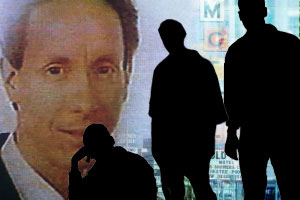

On any given day there were 13 kids sleeping on the floor of the butt hut. It was 2003, and Sam Icke was almost 19. To get to work in the morning, he had to pick his way over the limp bodies, the piles of dirty clothes, the half-empty bags of Doritos. The smell of dirty socks and stale beer clung to the matted carpeting and the ratty brown sofa. Nine hours later, when he got home, Icke found those same bodies upright, fixating on a high-speed car chase on the TV in the corner, getting stoned, and doing shots of Bacardi. In the kitchen, a swarm of roaches feasted on the ossified remains of a four-day-old spaghetti dinner.
Icke was the only one in the cramped, run-down apartment with a steady job, tiling floors for $300 a week in the desert town of Hurricane, Utah. Every week or two another kid showed up at the door, looking for a place to park his ass — that’s why they called communal houses like these butt huts. Icke took them in — no exceptions, no questions asked. He understood what they were going through. Like him, they had been banished from their homes by the Fundamentalist Church of Jesus Christ of Latter Day Saints, a radical offshoot of the Mormon church, and forbidden to ever see their families again. Their families wept and fretted and protested under their breath, but none of them fought to keep their sons. They didn’t dare defy the orders of Warren Jeffs, the dictatorial leader of FLDS, a self-proclaimed prophet whose followers believe him to be the earthly executor of God’s will.
The Utah attorney general’s office estimates that over the past five years, Jeffs has thrown as many as 400 boys out of Colorado City, Ariz., and a number of them have wound up in nearby towns like Hurricane, with no place to live and no resources. Most eventually find a butt hut where they can crash, but that hardly makes life in exile any easier. On a good day, they might pool their money, venture the quarter mile to Dairy Queen, buy a couple of Brazier burgers. Or try out their newfound freedom by flirting with the teenage girls who live up the street. But after growing up in the cocoon of Colorado City, where Jeffs encouraged community members to rat out their neighbors for unchurchly behavior, it is hard for them to trust anyone — even other kids from the church.
The FLDS follows the same scripture as mainline Mormons, with one key difference: They adhere to the final revelation of their founder, Joseph Smith, instructing his followers to take multiple wives. In establishing a separatist community in Colorado City and practicing polygamy, they believe that they are the only true Mormons. The mainstream Mormon church, for its part, disavows its historical connection to the FLDS the way a person might disavow a slightly deranged cousin.
Colorado City’s 10,000 residents make it the most populous town in the isolated wedge of chalky red desert north of the Grand Canyon and south of the Utah border. The town straddles the two states, materializing out of nowhere along a barren stretch of highway known as the Arizona Strip. Its seclusion is no accident: After polygamy was formally renounced by the Mormon Church in 1890, the town’s early settlers sought out a remote site where they could take multiple wives far from public scrutiny. Residents call it the Crick, for the creek that meanders through the center of town, and kids commonly refer to themselves as Crickers. Three-fourths of the town’s residents are members of the Fundamentalist Church of Latter-Day Saints; the other quarter belong to a sect called the Centennialists, which split off from the FLDS in the 1980s, insisting that the church be governed by its traditional committee of elders rather than submit to the dictates of the prophet.
When Warren Jeffs inherited control of the Fundamentalist Church of Jesus Christ of Latter Day Saints in 2000, following the death of his father, Rulon, the first thing he did was marry 30 of his father’s youngest and prettiest wives. Then he set about tightening his reins on Colorado City, a town where the women dress like the cast of “Little House on the Prairie” and the civic leaders — the mayor, the police chief, the superintendent of schools — are all subject to the prophet’s orders. Jeffs banned holiday celebrations, forbade followers from listening to music except for the droning spiritual chants that he himself records, and prohibited all forms of worldly entertainment, including sports — bowling, football, even snowball fights. Colorado City was run like a theocracy, with Jeffs its ayatollah.
In order to keep tabs on his followers, Jeffs relied on the local police, who acted more like the Taliban’s morality squad than keepers of the peace. The cops were essentially informants, loyal first to Jeffs and second to the state laws that they were sworn to uphold. They patrolled the community for violations of the prophet’s moral code, reporting infractions to their supreme leader. They would pull kids over for alleged traffic violations, then take photographs if they found CDs or other worldly possessions, which they turned over to the Jeffs. Until last year, when government officials in Utah and Arizona began investigating charges of underage marriage and tax fraud, Colorado City was essentially allowed to thrive outside the law.
These days, though, the only restaurant in town, a family-style place called Mark Twain, is shut down. So is the gas station just down the road. The streets are deserted. Even the church parking lot is abandoned. After decades of allowing the FLDS to practice polygamy, the attorneys general of Utah and Arizona have begun cracking down on the church. Last July, they moved to dissolve the United Effort Plan, the trust controlled by Jeffs that holds all property in Colorado City, stripping him of assets reportedly worth billions. They removed two members of the police force for serving the prophet rather than the law. And a grand jury indicted Jeffs on charges that he married off an underage girl to a married man — one of hundreds of such ceremonies he is believed to have performed over the years.
Jeffs fled and has been on the run ever since. The FBI has offered a $10,000 reward for his capture, and this May, added him to its Ten Most Wanted Fugitives list. But in spite of the high-profile manhunt, there remains little evidence that Jeffs has relinquished his power over the sect. From a distance, he has warned his followers who remain not to talk to outsiders and has told them to mount surveillance cameras on their homes. Last November, Jeffs’ brother, Seth, was pulled over by police in Pueblo, Colo. Authorities charged him with harboring a wanted person after discovering $140,000 in cash in his car, along with hundreds of letters addressed to Warren and a donation jar, bearing Warren’s photo, labeled “Pennies for the Prophet.” Other residents of Colorado City have reportedly fled to west Texas, where the church is building a nine-story temple. Earlier this month, Arizona attorney general Terry Goddard told the Arizona Republic that he believes Jeffs has overseen marriage ceremonies in trailers outside Colorado City within the past three months. And only last Friday, June 30, law enforcement officials responded to a tip placing Jeffs in Cedar City, Utah. When they arrived, he was gone.
– – – – – – – – – – – –
To most Americans Hurricane, Utah — home to Icke’s butt hut — is a small and unremarkable town of trailer parks and discount stores, little more than a fuel stop on the way to Zion National Park. But to kids like Icke who grew up within the rigid confines of Colorado City, just 30 miles down the road on the Arizona border, a town like Hurricane is Satan’s territory, a hostile and confounding place populated by evildoers.
Icke, now 21, was expelled from the FLDS community at age 18. While building sets for a community production of “Little Red Riding Hood,” he’d befriended a girl in the cast. After weeks of excruciating flirtation, the two teens consummated their attraction with a makeout session. But the girl, convinced she was going to burn in hell for her wickedness, began having panic attacks and, in a desperate bid for salvation, confessed everything. Jeffs called Icke’s father and told him that his son was to leave Colorado City and never return.
The next day, Icke threw some clothes into the back of his Honda Civic and made his way into the world. “I was basically dumped on my head,” he says. “I had no understanding of how to live on my own.” One of the FLDS elders owned a single-wide trailer in a weed-choked gravel lot, and he offered it to Icke as a sort of halfway house until he got on his feet. Outside the boundaries of Colorado City and of no interest to Jeffs, the trailer park was a refuge for meth addicts and prostitutes. Icke kept to himself, working long days laying tile, then escaping at night into fantasy novels about witches and warlocks.
In many ways, Icke was 18 going on 12. He had none of the tools he needed to make it in the world at large — no idea how to cook, how to save money, how to rent an apartment. Having grown up in a fundamentalist enclave where boys are forbidden to interact with girls, bathing is considered immodest, and education is eclipsed by religious indoctrination, the kids who are banished from Colorado City are like wolf boys thrust into the suburbs. Their social skills are awkward, their grooming is poor, and most are culturally illiterate.
In the early days of his exile, standing in line at the grocery store in Hurricane, dressed in the starched plaid shirt and unfashionable slacks the church had required him to wear, Icke felt like an alien from a far-away land. He knew the rumors about Colorado City: that Cricker kids are born with horns, and handicapped children are taken into the weeds and shot in the head. Sometimes, when church members drove to nearby St. George to stock up on diapers at the Wal-Mart, people leaned from their car windows and yelled “Plygs!” — a slur for polygamists. In Hurricane, guys wore jeans and T-shirts, and the girls wore almost nothing at all, so most of what you saw was their skin, glowing and coppery. Icke could hear the prophet’s words echoing in his head: All it takes to impregnate a girl is to look at her.
– – – – – – – – – – – –
Even as a kid, Richard Black hated all the prophet’s rules and restrictions: his hateful attitude toward homosexuals and blacks, his dismissal of women as “breeders,” his prohibitions against cutting hair, and his insistence that men and women wear a full set of long underwear at all times, even when desert temperatures climbed to 110 degrees. In school, Black sat in class, listening to recordings of Jeffs unmodulated voice pontificating about how to live well and prepare for the end times. He devoted every Saturday to working alongside the other men in the church, constructing schools and churches and other public facilities, a form of enforced service that Jeffs liked to call building the Kingdom.
Black dropped out of school in the sixth grade. Fed up with Jeffs’ indoctrination, and with the Destruction imminent — Russia and China were poised to invade America, according to the prophet — everything seemed pointless. Everything except for partying. “I figured, if I’m going to die in a few years anyway, why not have some fun while I’m around?” Black recalls.
That’s exactly what he did: Black and his friends drank a lot of beer, smoked a lot of pot, and roared around town on their four-wheelers. There was a trailer parked behind his mother’s pink-and-brown ranch house, and Black turned it into his own personal party palace. Every few nights around midnight, two hours after the Colorado City curfew and his mother’s bedtime, Black and a dozen friends would huddle around his computer, watching DVDs, chewing tobacco, and flipping through Hustler and Playboy magazines.
One night in 2001, when Black was 15, a cop knocked on the door of the party trailer and caught Black and his friends watching the teen horror-comedy “Scary Movie.” A few days later, Black and his mother were summoned to Jeffs’ compound, a monolithic beige McMansion sequestered behind a 12-foot wall plastered with No Trespassing signs.
“How are you doing, Richard?” Jeffs asked from behind the expanse of his oak desk. Jeffs had the gangly limbs of an adolescent on a growth spurt and the soft, high-pitched voice of a choir boy.
“Pretty good,” Black said.
Jeff fixed his notoriously unblinking gaze on him. Then he asked if Black had anything to confess.
“Yeah,” Black said. “I watched a movie.”
“Anything else?” Jeffs said. “Have you had sexual thoughts about girls? Have you touched yourself? Have you touched anyone else?”
“No,” Black insisted.
Jeffs sighed and leaned back in his chair. “You’re not doing so well, Richard,” he said, his voice ominously mild. “I think you need to pack your things and leave Colorado City and never come back.”
You would think that being banished from Colorado City would be bliss for a kid like Black: pot and pornos all day, every day, in the party trailer. And girls, too — real, live girls with visible curves, and no creepy preacher trying to guilt him out of touching them. But lying in the trailer at night, parked behind his brother’s house in the town of Apple Valley, Utah, all Black really wanted was his mother.
Granted the liberty to party his ass off, Black instead found himself wallowing in a fog of alcohol and despair. He worked as a framer six days a week, from 6 in the morning until 5 at night, then went back to his trailer and drank until he passed out. There was no heat in the trailer, and in winter, he shivered beneath his blankets night after night, unable to sleep. He talked to his mother on the phone about once a week, but his sisters and his nieces were forbidden by their husbands to talk to him. He was an apostate now, the most wicked creature on earth, and they couldn’t risk his polluting the minds of the righteous.
“I missed my family so bad,” says Black, now 20. “I went from being surrounded by lots of people who loved me to being totally alone in the world.” Some nights, he’d sit in front of the TV for hours, not watching, just staring, just to have some sound. Other nights, he’d lie in bed and plot ways to kill himself: slice open his wrists, jump off a cliff, run out in the middle of the highway, hang himself. “I could have slept on the couch in my brother’s house, but I didn’t want to be around nobody,” he says. “I wanted to be alone and cry myself to sleep.”
– – – – – – – – – – – –
As Jeffs exiled more and more boys, they began to wander the streets of neighboring towns like Hurricane, looking for work and getting into trouble. In February, five 19-year-old outcasts were arrested in St. George, Utah, for growing marijuana, selling cocaine and stealing $20,000 worth of tools from a general store. “These kids aren’t used to being outside of the kind of closed community they lived in, in Colorado City, and some don’t adjust well,” says Andrea Esquer, spokesperson for the Arizona attorney general. “They might start using meth, they might wind up homeless, they might end up prostituting themselves. They have to find someone who helps them transition, and that puts pressure on social service agencies.”
Like immigrants in a strange new land, Crickers find it safer and easier to cluster together than to integrate into the broader community. They desperately want to blend in with Gentiles, as they call anyone outside the FLDS, but they know they’re perceived as oddities.
That’s why, after a few months of bottomless loneliness in the trailer park, Sam Icke moved into the butt hut. As the oldest teenage resident, he soon became the boys’ de facto guardian. A few of them picked up a little construction work, to contribute what they could toward rent — $10 here, $20 there — but for the most part, Icke was supporting them all, struggling to make the $700 rent and to keep the refrigerator stocked. There were times when they ran out of food entirely, times where the power was shut off and everyone sat around in the dark with no TV to distract them. “The kids I took in were like little brothers to me,” Icke says. “I loved them and I was doing everything I could to help them, but it was like trying to fill up the ocean with a teaspoon.” From time to time, Icke contemplated returning to Colorado City to try to redeem himself. When he left, his father had given him some of the prophet’s sermons on tape, in hopes that Icke would listen to them and repent. He never did. Instead, he reused them, recording meandering stoned conversations between him and his friends.
About once a week, the local police would raid the butt hut and send the underage kids back to Colorado City, classifying them as runaways. After two and half months of police raids and financial stress, Icke started losing his temper. A lot. “I was acting like a woman with PMS,” he says. “I’d get pissed off and nobody could understand why.” He couldn’t take it anymore, trying to keep afloat his own life and the lives of a dozen kids who were just as shell-shocked and clueless as he was. One day he came home from work and gathered his charges around him in the living room.
“I’m really sorry,” he said, “but I’m going to give up the lease on this place, so you’re all going to have to find another place to live.”
The boys nodded and studied the carpeting. Banished again. Within two weeks they were gone, moved on to other butt huts or, if they were lucky, to the houses of brothers or cousins or uncles who were heretics just like them.
In 2003, Icke fell in love and married a woman 14 years his senior. They eventually made their way up to Salt Lake City, where he got a job laying carpet. When his wife began to suspect that she was pregnant, Icke felt panic setting in again. He was 19 years old, with only a high school education, and no job prospects beyond construction. “I couldn’t handle the stress of day-to-day life anymore,” he says. “I felt like I needed someone to guide me and tell me what to do, because I clearly wasn’t figuring it out on my own.” In his third month in Salt Lake, a fellow Cricker advised him to seek help from a nonprofit called the Lost Boys Foundation, which was founded by Dan Fischer, a dentist and former member of the FLDS.
Fischer left Colorado City in 1993, after his financial support of a play critical of polygamy got his kids kicked out of an FLDS school. Soon afterward, he and his wife began taking in boys who had been cast out of the church. In 2003, Fischer turned his ad hoc philanthropy into a formal nonprofit venture. It was a fiasco. Fischer is a genteel man with a soft heart and deep pockets, and the kids smelled his gullibility. Giddy from the freedom of life in the world, Crickers would go to Fischer with sob stories about not being able to pay their rent or their heating bill, then blow the check he handed them on pot and whiskey and prostitutes. If phase one of leaving the Crick is loneliness and despair, phase two is indulgence. After being penned up in a place where pleasure is strictly forbidden, expelled boys are suddenly free to indulge in every hedonistic thing they’ve ever dreamed of — and most do.
Fischer decided to regroup. He hired a stocky, take-no-prisoners guy named Dave Bills as director of the foundation and gave him a mandate to get tough. He warned Bills that the kids had harassed the former director, calling her at all hours of the night to ask her to order them pizza and prostitutes. At his first meeting with the kids, Bills let them know that he wasn’t going to take any shit. “You want to call me up at 6 a.m. and order a pizza, I’ll get you a pizza,” he told them. “But you’ll find it hard to eat after I’ve shoved it up your ass.”
The first change Bills made was to draw up a contract outlining his expectations of the kids and requiring them to sign it. Among the requirements: Every kid who got financial help had to be in school, get passing grades, keep his apartment clean, and stay off drugs. “A lot of the kids thought I was an asshole,” Bills says. “Some of them dropped out. They didn’t tell me. They’d just stop showing up or calling me back.”
For others, though, the structure was just what was needed. Following rules was familiar to them, almost comforting; after all, they’d grown up with mandates governing every facet of their lives. One year after meeting Bills, Icke has aced his GED and enrolled in accounting classes at a Salt Lake City college. He now works part time as an engineer at Fischer’s company and rents a house with two friends — who share the rent.
“If you had told me when I was living in that trailer park that in a few years I was going to be going to college, getting A’s, and working a good job, I would have said you were crazy,” Icke says. “Back then, the only thing I hoped for was not to die.”
– – – – – – – – – – – –
Once the boys have been outcast — once they’ve had that awakening — few want to return. They realize they were secretly skeptical about the prophet’s teachings — all that foolishness about the Destruction that never happened, the arbitrary rules about not wearing red or going bowling. Seeing it all from a distance only confirms their doubts. There’s no way they can go back. They’d be living a lie.
“Now that I’m out in the real world, I realize how much bullshit and corruption is going on at the Crick,” Black says. “That’s a part of my life I’d never want to repeat.” Today, like other exiled kids who have found their bearings, Black is more of the world than of the church. In December, he married a woman named Brooke, a Gentile, and they moved into a one-bedroom apartment in St. George. He drives a sporty canary-yellow car, listens to Eminem and 50 Cent, and hangs out with more Gentiles than Crickers. But he’s still nostalgic for the Crick, in a desultory way. On a recent Sunday, he and Brooke decide to drive to Colorado City and visit the house where he grew up, the places he used to party, the high-walled compound where the prophet held meetings with wayward boys.
As Black drove down the lifeless streets where he once lived, he spotted a boy riding an old-fashioned upright bicycle. The kid wore a red-and-blue plaid shirt buttoned to the top, and his hair parted neatly on the side.
“There’s a plyg kid,” Black said, jerking the wheel of his car to the right to follow him. He spit out the word like a wad of stale chewing tobacco.
The boy pedaled into the empty church parking lot, and Black followed close enough behind him to be slightly menacing. The kid glanced over his shoulder, sped up a bit.
“He knows we’re from the outside,” Black said, a hint of glee in his voice. “No one here would drive a car like this.”
Black rolled down his automatic window and craned his neck, preparing to yell “Plyg!” at the kid.
“Richard, don’t!” Brooke pleaded from the back seat.
“Why not?” he asked. “People used to do it to me.”
“Exactly.”
Black hesitated for a moment, his hand still on the window switch. Then he pressed the silver button and the window glided shut, and he watched as the kid pedaled frantically toward a row of uninhabited houses, not daring to look back.
