

Maybe there was once a time when football commentary was about more than Terry, Howie and Jimmy, T.O.’s mood swings, and the tailgate turducken. Maybe in the distant past, the experts, the ones who understood the glorious nuances of the most complicated American sport, didn’t have to shout, wave their hands and run out of breath to make their points. Maybe long ago, before the football broadcasts began resembling the beer ads, before John Madden became a video game, and before Hank Williams Jr. sang “Are you ready?” the sports world tried to imbue the gridiron with the same literary providence of baseball or boxing.
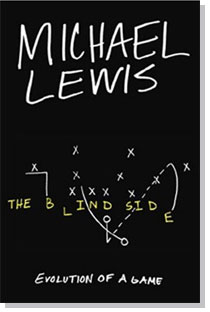
It would be nice to think that the message once survived the macho medium, but it is hard to imagine. Football is such a high-intensity behemoth, so imbued with cheese heads and hogettes that there is rarely time for a moment of grace between all the victory dances and highlight reels. But do not lose hope, football fans. Michael Lewis, one of the most compelling nonfiction writers in America, has decided to play with the pigskin.
Consider this passage, from the first chapter of “The Blind Side: Evolution of a Game,” his elegant new book on the sport. “There’s an instant before it collapses into some generally agreed-upon fact when a football play, like a traffic accident, is all conjecture and fragments and partial views. Everyone wants to know the whole truth but no one possesses it. Not the coach on the sidelines, not the coach in the press box, and certainly not the quarterback.”
This is not the lingo of the six-pack pre-game show. To assemble his profile of the sport, Lewis has decided to focus on the literal edge of the game, the left tackle position, home to little-known players of enormous gait and strength who are, on average, now the highest paid on an NFL team next to the quarterbacks. Without an overpowering left tackle, Lewis explains, quarterbacks get damaged by malicious pass rushers, sacked from behind, from their left side, their blind side. “When a star running back or wide receiver is injured, the coaches worry about their game plans,” he writes. “When a star quarterback gets hurt, the coaches worry about their jobs.”
So coaches have compensated over the last 20 years by rejiggering their offensive lines with giants, a necessary adjustment as they came to depend more and more on the passing game. Lewis credits Bill Walsh, the storied San Francisco 49er coach; Lawrence Taylor, the New York Giants’ quarterback killer; and revisions to the NFL rulebook in 1978 for the transformation. “The football field is usually a tightly strung ecosystem, an efficient economy: there is seldom a free lunch on it,” the author explains. “Yet Walsh had stumbled upon a systemic opportunity. The short, precisely timed passing game might not offer an entirely free lunch, but the discount to the retail price was steep.” In 1975, Lewis tells us, NFL teams were throwing the football 24 times each game, on average. By the early 1990s, however, quarterbacks were throwing about 34 times per game. With the passing game, the quarterback protection game blossomed. Before 1982, quarterback sacks were not even kept as a statistic in the NFL. By 2000, the Baltimore Ravens’ left tackle, Jonathan Ogden, was making $44 million over six years, eight times as much as the quarterback he was protecting.
Lewis is a chronicler of people, an immersive nonfiction writer, in the style of Gay Talese and Joan Didion. His dialogue is crisp, his scenes concisely rendered and his voice as fresh as the close-cropped turf of the Mississippi State University gridiron. In recent years, he has written about the mendacity of a Wall Street trader (“Liar’s Poker”), the buffoonery of a presidential campaign (“Trail Fever”) and the statistical insights of the Oakland Athletics (“Moneyball”). For “Blind Side,” he anchors the story in a single football player, Michael Oher, a young prodigy discovered in high school, who now plays for the University of Mississippi as he awaits the NFL draft.
Oher’s tale is by any measure extraordinary. “A poor black giant monosyllab of the Memphis ghetto comes to live with, and apparently be loved by, a rich white right-wing family on the other side of town,” Lewis explains. Unlike countless other talented but troubled prospects, Oher stumbles into good fortune, in the form of a wealthy white family with a spare bedroom and considerable free time. Most of the book chronicles Oher’s journey from homeless teenager to top-flight draft project. With any other writer, it might be a project too difficult to handle. For one thing, Oher doesn’t like to talk to people. He just doesn’t speak or reveal anything of himself. For another, his story has less to do with football than the tragedy of inner-city poverty in the South.
An affable giant, Oher moves through life as if in a daze. We are with him as he gets by without lunch money at his new private school, as he struggles to study 19th century British poetry, and as he learns that he can literally lift up opposing blockers on the football field. But for all the telling details, Lewis stumbles when he attempts to explain the social significance of Oher’s rise from the ghetto, never engaging the racial politics of a white family rescuing a black boy with enormous athletic gifts. As a high school junior, Oher was 6-foot-5, 350 pounds, and he could run a 40-yard dash in less than five seconds. For this reason, he was plucked into a white world of caring Christians, loved as a son, and sent off on the path of success. The same thing that allowed his escape from the ghetto lingers as an indictment of wealthy white America, which never bothers to give a chance to so many other disadvantaged children who lack athletic gifts. Almost by necessity, Lewis needs to glance over the most troubling questions of Oher’s success.
But “Blind Side” is a football book first, and a social critique almost by accident. Though small in scope, Lewis has written a tome that directly challenges the dumbed-down delivery of the brute-force school of football commentary. “The fans, naturally more interested in effect than cause, follow the ball, and come away thinking they know perfectly well what just happened,” Lewis writes. “But what happened to the ball, and to the person holding the ball, was just the final link in a chain of events that began well before the ball was snapped.” The story of football, in other words, is much bigger than big hits and turduckens. There is much left to tell.
This story has been corrected since it was originally published.
