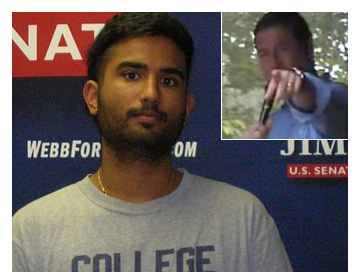

Salon Person of the Year: S.R. Sidarth

The Virginia native and son of Indian immigrants changed history with a camcorder and introduced Sen. George Allen -- and the rest of us -- to the real America.

Topics: 2006 Elections

Salon Person of the Year: S.R. Sidarth

Sometimes, for just a moment, nothing makes sense. The senator who would be president stands on the dais. It is a bright summer day. The branches of trees, still green, sway gently in the breeze. Republican George Allen is feeling good, and the crowd likes him. Almost everyone thinks he will win reelection. Then he says something. “Let’s give a welcome to macaca here. Welcome to America and the real world of Virginia.” No one knows what has happened.

But the confusion does not last long. Over the next week, people consult dictionaries in several languages. They find that the word “macaca” is a term for monkey, used in some places around the world as a racial epithet. At first, the senator recoils from the claims of insensitivity, refusing to apologize. Then he apologizes hesitantly, then profusely. At first, the senator’s advisors say the word was a nickname for a mohawk haircut. Then they say the word meant nothing at all.

As days stretch into weeks, a video of that moment, with the senator onstage, spreads over the Internet like a sickness, entering popular culture and political history. Months later in the fall, when the votes are counted, it becomes clear that a successful politician has stumbled badly over a 20-year-old with a camcorder. The career of George Allen, the former front-runner for the 2008 Republican presidential nomination, is in shambles. And when he finally concedes defeat two days after the 2006 election, he has not only lost a seat that was considered safe but also handed Democrats control of the Senate, completing their takeover of both houses of Congress.

It must be said that the young man, Shekar Ramanuja Sidarth, is not much of a cameraman. In the macaca footage, his hand shakes, though he manages to hold Allen in the frame as the senator points him out, an Indian-American in a crowd of whites. But in the weeks that follow, Sidarth does not shy from the spotlight that surrounds him. He undergoes a transformation of sorts, appearing on CNN and the network news, giving long interviews to the pen-and-paper press. He becomes a symbol of politics in the 21st century, a brave new world in which any video clip can be broadcast instantly everywhere and any 20-year-old with a camera can change the world. He builds a legacy out of happenstance.


Weeks after Allen’s blunder, Sidarth finds himself writing an entrance essay for a class at the University of Virginia, where he is a senior. The class is called Campaigns and Elections, and it has about four applicants for every spot. “I get all these large, elaborate essays about the meaning of politics and why they are going to be president,” says Larry Sabato, the professor. Sidarth writes only three words. “I am macaca.” Sabato lets him in. “When you have the right stuff, you don’t need to brag,” the teacher explains. “A simple declarative sentence will do.”

Of course the myth of macaca, like the myth of Achilles, does not capture the enormous complexity of the political war. Voters were also thinking about Iraq, about corruption in Congress, and about the unpopular president with whom Allen was allied. What’s more, Sidarth wasn’t really just a random 20-year-old with a camcorder testing the power of the Internet. He was backed by the full force of a Senate campaign, with a professional public relations machine that had the ear of national newspapers and networks.

“People sort of assume that we just threw macaca on YouTube and it just blew up and 400,000 people saw it and all this stuff happened with George Allen and then the whole tide was shifted in our race,” says Jessica Vanden Berg, the campaign manager for Jim Webb, Allen’s opponent. In fact, the Webb campaign bided its time, and then used the mainstream media to launch its message.

Hours after Allen uttered the word, Sidarth, who was a Webb volunteer, called the campaign to explain what had happened. It was getting late on a Friday afternoon. At Webb’s Arlington headquarters, campaign staffers were not initially sure what to do, so they did the only sensible thing. “We all went out to the bar,” Vanden Berg recalls. By Monday, the video had still not been released online, but political bloggers were abuzz with word that a bombshell was coming. When the campaign tipped off a Washington Post reporter, no one knew whether macaca would be a big story. “The Post reporter was sort of like, ‘I don’t know if this is news. I don’t know if we are going to write about it,’” says Vanden Berg.

The campaign did not put the video on YouTube, the file-sharing service, until the Post had taken the bait, publishing a short story online. It was a relatively slow news week, in the dead heat of August vacation season, and the political press, backed by hundreds of bloggers, went wild. The macaca frenzy was born. More stories followed, about Allen’s apparently uneasy relationship with his Jewish heritage, then about Allen’s alleged pattern of racist behavior. Though Allen’s denials were consistent, he never regained his balance or his standing in the polls.

A nation of political partisans took notice. Everywhere there were imitators. In Colorado, activists for the liberal group Progress Now taunted Republican Rep. Marilyn Musgrave as she walked down the street, hoping she would embarrass herself. In Montana, in another cliffhanger race won by a Democrat, opponents of incumbent Republican Sen. Conrad Burns hounded him with a camcorder as he traveled across the state making gaffe after gaffe. And in Virginia, an abrasive blogger named Mike Stark shouted questions at Allen until he was tackled by Allen’s staff.

Now with the onset of the 2008 campaign, the macaca myth is set to grow ever larger. Allen’s loss, after all, set the nation on a new course. It changed control of the Senate and suggested that Virginia, with 13 electoral votes, may have changed from red to purple. But the real lessons remain to be sorted out. Clearly, closely contested political campaigns will now take place in a sort of YouTube panopticon. Michael Moore-aping saboteurs will proliferate. But the upside is also considerable. Voters will have more opportunity than ever before to stand in Sidarth’s shoes and see their leaders in action, at their most candid, and perhaps their most honest.

Days after the election, Sidarth wrote an essay for the Washington Post analyzing his role as a key bystander in the 2006 election. He zeroed in on one important fact. The backlash against Allen had apparently reached into the southern Virginia county where the senator had uttered the word. Dickenson County was assumed by much of the national press to be a place that still embraced the old Confederate Virginia, a state where until 1997 the official song was a minstrel ballad called “Carry Me Back to Old Virginia.” In that ditty, the narrator, a self-identified “darkey” labors “so hard for old massa.”

“Nothing made me happier on election night than finding out the results from Dickenson County,” Sidarth wrote. “Webb won there, in what I can only hope was a vote to deal the race card out of American politics once and for all.”

Those are the hopes of an idealistic college student. While most of white downstate Virginia is solidly Republican, Dickenson County, with its history of unionized mining, tilts Democratic. Even John Kerry won Dickenson while losing the state.

But Sidarth is right that the macaca incident played a pivotal role in the election. It just may not be the role he imagined. Sidarth wants to believe it means the race card is losing its potency in the rural South. Pundits wonder about the long-term implications of homemade, unfiltered, viral webcasts on political campaigns. But the real message of macaca may have been the kid behind the camera.

Jim Webb eked out a statewide victory on the basis of massive margins in the booming suburbs of northern Virginia. Macaca and all the missteps that followed helped convince voters in these affluent, well-educated and increasingly diverse zip codes outside Washington that they had grown tired of George Allen. But the same voters may also have recognized Sidarth, born and raised in northern Virginia, a straight-A student at a state college and a member of the local Hindu temple, as their neighbor. Allen was just a California transplant with dip and cowboy boots who had glommed on to the ancient racial quirks of his adopted home. Sidarth was the kid next door. He, not Allen, was the real Virginian. He was proof that every hour his native commonwealth drifts further from the orbit of the GOP’s solid South and toward a day when Allen’s act will be a tacky antique. Allen was the past, Sidarth is the wired, diverse future — of Virginia, the political process and the country.

Michael Scherer is Salon's Washington correspondent. Read his other articles here.

More Related Stories

Featured Slide Shows

  • Share on Twitter
  • Share on Facebook
  • 1 of 11
  • Close
  • Fullscreen
  • Thumbnails

    Ten spectacular graphic novels from 2014

    Beautiful Darkness by Fabien Vehlmann & Kerascoët
    Kerascoët's lovely, delicate pen-and-watercolor art -- all intricate botanicals, big eyes and flowing hair -- gives this fairy story a deceptively pretty finish. You find out quickly, however, that these are the heartless and heedless fairies of folk legend, not the sentimental sprites beloved by the Victorians and Disney fans. A host of tiny hominid creatures must learn to survive in the forest after fleeing their former home -- a little girl who lies dead in the woods. The main character, Aurora, tries to organize the group into a community, but most of her cohort is too capricious, lazy and selfish to participate for long. There's no real moral to this story, which is refreshing in itself, beyond the perpetual lessons that life is hard and you have to be careful whom you trust. Never has ugly truth been given a prettier face.

    Ten spectacular graphic novels from 2014

    Climate Changed: A Personal Journey Through the Science by Philippe Squarzoni
    Squarzoni is a French cartoonist who makes nonfiction graphic novels about contemporary issues and politics. While finishing up a book about France under Jacques Chirac, he realized that when it came to environmental policy, he didn't know what he was talking about. "Climate Changed" is the result of his efforts to understand what has been happening to the planet, a striking combination of memoir and data that ruminates on a notoriously elusive, difficult and even imponderable subject. Panels of talking heads dispensing information (or Squarzoni discussing the issues with his partner) are juxtaposed with detailed and meticulous yet lyrical scenes from the author's childhood, the countryside where he takes a holiday and a visit to New York. He uses his own unreachable past as a way to grasp the imminent transformation of the Earth. The result is both enlightening and unexpectedly moving.

    Ten spectacular graphic novels from 2014

    Here by Richard McGuire
    A six-page version of this innovative work by a regular contributor to the New Yorker first appeared in RAW magazine 25 years ago. Each two-page spread depicts a single place, sometimes occupied by a corner of a room, over the course of 4 billion years. The oldest image is a blur of pink and purple gases; others depict hazmat-suited explorers from 300 years in the future. Inset images show the changing decor and inhabitants of the house throughout its existence: family photos, quarrels, kids in Halloween costumes, a woman reading a book, a cat walking across the floor. The cumulative effect is serene and ravishing, an intimation of the immensity of time and the wonder embodied in the humblest things.

    Ten spectacular graphic novels from 2014

    Kill My Mother by Jules Feiffer
    The legendary Pulitzer Prize-winning cartoonist delivers his debut graphic novel at 85, a deliriously over-the-top blend of classic movie noir and melodrama that roams from chiaroscuro Bay City to Hollywood to a USO gig in the Pacific theater of World War II. There's a burnt-out drunk of a private eye, but the story is soon commandeered by a multigenerational collection of ferocious women, including a mysterious chanteuse who never speaks, a radio comedy writer who makes a childhood friend the butt of a hit series and a ruthless dame intent on making her whiny coward of a husband into a star. There are disguises, musical numbers and plenty of gunfights, but the drawing is the main attraction. Nobody convey's bodies in motion more thrillingly than Feiffer, whether they're dancing, running or duking it out. The kid has promise.

    Ten spectacular graphic novels from 2014

    The Motherless Oven by Rob Davis
    This is a weird one, but in the nervy surreal way that word-playful novels like "A Clockwork Orange" or "Ulysses" are weird. The main character, a teenage schoolboy named Scarper Lee, lives in a world where it rains knives and people make their own parents, contraptions that can be anything from a tiny figurine stashable in a pocket to biomorphic boiler-like entities that seem to have escaped from Dr. Seuss' nightmares. Their homes are crammed with gadgets they call gods and instead of TV they watch a hulu-hoop-size wheel of repeating images that changes with the day of the week. They also know their own "death day," and Scarper's is coming up fast. Maybe that's why he runs off with the new girl at school, a real troublemaker, and the obscurely dysfunctional Castro, whose mother is a cageful of talking parakeets. A solid towline of teenage angst holds this manically inventive vision together, and proves that some graphic novels can rival the text-only kind at their own game.

    Ten spectacular graphic novels from 2014

    NOBROW 9: It's Oh So Quiet
    For each issue, the anthology magazine put out by this adventurous U.K.-based publisher of independent graphic design, illustration and comics gives 45 artists a four-color palette and a theme. In the ninth issue, the theme is silence, and the results are magnificent and full of surprises. The comics, each told in images only, range from atmospheric to trippy to jokey to melancholy to epic to creepy. But the two-page illustrations are even more powerful, even if it's not always easy to see how they pertain to the overall concept of silence. Well, except perhaps for the fact that so many of them left me utterly dumbstruck with visual delight.

    Ten spectacular graphic novels from 2014

    Over Easy by Mimi Pond
    When Pond was a broke art student in the 1970s, she took a job at a neighborhood breakfast spot in Oakland, a place with good food, splendid coffee and an endlessly entertaining crew of short-order cooks, waitresses, dishwashers and regular customers. This graphic memoir, influenced by the work of Pond's friend, Alison Bechdel, captures the funky ethos of the time, when hippies, punks and disco aficionados mingled in a Bay Area at the height of its eccentricity. The staff of the Imperial Cafe were forever swapping wisecracks and hopping in and out of each other's beds, which makes them more or less like every restaurant team in history. There's an intoxicating esprit de corps to a well-run everyday joint like the Imperial Cafe, and never has the delight in being part of it been more winningly portrayed.

    Ten spectacular graphic novels from 2014

    The Shadow Hero by Gene Luen Yang and Sonny Liew
    You don't have to be a superhero fan to be utterly charmed by Yang and Liew's revival of a little-known character created in the 1940s by the cartoonist Chu Hing. This version of the Green Turtle, however, is rich in characterization, comedy and luscious period detail from the Chinatown of "San Incendio" (a ringer for San Francisco). Hank, son of a mild-mannered grocer, would like to follow in his father's footsteps, but his restless mother (the book's best character and drawn with masterful nuance by Liew) has other ideas after her thrilling encounter with a superhero. Yang's story effortlessly folds pathos into humor without stooping to either slapstick or cheap "darkness." This is that rare tribute that far surpasses the thing it celebrates.

    Ten spectacular graphic novels from 2014

    Shoplifter by Michael Cho
    Corinna Park, former English major, works, unhappily, in a Toronto advertising agency. When the dissatisfaction of the past five years begins to oppress her, she lets off steam by pilfering magazines from a local convenience store. Cho's moody character study is as much about city life as it is about Corinna. He depicts her falling asleep in front of the TV in her condo, brooding on the subway, roaming the crowded streets after a budding romance goes awry. Like a great short story, this is a simple tale of a young woman figuring out how to get her life back, but if feels as if it contains so much of contemporary existence -- its comforts, its loneliness, its self-deceptions -- suspended in wintery amber.

    Ten spectacular graphic novels from 2014

    Through the Woods by Emily Carroll
    This collection of archetypal horror, fairy and ghost stories, all about young girls, comes lushly decked in Carroll's inky black, snowy white and blood-scarlet art. A young bride hears her predecessor's bones singing from under the floorboards, two friends make the mistake of pretending to summon the spirits of the dead, a family of orphaned siblings disappears one by one into the winter nights. Carroll's color-saturated images can be jagged, ornate and gruesome, but she also knows how to chill with absence, shadows and a single staring eye. Literary readers who cherish the work of Kelly Link or the late Angela Carter's collection, "The Bloody Chamber," will adore the violent beauty on these pages.

  • Recent Slide Shows

Comments

0 Comments

Comment Preview

Your name will appear as username ( settings | log out )

You may use these HTML tags and attributes: <a href=""> <b> <em> <strong> <i> <blockquote>