
Immigration

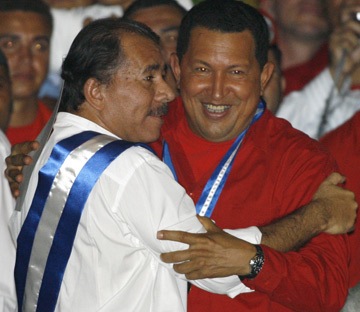
Daniel Ortega’s new best friend: Hugo Chavez

Former Sandinista revolutionary Ortega is back on top in Nicaragua. Will his alliance with Venezuela -- complete with subsidized oil -- be a model for the rest of Central America?

President Ronald Reagan referred to him in 1986 as the leader of a repressive regime and the only president in Central America who wore a military uniform. Then he asked Congress for an additional $100 million to get rid of Daniel Ortega and his 1979 Sandinista revolution.

By 1990 Ortega was out. Now, 16 years later, he’s back, but this time the 61-year-old Sandinista has shelved his fatigues for white button-down shirts. The former Marxist sounds almost Smithesque on private property, but Ortega also made it clear at his January inauguration as president of Nicaragua that after nearly two decades of Washington-style democracy in that country, he has something different in mind.

“It has been 16 years in which the people have paid a big cost with the economic policies known as neoliberalism,” Ortega told a crowd of thousands gathered at the Pope John Paul II Plaza of Faith in Managua. “Now we have the challenge to open a new road, a road that will permit Nicaraguan families to live in dignity.”

It took only one and a half hours for Ortega to reveal his trump card for restoring dignity in Central America’s poorest country: Venezuelan President Hugo Chávez. The oil-rich rebel may have been 90 minutes late to the inauguration — keeping more than a dozen heads of state waiting — but he arrived with so many goodies, it hardly appeared to matter to Ortega, who might as well have been humming “It’s Beginning to Feel a Lot Like Christmas.” The bounty included preferential pricing on crude oil in an amount equal to about a third of Nicaragua’s annual oil consumption, a refinery, the forgiveness of some $30 million in debt, new interest-free or low-interest loans of $20 million, and a good chunk of free money for homes and healthcare.

The new alliance between Venezuela and Nicaragua offers Central America its first alternative to Washington since the 1980s. Those were the years the Reagan administration spent billions of dollars to prevent leftist revolutions in El Salvador and Guatemala and to undo the 1979 Sandinista revolution, which allied with Cuba and the Soviet Union after being rebuffed by Washington.

Now, after a series of center-right governments and a steady dose of remedies by the International Monetary Fund — privatizing public companies, lifting trade barriers and reforming the banking sector — the region could use, well, a few revolutions.

Corruption and governments incapable of collecting taxes and spurring growth to improve wages have failed many Central Americans. In El Salvador, Guatemala and Honduras, misery plus surging violent crime has turned hope into one word: emigration, preferably to El Norte.

It’s as if Central America has pressed the Mute button on the ugly immigration debate in their promised land. Few care or even seem aware of how difficult their journey might be. It’s simply too important. The money sent home from relatives living legally — and illegally — in the United States holds their lives together.

Enter Chávez — into a Central America doing poorly in nearly every measure of quality of life, economics and security being at the top of the list.

His Bolívarian revolution — named for Simón Bolívar, who liberated much of South America from colonial powers — is far from the Cuban model, but it is still a work in progress. So far that means a mix of nationalism, demagogy and some old-fashioned conservative monetary policies, which include increasing tax collection at home by more than 50 percent. (Ouch, no wonder the rich hate him.)

Chávez has shrewdly played to the poor of Venezuela with handouts while placating the international community by respecting trade agreements. It’s too early to tell what he will do with the powers he recently won to legislate by decree, but even Thomas Shannon, U.S. assistant secretary of state for Western Hemisphere affairs, is sanguine. The new law, he says, is valid under the Venezuelan Constitution and it depends, “as with any tool of democracy,” on how it is used.

If the past is any indication, Chávez is unlikely to do anything too far out of the mainstream. Even in his approach to aid, Chávez rants against capitalism while using its moneymaking possibilities in an inspired way.

He has raised his profile in Latin America through savvy business deals — buying Argentine debt, for example, and making money off it, or giving Cuba oil in exchange for keeping his base healthy (and happy) with Cuban doctors and free education in Cuba for Venezuelan medical students. He’s trying to finance pipelines in Brazil, but there’s money to be made in those too.

Nicaragua is the Venezuelan’s first move into Central America, and it’s unclear what he will get in return. Unlike the South American countries where Chávez usually does business, Nicaragua has neither a large consumer market nor any major natural resources the South American leader might want.

It’s possible that Chávez’s move is pure ego — a contest that puts his Bolívarian revolution against Washington’s straight-up capitalism of free trade.

Nicaraguans and Ortega seem fully aware of the dynamic but are cagey about playing both sides.

At his inauguration, Ortega promised to respect the U.S.-backed Central America Free Trade agreement, known as CAFTA, but asked the crowd of farmers, students and poor families if they wanted to join Chávez’s Bolívarian Alternative of the Americas, known as ALBA, which now includes Venezuela, Cuba and Bolivia.

CAFTA is a full-fledged trade agreement that promises new markets and incentives for business, but it is too new to judge. ALBA essentially offers its members the symbolism of Latin American unity and the immediate reality of Venezuelan dollars.

“We are in CAFTA, and we’ll continue to fight for better conditions, but we have our own proposals, our own plans, for the unity of Latin America, which is ALBA,” Ortega said.

In a country where 80 percent of the people live on less than $2 a day, few have anything to lose. But for all of Ortega’s promises and new alliances, a lot of unanswered questions remain. The first is, who is this new Ortega?

A survivor, he accepted his first defeat in 1990 when he lost the presidency to Violeta Chamorro. Even then, however, he was never really out of the game. With his party still in control of the police and the military, he made life difficult for Chamorro. This didn’t inspire support, and when he ran for president again in 1996, he lost to a conservative, Arnoldo Alemán.

Then in 1998, Ortega’s stepdaughter, Zoilamérica, accused him of years of sexual abuse — a charge he denied. Many wondered how he would survive. Much credit is given to two people: his wife, Rosario Murillo, who stood by him and rejected her daughter’s allegations, and his rival, then-President Alemán.

By 1999, when Ortega was still reeling from Zoilamérica’s accusations, investigators were nipping at Alemán’s financial dealings. So Ortega and Alemán worked out what is known in Nicaragua as el pacto, a 1999 agreement that included three provisions: Former presidents could take a seat in Congress and thereby get automatic immunity, government appointments would be shared between the parties controlled by Alemán and Ortega, and the formula for calculating a presidential winner would be reduced from 45 percent to 35 percent.

El pacto came in handy in 2001 when Zoilamérica’s charges landed in a Nicaraguan court. Ortega grandly gave up his immunity and went before a Sandinista judge, who quickly concluded that the statue of limitations had run out.

Still, the presidency eluded him. That same year, Ortega lost to Enríque Bolaños. Finally, in 2006, the stars, pragmatism and el pacto aligned.

First, a former Sandinista and popular mayor of Managua, Herty Lewites, who was polling well on the Movement for Sandinista Renewal ticket, died in July of a massive heart attack.

Without real competition from a progressive, Ortega had to contend only with the right. To court this vote, he took a Sandinista opposition figure as his vice president and supported the Roman Catholic Church in its desire to ban abortion in Nicaragua.

With the opposition’s vote scattered among four other candidates, the benefits of el pacto kicked in. Ortega needed only 35 percent of the vote and a 5 percent lead. He got 38 percent and a 9 percent lead.

As Carlos Chamorro, the editor of Confidencial and Esta Semana, pointed out, even with all of his calculations, Ortega won only 15,000 of the new voters. His victory put him back in power with the smallest mandate in Nicaragua’s contemporary history. “What we want is that the basic things we need are cheap and that there are jobs,” said Amo Ballardo, a 40-year-old security guard. “And this old guy,” he said, referring to Bolaños, “has taken us” for a ride.

Later in the week, in the northern part of the country, many coffee workers seemed on the edge of desperation. Medando Espinoza, a 28-year-old worker who was drying the end of his coffee harvest, said he works until the job is done but earns only a few dollars a day. He hopes Ortega will help with fertilizer, low-interest loans and technical assistance. Venezuelan aid — if it comes in at the promised levels — will help. And despite Nicaragua’s position as the region’s poorest country, it has some advantages. The biggest is offering investors and tourists a safe place to put their money or spend their time. During a recent trip I made to El Salvador, Honduras and Guatemala, nearly every conversation I had included a crime story. Since the peace accords in El Salvador and Guatemala, murder rates have soared. The number killed per 100,000 citizens reached 55 in El Salvador, 40 in Honduras and 37 in Guatemala. These compare with eight in Nicaragua and six in the United States.

Gangs are only part of the problem. With few prosecutions, all kinds of common crimes flourish. Businesses in El Salvador, Honduras and Guatemala include the costs of security and extortion in their budgets. Armed thieves regularly board buses and walk down the aisles with large plastic garbage cans to collect purses and wallets. In wealthier neighborhoods, armed men simply ring the doorbell and bully their way in.

The governments in all three countries have run different get-tough, or mano duro, policies, but in all cases, crime has only gotten worse.

In El Salvador late last year, outgoing U.S. ambassador Douglas Barclay warned a group of Salvadorans that the violence threatens “to stop economic growth, stop foreign investment and even undo many of the gains since the peace accords.”

In this climate, the Chávez money could make a difference in stimulating small businesses, expanding an already growing tourism industry, and adding jobs to the economy. Or Ortega could use the aid to enrich himself and his friends — it would not be the first time foreign aid ended up being squandered in Nicaragua. The Central American presidents who waited patiently for Chávez to arrive for Ortega’s inauguration will be watching his alliance with Chávez. Until now, Central Americans have elected conservative candidates for fear of upsetting Washington. Moreover, with the exception of the late Lewites and his party in Nicaragua, Central America’s left has offered few new solutions. If Ortega succeeds, it’s possible that progressive candidates elsewhere could emerge and also ally with Chávez.

This possibility was not far from the thoughts of Ricardo Perez, a 25-year-old Honduran student who traveled to Managua with a group of friends to witness Ortega’s swearing-in. “Presidents like Ortega can stop the indifference toward the poor,” Perez said, adding that he considered Ortega the region’s best hope.

But he also understood that the Nicaraguan was unlikely to make it alone, so he and his fellow Hondurans all wore blazing red T-shirts sporting the image of day’s honored, if very late, guest — Hugo Chávez.

Rep. Steve King: Immigrants are like dogs

Updated: On Monday, the Iowa GOP rep used a degrading metaphor to describe how America should select immigrants

Steve King (Credit: Reuters/Larry Downing)

[Updated below]

Rep. Steve King, R-Iowa, compared immigrants to dogs at a town hall meeting yesterday, telling constituents that the U.S. should pick only the best immigrants the way one chooses the “pick of the litter.”

King told the crowd in Pocahontas, Iowa, that he’s owned lots of bird dogs over the years and advised, “You want a good bird dog? You want one that’s going to be aggressive? Pick the one that’s the friskiest … not the one that’s over there sleeping in the corner.”

King suggested lazy immigrants should be avoided as well. “You get the pick of the litter and you got yourself a pretty good bird dog. Well, we’ve got the pick of every donor civilization on the planet,” King said. “We’ve got the vigor from the planet to come to America.” The liberal research group American Bridge captured the comments:

King has long been one of Congress’ most vociferous and toxic opponents of illegal immigration and “amnesty,” often partnering with notorious immigration hawks like former congressman Tom Tancredo and Maricopa County, Ariz., Sheriff Joe Arpaio. In 2010, he took to the House floor to declare that he could detect “illegals” by their footwear and his “sixth sense.”

Lately, however, King has backed off his inflammatory rhetoric, thanks to a tough challenge from Democrat Christie Vilsack. His bird dog comments suggest, however, that his mouth will continue to dog him.

Update: In a statement, Vilsack’s campaign said, “If we’re going to have a real discussion on immigration, we should start by acknowledging that immigrants are human beings. Iowans are taught in their community, in their church, and at the dinner table to respect each other, not to compare people to dogs. People expect a serious discussion between candidates and that’s what we’re committed to.”

Continue Reading Close

Alex Seitz-Wald is Salon's political reporter. Email him at aseitz-wald@salon.com, and follow him on Twitter @aseitzwald.

Mitt’s new Latino hurdle

The conservative Hispanic group Romney will address this week once slammed "right-wing extremists" on immigration

Mitt Romney (Credit: AP)

As part of an effort to win back Latino voters, Mitt Romney will address a conservative Latino business group this week that has advocated immigration policy views in stark contrast to his own. Romney’s “self-deportation” policy put him well to the right of many of his GOP primary challengers, and the Latino Coalition once slammed “right-wing extremists” who opposed comprehensive immigration reform.

The presumed GOP nominee’s Wednesday speech to the Latino Coalition comes as polls show Romney way behind President Obama among Latino voters and with little hope of capturing the 44 percent of the bloc George W. Bush won in 2004, a highwater mark for the GOP.  Even New Mexico Gov. Susana Martinez (R) — whom Romney floated as a potential vice-presidential choice — mocked the presumed GOP’s immigration policy last week.

The Romney campaign’s response has been that immigration is irrelevant to winning over Latino voters — jobs and the economy are the only things that matter. But his speech this week underscores just how difficult an argument that will be for him to make: In the past, the Latino Coalition has argued that immigration reform is part of a pro-business platform, not separate from it.

These days, the only immigration issue the Coalition mentions on its website is the “Mexican Trucking issue.” But the group aggressively advocated for comprehensive immigration reform under President Bush. In 2007, the Coalition’s president slammed “far right extremists” who opposed “common-sense [immigration reform] legislation that is so important for the security and economic vitality of our country.” The group “urge[d] Speaker Nancy Pelosi (D-CA) and the Democratic leadership in the House to demonstrate courage and leadership on this issue and take on immigration reform,” saying Pelosi could pass a bill “without the level of Republican support she is demanding.”

In the 2008 GOP primary, the Latino Coalition favored Rudy Giuliani — a veritable leftist on immigration reform compared to most Republicans — with the former New York mayor capturing 64 percent of the vote in a straw poll of the group’s members. Romney apparently finished behind Sen. John McCain and former Sen. Fred Thompson, as his name was not mentioned in the statement.

Meanwhile, the Chamber of Commerce, whose grand D.C. offices will host the event Wednesday, also supported comprehensive reform under Bush, similarly seeing it as a boon for free market capitalism. The powerful business lobby still calls for “an effective and streamlined temporary worker program so that employers can hire immigrant workers” and “a pathway to legal status for undocumented workers currently in the United States.”

This was essentially Bush’s policy too. But Romney’s infamous immigration advisor, Kansas Secretary of State Kris Kobach, who authored the draconian anti-immigration laws in Arizona and Alabama, said his candidate would not support any kind of pathway to legalization for undocumented immigrants.

The Romney campaign briefly attempted to disown Kobach after Romney won the primary and the advisor’s utility was spent, but he may have to throw his entire immigration policy under the bus with Kobach if he hopes to win over the Latino business owners on Wednesday, let alone Hispanic voters more generally.

Continue Reading Close

Alex Seitz-Wald is Salon's political reporter. Email him at aseitz-wald@salon.com, and follow him on Twitter @aseitzwald.

Obama’s broken immigration promise

ICE said it would target dangerous immigrants, but it's actually deporting a higher percentage of non-criminals

A man in Ciudad Juarez, Mexico, stands next to the border fence as two U.S. law enforcement officers look on from the U.S. side of the fence. (Credit: AP/Raymundo Ruiz)

The Obama administration claims that it is deporting record numbers of illegal immigrants while focusing on those with criminal records. But new data from Immigration and Customs Enforcement shows that the number of deportation orders has declined dramatically since last summer and non-criminals comprise a growing percentage of those expelled from the country.

That wasn’t supposed to happen under a policy of “prosecutorial discretion” announced by ICE director John Morton last June. The goal of the policy, announced with much fanfare in the Spanish language media, was to spare “longtime lawful residents” from deportation and to focus on criminals.

Since then, the adminstration has deported many fewer non-criminal aliens. But non-criminals remain the vast majority of those deported. And those with no criminal record now actually comprise a slightly larger percentage of those forced to leave the country than they did before Morton’s announcement.

In the three months before the policy was announced last summer ICE filed for deportation proceedings against 61,192 people of whom 15 percent had criminal records. In the first three months of 2012, ICE sought 37,659 deportations orders, 14 percent of which involved people with criminal records.

“The agency continues to be headed in the opposite direction of its stated goals,” said Susan Long, co-director of the Transactional Records Access Clearinghouse at Syracuse University, which collected the data from ICE via a Freedom of Information Act request.

The goal of prosecutorial discretion, Long said in a conference call with reporters, “was to target and bring before the court those with more serious criminal history. As yet we’re not seeing any change. They have not turned the ship around.”

The administration implemented prosecutorial discretion in response to complaints that young people with no criminal records continue to face deportation. But the new data will come as no surprise to student groups such as United We Dream, National Immigrant Youth Alliance and DreamActivist, which continue to highlight the cases of law-abiding young people facing deportation.

Rep. Luis Gutierrez, D-Ill., has championed the case of a South Carolina man, Gabino Sánchez, a married father of two, who was arrested for driving without a license last year and now faces deportation.

“Gabino Sánchez has lived and worked and raised a family here for more than a decade and it is not in anyone’s interest to have him deported,” Rep. Gutierrez told Fox News Latino on Tuesday after a deportation hearing in North Carolina.  ”I do not understand why ICE has not followed President Obama’s guidelines and decided to move on from this case to go after someone else, someone who is a threat to his community or a serious criminal.”

In response to the TRAC findings, Gutierrez  said, “The president should make sure the Department of Homeland Security is actually following its own rules and he should proclaim proudly and loudly that he will not deport another DREAMer or anyone else who fits the prosecutorial discretion criteria.”

Continue Reading Close
Jefferson Morley

Jefferson Morley is a staff writer for Salon in Washington and author of the forthcoming book, Snow-Storm in August: Washington City, Francis Scott Key, and the Forgotten Race Riot of 1835 (Nan Talese/Doubleday).

Dreamers spurn Obama

Young immigrants feel tricked by the White House line on Marco Rubio's revival of the DREAM Act

Supporters of the DREAM Act take part in a demonstration in front of the White House. (Credit: AP/Pablo Martinez Monsivais)

Mohammad Abdollahi has not followed every twist and turn of the national immigration debate.  He has been too busy trying to save a friend from deportation.

Last month, 20-year-old Izlia Luna of Medford, Ore., was stopped by police for a traffic altercation. The judge threw out the charges. But under the mandate of the Obama administration’s Secure Communities program, Luna’s fingerprints had been taken. She was found to be undocumented. Luna was brought to the United States from Mexico when she was 2 years old. Instead of being released she was sent to an ICE detention facility in  Tacoma, Wash., 340 miles from her home.

“This is what immigration reform under Obama has gotten us,” says Abdollahi, who traveled to Tacoma to rally public attention to Luna’s case. “The right to spend up to $5,000 to get a loved one out of jail. When Obama says he isn’t deporting dreamers, he’s lying.”

“Marco Rubio is being a lot more authentic with us,” Abdollahi added.

The positive response of young immigrants  to Rubio’s still-vague alternative to the Democrats’ DREAM Act is central to the changing politics of immigration in the 2012 presidential campaign. In a series of meetings in Washington, Rubio is shopping for support, hoping to put forward a legislative proposal in the next few weeks. The Washington Post endorsed the idea on Monday.

By flirting with Rubio, the DREAM activists — representing an estimated 1 million young Americans, or “dreamers,” who are now barred from a path to U.S. citizenship — have wrong-footed the Obama White House and given pause to reelection campaign officials who had been counting on Latinos to fall in line with the president’s reelection. They have also caught the interest of Republican strategists worried about Romney’s narrowing path for victory in November.

Rubio is expected to propose the creation of a non-immigrant visa that would ensure undocumented young people who don’t have criminal records would not be deported and could eventually become citizens. The original DREAM Act failed to pass  the Senate in 2010.

“We are going to support whoever will come out and talk about the issue,” said Gabby Pacheco, a 26-year-old special education teacher from Miami and DREAM Act activist. “Rubio realizes this is key for us. Even if he is only doing it for political reasons, we’re willing to listen.”

The dreamers are backed by Latino Democrats on Capitol Hill, who feel betrayed by the Obama administration’s boasts of deporting a record annual average of 400,000 people over the last four years. After a friendly if inconclusive meeting with Rubio, Rep. Luis Gutierrez of Illinois told Politico his liberal allies  accused him of being the Florida senator’s new “best friend.”

The Obama White House hates the idea. Last week, presidential advisors Celia Munoz and Valerie Jarrett tried to discourage the dreamers from embracing Rubio’s proposal, saying it put at risk the original DREAM Act, which laid out a specific path to citizenship. According to the Washington Post, they had a meeting with DREAM Act-eligible students in Washington, arguing that “Rubio had not demonstrated he could win support from fellow Republicans and that the president would use his clout to push an immigration plan next year. ”

Pacheco, who attended the meeting, was not impressed with the White House appeal.

“You can’t wait until next year if you’re getting deported this year,” she said.  She described the White House officials as “very strategic” in their opposition to Rubio. She said the dreamers asked Munoz and Jarrett if the president could stop the deportations by taking administrative action that would not need to be approved by Congress, as Florida immigration activist Cheryl Little recently wrote in the Miami Herald.

“The thing that surprised us was they said no,” Pacheco told me. “They said, practically, ‘We don’t have the power to do this.’We’re trying to find out if that is true.”

It isn’t true, says Laura Lichter, an attorney in Denver and president-elect of the American Immigration Lawyer’s Association.

“The Obama administration  could certainly be doing more and better to improve the situation for DREAM Act students and to make immigration law and policy predictable and fair for everybody,” Lichter said in a telephone interview. “Whether they’re willing to do that in any way that might look like reasonable treatment for the undocumented remains to be seen.”

Presumptive Republican nominee Mitt Romney, who has advocated “self-deportation” for the likes of Abdollahi and Luna and the estimated 1 million DREAM Act-eligible students, is noncommittal about Rubio’s idea. Romney’s hard-line immigration advisor, Kansas Secretary of State Kris Kobach, initially rejected the suggestion as “amnesty,” but has more recently said he can “work with” the Florida senator, a nod to the growing realization that running on a platform of “self-deportation” is Romney’s ticket to self-destruction among Latino voters in November.

Whether Rubio’s gambit can sway Republican votes on Capitol Hill is doubtful. House Speaker John Boehner described passage of such a bill this year as “difficult at best.” Helping the undocumented is not a priority for most non-Latino voters, according to Republican pollster Scott Rasmussen.

While elite Republicans like Haley Barbour have said positive things about Rubio’s idea, the conservative blogosphere is notably unenthusiastic. The Weekly Standard touted Rubio’s recent foreign policy speech while ignoring his much-publicized idea of helping young undocumented Americans closer to home. The National Review hyped Rubio as a Romney running mate without taking a stand  on his proposal “to give the children of illegal immigrants a visa to continue their studies.” Talk radio stalwarts like Rush Limbaugh and Hugh Hewitt have yet to mention Rubio’s plan, while Mickey Kaus, the Daily Caller’s anti-immigrant blogger, notes conservative intellectuals can only agree to disagree on the issue.

If the Republicans’ intellectual base seems stumped by Rubio’s gambit, the Democratic incumbent comes off as arrogant. In a recent interview with Telemundo, President Obama said:

This notion that somehow Republicans want to have it both ways — they want to vote against these laws [like Arizona and Alabama] and appeal to anti-immigrant sentiment … and then they come and say, ‘But we really care about these kids and we want to do something about it’ — that looks like hypocrisy to me.

To the dreamers, Obama is just as hypocritical. “A lot of folks want us to be against  it,” Abdollahi said. “At the same time we hear from Obama administration that they’re not deporting dreamers. They’re tricking us. That’s what makes us supportive of Rubio.”

Continue Reading Close
Jefferson Morley

Jefferson Morley is a staff writer for Salon in Washington and author of the forthcoming book, Snow-Storm in August: Washington City, Francis Scott Key, and the Forgotten Race Riot of 1835 (Nan Talese/Doubleday).

Will Arizona case help Obama?

The Supreme Court's consideration of the state's tough immigration law puts Mitt Romney in a tough place

As the Supreme Court hears oral arguments today on the constitutionality of Arizona’s hard-line immigration law, lawyers will revel in arcane discussions of “preemption” and “severability” and “harmonious regulation.” Others will ponder the ever-elusive question of whether the eight sitting justices (Justice Elena Kagan is recused) will prove to be “strict constructionists” or “judicial activists.”

The rest of us may prefer to cut to the political chase. The justices will, in all likelihood, either generally uphold the constitutionality of Arizona’s law — which expands the powers of state police officers to ask about the immigration status of anyone they stop and to hold those suspected of being in the country illegally — or they will throw out its key provisions as a usurpation of the federal government’s powers. What happens then?

The court’s decision, expected in June, is sure to roil an accelerating presidential campaign where immigration has already proven to be a potent issue — and possibly in unexpected ways. ”In terms of electoral politics, it’s a win-win for Obama,” says Antonio Gonzalez, president of William C. Velasquez Institute, a Latino public policy research organization. If the court throws out the law, Obama can claim vindication that immigration restrictionists have gone too far, Gonzalez says. If the court upholds the Arizona law, he can “condemn the decision and vow to fight other state laws,” a stance that is likely to be popular with Latinos who now make up 25 percent of the electorate and whose support is crucial to the president’s reelection prospects.

While upholding  the law would “give a shot in the arm to the politics of immigrant exclusion,” Gonzalez argues it would also limit Romney’s ability to expand his appeal to Latino voters, something that the candidate seems inclined to do.

During the primary season, Romney effectively blunted challenges from Texas Gov. Rick Perry and former House Speaker Newt Gingrich by portraying them as soft on illegal immigrants, the vast majority of whom are from Mexico and Central America. At the same time, polls showed Obama opening an enormous lead among Latino voters, prompting Romney to confide to supporters that his campaign was “doomed” unless he could win Latino votes. This week the Romney campaign distanced itself slightly from Kansas Secretary of State Kris Kobach, author of the Arizona law and a Romney adviser. At the same time the candidate stumped with Sen. Marco Rubio of Florida who has said the Arizona law is “not a model” for the country.

“He’s trying to get out of the shackles” of his hard-line position, Gonzalez argues. “If law is upheld, it makes it much harder for him to do that.”

If the law is thrown out, “Romney has more of an opening to back up from his primary positions and talk about alternative plans,” says Chuck Rocha, executive director of the Latino Project, a Democratic political action committee. “If its not thrown out, he has to own it.”

Rocha says his PAC will use a decision favorable to Arizona “to appeal to Mexican-American voters who see this law as Republican overreach” in a dozen contested congressional elections from Florida to California.

Meanwhile, immigration restrictionists talk bravely that Romney will benefit among the general electorate, if not with Latinos, if the law is upheld.

“If Romney holds firm, we know there’s a broad activist base across the country that is highly motivated and that doesn’t want to see taxpayers pay for services for people who have no right to be here,” says Dan Stein of Federation for American Immigration Reform (FAIR), which supports the Arizona law.

Stein is right that restrictionist laws are increasingly popular. Five states (Alabama, Georgia, South Carolina, Utah and Indiana) have adopted similar laws, but have been enjoined from enforcing them. FAIR says six other states are actively considering them. But they have also mobilized resistance from business interests. When Rubio served as Speaker of the Florida House, Arizona-style immigration legislation never got out of committee. Even in solidly Republican Texas and Mississippi, restrictionists could not get an Arizona-style blll approved this year.

Chris Newman, general counsel for National Day Laborer Network in Los Angeles, isn’t so sure, however, that the case will help Obama. He think a decision favorable to Arizona would “put Obama in a tough spot.” While the Obama administration has fought the states seeking to establish their own immigration policies, it has also carried out record numbers of deportations, including children.

“He’ll have to make normative arguments why Arizona law is immoral and unjust and he’ll have a hard time doing that because many parts of the law track his own policy. His signature policy has sought to sue local police as a ‘force multiplier’ for immigration enforcement. Arizona policies are a symptom of that force multiplication.”

“The administration,” he says, “has sought to benefit from the misery imposed on immigrants on Arizona.”

The political impact of the court’s decision may be most decisive in two swing states where the immigration issue is most hotly contested: Missouri, where the legislature is considering an Arizona-style bill, and Arizona itself, where the devastating effects of the law on families with undocumented members is driving so many Latinos away from the Republican Party that the Obama campaign now dreams of winning the state in November.

“The issue is not going to go away,” says Stein. “If anything its hotter and more robust than ever.”

Continue Reading Close
Jefferson Morley

Jefferson Morley is a staff writer for Salon in Washington and author of the forthcoming book, Snow-Storm in August: Washington City, Francis Scott Key, and the Forgotten Race Riot of 1835 (Nan Talese/Doubleday).

Page 1 of 69 in Immigration