
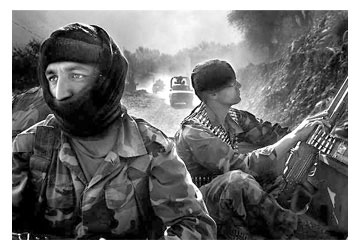

At 9 p.m. on my first night at the U.S. Army base in Kamdesh, I was shaken awake by a 105 mm howitzer round. Then a symphony of incoming and outgoing fire sounded. BO-OM! BO-OM! BO-OM! Tat! Tat! Tat! Pop! Pop! Pop! Pop! Pop! From the pine- and cedar-lined mountain slope that loomed over the base, several insurgents were firing down on us with rocket-propelled grenades and AK-47s. The line of Humvees ringing the base spotted the insurgents and began shooting back. For 10 minutes U.S. forces blanketed the ridgeline above with machine-gun and rifle fire and RPGs. A soldier manning a thermal-imaging device (LRAS) spotted the silhouette of Afghans and began pulling the trigger of his machine gun.
After the first round of fighting, the soldier yelled that he had confirmed at least one death. “I saw that motherfucker through the LRAS!” he screamed, breathing heavily, his adrenaline high. “I saw him explode into a bunch of pieces! Parts were everywhere!” He smiled.
As the volleys began to subside, Sgt. Matthew Netzel guessed aloud that roughly five insurgents had been killed. “I think there are more up there, but we’re not certain yet, ’cause we don’t know how many there were to begin with,” he said. As they fired, U.S. forces launched slow-falling flares that lit up the wooded area they were firing upon, hoping to illuminate the insurgents’ positions. But there were no more insurgents to be seen. The echo of automatic-weapons fire stopped bouncing through the valley and most of the soldiers went back to sleep. It was just another night in Kamdesh. The base averages three attacks per week.
The next morning, a group climbed up the mountainside to look for casualties but found none. “They usually clean their bodies up before we can get to them,” Lt. Benjamin Keating, a 27-year-old from Maine, told me. “They will pull the bodies, scrub bloodstains, and sometimes they pick the shells up too. We never know how many we killed or who they were. They’re like ghosts.” The inability to know how many and who was killed has made it hard for U.S. forces to identify whom they are fighting — Arabs, Afghans or other groups. When they can, a confirmed kill requires a digital photo of the dead man’s face. But those are few and far between.
In November, I traveled with the Army’s 10th Mountain Division to Afghanistan‘s Kunar and Nuristan provinces, the region where Osama bin Laden and Ayman al-Zawahiri have been sighted over the past three years, to see how American forces were fighting the “other” war. What I learned is that the war in Afghanistan is going badly. Three years after U.S. forces secured much of the country and helped 10 million Afghans vote in a presidential election, the country has slid back into a dangerous power vacuum, with the Taliban again competing for control of significant sections of the country. Last November, a CIA analysis of the Karzai government found it was losing control, and American ambassador to Afghanistan Ronald Neumann warned then that the U.S. would “fail” if the plan for action didn’t include “multiple years and multiple billions.” Our gains, once held firmly, have been lost and the coming year may portend Afghanistan’s future, with ominous rumors floating down from the mountains about a spring offensive by insurgents.
Tuesday morning, a suicide bomber killed and wounded Afghans and Americans at the gate to the main U.S. base in the country — in Bagram — while Vice President Dick Cheney was visiting the base. Cheney was unhurt, but the incident was a clear sign of the growing strength of the Taliban and other insurgents. Earlier this month, concerns about the U.S. effort in Afghanistan were finally acknowledged in Washington. President Bush announced he would request $10.6 billion in extra aid for Afghanistan and increase the number of troops, especially along the Afghanistan-Pakistan border. “We face a thinking enemy,” said Bush. “And we face a tough enemy — they watch our actions, they adjust their tactics. And in 2006, this enemy struck back with a vengeance.” Bush’s announcement came after repeated calls from U.S. generals for more boots on the ground and repeated predictions of a spring offensive, pleas for help the military had been making since last summer.
After spending a month along Afghanistan’s northeast border with Pakistan, it is clear to me that the help is needed. The region is one of the most wild and ungoverned areas of Afghanistan. The Americans pushed north last summer, part of Operation Mountain Fury, trying to seal off the Pakistan border and find al-Qaida’s Arab forces. The border’s invisible line, soldiers say, allows high-value targets, like bin Laden, to find sanctuary and a base of operations. What I saw was a skilled but unprepared U.S. force battling literally uphill against an unidentified enemy. 2006 was the deadliest year for coalition forces since the war began, with 191 dead. For the roughly 20,000 U.S. troops in the country, Afghanistan is only slightly less deadly per soldier than Iraq. But while a lack of troops may help the undermanned U.S. effort in the short term, it does not address a larger problem. American forces don’t have an adequate understanding of the culture, the many languages or the formidable terrain.
The Kamdesh base is the northernmost American outpost in Afghanistan, in an area of Nuristan so remote that local villagers asked American troops in August, when they arrived, if they were Russian. The base itself is not more than a quarter-mile wide, on a valley floor, next to a clear, trout-filled river. Three-thousand-foot mountains rise above the base on both sides of the river. A row of Humvees, all mounted with grenade-filled Mark-19 machine guns, face the closest mountain, which nearly hangs over the front of the base. When I was there the soldiers hadn’t yet named the base, and had made up their own name, Warheight, for the imposing peak. From Kamdesh, a small outpost near the Pakistani border, to Naray, a larger base 25 miles south, to another border outpost called Camp Lybert, the 10th Mountain Division’s 3rd Squadron, 71st Cavalry — the so-called 3-71 — was supposed to control a 220-square-mile triangle of territory.
The U.S. forces in Nuristan have a multipart mission. First, they are supposed to seal the province’s border with Pakistan, an invisible 1,500-mile line that crosses peaks topping 15,000 feet. Second, they are to create security village by village by rooting out insurgents. Third, they are supposed to provide Nuristan with potable water, electricity, schools, passable roads and bridges. The lack of infrastructure in rural and isolated regions has been a key factor in America’s failure to date.
The base in Kamdesh was installed in August 2006 as a provincial reconstruction team, one of 12 in Afghanistan. PRTs are supposed to supply the missing infrastructure; thus the troops are nation building at a local level. In Kamdesh, for example, contracts had been given out to engineers and builders for road improvement, bridges, school construction, and installation of micro-hydro turbines that can produce electricity to power neighboring villages. But since their arrival, the team members have been attacked on average of once every two days, with an especially heavy onslaught the first month. No soldiers were killed, but the PRT’s mission was initially minimized to simply securing the base and making it safe enough for troops to live there. The building of roads and schools has begun. Lt. Col. Anthony Feagin, who commands the PRT, told me he was cautiously optimistic about his team’s work. “We are making gains,” he said. “But the gains are fragile.” As soon as I arrived on the base, a soldier warned me not to talk openly or loudly about incoming or outgoing convoys. “The workers here are listening,” he said. “They don’t know much English, but they’re reporting troop movements.”
Just before I got to Kamdesh, the insurgents had nearly killed several soldiers at the base, including the commanding sergeant major from the 3-71’s forward operating base in Naray. He had flown in by Chinook helicopter. After a five-minute tour of the base, during which his Chinook never slowed its rotors or refueled, the sergeant major got back on the chopper. As soon as it lifted off the ground, a rocket erupted from a nearby ridge and hit the spot where the helicopter had been idling. The air shook, concrete and rock flew into the air, but the Chinook, after wavering, didn’t come down.
The attack injured no one, but was successful nonetheless. In a guerrilla war, where the measure of victory can simply be preventing the occupiers from winning, an attack like the one in Kamdesh can have far-reaching effects on how the U.S. military operates. The near downing of the sergeant major’s helicopter was too close for the Army’s comfort. The brass immediately issued an order that helicopters would no longer be allowed to land at the base. The supplies and equipment that the soldiers in Kamdesh needed would now have to travel the 25 miles from Naray via Humvee and truck, a six-hour drive. The insurgents hadn’t killed anybody with their rocket, but they had further isolated an already isolated base, limiting how quickly buildings could be built, money distributed and local projects completed.
When I first arrived in Kamdesh, I came by Chinook, but I wasn’t allowed to fly directly to the base either. I had to land at night at another location and walk three hours through the darkness down dusty ravines.
The Americans believe the forces attacking the base are a combination of local militias and Gulbuddin Hekmatyar‘s Hezb-e-Islami fighters, estimated at 300 strong. Hekmatyar, the CIA’s leading recipient of mujahedin funds during the 1980s, has since aligned himself with bin Laden and become a “high-value target.” The U.S. believed the attacks on the base were being mounted and organized by Hezb-e-Islami cell leaders Abdul Rahman and Abdul Haq. A few nights before I arrived, U.S. forces planned and executed a raid in the neighboring village of Kamdesh, where they killed Rahman and three others and captured Haq. The mission, according to Army officers apprised of the operation, was a success.
Showing me around the Kamdesh base was Ben Keating, a blue-eyed tree trunk of a young lieutenant on his first foreign deployment. Keating was proud of the 3-71’s mission, but thought time was not on the Americans’ side. “We’ve been up here for less than seven months,” he told me. He held up a thick book on Alexander the Great’s travails in the Hindu Kush mountains. “We have a couple of thousand years of history against us. You do the math.” Keating was a history and political science major in college. “I’m not saying we’re not doing any good — we are — but how long do we plan on staying? And what is the 82nd [the 82nd Airborne replaced much of the 10th Mountain Division this month] going to do with the progress we’ve made? How do you maintain the successes we’ve achieved?”
On my first night came the attack that left no bodies. On my second night in camp, half a dozen Afghans were preparing a rocket to fire at the base when U.S. soldiers spotted them. The Americans fired at them for five minutes, then the insurgents climbed the mountainside and retreated into Kamdesh, a village of 20 homes and a mosque several thousand feet uphill. The U.S. troops called for helicopter backup and an Apache arrived within 10 minutes. As the insurgents took cover in a village home, several women and children fled the house, knowing the Americans would likely attack. The Apache, nearly invisible against a starlit sky, flew toward the village, its nose pointed downward a few degrees to get a better aim. For 45 seconds the Apache fired several hundred 30 mm bullets into the house, a steady barrage that lit up the darkened village. The shots killed all the insurgents and also injured six of the fleeing women and children.
In a five-day span, U.S. forces had killed roughly 15 insurgents and injured several more. Local villagers, however, including several I spoke to, believed the Americans had killed an innocent man in the earlier Rahman and Haq raid. “Ahmed was a good man,” said a 30-year-old man named Khalil Nuristani. “He was not al-Qaida.” In Afghanistan’s north, locals use al-Qaida to refer to any anti-U.S. insurgent, a name that came to them by way of the Americans. Nuristani said the innocent man had a childlike intelligence and had been taken advantage of by the insurgents, followers of Rahman and Haq who used his house for operational planning. They had tried to hide there during the raid, which cost Ahmed his life. An intelligence officer on the base disputed Ahmed’s innocence, but declined to give an explanation.
The villagers were further incensed when the second Apache raid injured women and children. The afternoon after the raid, they called a shura, or tribal council, with Lt. Col. Feagin and a CIA officer to discuss the security and operations conducted in the valley.
The Americans had been feeling good about their progress. But it was clear that all the collateral damage had further strained a relationship with the locals that was already tense. The shura, a collection of middle-aged men from all the nearby villages, arrived complaining of the deteriorating situation. Forty strong, in stained salwar kameez and flat hats, they sat in rows of white plastic chairs inside an uncompleted building on the base. One man after another stood up to direct his anger, through a translator, at Feagin and the CIA officer. “You told us when you came here that you would not hurt innocent and peaceful people,” said a man with an ink-black beard stretching to the middle of his chest. “You have big guns and helicopters with good technology, surely you can tell the difference between those who are innocent and those who are not. You told us if we helped you, the Americans would not harm us. We are prisoners in our villages now!” Several of the men nodded their heads as the man sat back down.
Lt. Col. Feagin, whose chest seemed to point upward, sat still on an unfinished stone wall facing the shura. “There was no intent to target anyone but our enemy,” he told them. “If the enemy continues to fight us, many more will die. I am certain.” A few gunshots echoed in the valley. Feagin pointed to the direction of the noise and said, “This is part of the problem. The only thing the enemy can bring is fear, intimidation and death.” Feagin informed the shura that the injured villagers had been flown to Bagram Air Base to get “the best medicine and treatment the Army has to offer.” He then offered to hire more fighting-age men for the Afghan army unit that would soon be posted in the valley.
Lt. Dan Dillow, executive officer of the 3-71’s Bravo Company, later told me the counterinsurgency model was the only way to fight the war in Afghanistan. “I don’t like civil affairs” — building roads and schools, offering jobs — “but you need it out here,” he said. You have to give them something. You can’t defeat the Nuristanis. They know who is ambushing us and when it’s going to happen, but they won’t tell us. They have us by the balls and they know it.”
Next to speak was the CIA officer, a man I’ll call Arnold. He was dressed like a toy soldier, with black “Terminator”-style sunglasses and an Under Armour T-shirt that even with elastic was stretched to its limits by his muscle. He looked like he should have been lifting weights in a gym. He told the Nuristanis a convoluted story about a wild dog he had killed near his farm in the United States. He had asked the dog’s owner, his neighbor, to put the dog down. After several attempts to reason with the neighbor, and with the dog still running amok, Arnold killed the animal. The Nuristanis, he said, were his neighbors, and the Pakistani-trained insurgents were the wild dogs. If the locals didn’t take responsibility for keeping insurgents out of their villages, he would be forced to kill the insurgents in their midst. “These [fighters] only know war in their heart,” he said, giving his left breast a double tap with a closed fist to make his point.
The shura members responded by looking at the translator quizzically. Later I asked the translator what the villagers had thought of the CIA officer’s comments. “They didn’t like it” was all he would say.
The 10th Mountain, meanwhile, has suffered its own losses to “wild dogs.” Thirty-nine soldiers from the 10th have died since May 2006, 25 by enemy fire, making them the hardest hit U.S. division in the history of the Afghan theater. Camp Lybert is named for Staff Sgt. Patrick Lybert, who fell in combat.
But the troops in Nuristan have also suffered from sheer isolation and the topography of the Hindu Kush. At Lybert (altitude 6,500 feet), the 3-71’s Charlie Company had gone 70 days without a hot shower or a hot meal. They have sustained deaths and injuries from hiking and falling. Soldiers who have served in both Iraq and Afghanistan before said their current living conditions are much worse. “Leadership doesn’t care about us,” said one officer, who requested that his name be withheld to avoid punishment for his comments. “We’ve gone on mission after mission after mission where we’ve gone black [run out] on food and water. They tell us, ‘Pack light, your mission will only be four days tops.’ But then we end up stuck on a mountaintop for two weeks. We didn’t have anything, not even tents. If you can’t get us off a mountain, don’t put us on there.”
Several soldiers and officers I spoke with told me they were unprepared for their mission in the north of Afghanistan. No one, it seems, told them they would have to fight a Vietnam-style war at high altitudes. One officer told me the 10th Mountain’s limited resources and poor planning frustrated him. (He also asked that his name be withheld for fear of retribution.) “Leadership has failed us,” he told me. “They don’t give a shit about us. We’ve been shorted everything we needed. Our training didn’t prepare us for this terrain or this mission. We’re doing the best we can but we’re not getting support.” He said the summer of 2006 had been filled with air-assault missions in which Chinooks delivered 20 to 30 troops to a ridgeline with little food or water, and no plan to pick them up.
Places like Gowardesh, the site of Camp Lybert, and Kamdesh are crucial in America’s war in Afghanistan. Their proximity to the areas of Pakistan where U.S. intelligence officials believe bin Laden and al-Zawahiri travel has created an instability U.S. forces are trying to counter. “Camp Lybert was built to keep border infiltration routes closed off to the insurgents,” said Spc. Timbo Harrell. “They bring weapons and men over from Pakistan and then go back when fighting gets intense. We try to light ’em up if we can see them carrying the weapons. But usually weapons are hidden on donkeys and we’re not allowed to engage.”
And because U.S, soldiers are allowed to pursue insurgents only a certain distance into Pakistan, the border acts as an invisible wall, the insurgents’ best protection.
Adding to Charlie Company’s frustration, it cannot go on manned patrols in the villages below. Capt. Mike Schmidt, the commanding officer, told me the location of the base and size of his troop limited how much he could do. “We depend a lot on locals walking up from the neighboring villages to give us information,” he said.
Again and again soldiers referred to insurgents as “the enemy” or “the bad guys.” But the lack of detailed knowledge about whom they were fighting, and why their adversaries were fighting in turn, is troubling. In the north, for instance, the Taliban are weak and unwelcome. And while al-Qaida has local fighters in some valleys, their reach, according to U.S. intelligence officials, has been diminished. Though Army officials quietly say the insurgents are religious fighters, some evidence shows the disputes are local and have little to do with jihad. A translator named Abdul who has worked for the CIA and the Special Forces told me that the biggest threat to American troops in the north, a man named Haji Usman, had been nothing more than a rich timber smuggler before the war. “Now he’s enemy No. 1,” Abdul said. “He was not a nice guy, but he was not fighting a jihad. He wasn’t fighting the Americans. But they took favor with his biggest smuggling competitor, and now he’s the No. 1 enemy. I do not understand this.”
Back at Kamdesh, the base was gearing up for an incoming convoy. Humvees and LMTVs (for light medium tactical vehicle, a 2.5-ton truck) would be arriving from Naray, carrying ammunition, food, fuel and water along a winding, rock-strewn dirt road. In 2006, insurgents had ambushed many convoys with RPGs, light arms and improvised explosive devices, along a stretch that 3-71 had come to call “Ambush Alley.” Several supply trucks driven by Afghans had been torched and pushed into the river. Some U.S. soldiers had been killed, and dozens had been injured in a three-month span. Sometimes security precautions meant it took nine hours, instead of six, to cover the 25 miles between bases.
Soldiers began to intercept radio communication between insurgents. A man speaking the local Nuristani language began to yell “Allahu akbar!” — “God is great!” — before directing his men to attack. “Do not miss. Be accurate. Do not worry, they don’t have any planes.” He was right. Close air support, the element that gives U.S. forces the biggest advantage over the insurgents, didn’t seem to be nearby, and even if planes and choppers were on their way, the radio traffic didn’t identify where the insurgents would fire. One of the military intelligence officers who helped relay the information to the convoy expressed frustration. “We know they’re going to try to fire, but we don’t know from where, so we can’t help the convoy out much,” he said.
Within a minute, the Americans were hit with several RPGs and rifle fire. A Humvee flipped and was evacuated. A group of soldiers sat around the radio at the Kamdesh control post, listening, hoping the platoon could make it through the “kill zone” without taking casualties. They did. Hours later the convoy reached camp, and there had been only a few minor injuries.
However, the convoy had lost another vehicle in addition to the Humvee, and there were signs that the insurgents were trying new tactics. For the first time, instead of one firing position, the ambush had come from three positions on a mountainside, creating more fire of longer duration and hitting more vehicles. The insurgents had had another success, and had isolated the PRT base even further. Lt. Ben Keating, for one, admitted a grudging admiration for his adaptable foes. “They’re smart. They keep low, never expose themselves for more than 30 seconds to a minute, and then disperse. It’s frustrating.”
A few nights after I left Kamdesh, word came that a soldier had died in an accident. A team was attempting a lights-out, nighttime convoy to return a truck. The 2.5-ton truck flipped off of a cliff, tossing its two passengers 300 feet down to a riverbank covered with boulders. The Kamdesh soldiers knew the drive would be dangerous. The truck was large and unstable going over a poorly constructed road littered with rocks, boulders and craters. It was the main section of Ambush Alley that Lt. Col. Feagin had ordered rebuilt. But four months later, it was still in bad shape. By the time a group of soldiers got the injured back up the cliff and to a medevac helicopter, one of the passengers, Lt. Keating, had died from his fall, at the age of 27. The men of the PRT base renamed it Camp Keating.
