
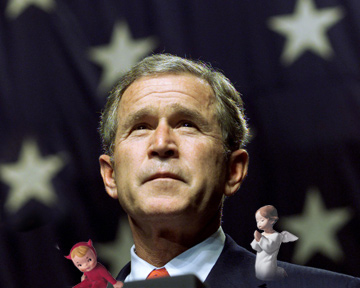

We all remember how many religious wars were fought for a religion of love and gentleness; how many bodies were burned alive with the genuinely kind intention of saving souls from the eternal fire of hell.
— Sir Karl Popper, twentieth-century British philosopher of science
One of the principal dangers of vesting power in a leader who is convinced of his own righteousness — who believes that, by virtue of his ascension to political power, he has been called to a crusade against Evil — is that the moral imperative driving the mission will justify any and all means used to achieve it. Those who have become convinced that they are waging an epic and all-consuming existential war against Evil cannot, by the very premises of their belief system, accept any limitations — moral, pragmatic, or otherwise — on the methods adopted to triumph in this battle.
Efforts to impose limits on waging war against Evil will themselves be seen as impediments to Good, if not as an attempt to aid and abet Evil. In a Manichean worldview, there is no imperative that can compete with the mission of defeating Evil. The primacy of that mandate is unchallengeable. Hence, there are no valid reasons for declaring off-limits any weapons that can be deployed in service of the war against Evil.
Equally operative in the Manichean worldview is the principle that those who are warriors for a universal Good cannot recognize that the particular means they employ in service of their mission may be immoral or even misguided. The very fact that the instruments they embrace are employed in service of their Manichean mission renders any such objections incoherent. How can an act undertaken in order to strengthen the side of Good, and to weaken the forces of Evil, ever be anything other than Good in itself? Thus, any act undertaken by a warrior of Good in service of the war against Evil is inherently moral for that reason alone.
It is from these premises that the most amoral or even most reprehensible outcomes can be — and often are — produced by political movements and political leaders grounded in universal moral certainties. Intoxicated by his own righteousness and therefore immune from doubt, the Manichean warrior becomes capable of acts of moral monstrousness that would be unthinkable in the absence of such unquestionable moral conviction. One who believes himself to be leading a supreme war against Evil on behalf of Good will be incapable of understanding any claims that he himself is acting immorally.
These principles illuminate a central, and tragic, paradox at the heart of the Bush presidency. The president who vowed to lead America in a moral crusade to win hearts and minds around the world has so inflamed anti-American sentiment that America’s moral standing in the world is at an all-time low. The president who vowed to defend the Good in the world from the forces of Evil has caused the United States to be held in deep contempt by large segments of virtually every country on every continent of the world, including large portions of nations with which the U.S. has historically been allied. The president who vowed to undertake a war in defense of American values and freedoms has presided over such radical departures from the defining values and liberties of this country that many Americans find their country and its government unrecognizable. And the president who vowed to lead the war for freedom and democracy has made torture, rendition, abductions, lawless detentions of even our own citizens, secret “black site” prisons, Abu Ghraib dog leashes, and orange Guantánamo jumpsuits the strange, new symbols of America around the world.
In sum, the great and tragic irony of the Bush presidency is that its morally convicted foundations have yielded some of the most morally grotesque acts and radical departures from American values in our country’s history. The president who insists that he is driven by a clear and compelling moral framework, in which the forces of Good and Evil battle toward a decisive resolution, has done more than almost any American in history to make the world question on which side of that battle this country is fighting. The more convinced President Bush and his followers become of the unchallengeable righteousness of their cause, the fewer limits they recognize. And America’s moral standing in the world, and our national character, continue to erode to previously unthinkable depths.
The Tools of the “Good”
In November 2006, the U.S. Congress enacted legislation, the Military Commissions Act of 2006, that vested in the president the power to order individuals (including legal residents of the United States) to be detained and imprisoned indefinitely without having been charged with any crimes or provided with a forum to prove their innocence. In reality, all of the powers granted by the Congress with that legislation were already being exercised by the Bush administration in the absence of legal authority. Ever since 9/11, and without any Congressional authorization, the president has asserted the power to imprison anyone without being charged with a crime and even with no ability to contact the outside world. And he has so imprisoned even U.S. citizens, including José Padilla and Yaser Esam Hamdi.
The power to order people detained and imprisoned based solely on accusation is one of the most extraordinary and tyrannical powers any political leader can hold. One of the core rights established against the British king by the Magna Carta in the thirteenth century was that the king could not order subjects imprisoned except upon a finding of guilt arrived at in accordance with legal process. The Military Commissions Act thus literally vested in President Bush — and in subsequent U.S. presidents — a power no British king has possessed since 1244. The founders of the United States thoroughly objected to such tyrannical power. Thomas Jefferson wrote in a 1789 letter to Thomas Paine, “I consider trial by jury as the only anchor ever yet imagined by man, by which a government can be held to the principles of its constitution.”
Beyond indefinite detentions, the Bush presidency has ushered in a host of practices that Americans have generally found to be unconscionable and that violate virtually every principle America has long endorsed. From admitted presidential lawbreaking, to the use of torture (or “rendering” our detainees to other countries for torture, including detainees we later admit were wholly innocent), to enlisting the resources of our foreign intelligence agencies (the NSA and CIA) to spy inside the U.S. and collect and maintain all sorts of personal data about American citizens, the Bush administration has seized and exercised powers that have long been anathema to what “America” has meant at its core.
The president has been able to engage in this conduct because the country collectively accepted the dualistic framework with which he views the world, whereby the goal of “protecting” ourselves from the “forces of Evil” outweighs every other consideration and justifies every means employed in service of this battle. When President Bush acts in the name of fighting The Terrorists, with the goal of battling Evil, what he does is by definition justifiable and Good because he is doing it.
This absolutist Manichean mind-set venerates physical safety above all else. When President Bush signed the Military Commissions Act into law in October 2006, he dismissed objections to its Draconian and tyrannical provisions with one very simple and straightforward argument (emphasis added):
Over the past few months the debate over this bill has been heated, and the questions raised can seem complex. Yet, with the distance of history, the questions will be narrowed and few: Did this generation of Americans take the threat seriously, and did we do what it takes to defeat that threat? Every member of Congress who voted for this bill has helped our nation rise to the task that history has given us.
That paragraph summarizes the Bush movement. Because the threat posed by The Evil Terrorists is so grave, maximizing protections against it is the paramount, overriding goal. No other value competes with that objective, nor can any other value limit our efforts to protect ourselves against The Terrorists.
That is the essence of virtually every argument Bush supporters make regarding terrorism. No matter what objection is raised to the never-ending expansions of executive power, no matter what competing values are touted (due process, the rule of law, the principles our country embodies, how we are perceived around the world), the response will always be that The Terrorists are waging war against us and our overarching priority — one that overrides all others — is to protect ourselves, to triumph over Evil. By definition, then, there can never be any good reason to oppose vesting powers in the government to protect us from The Terrorists because that goal outweighs all others.
But our entire system of government, from its inception, has been based upon a very different calculus — that is, that many things matter besides merely protecting ourselves against threats, and consequently, we are willing to accept risks, even potentially fatal ones, in order to secure those other values. From its founding, America has rejected the worldview of prioritizing physical safety above all else, as such a mentality leads to an impoverished and empty civic life. The premise of America is and always has been that imposing limitations on government power is necessary to secure liberty and avoid tyranny even if it means accepting an increased risk of death as a result. That is the foundational American value.
It is this courageous demand for core liberties even if such liberties provide less than maximum protection from physical risks that has made America bold, brave, and free. Societies driven exclusively or primarily by a fear of avoiding Evil, minimizing risks, and seeking above all else that our government “protects” us are not free. That is a path that inevitably leads to authoritarianism — an increasingly strong and empowered leader in whom the citizens vest ever-increasing faith and power in exchange for promises of safety. That is most assuredly not the historical ethos of the United States.
The Bill of Rights contains numerous limitations on government power, and many of them render us more vulnerable to threats. If there is a serial killer on the loose in a community, the police would be able to find and apprehend him much more easily if they could simply invade and search everyone’s homes at will and without warning. Nonetheless, the Fourth Amendment expressly prohibits the police from undertaking such searches. It requires both probable cause and a judicial warrant before police may do so, even though such limitations on state power will enable dangerous killers to elude capture.
Imagine George Bush present during pre-founding debates over the Constitution. Is there any doubt that he or Dick Cheney or Alberto Gonzales would have argued in opposition to proposed Fourth Amendment restrictions on police powers by stressing that violent criminals can kill our children, that we must do everything to protect ourselves against Evil, and that those who favor search warrant requirements for the police are “pro-murderer”? And surely the Constitutional Convention would have been subjected to this argument: “If you’re not doing anything wrong in your home, what do you have to hide from the police?”
Our country is centrally based upon the principle that we are willing to assume risks in order to limit government power. Numerous other amendments in the Bill of Rights are grounded in that same principle. And, of course, that is the central belief that drove the founders to risk death by waging war against the most powerful empire on earth. Objectives other than physical protection matter greatly. We have never been a country that ignores other objectives and asks only, as the president put it, did “Americans take the threat seriously, and did we do what it takes to defeat that threat?”
The president’s mind-set is utterly contrary to core American principles. Historically, the worst mistakes America has made — those instances in which it has departed most radically from its ideals — happened not when Americans failed to take seriously enough some Evil lurking in the world, but, to the contrary, they occurred when our government leaders exaggerated the threat of Evil and accordingly induced overreactions among citizens.
Historians will almost certainly ask about the Bush presidency: Did America adhere to its values and principles when defending itself against the threat posed by terrorism, or did it succumb to fear, overreaction, and violate its core beliefs in pursuit of illusions of maximum protection? As history professor Joseph Ellis wrote in 2006 in the New York Times:
My second question is this: What does history tell us about our earlier responses to traumatic events?
My list of precedents for the Patriot Act and government wiretapping of American citizens would include the Alien and Sedition Acts in 1798, which allowed the federal government to close newspapers and deport foreigners during the “quasi-war” with France; the denial of habeas corpus during the Civil War, which permitted the pre-emptive arrest of suspected Southern sympathizers; the Red Scare of 1919, which emboldened the attorney general to round up leftist critics in the wake of the Russian Revolution; the internment of Japanese-Americans during World War II, which was justified on the grounds that their ancestry made them potential threats to national security; the McCarthy scare of the early 1950’s, which used cold war anxieties to pursue a witch hunt against putative Communists in government, universities and the film industry.
In retrospect, none of these domestic responses to perceived national security threats looks justifiable. Every history textbook I know describes them as lamentable, excessive, even embarrassing. …
But it defies reason and experience to make Sept. 11 the defining influence on our foreign and domestic policy. History suggests that we have faced greater challenges and triumphed, and that overreaction is a greater danger than complacency [emphasis added].
The scare tactic of telling Americans that every desired expansion of government power is justified by the Evil Terrorist Threat — and that there is no need to worry because the president is Good and will use these powers only to protect us — is effective because it has immediate rhetorical appeal. Most people, especially when placed in fear of potentially fatal threats, are receptive to the argument that maximizing protection is the only thing that matters, and that no abstract concept (such as liberty, or freedom, or due process, or adhering to civilized norms) is worth risking one’s life by accepting heightened levels of vulnerability.
But nothing in life is perfectly safe. Perfect safety is an illusion. When pursued by an individual to the exclusion of all else, it creates a tragically worthless, paralyzed way of life. On the political level, safety as the paramount goal produces tyranny, causing people to vest as much power as possible in the government, without limits, in exchange for the promise of maximum protection.
All of this is independent of the fact that vesting ever-increasing and unchecked power in a political leader most assuredly does not make a country “safer.” Though it is beyond the ken of the discussion here, it is well-established that open governments with substantial checks and oversight operate far more efficiently than highly secretive, unchecked governments run by unaccountable political leaders. As the American founders well understood, transparent government is critical for detecting errors, uncovering corruption, and ensuring accountability, while political leaders who operate in the dark, wielding vast powers with little oversight, virtually always conceal their mistakes and act to maximize their own interests rather than the country’s.
For that reason, the most radical and controversial Bush policies — from warrantless eavesdropping to detentions, torture and rendition carried out in secret and with no oversight — have not made us remotely “safer.” But even if one assumes that they had, our core political values are profoundly betrayed by the notion that we should vest blind faith and tyrannical powers in the president in exchange for promises of “protection.” The central rhetorical premise of the Bush presidency, however, has been that eliminating all risk of the Evil Terrorist Threat is paramount. Hence, the whole array of authoritarian powers seized by this administration is justified because none of the principles and values that are destroyed in the process really matter when set next to the scary prospect that The Terrorists will kill us. In his 2004 acceptance speech at the Republican National Convention, the president described his all-consuming mission this way:
THE PRESIDENT: This election will also determine how America responds to the continuing danger of terrorism — and you know where I stand. (Applause.) … Since that day [9/11], I wake up every morning thinking about how to better protect our country. I will never relent in defending America, whatever it takes.
AUDIENCE: U-S-A! U-S-A! U-S-A!
This approach has radically transformed America’s national character and has led us to engage systematically and openly in behavior we previously scorned when engaged in by other nations. That is why the Bush legacy has left the U.S. with the burden and danger of rising anti-American sentiment. A superpower — especially the world’s only superpower — can be either respected and admired or despised and feared. Since the end of World War II, America — albeit with numerous exceptions — has largely chosen the former. America’s leadership in advocating and defending universally applicable principles did not weaken it, nor did our efforts to avoid war make us appear “weak.” Quite the contrary. America’s strength has been grounded in the legitimacy and moral credibility of its power.
But with his monomaniacal obsession with annihilating perceived Evil, the president has squandered virtually all of the goodwill and respect that the United States built up in the last century. Accurately or not, large numbers of people around the world, on virtually every continent, now perceive the United States as a threat to peace. As they watched us invade and relentlessly bomb Iraq, a country that had not attacked us, and as we threaten still more countries with invasion, citizens around the world — including many of our own allies whose citizens had previously admired America — have come to view our country as a source of instability and aggression. Eight years is a long time, and millions and millions of young adults around the world have formed their perceptions of “America” based on its actions during the Bush presidency.
What is “Good” and what is “Evil” are not determined by some preordained or intrinsic distinction. Those are designations determined only by one’s conduct. America has always touted its principles as the source of its moral credibility in the world. But once those principles are relinquished and violated, America’s moral credibility and its legitimate claim to “Good” cease to exist.
Reprinted by permission of Glenn Greenwald/Crown Publishers. All rights reserved.
