Bill Richardson

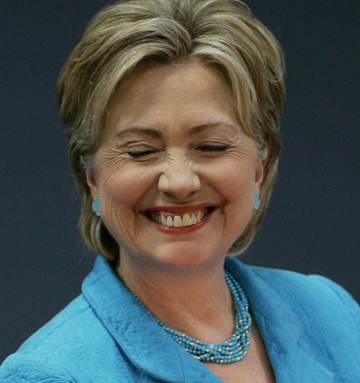
Cheerful boos for Hillary

At the YearlyKos convention, the mixed reception for Hillary Clinton is more evidence that the liberal blogosphere might not take sides in the coming Democratic primary.

The most self-controlled figure in Democratic politics, Hillary Clinton, seemed to know from the outset that she was walking into a trap. The cavernous ballroom of the Hyatt Regency was filled with about 1,500 liberal bloggers and activists — the so-called Kossacks, the former Deaniacs, the people-powered Joe Lieberman-bashers who helped reshape the Democratic Party for the 21st century. So when the loud boos finally arrived, a full hour into the Democratic presidential debate at the second annual YearlyKos convention Saturday, and two hours after her arrival at the convention, all she could do was smile. “I’ve been waiting for this,” she told the crowd. “This gives us a real sense of reality with my being here.”

Then something happened: The crowd started to laugh. Then it cheered. Then the cheering grew even louder than the booing. Up to that moment, the debate audience had been voicing their disapproval of Clinton for defending Washington lobbyists, whom she allows to contribute money to her campaign unlike her top two rivals, Barack Obama and John Edwards. “A lot of those lobbyists, whether you like it or not, represent real Americans,” she told them. But now they were voicing their approval, and not because they suddenly agreed with her. Any poll of YearlyKos attendees would almost certainly place lobbyists in a circle of hell just a step or two outside the ones reserved for Attorney General Alberto Gonzales, Fox News talker Bill O’Reilly and Vice President Dick Cheney.

They were cheering because Clinton had, in her way, acknowledged the views and the legitimacy of the blogging community. This had been her mission from the moment she arrived in Chicago. “Don’t tell anybody, but I actually read the blogs,” she had joked about an hour before the debate, during a breakout session with hundreds of bloggers and activists. “Don’t share that.” It was a modest step, to be sure, but it was pitch perfect given the current state of the liberal online community.

The so-called netroots is undergoing a transition of sorts in the wake of the 2006 Democratic victories, when the party leadership effectively adopted the message and tactics of mostly liberal online insurgents. For the first time since the invasion of Iraq, Democrats spoke with a muscular voice against Republican rule and the misbegotten war overseas. Two Senate candidates who garnered early online support, Jim Webb in Virginia and John Tester in Montana, won upset elections that changed control of the legislative branch. The community’s chief punching bag, Connecticut Sen. Joe Lieberman, was forced to leave the party. Now, with the most costly Democratic presidential primary in U.S. history on the horizon, the same blogging community finds itself in uncharted territory. Once the outsiders, the lefty bloggers and readers who gather each day online have now become an unmistakable part of the Democratic family. Every presidential candidate, save Delaware Sen. Joe Biden, attended Saturday’s YearlyKos debate in Chicago. Democratic Party leader Howard Dean gave a rousing keynote address to the convention Thursday. Illinois Sen. Dick Durbin delivered a video message to the opening day crowd. He declared, “If it weren’t for the progressive netroots, I wouldn’t be assistant majority leader.”

At the same time, much of the frustration that once led Democratic bloggers to wage fierce intraparty battles appears to have dissipated. In its place is a sort of cautious elation at the direction of the country’s politics, especially when the topic shifts to the coming presidential election and the Democratic candidates. “I feel no compulsion to pick anybody,” confessed Markos Moulitsas Zuniga, the proprietor of DailyKos, the largest liberal blogging community, “because they are all so great.”

His broad confidence papered over the many substantive differences that divide the Democratic primary field. Clinton and Obama, for example, appear prepared to leave residual U.S. military forces in Iraq for perhaps years, while Edwards and Bill Richardson seek a more prompt withdrawal. Edwards believes the “global war on terror” is an empty “bumper sticker” phrase, while Clinton embraces its rhetorical value and maintains that America is safer now than it was on Sept. 11, 2001. Obama harps exhaustively on Clinton and Edwards for their initial support of a resolution allowing the Iraq war, which he opposed. He has also recently announced his willingness to preemptively attack Pakistan as part of the effort against al-Qaida. All of the candidates have announced, or will announce, different approaches to establishing universal healthcare.

But with only rare exception, these differences have not become flash points on the liberal blogs, a marked contrast to 2003, when the nascent blogosphere heartily rallied behind a single candidate, Howard Dean, in the primary. Even some of the netroots founding members have begun to take notice. “The bloggers are I think in many ways taking themselves out of the debate by not participating in it,” explained Jerome Armstrong, the proprietor of MyDD.com, who co-wrote a book with Moulitsas on Democratic blogging. “They are becoming sort of conflict avoiders in the primary.”

A recent unscientific poll of DailyKos readers confirmed that Clinton had much less support on the site than among Democrats generally, with Obama and Edwards leading the pack. But during Clinton’s breakout session with bloggers Saturday, she was not asked a single question about her vote to authorize the Iraq war or her plans for withdrawing troops. The questions, instead, had all the noncombative flair of an upstate New Hampshire town hall meeting. What would she do about education reform? What did she think about welfare reform and gays in the military? How would her attorney general be different from Gonzales? “I think it would be a breath of fresh air to have an attorney general who actually believed in the rule of law,” Clinton said, earning immediate cheers.

Last summer, when YearlyKos met in Las Vegas for its inaugural convention, such harmony was difficult to imagine. Prospective presidential candidates seemed desperate to ply bloggers with drink and attention. Wesley Clark threw a riotous party for bloggers at the Hard Rock Casino, while former Virginia Gov. Mark Warner spent around $50,000 to entertain bloggers with a John Belushi impersonator and a chocolate fondue waterfall at the top of the Stratosphere casino. At the time, all the buzz was about which candidate could win over the blogs. Even Moulitsas got caught up in the frenzy, comparing the Warner party to a “first date.”

A year later, it is hard to see how any single Democratic candidate emerges before the primary as the prohibitive choice of liberal bloggers. Instead the various campaigns are fighting a battle of margins. Not a single candidate or campaign threw a party at this year’s conference. “There is just not critical mass moving to one candidate right now,” said Joe Trippi, the former Dean campaign manager who is now overseeing the Edwards campaign. “Every campaign has been competing like crazy for every inch they can get on the Internet and the blogosphere.”

Another prominent blogger, Matt Stoller, who recently co-founded OpenLeft.com, described what was happening to progressive blogs as a temporary loss of liberal momentum. “People feel confused,” he said. “Because that’s what happens to a movement that hopes if you get Democrats elected it will solve some of our problems, and then our problems aren’t solved.” He predicted that the blogs will again find their voice on intraparty matters once it becomes clear that the current crop of presidential candidates do not sufficiently represent the liberal cause on everything from telecommunications laws to military withdrawal from Iraq.

But the collective neutrality only goes so far. Even if most bloggers decide to sit out the primary, there is little doubt that they will be back with a vengeance to show their Democratic stripes once a nominee is chosen. The only candidate who was booed louder than Clinton at Saturday’s presidential debate was the unlikely left-winger Dennis Kucinich. He made the mistake of aping one-time presidential candidate Ralph Nader, who regularly attacked the Democratic leadership as a bunch of sellouts. “Why don’t people vote?” Kucinich asked, rhetorically. “It’s because they don’t think there is much of a difference between the two parties.”

The booing immediately drowned Kucinich out. He had committed a cardinal sin, demeaning the Democratic Party before a crowd that works countless unpaid hours a week to make the party stronger. He had also provided, inadvertently, another reason for Clinton to smile. The YearlyKos community may not be her most natural constituency, but it is also unlikely to be her enemy. All she has to do is keep showing it respect.

Michael Scherer is Salon's Washington correspondent. Read his other articles here.

Richardson — not charged, but not exonerated

A U.S. attorney pours cold water on the New Mexico governor's celebration

The cloud that’s been hanging over New Mexico Gov. Bill Richardson recently, and cost him his shot at being Commerce secretary, appeared to be lifted yesterday. That’s when the Associated Press broke the news that Richardson won’t face charges stemming from a federal probe of pay-to-play allegations. Now, the cloud is back.

On Thursday, a Richardson spokesman, Gilbert Gallegos, took a little victory lap, saying in a statement that the governor is “gratified that this yearlong investigation has ended with the vindication of his administration.”

That’s not the way the U.S. attorney sees it, though. Greg Fouratt sent a letter to defense attorneys, the AP reports, in which he said the fact that no charges were filed “is not to be interpreted as an exoneration of any party’s conduct.” He also said the investigation “revealed that pressure from the governor’s office resulted in the corruption of the procurement process.”

It’s not great form for a prosecutor to be talking guilt out of court when there weren’t even any indictments, but that’s not likely to matter politically. Rather than being able to go on from here free and clear, Richardson will have to deal with that letter hanging around his neck for some time.

In another statement, this one released Friday, Gallegos said Fouratt’s letter “is wrong on the facts and appears to be nothing more than sour grapes.”

Continue Reading Close

Alex Koppelman is a staff writer for Salon.

Richardson won’t face charges in federal probe

The New Mexico governor was part of an investigation into a pay-to-play scheme

New Mexico Gov. Bill Richardson appears to have successfully weathered the federal investigation that cost him a spot as secretary of Commerce. The Associated Press reports that Richardson and former top aides will not be charged in the investigation, which was looking into an alleged pay-for-play scheme.

Decisions about charging high-ranking political figures are generally made in consultation with main Justice back in Washington, D.C., which typically has final say. That appears to be what happened here, as the AP reports the decision “was made by top Justice Department officials.” The AP’s source doesn’t appear to be happy about it, saying, “It’s over. There’s nothing. It was killed in Washington.”

Alex Koppelman is a staff writer for Salon.

Bill Clinton to the rescue

The former president's trip may be successful in securing the release of two American journalists

Update: Clinton’s mission was successful, and Kim Jong Il has pardoned the two journalists. See this post for more.

In a surprise visit, former President Bill Clinton arrived Tuesday in Pyongyang, North Korea, to meet with the isolated nation’s leader, Kim Jong Il. While North Korea’s nuclear program and recent spate of missile tests have caused growing consternation around the world, the main purpose of Clinton’s trip was to negotiate for the release of two U.S. journalists currently imprisoned there.

ABC News is now reporting that Clinton also met with the jailed reporters, Laura Ling and Euna Lee. A government source described the meeting as highly emotional but told ABC that those on Clinton’s team in North Korea are hopeful the journalists could be released as early as tomorrow.

Clinton has a loose connection to the jailed reporters. Both work for Current TV, a news and media venture headed by Clinton’s former vice-president, Al Gore. Ling and Lee were arrested on the border between North Korea and China in March. In June, they were sentenced to 12 years of hard labor for what North Korea said was their illegal entry into the country, as well as engaging in undefined actions deemed hostile to the communist country.

The White House has thus far remained reserved when discussing Clinton’s trip. North Korean media said Clinton shared a message from President Obama, but White House Press Secretary Robert Gibbs released a statement in which he said, “While this solely private mission to secure the release of the two Americans is on the ground, we will have no comment … We do not want to jeopardize the success of former President Clinton’s mission.”

However, Sen. Lindsey Graham, R-S.C., seemed somewhat confused by the decision to send Clinton. On the “Today” show this morning, he said of Clinton’s visit that “I don’t know what this is,” though he expressed hope that the visit could lead to progress on limiting North Korea’s nuclear arsenal.


There is a long history in the U.S. of notable political emissaries traveling across the globe to try to free hostages.

Perhaps the most memorable diplomatic mission was the Rev. Jesse Jackson’s 1999 trip to Belgrade to ask for the release of three U.S. soldiers held as prisoners of war by then Yugoslav president (and war criminal) Slobodan Milosevic. The trip was controversial because Jackson made the journey without the blessing of the Clinton White House. That he actually convinced Milosevic to release the soldiers after the Clinton administration had been unable to do so made Jackson’s fame as a hostage-release negotiator grow. The civil rights leader has worked as a diplomat in similar circumstances numerous times over his career: He was able to get hostages released from Syria in 1984, from Cuba in 1987 and from Kuwait and Iraq in 1990 — all without official presidential or congressional approval.

New Mexico Gov. Bill Richardson, who had been discussed as a possible liaison to negotiate the return of Lee and Ling, brokered the release of U.S. hostages from North Korea in the 1990s. Richardson has also helped secure the release of hostages from Iraq, Cuba and Sudan and most recently met with Venezuelan President Hugo Chavez to seek his support in getting a Colombian Marxist guerrilla group to release three U.S. contractors they’ve detained since 2003. Colombian commandos eventually freed the hostages, along with Ingrid Betancourt, in June 2008.

And in one of the most embarrassing hostage situations the U.S. ever faced, President Jimmy Carter proved unable to negotiate with Iran for the release of 52 Americans held after the overthrow of the shah during the Iranian revolution. A daring military operation to free the hostages also failed. Iran eventually released the hostages once President Ronald Reagan took office. Later in his presidency, Reagan suffered a major political scandal when it was revealed that his administration had sold arms to Iran in an attempt to gain the release of seven American hostages being held in Lebanon by Iranian terrorists.

Continue Reading Close

Vincent Rossmeier is an editorial assistant at Salon.

Will third time be the charm at Commerce?

Former Washington Gov. Gary Locke is reportedly President Obama's new choice to head the department.

President Obama struck out with his first two picks for Commerce secretary, as both New Mexico Gov. Bill Richardson and Sen. Judd Gregg (R-N.H.) withdrew their nominations for the post. Now, he’s reportedly hoping to do better with a fairly obscure choice — former Washington Gov. Gary Locke.

Locke, who left in office in 2005, served two terms and opted not to run for a third; he was the first Chinese-American governor in U.S. history.

Alex Koppelman is a staff writer for Salon.

Richardson speaks

The New Mexico governor explains his decision to drop out of the running to be commerce secretary, and says his political career isn't over.

One day after the sudden announcement that New Mexico Gov. Bill Richardson’s nomination to be commerce secretary was being withdrawn, Richardson offered additional details during a press conference. It did not go off without a hitch.

Richardson maintained that the decision to withdraw was his, and said he came to make that choice because an investigation into state contracts given to CDR Financial Products Inc., whose president is a Richardson donor, had gone on longer than he expected it to — he’d hoped it would be done in December, removing the cloud from over his head before confirmation hearings were to begin. The governor said, as he had in a statement on Sunday, that the country couldn’t afford any delay in confirming a new head for the department. “Sometimes your own dreams and plans must take a back seat to what is best for the nation,” he told reporters.

Still, Richardson made clear that he doesn’t believe this is the end of his political career. Referencing a statement from Barack Obama in which the president-elect said he “look[s] forward to his future service to our country and in my administration,” Richardson said, “I still believe I have a future in public service.”

There was one odd note Monday afternoon. When one reporter asked Richardson — who’d previously said he would not take any questions related to the CDR investigation — whether he had a lawyer, the governor responded, brusquely, “I am not getting into any more questions,” and the press conference was over.

Continue Reading Close

Alex Koppelman is a staff writer for Salon.

Page 1 of 12 in Bill Richardson