
Bruce Springsteen

The 9/11 backlash against women

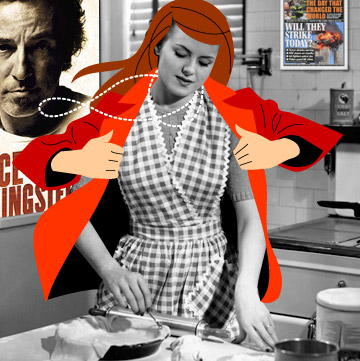
Terror swept women back into the kitchen, argues Susan Faludi, and tore open the worst scar in American history. But it's Bruce Springsteen who makes the fear so real.

  • more
    • All Share Services

The 9/11 backlash against women

It may be pop culture heresy to rope together Susan Faludi‘s new book, “The Terror Dream,” and Bruce Springsteen‘s new album, “Magic,” both released this week. Faludi, author of 1991′s “Backlash,” is a diligent chronicler of the country’s gender problems. Springsteen is a swaggering blue-collar cult hero whose critical thinking about American culture has made him an international rock star. Yet there is a neat perfection in the pairing of these two uniquely American storytellers, as if Mars and Venus had conveniently weighed in simultaneously, after six years of consideration, on what exactly has unfolded in this country, with which they are each so critically obsessed, in the wake of the terrorist attacks of Sept. 11, 2001.

Springsteen, of course, has already made one contribution to the national artistic accounting of 9/11 with “The Rising,” his 2002 album that Faludi might crankily write off (as she does movies like “United 93″ and “World Trade Center”) as a piece of art that “seemed to have no purpose but to repeat what we already knew.” On it, Springsteen gave voice to those whose lives had been damaged by 9/11: a firefighter who died, one who survived, widows both American and Arab. Five years later, he and Faludi are on related missions: to step back from the firsthand experience of events and attempt to pick out the patterns in all that’s gone down since.

Faludi is characteristically grim in her reading of the country’s tea leaves; she is unsurprised to report that the cultural signifiers are, as always, oppressive. Springsteen’s music has always been buoyed by American symbolism; he’s never been shocked by its misuse, but on this record, his grief and anger over its twisted meanings are palpable. Both “The Terror Dream” and “Magic” employ images of surrealist dread to describe the post-9/11 manipulation — by media and politicians — that has left us warped and brainwashed, and both deploy terrifying visions to make their points. On the title track and throughout his record, Springsteen describes the creepy carnival tricksterism of the Bush administration and the sinuous ways it has distorted his vision of America, while Faludi sees a vast national conspiracy to put women back in the kitchen and alpha males like John Wayne (or perhaps Bruce Springsteen) back in their lost positions of power.

Before she can pursue the big picture, Faludi must start where everyone else in America did: her personal experience of Sept. 11. There is her prophetic dream on the night of Sept. 10, in which she is shot while on a plane, a bullet lodged in her throat; she wakes only to discover that the world is under attack. Before the end of the day she has received the phone call that provides her book with its foundation myth: A reporter asks for her reaction to the tragedies, crowing to Faludi, “Well, this sure pushes feminism off the map!”

Not 24 hours out, and Faludi has been handed the key to how this plot will unfold: To her mind, Sept. 11 will give the nation, uneasy with the strides made by women in the decades leading up to the attacks, an excuse to stuff them back into traditional boxes. That first gleeful caller is soon joined by others, all anxious to know how quickly women will abandon their corner offices and get back to tweaking their meatloaf recipes.

Apparently, Faludi has spent the past six years writing down the license plate number of every drive-by offense against gender parity, and the first two-thirds of “The Terror Dream” is her obsessive catalog — a simply staggering one.

There are the media stories promoting a never-realized post-9/11 baby boom and the “return of the cowboy/superhero” trend pieces. Here are the fawning portrayals of the macho Bush administration (she’s looking at you, Graydon Carter), the newscasters heralding the death of the “girly-man,” the breezily patronizing “We’re at War, Sweetheart” headlines.

You’d almost forgotten the feeling of impotence provoked by 9/11? Faludi hasn’t. Here’s her recounting of the people lined up at the blood banks with no one to give blood to, the police faking “live saves” to cheer up rescue dogs on the pile, because even the canines were depressed. There’s the adoration of the firefighters and of the “Let’s Roll!” male heroes of Flight 93 — remembered always for their college sports achievements and their regular-guy toughness — while the stewardesses who boiled water to throw on the terrorists were written out of the myth.

Just when you think there can’t be more, Faludi concludes Chapter 3 by asking, “If women were ineligible for hero status, for what would they be celebrated?” Well, see Chapter 4: “Perfect Virgins of Grief.” From here on out you’ll find the victimization of Jessica Lynch, and the tale of how widows — especially stay-at-home-mom widows, and especially widows who were pregnant — became the golden geese of the morning shows. She recalls articles about how lonely all those haughty, self-satisfied single career women were now that we’d been attacked by terrorists and they had no one to snuggle up with at night; the Bush administration’s phony interest in women’s rights in the Middle East; makeup tips on how to look like a pale, pure angel; the decrease in female bylines; the nesting obsession.

All the most shoot-yourself-now memories of 2001 (and 2002 and 2003 and 2004 …) collected in one long slog through the jingoism and overreaching proclamations made by anyone with a voice box. Each chapter makes you want to bang your head against the wall harder in the hopes that you may lose consciousness and forget all this stuff again.

It’s a complaint that has been lodged against Faludi before: that she’s a cherry-picker, rounding up the juiciest anecdotes that suit her argument and leaving the rest to languish. On the other hand: What a bumper crop of cherries! Like the MensAction.com blog entry about how “the phallic symbol of America has been cut off … and at its base was a large smoldering vagina, the true symbol of the American culture.” Oh. My. God. How about Frank McCourt’s turgid ode to firemen: “They man a hose that could be a wild animal … They hack and smash and isolate and drown that other wild animal, the old god fire.”

Faludi faithfully records the outrageous assaults against female critics like Susan Sontag, Arundhati Roy, Barbara Kingsolver and Katha Pollitt, who dared to consider America’s role in the attacks or express ambivalence about the ensuing patriotism. “Pollitt, honey, it’s time to take your brain to the dry cleaners,” went one headline, while the New York Post’s Rod Dreher expressed his wish to “walk barefoot on broken glass across the Brooklyn Bridge, up to that despicable woman’s [Sontag's] apartment, grab her by the neck, [and] drag her down to ground zero.”

She more than makes her point: 9/11 unleashed a torrent of pent-up rage against women and feminism. Kingsolver tells Faludi that while the accusations hurled at her and her peers were meant to be infantilizing and patronizing, “if we were so silly and moronic, why was it so important to bring us up and attack us again and again and again? The response was not the response you would expect toward a child. It was more like we were witches.” Post-feminist women had become scary, and the fury directed at them was symptomatic not simply of relief at returning them to the domestic sphere, but of the fear that they might not be willingly contained.

This collection of media moments is an invaluable document. And yet. One can’t help thinking that, as in an ugly fight between lovers, some of the things that were said in the heat of the moment — about the goodness of Rudy Giuliani; about how the attacks were retribution against the pagans, abortionists, feminists and gays; about “the end of irony” — are better left unpacked, because if we dredged them up again, we might never get past them.

And yet, I want to thank Faludi for going to the library while the rest of us gave in to baser instincts, drank a six-pack and passed out. I want to thank her for adding it all up and making shape and sense out of six years of history. When she writes about how the attacks provoked “the denigration of capable women, the magnification of manly men, the heightened call for domesticity, the search for and sanctification of helpless girls,” it’s almost a relief: Of course! I knew there had to be an explanation! This must also have led to the fetishization of parenting, the mommy wars, the obsession with celebrity baby bumps, and stupidly expensive baby strollers! Wheee! Thank you, Susan Faludi, for drawing the map!

Except that she hasn’t. She doesn’t really get to any of those things. In fact, while she has pulled through a critical thread, “The Terror Dream” does not show the full tapestry of post-9/11 gender relations.

There are oddly blank spaces in her argument. In her estimable effort to diagnose the toxicity of attitudes toward women, she eliminates events that do not fit her argument, and thus fails to tell the whole story. In the discussion of the big-dicked alpha-male Bush administration, why doesn’t Faludi examine the roles of Karen Hughes and Condoleezza Rice and Harriet Miers? Hughes is brought up when she quits to spend more time with her family — a move that supports Faludi’s argument and merits consideration. But why not complicate the issue by exploring why, exactly, the Mr. Guns Blazing president has put more women in positions of power than any chief executive before him? Faludi’s argument is strong enough to withstand complexity. That she rarely acknowledges it only serves to weaken her claims.

Faludi devotes part of the book to tallying the diminished number of female bylines in papers, the paltry number of girl guests on TV. She’s not the first to do this, and she’s not wrong. “The silencing of women took place largely in silence,” she writes dramatically at the conclusion of her passage on the media.

Eh. Sure. For a while. But in the years Faludi is describing, Jill Abramson ascended to the top of the New York Times masthead and Katie Couric took over the nightly news, albeit to ill effect. Why not explore the unearthing of feminism as a beat by young women like Ariel Levy at New York magazine, Sheelah Kolhatkar, formerly of the New York Observer, by Meghan O’Rourke at Slate, Jessica Valenti at Feministing, and by several of us here at Salon? Levy is mentioned in “The Terror Dream,” but only as a cog in New York magazine’s dastardly scheme to tell free-loving New York women they should be getting married; Faludi does not credit her for writing one of the better-received feminist books of the past decade, “Female Chauvinist Pigs.” What about Linda Hirshman’s “Get to Work” or Leslie Bennetts’ “The Feminine Mistake”? It’s not as though these women are working in echo chambers: Levy was on “Oprah”; she, Valenti and Linda Hirshman have all appeared on “Stephen Colbert” … To talk about feminism! … On television!

None of these developments make Faludi’s argument less true: There was, and is, a paucity of women in major newspapers, magazines and political blogs, and on the talk shows. But it is possible to make that point while also acknowledging a simultaneous increase of women, besides Faludi, who are rattling the chains and getting heard.

Can a book that alleges that the United States reembraced a John Wayne model of male leadership post-9/11 really only contain three references to the woman who may be the first major-party female candidate for president? What about the first female president of Harvard, the first female speaker of the House?

The first two-thirds of “The Terror Dream” offers a compendium of the offenses against gender civility without extending itself to contemplate how they have evolved and what they have come to mean now, in 2007. Faludi lays it all out, gets the reader good and riled, and then … nothing.

That’s because she is far less interested in the present or the future than she is in the past. Her real thesis (more complicated than “9/11 pushed us back into traditional roles”) is laid out in the preface, but does not get fully realized until the book’s bizarre structure becomes apparent. Her central idea is that Ernst Haeckel’s hypothesis that “ontogeny recapitulates phylogeny” — or, as Faludi translates for us, that the development of an embryo repeats in compressed form the evolutionary stages of its species — can be applied to American history.

Faludi wants to show how “the way we act, say, in response to a crisis can recapitulate in quick time the centuries-long evolution of our character as a society and of the mythologies we live by.” But because Faludi does the recapitulation part — the reactions to Sept. 11 — before she gets to the evolution part more than halfway through the book, her point gets muddied, and readers may wonder, upon beginning the final section, whether they walked into a graduate thesis on America’s founding conflicts.

It’s a pity, because this last section — the phylogeny — is brilliant and exhilarating. Faludi examines with great gusto the popular captivity narratives of 18th and 19th century America, including those of Mary Rowlandson and Cynthia Ann Parker. The stories themselves are fascinating, like that of Hannah Duston, captured in 1697 by Abenaki Indians, five days after having given birth to her 12th child. Before her captors could take her to Canada, Duston took a hatchet to them (two men, two women, six children) and escaped, only to return to collect their scalps. This bravery earned her the attention of that famously easygoing Massachusetts Bay preacher Cotton Mather, who was concerned that nice, passive women might get the wrong idea about their own self-sufficiency from Duston’s story.

Faludi’s point is that our behaviors in the wake of the supposedly unprecedented terrorist attacks on Sept. 11 were in fact practically written into our national DNA. “Our foundational drama as a society was apposite, a profound exposure to just such assaults, murderous homeland incursions by dark-skinned, non-Christian combatants under the flag of no recognized nation,” she writes. “September 11 was aimed at our cultural solar plexus precisely because it was an ‘unthinkable’ occurrence for a nation that once could think of little else. It was not, in fact, an inconceivable event; it was the characteristic and formative American ordeal, the primal injury of which we could not speak, the shard of memory stuck in our throats. Our ancestors had already found a war on terror, a very long war, and we have lived with its scars ever since.”

This argument is fluid and thrilling to read. It just should have been its own book, perhaps with Faludi’s collected contemporary gripes appended as evidence of how in the narratives of the country’s founding we can find the dental records of nearly every one of our modern impulses to contain femininity.

Faludi leaves us with a list of kidnappings and witch hunts that provide a fascinating tableau against which we are free to measure — without much direct guidance from her — our modern gender impulses. But again, the book feels unfinished, the work of connecting the dots left to the reader; Faludi has laid down a good strong drumbeat, but little melody to carry us through.

Which brings us back to Bruce Springsteen, whose album catalogs the very stuff that “The Terror Dream” is concerned with: Here is the cowboy George Bush, showing up ’round sundown on Election Day, “boot heels clicking like the barrel of a pistol spinning round” in “Livin’ in the Future.” There is the image of perfect, angelic femininity in a barmaid ’round whose hair the sun lifts a halo. Where Faludi has prophetic nightmares, Springsteen imagines, in the title track, a world in which bodies hang from trees in a tableau of post-Katrina racial horror.

I’m not sure that one line from Springsteen’s song “Devil’s Arcade” wasn’t actually written by Faludi: “You said heroes are needed, so heroes get made,” and that the two of them aren’t making identical points about the manipulative power of terror when Springsteen’s magician in “Magic” evilly cajoles, “Leave everything you know/ Carry only what you fear.”

In Faludi’s concluding chapter, “What If?” she takes a stab at hope, wondering, “What if the nation had responded to 9/11 differently? What if we hadn’t retreated into platitudes and compensatory fictions? What if we had taken the attack as an occasion to ‘confront the truth’?” Or, as Springsteen puts it in “Livin’ in the Future,” a song in which he retroactively reimagines Election Day: “Don’t worry, darlin’, now baby don’t you fret/ We’re livin’ in the future and none of this has happened yet.”

Both Faludi and Springsteen have always specialized in seeing the personal in the political and vice versa. Faludi tends to see dysfunction, in ways that have been exceedingly useful in the past, as they are here. Her failure this time is in her refusal to acknowledge the upside. Springsteen, of course, has always been a hope peddler, if not an optimist. Laced throughout both these texts are frustration, bewilderment, a desire to shake the country by its shoulders. With Faludi, the sense is that none of this comes as a surprise, she is just Charlie Brown kicking the football, only to have it yanked out from under her by a country that is still, yup, sexist. So it was written by Cotton Mather, so it will be post 9/11.

For Springsteen, the realization that “this is what will be” is both more startling and more painful. He is, like Walt Whitman before him, pained at the vision of his beloved nation torn asunder.

Both writers are furious. And I sort of want to tell them: Have a little faith. But maybe this is a moment in which there is little to believe in, and a lot to fear.

Rebecca Traister

Rebecca Traister writes for Salon. She is the author of "Big Girls Don't Cry: The Election that Changed Everything for American Women" (Free Press). Follow @rtraister on Twitter.

Born in the U.S.A.: When the president met the Boss

Bruce Springsteen's politics were unformed in the '80s. When Ronald Reagan invoked his name, that changed fast

  • more
    • All Share Services

Born in the U.S.A.: When the president met the BossBruce Springsteen (Credit: AP)
Excerpted from "Bruce Springsteen and the Promise of Rock ‘n’ Roll" by Marc Dolan. Copyright © 2012 by Marc Dolan. With the permission of the publisher, W.W. Norton & Company, Inc.

In the same week that “The River” hit No. 1, in a seemingly unrelated event, Gov. Ronald Reagan of California was elected the 40th president of the United States, garnering a whopping 489 Electoral College votes, while incumbent Jimmy Carter received a mere 49. During the last days of the campaign, Bruce Springsteen and the E Street Band were on tour, of course, still promoting the month-old “River,” but they had election night off. The next night, on November 5, they played a concert at Arizona State University in Tempe that was virtually identical to the one they had played in Los Angeles the previous Thursday — except that it was longer. “All you guys in the aisle find your seats, OK?” Bruce announced three songs in. “There’s gonna be a real long show.”

That night Springsteen rambled, more than usual. Before the postindustrial triptych of “Independence Day,” “Factory” and “Jackson Cage” midway through the first set, he began a long monologue, although not about his father, whom he frequently talked about before “Factory.” Instead, Springsteen used this opportunity to talk about his love of pop music, about what it had meant to him growing up. Spontaneously, falteringly, he offered the most coherent argument he would ever make for the essential unity of the two distinct compositional strains that had flowed into “The River,” its idealistic and pessimistic “hearts”:

I never did good in school, never did good, and they always figured that if you’re not smart in school, it’s because you’re dumb. But I always felt that I never really learned anything, or learned anything that was important to me, till I started listening to the radio back in the early ’60s. And it seemed that the stuff that I was hearing off the radio in all those great songs was stuff that if they knew how, they’d be trying to teach you in school … but they just didn’t know how to. They always talked to your head, they could never figure out how to talk to your heart, you know. And it seems that, like all those singers and all those groups, there’s one thing that they just knew: what it was about. And when I started listening, I found out that the first time … that, instead of the fantasies that you have when you’re a little kid, I had dreams now and that they were different, it was different, and that if that was possible, that I didn’t have to live my life the way that I was, that things could be better. If you just go out, take a chance, find out what’s going on …

It was only toward the end of the first set in Tempe that Springsteen finally addressed the election. “I don’t know what you guys think about what happened last night,” he said as a transition between “The River” and “Badlands,” “but I think it’s pretty frightening. You guys are young, there’s gonna be a lot of people depending on you coming up, so this is for you.” When you listen to recordings of this concert, during this speech you hear scattered cheers from the crowd, but nowhere near as strong as when Springsteen actually started the next song.

Springsteen’s comments before “Badlands” in Tempe that night were virtually the first recorded statement he ever made about politics. At the MUSE concerts a year earlier, he was practically the most apolitical performer on the stage. He had played a small acoustic benefit for George McGovern’s campaign at the Red Bank Drive-In in 1972, but there is no other record of his ever endorsing a political candidate up to this point, or even expressing displeasure with one as he did in the wake of Reagan’s election. In subsequent interviews, he would admit that he had maybe voted once, but no more than that. Like the draft or Kent State, politics was something that happened outside of his life, to his life, while he was trying to make his dreams come true. And he was obviously not the only American who viewed politics that way, especially not in the fall of 1980. Ronald Reagan’s victory, much closer in the popular vote than in the Electoral College, reflected the will of about a quarter of the electorate; only a little more than half of those eligible to vote had done so that year. Like Bruce Springsteen, many other Americans at that point in our history were essentially apolitical.

But there’s a subtle difference between politics and ideology, between elected officials and the policies they enact on the one hand and the underlying principles that cause people to trust or distrust politicians on the other. You can live your life without ever having an opinion on any elected official or legislative body, but you cannot live your life as an adult without having some notion of what a better world would look like. In the late 1970s, as the two dominant political parties in the United States reacted to contemporary economic crises by dissolving into ever greater procedural disarray, such utopian visions of what might work better suddenly became far more important. In 1979, however, only the college professors called this “ideology.” The word that both First Lady Rosalynn Carter and the Reverend Jerry Falwell of the Thomas Road Baptist Church started using that year was “values.”

In 1979 and 1980, as Bruce Springsteen crafted “The River” and began touring to support it, his politics were virtually nonexistent, but his ideology — his “values,” if you must — was all over his songs. Springsteen believed in “freedom,” in as vague a sense as any American would define it, in the freedom to head out where you wanted when you wanted with whomever you wanted with no bossman or exaggerated patriarch telling you what to do. On Springsteen’s first four albums, his ideal world was the road, the way to the next great place but not necessarily the place itself, because all fixed places had the potential to trap you. In Springsteen’s songs, success was seldom material success (no matter how much the singer might want it in real life). In most cases, the success his characters dreamed of or attained was mere survival, making their stand in an environment that was constantly trying to grind them down.

Half of “The River” reinforced this view, not only such “Darkness” survivors as “Sherry Darling” and “Independence Day” but such newer songs as “Ramrod,” “Jackson Cage,” “Out in the Street” and “Cadillac Ranch” as well. There were also all the new songs about connection (“I Wanna Marry You,” “Fade Away,” “Stolen Car,” “The Price You Pay,” “Drive All Night,” and “Wreck on the Highway”), but they were about personal commitments rather than communal ones. Both these aspects of “The River” were undeniably ideological, but they were not political; they sought no help for their characters through governmental or collective action. Even in the album’s title track, the characters’ situation seems more mythic than political. In that song, Springsteen sings, “Lately there ain’t been much work on account of the economy,” but there is no sense here that these characters’ problems could be fixed by a government stimulus package or a cut in the mortgage rates. Their problems are synchronic rather than historical and must simply be endured.

But during this same period, as the nation around him felt adrift in an uncertain and uncommitted age, Springsteen was crafting his first specifically topical songs in almost a decade, since the trendy, epic antiwar songs he had written during the Nixon era. The most obvious of these was “Roulette,” written in a white heat during the first week after the event at Three Mile Island but by all accounts never seriously considered for the album. Almost a year later, toward the end of the “River” sessions, Springsteen had also written the little gem “Held Up Without a Gun,” which managed to turn the most pressing political issue of the late 1970s — the exorbitantly rising price of gasoline — into a rocking good joke.

Indeed, with the gas crisis of the Carter years, history practically forced Springsteen to consider the political implications of his apolitical, personal ideology. In his pre-1979 songs, as in rock songs since at least Chuck Berry, cars and motorcycles were the vehicles of the individualized freedom that he craved. In the late 1970s, however, ration-starved cars and motorcycles became much more specific cultural symbols, emblems of how Americans saw their personal freedom limited by current events. Gas prices had been rising since the beginning of the decade, and in one day, June 28, 1979, OPEC raised the price of a barrel of crude oil by 24 percent. That summer, as Springsteen labored at the Record Plant, blocks-long lines at gas stations became a common, even violent occurrence.

Suddenly, Springsteen’s favorite form of mindless fun had taken on economic, political, and even international significance. The two roadhouse numbers he and the band cut that fall, “Ramrod” and “Cadillac Ranch,” spoke about the sheer fun of driving, in purely sensual terms that were a world away from the desperate tales of escape he had trafficked in on his last two albums. Simultaneously, though, in songs like “Stolen Car” and “The River,” it was also becoming clear that cars could take you nowhere as well, that they could signify escape in the sense of avoidance rather than freedom. In many ways, the great lost album that Springsteen could have released but didn’t in 1980 was a single disc of songs about cars, taking in the freedoms and restrictions that they made possible for his fellow citizens. It would have been a perfect project to release during a year in which driving was an implicitly ideological act.

- – - – - – - – - – - -

Like many other Americans of his era, Springsteen was caught up in the “crisis of the American spirit” about which President Carter had spoken during that same brutal summer of 1979. This was another part of Springsteen’s dissatisfaction during the late 1970s, a more abiding need than could be solved by a simple Top 10 single. He knew that something was missing in his life, that just driving off into the night wouldn’t fill the absence he increasingly felt in his soul, but he was still nowhere near embracing Carter’s solution to this crisis: increased civic involvement. “In a nation that was proud of hard work, strong families, close-knit communities, and our faith in God,” Carter had declared, “too many of us now tend to worship self-indulgence and consumption.” Springsteen obviously believed in hard work, but the only community he had ever been a part of was the Upstage. Ever the proud individualist, he was innately suspicious of virtually all systems, structures, clubs, and experts, even if they claimed they were trying to help him.

In other words, Springsteen’s criticism of Ronald Reagan from the stage in Tempe was in no way a too-late endorsement of Jimmy Carter. It was simply a voiced suspicion of Reagan, who had been clearly labeled a public enemy of rock ’n’ roll since Jeffrey Shurtleff’s mockery of him at Woodstock at the absolute latest. Given his later admissions of political apathy during the 1970s, it is doubtful that Springsteen was acquainted with too many of the specifics of Reagan’s political platform. He just seemed like the kind of person who wouldn’t be too comfortable with “freaks.”

Nevertheless, there was more truth than Springsteen realized to his knee-jerk statement that he didn’t know what his fans thought about what had happened the previous night. What Springsteen probably didn’t know at that time, but would become clear once the 1980 election results were more closely analyzed, was that the youth vote broke slightly for Reagan, with many of the youngest baby boomers casting their first presidential votes that year for the former California governor. Moreover, Reagan received 49 percent of the Catholic vote, 40 percent of the union vote, and 24 percent of the votes cast by registered Democrats, all groups to which Springsteen had strong personal ties.

We will never know for sure, but statistically there is an excellent chance that many of the young women and men in Springsteen’s audience in Tempe who had voted the previous day had voted for Ronald Reagan. This may have seemed inconceivable to Springsteen, but if you weren’t listening carefully, it was surprisingly easy to be a fan of both men that fall. Like Springsteen (not to mention the pop singers of the 1960s whom he so admired), Reagan spoke to the heart, not the head; he “made sense of the world narratively”; and he thought that structures and institutions tended to get in the way of individual effort — all attitudes surprisingly consonant with the ethos of a song like “Out in the Street,” for example. The night before the election, Governor Reagan had even declared that he would be honored to lead what he called “the freest society the world has ever known.” Until Bruce Springsteen started telling audiences what he thought about the Soviet Union or the size of the federal budget — until he told them specifically what he found frightening about the president-elect, which he did not do that night in Tempe — it was perfectly understandable for his more casual fans to think that he might be a “Reagan Democrat” too.

- – - – - – - – - – - – - -

In 1980, Ronald Reagan ran for president mostly on what he considered the most important issues: lowering taxes, shrinking the federal government, rebuilding U.S. defense in the face of what he deemed a détente-emboldened Soviet Union. That year, his campaign aired cheap-looking TV spots in which the candidate spoke directly to the camera about soaring energy costs in front of a fake-looking shelf of books, as if he were a personal-injury lawyer looking for new clients. Four years later, however, after closely reading the poll data, in-house pragmatists like James Baker counseled the president that his long-standing supporters would vote for him no matter what. For the reelection campaign, Reagan’s team focused on images rather than issues, particularly in its advertising, which featured suburban homes, rural churches, forests, and gardens, all of them signifying a bucolic America that the ad copy suggested the president had restored. In 1980, the campaign had sold Reagan. Four years later, it was selling a putatively reborn America, in order to pull in voters who didn’t agree with the president already on specific political policies.

So, just as Bruce Springsteen and his advisers were plotting in the spring of 1984 to snag the broadest possible segment of the record-buying public, Ronald Reagan and his advisers were planning that same season in strategically similar ways to pull in the largest possible portion of the electorate. Reagan might be proceeding from the House Un-American Activities Committee-based right and Springsteen from the Monterey Pop-based left, but in 1984 each man was seeking to go beyond the loyal base that he had painstakingly built during the 1970s in order to capture the hearts and minds of the much wider American center. Viewed side by side, their relaunches look strikingly similar at points, particularly in terms of the visuals they presented. Like Springsteen’s “Dancing in the Dark” video, “Morning in America,” Reagan’s most famous 1984 reelection ad, was filled with pastels and variations on the American tricolor: pretty red roses, a true-blue sky over the District of Columbia, and dazzlingly bright white picket fences and wedding gowns. A casual observer might think that Springsteen was trying to cynically cash in on the contemporary rise in patriotism, but the reverse was actually true: Reagan and his team were, like Springsteen, trying to put on a good show. Walter Mondale might have sought to be the rock ’n’ roll candidate of 1984 by using a Crosby, Stills and Nash song in one of his advertisements, but the sad truth of that year’s presidential campaign is that Reagan knew how to throw a better arena-style concert than Mondale did. Skydivers, hot-air balloons, and forty thousand people chanting “U.S.A.!” may not have been how Franklin Delano Roosevelt would have kicked off a reelection campaign, but it did sound like one hell of a finale for a Van Halen concert.

Politically, Springsteen’s sympathies may have been more with the Democratic camp, but when Democratic politicians spoke about America, none of them seemed to describe the country found in Springsteen songs. At the Democratic National Convention in San Francisco in mid-July — a month after Bruce’s stand at Alpine Valley — Governor Mario Cuomo challenged Reagan’s invocation of John Winthrop’s “shining city on a hill” by speaking about “the other part of the city [where] there are more poor than ever, more families in trouble, more and more people who need help but can’t find it.” Two nights later the Reverend Jesse Jackson famously spoke to the convention of “our Nation [as] a rainbow.” What both Reagan and Springsteen understood in 1984, however, was that, after the last 15 or 20 years of battering national history, most Americans didn’t want their nation to be two or many. They wanted it to be one. As one Reagan aide remarked in a memo written on March 8 (while Arthur Baker was adding aerobic-friendly rhythms to the already synth-heavy “Dancing in the Dark”), “If we allow any Democrat to claim optimism or idealism as his issue, we will lose the election.”

Ronald Reagan’s most deeply held ideological tenet, far more important than any specific policy that might have grown out of it, was his belief that the United States was a nation of individuals. In his acceptance speech at the Republican National Convention, Reagan contended that the core change that his administration had made during the last few years was to shift the government from a philosophy of “statism” that only viewed “people in groups” to one that advanced “the ultimate in individual freedom consistent with an orderly society.” For the casual listener, how different was that from Springsteen’s current variation on the Elvis Presley freedom speech from four years before, now used to introduce “Born to Run” (in this case, in Largo, Maryland, two nights after Reagan accepted the Republican nomination)?

When I was a kid growing up, and I first heard the music of Elvis Presley, the main thing it did for me was it set my mind free a little bit. I could dream a little bit bigger than I had been. His music and the best of rock ’n’ roll always said to me “Just let freedom ring,” and that’s what we’re here for tonight. But remember you gotta fight for it every day.

For the most part, this was as political as Springsteen got in the summer of 1984. Despite the presence of two or three “Nebraska” songs every night, Springsteen’s most notable response to contemporary politics on this tour so far was his decision to cover the Rolling Stones’ “Street Fightin’ Man” during his encores many nights, as significant an addition on this tour as “Who’ll Stop the Rain” had been four years earlier.

That night at the Capital Centre in Largo, “Street Fightin’ Man” directly followed “Born to Run” during the encores, its first appearance after a two-week absence. In the audience that night was syndicated columnist George Will, who had been invited to the show by Max Weinberg’s wife, Rebecca, who was a fan of his tag-team punditry with Sam Donaldson on Sunday morning TV. For his first and only Springsteen concert, Will wore a bow tie, double-breasted blazer, and dress slacks rather than the increasingly de rigueur denim. At Rebecca’s suggestion, the columnist also stuffed cotton in his ears. In general, Will found Springsteen androgynous, noisy and surrounded by pot smokers, yet in the end he concluded that the singer was “a wholesome cultural portent.” As a political commentator, Will may not have cared about rock ’n’ roll’s future, but he did see Springsteen’s abundant success as an emblem of a robust American present.

Although his columns that year never made this clear, George Will was in fact an off-the-books adviser to the president’s reelection campaign. He seems to have come up with the idea of linking Springsteen with Reagan, but his genuine reaction to Springsteen’s concert was very much in keeping with the Reagan camp’s wider reelection strategy — don’t divide, co-opt. In attempting to seize many formerly liberal strains (even ones associated with the 1960s) and claim them for their own, Reagan’s advisers were piggybacking on a larger, hegemonic shift that had been building in U.S. society for the last year or two. In retrospect, historian Gil Troy has dubbed this shift “the Great Reconciliation,” which evidenced itself, in his words, “in the rise of the corporate activist, the consumer with a conscience, a society filled with people yearning to earn like Rockefellers, but occasionally live and sometimes even vote like Beatniks.”

Very much in this spirit, Will essentially announced in his column that rock was not rebellion. It was hard work. “Backstage,” he noted, “there hovers the odor of Ben-Gay: Springsteen is an athlete draining himself for every audience.” Moreover, he classified Springsteen’s brand of rock as a well-made American product, one that produced large profits and need not be shipped overseas (except on well-managed tours). “If all Americans,” Will continued, “—in labor and management, who make steel or cars or shoes or textiles — made their products with as much energy and confidence as Springsteen and his merry band make music, there would be no need for Congress to be thinking about protectionism.”

Whether it was just a lucky accident due to Will’s vacation schedule or a more purposeful delay to help out the president’s cause, Will’s column on Springsteen finally appeared in print on September 13: Over a month after the concert he had attended; a week or so into the official presidential campaign; as “Dancing in the Dark” sank down to no. 50 on the Hot 100, “Cover Me” rose to no. 15, and John Cafferty and the Beaver Brown Band’s ersatz E Street track “On the Dark Side” sat between the two genuine articles at no. 37. Less than a week later, Ronald Reagan made a scheduled stump appearance in Hammonton, N.J., a fairly rural community about an hour’s drive southwest of Freehold and half an hour northwest of Atlantic City. At this appearance, Reagan’s standard stump speech was altered as usual to include a local reference or two. In this case, the president noted, “America’s future rests in a thousand dreams inside your hearts. It rests in the message of hope in [the] songs of a man so many young Americans admire  —New Jersey’s own, Bruce Springsteen. And helping you make those dreams come true is what this job of mine is all about.”

Over the weekend, between shows, Springsteen tried to make light of Reagan’s comments, but the impression persisted that Reaganism and Springsteenism were one and the same. When you heard Springsteen extol unrestricted individualism as he did in the Let freedom ring rap before “Born to Run,” or speak about the Revolutionary War monument in Freehold as he frequently did before “My Hometown,” you could easily understand why. Generationally specific as Springsteen’s remarks before “My Hometown” might be, they were still stylistically in tune with the similarly honorific remarks that the president had made in France in early June on the fortieth anniversary of D-Day, not to mention the tribute to the Statue of Liberty with which he had concluded his speech in Dallas.

By the night of Springsteen’s next performance, at the Civic Arena in Pittsburgh on September 21, it was clear that the singer’s Reagan problem was not going away. That night, almost the first thing Springsteen mentioned to the audience was Reagan’s appropriation of his music. “Well, the President was mentioning my name in his speech the other day, and I kind of got to wondering what his favorite album of mine must’ve been, you know? I don’t think it was the ‘Nebraska’ album,” Bruce concluded, “I don’t think he’s been listening to this one,” and he led the band into their customary rave-up on “Johnny 99.”

Throughout the concert that night, Springsteen made his displeasure at the current administration known, as he had done briefly after Reagan’s election and during the VVA benefit. It’s important to note, though, that in the ensuing three or four years the specific fight that Springsteen had hinted at back then had never really come. In 1980 and 1981, Springsteen implicitly feared another culture war, like the one the nation had experienced during the early Nixon years. But in its rhetoric, the Reagan administration stressed unity rather than division, especially during this election year. Rock ’n’ roll was not a designated enemy for Ronald Reagan (as it might have been for a previous Republican like Spiro Agnew); pessimism was. Springsteen seems to have prepared himself for a fight that wasn’t even an open disagreement.

That night in Pittsburgh, in trying to definitively distinguish himself from Reagan, Springsteen went somewhere he had rarely gone before: Into the politics of class — not the division of the world into conformists and free spirits, but rather its division into haves and have-nots. Pushed to articulate his political convictions, Springsteen finally moved beyond his 1960s rock ’n’ roll individualism, back to the New Deal communalism he had instinctively absorbed from his parents. Now, as he once again reformulated the monuments story before “My Hometown,” he made his most directly anti-Reagan comment yet:

It’s a long walk from the government that’s supposed to represent all the people to where we [are now. It] seems like something’s happening out there where there’s a lot of stuff being taken away from a lot of people that shouldn’t have it taken away from them. Sometimes it’s hard to remember that this place belongs to us, that this is our hometown.

This was a start. If actively articulating his political concern for those less fortunate, those who might benefit from a larger federal government, was all it took for Springsteen to distinguish himself from the president, then a statement like this should have solved his problems of misperception.

But despite Springsteen’s increasingly explicit political statements as the tour rolled on, the ideological similarities between the two men remained. Springsteen could tell you better than anyone else that music speaks louder than words, and arrangements and setlists often speak louder than both. Every night, Springsteen took his audience on the same phased journey from the bad times of late 1981 to the good times of 1983-84, precisely the same historical journey on which President Reagan took his audiences during his stump speeches; from the “Nebraska”-esque days of “drift” and “torpor” to the promise of “you young people.” “[M]y generation,” Reagan declared near the end of his standard stump speech that fall (almost setting his audience up for a rendition of “Born to Run,” his allegedly favorite Springsteen song), “and a few generations between mine and yours . . . grew up in an America where we took it for granted that you could fly as high and as far as your own strength and ability would take you.” In the end, when you compared Springsteen’s fall 1984 tour with Reagan’s, no matter how different their political visions were supposed to be, their rhetoric seemed a lot alike.

Bruce put in more appearances that fall than the president, whose campaign had restricted his stumping to two or three well-chosen photo ops a week. Springsteen was still introducing “Born to Run” by saying “Let freedom ring” but now added “but it’s no good if it’s just for one. It’s gotta be for everyone.” More effectively, he started making room at his concerts for representatives of local food banks and political organizations, giving a shout-out from the stage of the Tacoma Dome to Washington Fair Share, a local coalition dealing with the results of toxic-waste dumping in the Northwest. By that point in the tour, the rock critical establishment (in the person of Jersey Shore-born soon-to-be MTV employee Kurt Loder) had stepped in to try and reburnish Bruce’s liberal reputation. As the tour made its way down the coast to Los Angeles, Loder conducted Springsteen’s first extended interview with Rolling Stone, giving him a widely distributed, rock-friendly forum in which to make his differences from the president clear.

None of it, though, made any difference, at least not in terms of the presidential race. On Sunday, November 4, two days before the election, Bruce and the band finished up a seven-night stand in Los Angeles, pulling out a rarely performed “Shut Out the Light” as a dedication for audience member Ron Kovic. Four days later, they were right back where they had been almost exactly four years earlier: onstage at Arizona State University in Tempe, looking ahead to four years of Ronald Reagan in the White House, this time elected by a wider margin than any nominee since Franklin Delano Roosevelt nearly half a century before. This time, Bruce didn’t say anything from the stage about the election.

Reprinted from “Bruce Springsteen and the Promise of Rock ‘n’ Roll” by Marc Dolan. Copyright © 2012 by Marc Dolan. With the permission of the publisher, W.W. Norton & Company, Inc.

Continue Reading Close

Marc Dolan is an associate professor of English and Film Studies at John Jay Colllege, CUNY, and the author of "Bruce Springsteen and the Promise of Rock ‘n’ Roll"

Love and death on the Springsteen tour

From the pit at his "Wrecking Ball" show, even his joyous body surfing ritual feels funereal -- and healing

  • more
    • All Share Services

Love and death on the Springsteen tourBruce Springsteen (Credit: AP/Rob Carr)

Everyone knows that Bruce Springsteen’s “Wrecking Ball” tour is on one level a months-long traveling memorial service for saxophone player and Springsteen muse Clarence Clemons, who died last June, and organist Danny Federici, who succumbed to melanoma in 2008. Springsteen has said that he hopes the tour lets the E Street Nation mourn together. It wasn’t until I saw the show a second time – and from the legendary “pit,” where the blessed few gather and commune, literally at Springsteen’s feet right below the stage — that I understood what a thoroughgoing, transcendent exercise in communal grief and joy it has become.

There are obvious spots where he pauses to acknowledge the losses; every show review describes them. (If you haven’t read reviews and you want to discover these moments yourself, as I did at my first show, bookmark this piece and read it later.) In the elegiac “My City of Ruins” (from “The Rising,” his epic album of grief to commemorate 9/11), he announces a roll call for his band members, introducing them one by one, and then asks, “Is anybody missing?” over and over, as the crowd screams an ever-louder “Yes!” What began early in the tour as a spoken riff about the loss, “If you’re here, and we’re here, than they’re here” is now, in mid-tour, part of the song, and the crowd sings along. The first time I saw him, in Madison Square Garden, that ruined me. I had never heard the closing lyrics, “With these hands, with these hands,” as a prayer before.

The show famously ends with “Tenth Avenue Freeze Out,” the E Street Band’s founding myth, which tells the story of how Springsteen and Clemons met, solidified the band, and changed one another’s life. After the line “When they made the change uptown and the big man joined the band,” Bruce goes silent, the jumbo televisions in every arena now show a montage of Clemons photos, to crowd cheers and tears. After that, “all the little pretties,” most of them now 40 to 60, “wave their hands” like it’s 1975.

Seeing the show a second time, in San Jose Tuesday night after New York two weeks earlier, it worked on a deeper level. I came to feel that even the tour’s joyous climax – Springsteen’s backwards plunge into the pit from mid-arena, when the crowd rapturously and reliably ferries him from one stage to the next – had to do with death, and our physical duty to help deliver one another from this world to the next. That might be because I wasn’t a spectator, but part of the crowd in the pit, charged with the duty of carrying him safely overhead. (For ultra-fans: I know he body-surfed at several shows toward the end of the 2009 “Working on a Dream” tour; this feels more central to the tour.)

As he passed above me, dressed in all black, drenched in sweat, I felt his literal body weight in my hands as I handed him back to the folks behind me. (I had a lot of help – we were never in danger of dropping him, only of maybe devouring him with love, lust and need.)  The corporeal reality, his body in my hands, reminded me for one eerie moment of the duty of a pall-bearer. I thought about Anna Deavere Smith’s “Let me down easy,” her poignant show about illness and dying. We do physical and spiritual work helping one another die – and helping one another cope with death, too.  It’s all here, in this one show.

The “Wrecking Ball” tour is also making me more conscious of Springsteen’s Catholic upbringing (which was maybe more overtly on display in “Devils and Dust.”) In the haunting gospel “Rocky Ground,” he’s the shepherd who needs his flock. “We are Alive,” a song told from the point of view of the dead in their graves who declare that their “spirits rise,” opens with a reference to “Calvary Hill,” which is one of the album’s two references to Calvary, where Jesus died. The other reference is sort of controversial. In his searing “We Take Care of Our Own,” an indictment of all the ways we actually don’t do that in this country, he rails against our indifference to the struggles of the poor, “from the shotgun shack to the Superdome,” continuing

There ain’t no help, the Calvary stayed home

There ain’t no one hearing the bugle blowin’

Springsteen fan boards immediately lit up about the “mistake” – he would seem to have meant “cavalry,” the soldiers who charge in on horseback to save the day, often at the cry of a bugle – but I recognized his Catholic school education, in which you learn the excruciating physical details of Jesus’s suffering and death at Calvary before you learn about divisions of the military, and you confuse the two words for the rest of your life. Two other recent “Calvary-cavalry” mix-ups come from two other Catholics, Bill O’Reilly, who confused the two when reading his Lincoln audiobook, and Conan O’Brien, who reportedly mixed them up in a comic-dramatic rendition of “War Horse.” Even though the song’s official lyrics were later corrected to “cavalry,” he sang “Calvary” again Tuesday night, another deeply Catholic reflex that provided a clue to why his rituals of grief and redemption are so physical.

Of course his physical performance isn’t only about death and grief, it’s about love and sex. Early in the show the 62-year-old promised to send his aging crowd home “with your back aching and your hands aching and your voice hoarse and your feet aching and your knees aching – and your sexual organs stimulated.” At the end, during the six-song encore, he asked us “are your sexual organs stimulated?” Apparently dissatisfied with the answer, he launched into the rollicking teenage love song “Rosalita.”

I was singing along with “Rosalita” in high school, back when you could sing “we’re gonna play some pool, skip some school, act real cool” without nostalgia or irony. The fact that I sang along with “Thunder Road” just as passionately – particularly the searing line “so you’re scared and you’re thinking that maybe we ain’t that young anymore” — at 17 today seems a little odd.

Or maybe not. My mother died after a long fight with cancer when I was 17. I saw my first Springsteen show a few months later, at Madison’s Dane County Coliseum. That time, it wasn’t about mourning. Unbelievably (to me, to this day), he jumped off the stage and danced with me and another woman to “Rendezvous,” a sweet pop-love song that’s only on “Tracks”; I stopped telling that story after he danced with Courtney Cox on the “Dancin’ in the Dark” video. Back then I needed cheering up, a way out of the land of sickness and death, grounding in the world of youth and joy, moving on without my mother. I took my little sister to her first show a year later, when she was just 14, to save her from the undertow of too-early grief as well. (We still see him together every chance we get; we were side by side in the pit Tuesday night.)

Now, though, we need a different way to approach death, as losses mount in middle age, and here he is again for us, with a tour that acknowledges our changed relationship with time. And we’re there for him, too. I’ve always felt that those in the pit were the anointed, the saved – you have to win a lottery, and if you lose, you stand fenced outside in general admission, like the damned. This time I wondered whether we in the “pit” are in fact saved. We spend so much time writhing beneath him, reaching up to touch his hand, or just his clothes; hot, thirsty, craving a drop of water from when he periodically soaks the crowd with a drenched rag. I know we aren’t damned, but maybe it’s purgatory?

If so, he’s there in purgatory with us, and we’re all trying to take one another to the Promised Land. “I’ve been so lonely,” he crooned sadly, as he opened his tribute to lost loved ones in “My City of Ruins.” Then he told us about the magic world we were about to visit during the show, and added, “We need you to take us there, we can’t get there by ourselves.”

If there were a church like this, I’d be there every Sunday. If you can see him this Sunday in New Orleans, do it. Experiencing this show in the land of stately above-ground cemeteries and glorious marching-band funerals, as well as Hurricane Katrina and the Superdome, might be the ultimate way to experience this sad, heroic, redemptive tour.

CORRECTION: I first wrote that an early version of “Rosalita” dreamed of “a sandy beach where we’d never grow old.” It was actually in “Wings for Wheels,” an early version of “Thunder Road.” Thanks, Rebecca Traister!


Continue Reading Close
Joan Walsh

Joan Walsh is Salon's editor at large.

Springsteen in the age of Occupy

Newly skeptical of Obama, music's greatest progressive hero remains as relevant as ever

  • more
    • All Share Services

Springsteen in the age of OccupyBruce Springsteen performs at the 54th annual Grammy Awards in Los Angeles, California (Credit: Reuters)

Bruce Springsteen is 62, a little old for a pop star but a good age for a presidential candidate. He was born in the late 1940s, a child of the very first years of the baby boom, as were both Mitt Romney (who is two years older than him) and Rick Perry (who is one year younger). A number of times over the years, semi-sincere New Jersey fans have threatened to draft Springsteen as a candidate for the U. S. Senate, but the singer has wisely demurred. Nevertheless, he is widely viewed as one of the most politically active U.S. pop stars of his generation, and an especially vivid presence during presidential election years.

It is hard to remember it now, but in the beginning of his career Springsteen was largely apolitical. During his first decade and a half as a professional musician, he made almost no political endorsements or even statements from the stage. In November of 1980, he told an audience at Arizona State University that the election of Ronald Reagan “frightened” him, but he didn’t specify just what he was afraid of. In September of 1984, Reagan’s reelection team, looking for local references to liven up a campaign stop in Hammonton, N.J., had Reagan name-check Springsteen in that day’s variation on the president’s standard stump speech. When informed of this, Springsteen tried to shrug off the association and distance himself from Reagan, but there were certain vague similarities. More than anything, Springsteen and Reagan both often saw life in the United States as the same essential conflict: a war between individuals with dreams and the larger institutions that sought to keep them down.

Being a pop star doesn’t have much in common with being a president, but it does have a great deal in common with being a presidential candidate. Both pop stars and presidential candidates can’t just sell their material. To be widely popular, they have to sell a vision that unifies that material. To tell the truth, in 1984 Springsteen and Reagan did have strikingly similar ideologies, even if they were politically far apart — and that was Springsteen’s dilemma. Even if it is necessary for pop stars to sell a national vision, policy and government have nothing to do with their jobs. Nevertheless, if Springsteen didn’t want his audience to get too comfortable with his ideological similarities to Reagan, he had to find some way to make their political differences more explicit.

From the fall of 1984 on, activism — particularly attention to local causes — became a regular part of Springsteen’s concerts. His public attachment to World Hunger Year, City Harvest and Amnesty International, among other broad-based organizations, became well-known, but he also made sure to invite local causes to set up booths at each of his venues. He began, not only to take much more open stands on the issues about which he cared, but to inform himself in more detail about those issues so that he could speak more knowledgeably to them.

In 1996, he performed at rallies to defeat California’s anti-affirmative action Proposition 209. In 2004, he endorsed a presidential candidate for the first time, John Kerry, and headlined one of the pods of the Vote for Change tour, which sought to build awareness and support for Kerry’s candidacy in swing states. Four years later, Springsteen was an earlier and even more enthusiastic supporter of Barack Obama. As he told a crowd at a voter registration rally in Philadelphia in October of 2008, “I’ve spent most of my creative life measuring the distance between [America’s promise and its reality] … I believe Sen. Obama has taken the measure of that distance in his own life and in his work, and I think he understands in his heart the cost of that distance, in blood and in suffering, in the lives of everyday Americans.“

Like many Americans, Springsteen has apparently spent time over the last four years measuring the distance between the promise of Mr. Obama’s candidacy and the reality of his presidency. At a press conference in Paris last month to promote the release of his new album “Wrecking Ball,” which will be in stores March 6, Springsteen gave a mixed to favorable review of President Obama’s first term, commending the president’s hard work on healthcare and his reduction of the war in Afghanistan but expressing frustration that neither effort went further. At the same press conference, Springsteen was more unalloyed in his praise of Occupy Wall Street, for their introduction of the very idea of income disparity to the national dialogue. Significantly, he told reporters that he probably wouldn’t take part in the presidential campaign this year, suggesting that it had been more essential to get up off the bench in 2004 and 2008.

As much as Springsteen may applaud Occupy Wall Street, much of “Wrecking Ball” predates it. At least two of its songs (“Wrecking Ball” and “We Take Care of Our Own”) were written in 2009, in the first shock of the current recession, and another (“Land of Hope and Dreams”) dates back 13 years to the days of Starr vs. Clinton. Here, as in his last several albums, Springsteen references the botched handling of Hurricane Katrina on multiple occasions, with at least two songs specifically calling back to that moment and others seemingly alluding to it. While some of the songs on “Wrecking Ball” do address income inequity, a far more abiding theme on the album is unemployment, specifically among those who do manual labor. The woeful narrator of “Jack of All Trades” spends six minutes listing all the jobs he would be willing to do, just to put bread on his family’s table, and not one of them is a desk job. The narrator of “Shackled and Drawn,” one of the album’s best songs, is far more assertive and direct. “Let a man work — is that so wrong?” he righteously yells. “Freedom, son,” he declares, “is a dirty shirt.”

Springsteen may be a lifelong individualist, he may be every bit as suspicious of institutions and bureaucracies as Ronald Reagan was, but he clearly doesn’t believe that success is wholly individual either. There isn’t a Social Darwinist bone in his body, and Ayn Rand may very well be his ideological antipode. In paying tribute to OWS at the Paris press conference, it was this sort of solipsistic individualism against which Springsteen most directly raged, accusing those who disproportionately profited from the boom years of “a complete disregard for the American sense of history and community.”

The history and community to which Springsteen most clearly appeals on “Wrecking Ball” and throughout his career is the workingman’s world of his youth, a world of factories and union halls, in which good-paying jobs, benefits and affordable housing were much more widely available to those who might not have an Ivy League education but were willing to get their shirts dirty. For decades now, since 1978’s “Darkness on the Edge of Town” at the very latest, Springsteen has been lamenting the loss of that world, as globalization has seen the union-made jobs of Springsteen’s childhood vanish or flee overseas. In “My Hometown,” the closing song on 1984’s “Born in the USA,” Springsteen lamented the loss of a local textile mill, famously declaring that “these jobs are going, boys/And they ain’t coming back.” On “Wrecking Ball,” in the deliberately titled “Death to My Hometown,” the castoff workers aren’t just lamenting, they’re pitchfork-and-torches mad. Even the seemingly more resigned narrator of “Jack of All Trades” is looking for a gun in that song’s last verse, to use on those responsible for his underemployment, if he can even find them.

Springsteen knows, more than anyone perhaps, that neither this cause nor these characters are new. “Wrecking Ball’s” final song, “We Are Alive,” specifically links the struggles of 19th-century railroad strikers and 20th-century civil rights activists to 21st-century immigrants who die during border crossings. These are the citizens of Bruce Springsteen’s America, generation upon generation who have looked to their more affluent neighbors for a fair shake and not a handout. The music in which Springsteen sings of these characters is old, too. In fact, it is doubly old: The songs and their arrangements stem from Springsteen’s love of early 20th century folk, blues and gospel; and in Ron Aniello’s production, those songs and arrangements are frequently infused with audio samples drawn from the Smithsonian’s archive of Alan Lomax’s 1930s and 1940s field recordings. The sounds on “Wrecking Ball” (as on Jay-Z and Kanye West’s recent “Watch the Throne”) aren’t new, but the artists have tried to make them fresh for our ears, because we need to listen to them again. Indeed, the ideas on “Wrecking Ball” (as on Ani DiFranco’s recent “Which Side Are You On?”) aren’t all that new either, but we need to give them a fresh hearing too, because it is blind faith in progress that got us into this mess in the first place.

For a young woman or man around the age of thirty today, the world of Bruce Springsteen’s childhood is unimaginable. A federal government that funds college and cheap mortgages? Employers that routinely supply health benefits and pensions? To those unfamiliar with American history, that doesn’t sound like the world of the Greatest Generation; it sounds like a socialist fantasy. Obviously, the world has changed immensely during the last 62 years; neither America’s economy nor the world’s generates jobs and wealth in quite the same way as they did in 1949. But justice does demand that the “right to work” mean something more than the right for employers to underpay their employees — and it’s not Bruce Springsteen’s job to determine the details of how to make that happen. He’s measured the distance between our past and our present, between our promises and our reality, and he’s given us the benefit of his vision. It’s up to presidents and senators to make that distance shorter, to turn visions into policy and actually govern.

Continue Reading Close

Marc Dolan is an associate professor of English and Film Studies at John Jay Colllege, CUNY, and the author of "Bruce Springsteen and the Promise of Rock ‘n’ Roll"

The Boss embraces Occupy

Bruce Springsteen's new single explores income inequality and captures the rage of the 99 percent

  • more
    • All Share Services

The Boss embraces Occupy (Credit: Pitchfork.com)

Bruce Springsteen officially announced today that his new album, “Wrecking Ball,” would hit shelves on March 6. Rumors had hinted that this would be his angriest album and that he would be addressing the current recession and the economic travails of middle- and lower-class America. If the first single, “We Take Care of Our Own,” is any indication, this will be to Occupy Wall Street what “The Rising” was to 9/11: the moment when Springsteen takes up a cause and makes sense of an event that has stymied other musicians.

Springsteen’s not the first artist to take up the occupiers’ cause, nor is he the first to filter his outrage through the iconography of Woody Guthrie, the Dust Bowl folkie who has become, 44 years after his death, the patron saint of the 99 percent. Tom Morello evoked Guthrie’s example when he strolled around Zuccotti Park singing “This Land Is Your Land,” which won MTV’s dubious award for Best #OWS Performance last year. More recently, Jackson Browne debuted a folksy number at Occupy Wall Street that played against his soft-rock strengths in favor of talking-to-the-masses piety. Guthrie has proved to be a potent symbol of grass-roots dissent, yet these songs make it appear as though the folk singer has been thrust upon OWS rather than embraced by its demonstrators. And it’s a limited view of the singer as well, one that doesn’t accommodate his sense of humor or his sense of wonder.

In a sense, it could be considered a failure of imagination: No one has been able to conceive of a new form of protest music specific to this moment in American history, so they revisit the old, obvious exemplar and hope it still fits. Springsteen certainly draws from this vision of Guthrie. The cover of “Wrecking Ball” shows him hoisting a guitar as a symbol of proletariat power, partially obscured by text in the Guthrie Bold Condensed font. “We Take Care of Our Own” is a tangle of barbed lyrics that confront economic and social issues in the broadest way imaginable: “Where are the eyes, the eyes with the will to see?” he asks, not quite rhetorically. “Where are the hearts that run over with mercy?” Later, he poses the burning question, “Where’s the promise from sea to shining sea?”

It’s all very straightforward and sincere, in language that’s simultaneously plainspoken and grandiose. Springsteen has long identified with the Okie folkie, covering “This Land Is Your Land” on the box set “Live 1975-85″ and recording a handful of spare acoustic albums addressing social concerns. On “Nebraska” (1982) and even on the fairly forgettable “Ghost of Tom Joad” (1995) and Devils & Dust (2005), Springsteen channeled his own worries through Everyman characters, such as the desperate gunman of “Johnny 99” and the hard-luck meth cooks of “Sinaloa Cowboys.” The people came first, it seemed, and the issues second. Springsteen may have stretched to rhyme “ravine” and “methamphetamine,” but those songs had the power of parables, delivering potent messages without sounding preachy or overtly political. “We Take Care of Our Own” does just the opposite. Rather than view this historical moment through the eyes of a character, Springsteen writes like he’s using bumper stickers like magnetic poetry. There’s nothing in the song to personalize the outrage, to give it relevance or impact or specificity.

Musically, “We Take Care of Our Own” doesn’t sound much like Guthrie at all. Rather than austere acoustic folk, the song nods to Springsteen of the past decade, with its florid strings and busybody production courtesy of Ron Aniello (Lifehouse, Jars of Clay). It sounds ostentatiously expensive, yet Springsteen’s vocals are lively and sympathetic, which makes him sound like the 99 percent instead of the 1 percent.

He’s writing what he thinks the country needs, which is not the same as what it actually needs. Yet, the best aspect of “We Take Care of Our Own” — the one component that makes you look forward to hearing the rest of the album — is that wonderful boardwalk bells-and-guitar theme that repeats throughout the songs, sounding heraldic and optimistic and perhaps even celebratory. It’s signature Springsteen, both a throwback to the immigrant culture that produced him and an ageless alternative to the blues-derived riffs that pervade so much rock ‘n’ roll. That theme turns “We Take Care of Our Own” into something like a singalong — inclusive rather than exclusive, a communal experience that supports the sentiment of the song’s title. That may be truer to the spirit of Guthrie than any of the song’s well-meaning lyrics.

Continue Reading Close

How big was the Big Man?

"Too f-ing big to die." Bruce Springsteen remembers the great Clarence Clemons and their early interracial bromance

  • more
    • All Share Services

How big was the Big Man?Musician Clarence Clemons (L) grabs Bruce Springsteen during an appearance with the E-Street band at the "Today" show in New York, September 28, 2007. The band's U.S. tour begins October 2, 2007 in Hartford, Connecticut. REUTERS/Brendan McDermid (UNITED STATES)(Credit: Reuters)

I still remember the thrill I felt looking at the iconic black and white cover of “Born to Run” in 1975, with a grinning, sweaty Springsteen leaning on the shoulder of Clarence Clemons, gazing at him adoringly; that early interracial bromance. I’ve been thinking about it a lot since Clemons died way too young at 69, 10 days ago. It was the way we were all supposed to live, but still weren’t living. And still aren’t today.

Springsteen and Clemons weren’t quite living that way, either. In his memoir Clemons wrote: “You had your black bands and you had your white bands, and if you mixed the two you found less places to play.” Springsteen explained the power of the “Born to Run” cover this way: “When you open it up and see Clarence and me together, the album begins to work its magic. Who are these guys? Where did they come from? What is the joke they are sharing? A friendship and a narrative steeped in the complicated history of America begins to work and there is music already in the air.”

I love that quote, but it might also make their collaboration sound like a civics lesson. It wasn’t. Describing the first time he met Springsteen in an interview, Clemons captured the chemistry fans witnessed more vividly: “I swear I will never forget that moment. I felt like I was supposed to be there. It was a magical moment. He looked at me, and I looked at him, and we fell in love. And that’s still there.”

Clemons died of complications from a stroke, on top of complications of getting older and living life joyously and full-throttle. His friends gathered to remember him last week, and Bruce Springsteen posted his eulogy on his website today. Go read the whole thing, but I loved this part:

Standing next to Clarence was like standing next to the baddest ass on the planet. You were proud, you were strong, you were excited and laughing with what might happen, with what together, you might be able to do. You felt like no matter what the day or the night brought, nothing was going to touch you. Clarence could be fragile but he also emanated power and safety, and in some funny way we became each other’s protectors; I think perhaps I protected “C” from a world where it still wasn’t so easy to be big and black. Racism was ever present and over the years together, we saw it. Clarence’s celebrity and size did not make him immune. I think perhaps “C” protected me from a world where it wasn’t always so easy to be an insecure, weird and skinny white boy either. But, standing together we were badass, on any given night, on our turf, some of the baddest asses on the planet. We were united, we were strong, we were righteous, we were unmovable, we were funny, we were corny as hell and as serious as death itself. And we were coming to your town to shake you and to wake you up. Together, we told an older, richer story about the possibilities of friendship that transcended those I’d written in my songs and in my music. Clarence carried it in his heart. It was a story where the Scooter and the Big Man not only busted the city in half, but we kicked ass and remade the city, shaping it into the kind of place where our friendship would not be such an anomaly.

And that … that’s what I’m gonna miss. The chance to renew that vow and double down on that story on a nightly basis, because that is something, that is the thing that we did together … the two of us. Clarence was big, and he made me feel, and think, and love, and dream big. How big was the Big Man? Too fucking big to die. And that’s just the facts. You can put it on his grave stone, you can tattoo it over your heart. Accept it … it’s the New World.

Clarence doesn’t leave the E Street Band when he dies. He leaves when we die.

Continue Reading Close
Joan Walsh

Joan Walsh is Salon's editor at large.

Page 1 of 12 in Bruce Springsteen