
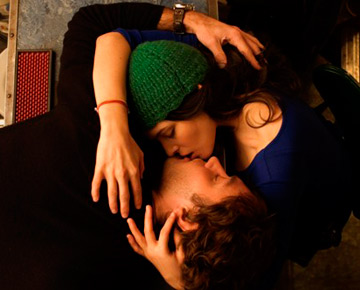


The Weinstein Co.
Jude Law and Norah Jones kiss in “My Blueberry Nights.”
You can argue that the Chinese-born, Hong Kong-based filmmaker Wong Kar-wai was jumping off a cliff by making “My Blueberry Nights” — a movie written in English, shot in the United States, and starring an untested pop singer with no acting experience — but you can’t argue it was the first time. In eight feature films spread over two decades, Wong has made a violent gangland drama, a period romance, a 1960s coming-of-age picture, an elliptical science-fiction epic and a tale of bohemian gay lovers shot in Argentina. It’s difficult to say whether any of his pictures belong to the same genre as any of the others, but they’re all defiantly Wong Kar-wai films that seem to fuse the traditions of Western and Eastern art cinema, languorous dreamlike experiences where plot is secondary to mood and where the beauty of each episode, each face, each room and each moment is paramount.
Having seen two versions of “My Blueberry Nights” — the cut that was screened at Cannes last May, and the slightly shorter, less complicated edit opening this week in the U.S. — I’ve pretty well concluded that it’s a noble experiment that doesn’t quite work. (If anything, I liked the first version better. Or else it was just Cannes, and I was drunk on good wine and louche atmosphere.) Fans of Wong’s now-classic Hong Kong films, from “Days of Being Wild” and “Ashes of Time” to his international hit “In the Mood for Love” and the incoherent but gorgeous “2046,” will likely find “My Blueberry Nights” lightweight and sentimental. On the other hand, anybody who shows up to see Jude Law and Norah Jones in a love story may be mystified by Wong’s near-plotless Americana road movie, which contrives improbable means of keeping the central couple apart as long as possible.
As I wrote when I reviewed the first version at Cannes, you need to detach yourself from any desire for plausible reality if you want to enjoy “My Blueberry Nights.” More than that, you have to survive the film’s awkward and embarrassing first 10 minutes, because it gets a lot better after that. The New York coffee shop run by Jeremy (Law), where heartbroken Elizabeth (Jones) starts showing up to drown her sorrows in late-night coffee and slabs of left-over blueberry pie, has nothing to do with the real New York of 2008. It’s a vision drawn from 1940s films and Edward Hopper paintings, infused with Wong’s trademark midnight-fluorescent colors. (As Wong explained in our conversation, he used a restaurant in Manhattan’s SoHo neighborhood and various exteriors in Brooklyn and Queens.) If there are some similarities between this film and Wong’s 1994 shopping-mall romance “Chungking Express” — still my favorite of all his movies — “My Blueberry Nights” is even closer to Alan Rudolph’s wistful 1984 indie hit “Choose Me.”
Jones is a lovely woman and a likable screen presence, but not much of an actress; she plays Elizabeth as a good girl with bad posture who doesn’t quite realize that she’s beautiful. Both Elizabeth and Jeremy, a cheerful Mancunian expat who’s somehow become a diner proprietor, are presumed to be so dense, and so damaged by their respective broken hearts, that they don’t notice how movieland-perfect they are for each other. (As ever, Law is a total ham. I always wonder why his slightly self-mocking pretty-boy shtick doesn’t bug me more than it does, but I always like him.) On one hand, this plot element is pretty damn far-fetched, but on the other, it underscores how stilted and inert the film’s early scenes are, and how devoid of sexual chemistry the Jones-Law pairing is.
That said, once Elizabeth hits the road and becomes a bystander to other people’s doomed love stories instead of a protagonist in her own, Wong’s film — shot by Darius Khondji, instead of his longtime collaborator Christopher Doyle — begins to exert a peculiar charm. Elizabeth tarries in Memphis awhile, befriending an alcoholic cop (a simply great performance from David Strathairn) who can’t let go of an evil, evil woman (Rachel Weisz, in a traffic-stopping role). Later, in rural Ely, Nev., Elizabeth explores a Thelma & Louise friendship, possessing an infinitesimal lesbian undertone, with a trashy tomboy gambler played by Natalie Portman. Both these episodes are arguably much more interesting than the question of when Elizabeth’s getting back to New York, or whether Jeremy will still be there waiting for her. (Chan Marshall, aka the singer Cat Power, is terrific in a cameo as Jeremy’s ex-girlfriend. And see if you can find Tim Roth, in an uncredited role as a sleazeball in a Hawaiian shirt.)
I had to resist the tendency to pick these characters and settings apart, but they’re not meant to be naturalistic. They’re snippets of American archetype, picture postcards mailed from a Chinese director’s road trip through our collective past. After discussing the film with Wong, I’m inclined to view it more generously, and not just because he was charming and his wife made me a cup of tea. The fact is, it’s awfully easy to sit in the audience and snicker knowingly at the most ungainly aspects of “My Blueberry Nights,” as a handful of younger critics were doing at the screening I attended last week.
If this film is in certain respects a failure, it’s an ambitious one, belonging to the same noble species as other intermittently terrible and thrilling films about America made by international directors, from Antonioni’s “Zabriskie Point” to Emir Kusturica’s “Arizona Dream” to Andrei Konchalovsky’s “Shy People” to Bruno Dumont’s “Twentynine Palms” … one could go on. Without those kinds of failures, maybe you don’t get the other kind of American films made by foreigners, like, say, “It Happened One Night” and “Vertigo” and “Sunset Blvd.”
I guess what I’m saying is that Wong Kar-wai has earned the right to jump off any cliff he damn well pleases. You can fall in love with the lighter-than-air, imagined-America sweetness of “My Blueberry Nights” or you can write outraged Internet screeds against it, as some offended Wong cultists have done. But it might also be wise to wait and see where Wong’s idiosyncratic journey takes him next. (Reportedly, that will be a long-delayed remake of Orson Welles’ 1947 “The Lady From Shanghai,” and there’s nobody better to take it on.) I met with Wong in his New York hotel room, a few hours after his arrival from Hong Kong. He speaks fluent English, but his grammar and syntax are not perfect; here and there I’ve cleaned up the transcript for clarity.
(You can listen to a complete audio podcast of this interview here.)
You’ve spent much of the last year going around the world talking about your decision to make a film in America, and in English. So I bet you’ve got a really good answer to that question. Why was this an important thing for you to take on in your career?
First of all, it’s because of Norah Jones. Obviously I cannot make her speak Cantonese, so I have to make the film in her language. The second thing is, I think, after “2046” — a film I spent five years making — I tried to do something which is very different than that. I thought it might be a very nice idea to shoot in English, to shoot in a country where I’ve never worked before. It was something I wanted to do at that point.
I guess you can say that all of your films have been different — formally different from each other and in different genres. So in that sense it was truly what you’ve always done, take on something new with each new project.
I think so. The only difference is here, the language is so different and it is not a language with which I am familiar, which I can command. The process at the very beginning is a bit difficult but it also gives me a chance to open myself up. That means I have to ask my crew and my cast to collaborate with me. This film, in a certain way, is almost like a student film. We worked together instead of saying, “I have an idea and I want everyone to do it this way or that way.”
I know you co-wrote the screenplay with Lawrence Block, the New York mystery novel writer. How did that come about? How did you meet him?
I’m a big fan of Larry and I like his work, especially the Matthew Scudder series. At that point, I had been discussing with Larry to work on something, maybe to adapt one of his books. Then somehow I had a meeting with Norah and then we decide to make a film together. The story is based on a short film that I made a few years ago. I wrote it myself and then I needed someone to help me, so I proposed [the idea] to Larry. At first I proposed that he write the New York chapter, but he really understood most of the characters so I asked him to help me with the whole story.
You’ve said the starting point was Norah Jones. She’s obviously a beautiful woman and a talented performer, but she had not acted before. Why were you so convinced that you could make a movie with her?
First of all, it’s basically instinct, because casting is really like love at first sight. You look at the face and you have a sense that this is something worth working on and this is a person that is very interesting. You can create a story out of her. Also, Norah has been performing since she was 15, so I had no doubts that she could act.
The story begins and ends in New York but along the way it’s a road movie. In that sense it’s a very classic American film genre.
To tell you the truth, the original story took place in New York, in that diner. It’s almost like a “Nighthawks at the Diner” story. But shooting the whole film in New York became too expensive for the production so we decided to move part of the story out of New York. We decided to shoot this film fairly quickly, and I thought the best way to do that, just because it was Norah, was a road tour, like a band. So we traveled across the country and ended up back in New York.
Once the Norah Jones character hits the road with a broken heart, the first place she lands is Memphis. I think that’s my favorite section. Did you actually shoot in Memphis?
That’s Memphis. We took three trips across the country to decide where we were going to shoot the rest of the film. I thought we should definitely have something from the South. We went to New Orleans after Katrina, like a week after Katrina. At that point, Louisiana was offering very good rebate for film productions, but I decided not to do it because the film had nothing to do with Katrina and I didn’t want to take advantage of that. So we moved on to Memphis and I remember the night we got there, the first place we went was to the bar [that became a location in the film]. In most towns, the first way to understand the town is to drop by the bar. The people there will tell you a lot about the place. I was amazed by the structure of this corner because right across the street there’s another diner and there’s the streetcar passing by. It reminded me of all those Tennessee Williams stories. He’s one of my favorite writers so it was interesting to make a stop in Memphis, to have all these blue, Tennessee Williams elements in it.
The Memphis story is about a busted-up love affair, with David Strathairn as an alcoholic cop and Rachel Weisz as the femme fatale who has broken his heart and maybe still loves him. It’s definitely very Tennessee Williams, archetypal.
For Norah, even though in this chapter she seems to be someone looking on from the side, in both characters — David and Rachel — is a reflection of herself. At first she identifies with David because he’s being cheated on and betrayed by the partners. But then she sees the perspective from the other side, from Rachel’s long conversation with her.
Later in the film, we get to Nevada, another place where lots of films have been set, and then you get the Western landscape. You have the story about Natalie Portman as a professional gambler, this tomboy, butch kind of woman. Did you need to find a story that was very specific to that landscape?
In fact, it was really by accident. We went to this small town called Ely, Nev., which is like five hours out of Las Vegas, because we got lost in the desert. We get to this small town and the first thing we notice is that in the gas station there is a Korean woman running a grocery store. It’s very strange. I speak a little bit of Korean and we became very friendly. She explained the background of this town, and it was really interesting. I felt like if Norah Jones’ character dropped by this town and spent some time there, it could be interesting, instead of going to Vegas, which is more or less expected.
There’s a tradition of great international filmmakers coming to America and making, with lesser or greater success, films about America, films that engage the archetypes of America. There are the obvious immigrant directors like Billy Wilder and Frank Capra, but I’m also thinking about Antonioni, Emir Kusturica, Wim Wenders, Bruno Dumont and other people. Did you think about that at any point?
I think no matter where we live, we all grew up with fragments of American culture. I think the most interesting and joyful aspects of making this movie was the joy of revisiting those fragments and paying homage to them. It’s very hard for me to think like an American. No matter how many trips I take, it’ll take a lifetime. I can only be a visitor or a traveler.
Some reviewers have called attention to logical inconsistencies in the plot: Why does Elizabeth travel all the way across the country to buy a car and drive back? I wonder if you would argue that asking those questions is to miss the point of what you’re trying to accomplish in the movie, what you want the viewer to see?
I think so, because there’s so many ways to explain why and, in fact, it’s not the point. I think the point of this film is about letting go. At certain points, we all have to let go of something which means a lot to us but somehow we realize it’s not that way anymore. It doesn’t only apply to relationships, it can apply to a lot of things. We’re living in a world, in a daily life, that has so many routines. We rely on something, we’re obsessed with something, but sometimes you have to let go.
