
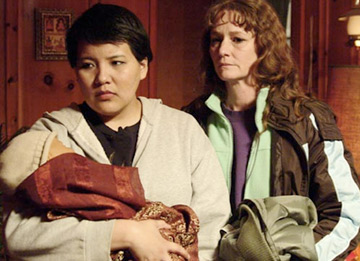



At first, Courtney Hunt’s “Frozen River” feels like a low-budget American film in the “Cheerios realism” mode, meaning that it’s focused on the day-to-day details of domestic existence. Its protagonist, a rural white woman named Ray (Melissa Leo), lives in a battered single-wide trailer in the backwoods of upstate New York, not far from the Canadian border and the St. Regis Mohawk reservation known for its cheap gas and its bingo parlor.
Ray’s husband, a compulsive gambler, has absconded with the money she’d saved to pay for a brand-new double-wide, and now she’s stuck trying to feed her two sons, a teenager and a 5-year-old, on the wages of a dollar-store cashier. But “Frozen River,” although it was shot fast and cheap in subzero cold, isn’t some minimalist study of miserable lives in nowheresville. Gradually Hunt ratchets up the tension until Ray is caught in something close to a slow-motion rural crime thriller. Before you know it, this is a movie that involves gunfire, a strip club, a Christmas miracle and a conspiracy to smuggle illegal immigrants across the frozen St. Lawrence River in the trunk of Ray’s Dodge Spirit.
Ray winds up in an uneasy alliance with Lila (Misty Upham), a sour Mohawk single mom whose mistrust of whites — and everybody else, for that matter — is palpable. But both Ray and Lila need to make some money and recover some semblance of self-respect as capable mothers, and those mutual needs drive them to keep taking the perilous assignment of hauling Chinese or Pakistani arrivals across the ice, two by two. (The river, which is also the border, bisects the Mohawk reservation. While the United States does not entirely agree that Indian land is sovereign territory, neither the border patrol nor local authorities police the reservation.)
Hunt’s measured blend of indie-realist conventions and mainstream melodrama grabbed the attention of the Sundance jury last January, which awarded “Frozen River” the dramatic grand prize. Jury president Quentin Tarantino was fulsome in his praise, saying that Hunt “put my heart in a vise and didn’t let go.” A distribution deal with Sony Pictures Classics soon followed, and “Frozen River” may well be the picture that breaks a string of award-winning Sundance flops, movies honored in the hothouse atmosphere of Robert Redford’s winter indie paradise that have sunk almost without a trace, embraced neither by audiences nor critics. (Dramatic grand-prize winners from 2003 to 2007: “Primer,” “Forty Shades of Blue,” “Quinceañera,” “Padre Nuestro.” Two of those films underwent subsequent title changes; none had a successful theatrical release.)
“Frozen River” isn’t cinematically ambitious or formally adventurous, but it’s built around powerful and nuanced performances by Leo, Upham and Charlie McDermott (as Ray’s teenage son, uncomfortably poised at the edge of manhood). Furthermore, it showcases a confident director who uses her characters to fill out an engaging, well-constructed plot, and you can bet Hollywood execs are paying attention. For better or worse, Hunt won’t be making low-budget indies for long. In person, she’s a poised and attractive woman with the pleasant, professional demeanor of a college president or a child psychologist. I met her at her Manhattan hotel. (Listen to the interview here.)
Your film is set along the border between New York state and Quebec, in the middle of winter. That isn’t the most picturesque country in the world, but it’s impressive in its own way. It’s almost a geometrical landscape: flat, horizontal snow, the vertical trees, the frozen river. It’s one of those movies where the geography is almost like a character.
Yes, well, that’s where this kind of smuggling takes place. That geography is powerful. I like it because it’s a border and it has that borderland feel. It’s sort of a lawless, open plain. It reminds me of a Western. You know, “Where’s the civilization?” And I’m from west Tennessee which is also completely flat, with a big river, so it’s familiar in some ways. But I was most drawn to the landscape because that’s where this goes on. It lent itself to the reality of the movie.
And this amazing story about human smuggling is based, I guess, on things that really happen. People actually drive illegal immigrants across the St. Lawrence when it’s frozen over? This is something you know about or have read about?
Yeah. There’s been a smuggling culture up there since Prohibition: bootlegging liquor, bootlegging cigarettes, whatever is the commodity of the moment. It’s often illegal immigrants now. The extent of it, I think, is rather limited. I don’t think there’s a lot of it, but it does go on. You see it in the news sometimes. I don’t know any people who run illegal immigrants, but I did meet women smugglers who carried cigarettes across the border, back when that was the commodity. That helped me learn about who these women were and why they were doing it.
Most of this film is set on or around the St. Regis Mohawk reservation, which straddles the border and provides an avenue from Canada to the United States. So relationships between whites and American Indians become a theme of the film, which is, shall we say, a historically loaded subject.
Well, I do think it’s interesting where that reservation ended up, sitting on the border that way. Within their territory, the Mohawks don’t really see that border, which is sort of a mental construct anyway. All these people with different borders in their minds, living sort of side by side. I found that inherently interesting.
It’s almost like there’s a tension in the film about what is and isn’t a border. If I understand the situation correctly, the Mohawks don’t necessarily agree with the U.S. and Canadian authorities about what can and can’t happen inside the reservation, or about who holds power there, who can be arrested there and under what circumstances. All those things come into play in the film.
Not only are there those disagreements or points of view about what the borders are, but within the Mohawk reservation there are different perspectives, which I tried to reflect in the movie. Some people are not in favor of gaming and smuggling, and in fact I think a very small group of Mohawks are. By and large, people on the reservation are just trying to do the right thing and get by and preserve their culture.
I felt that the complexity of that situation was so interesting, and I thought, “How in the world will I get that across without doing a totally expositional movie?” But I had this idea: a white woman and a Mohawk woman stuck together in a car. That was sort of my central image for this movie, driving across a frozen river. Because Ray, the white woman, comes into this situation knowing nothing [about life on the reservation], we’re able to learn it through her. It’s way more complicated than I can even describe. It definitely would be a great subject for a documentary.
Right, although this is a fictional story it opens a window into a world that I, and probably most viewers, are going to know almost nothing about.
And it’s only 300 miles north of here. When I was shopping the movie in Los Angeles, it was really hard to get through to people that I was basing it on an absolutely true story. I kept having to say, “You know, the characters are fictionalized but this really does go on.” There usually is a story about it every six months in the New York Times. Some sort of smuggling operation will be uncovered, not necessarily among the Mohawks, just on the border. And then the thing will just disappear again. It’s not that big, but it is that near.
Is that actually the Mohawk reservation that we see in the film?
No. I shot my short film [an earlier version of “Frozen River”] on the reservation. We shot the feature in Plattsburgh, N.Y., which isn’t that far away but has much more of the infrastructure needed to support that operation.
I’ve been to Plattsburgh. You must have been the biggest thing in town while you were there.
That is correct. In the middle of winter! Yes, the people of Plattsburgh kept us warm, they looked after us, they closed streets, they really made it happen. They were very game about this whole thing; they thought it was kind of cool that we were doing a movie about smuggling. Nobody was offended. They were like, “Yeah, this is great, and my great-uncle was supposed to be a smuggler!”
Now, the core of this film is this very tense relationship between the two women, between Ray and Lila, where the thing that ultimately binds them together is their economic fortunes. These are poor single mothers, trying to make a go of it in some dire circumstances.
That’s true. I think the economics of the situation brings them together. I think the fact that they’re both mothers keeps them together, and that’s the overarching theme. There are things bigger than culture and gender, like the human drive to make it better for the next generation. More specifically with them, one’s a mom who’s trying to take care of her kids by getting a better house and putting food on the table, and the Mohawk mother is sort of alienated from her motherhood and trying to find her way back to it. They help each other in funny ways. They get there without ever talking about it.
One of the central dramas is the question of whether Ray, Melissa Leo’s character, is going to get her double-wide trailer. I can imagine a lot of movies where that would be played at least partly for laughs, but your approach is entirely sympathetic. You draw us into understanding how important that is for this woman.
Well, I wanted people, when they drive down the road outside New York City and they see trailers, to not be so sure they know who’s in there. Also, everybody has their own idea of a palace, everybody has a palace in their head. Just because your palace and my palace are different, that doesn’t mean I don’t care about yours or can’t understand that yours is important to you.
You won the grand jury prize at Sundance, and the president of that jury was Quentin Tarantino. This is very different from any kind of film that he could conceivably make, but he clearly loved it. That must have been a terrific validation.
It’s so funny that you say that. When I saw him at the director’s brunch I didn’t make eye contact. Of course he didn’t know who I was, but I recognized him and I just walked by him and thought, “He is going to hate my movie.” So needless to say, I was shocked when he gave us that little lead-up speech to the prize. It was just incredibly generous.
You know, now that I’ve seen your film his response doesn’t mystify me so much. There’s a certain kind of American indie film that we’ve gotten very used to, which is very naturalistic and made on a low budget. What often goes with that is a sort of plotlessness. This is a naturalistic film made on a low budget, but it’s definitely not plotless. You’ve got people shooting at each other, you’ve got stolen money, you’ve got a Christmas miracle happening out there on the frozen river. You’re not afraid of drama.
Right. As a nice white girl, I felt like I should pay my investors back. They put this money out and by God I was going to pay them back, that was my kind of driving need. So to do that, I thought, there better be some story here. If you’re going to ask people to sit down for 97 minutes and give you their attention, you better keep them in their seats. This story itself lends itself to that. I mean, there’s quite a bit of suspense built into this sort of real-life circumstance. So that was the way I went about it.
I’m saying, yes, I’m going to talk about things that could be considered indie, but I’m going to make sure that the audience needs to see the very last frame as well, and that’s more of a mainstream approach. Maybe it’s because my father only watches Westerns, you know? I just felt like, you’re gonna put people who are used to seeing these action movies in the seat, and you better keep them there.
“Frozen River” opens Aug. 1 in New York and Los Angeles, with national rollout to follow.
