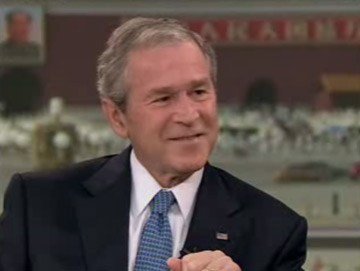

George W. Bush
The strange smile of George W. Bush
Bush looked weirder than he ever has during his Bob Costas interview -- but he made more sense. Too bad it's too late.
I know, this is a couple of days after the fact, but I just have to weigh in on President George W. Bush’s bizarre appearance on NBC with Bob Costas during their prime-time Olympics slot. First of all, it was strange just to see Bush in such an intimate setting. I can’t recall ever seeing him doing a one-on-one interview, certainly not in such an informal setting. It felt like we were getting a completely different view of Bush than we ever have.
Which brings up the second point: Bush’s facial mannerisms were so odd, so truly eccentric, that it seems impossible that if Americans of any political persuasion had been exposed to them earlier, they could ever have elected him. I’m talking about his weird, canned and completely inappropriate smile, which he turned on Costas like an autistic beauty queen every time he finished answering one of the host’s questions. It was a smile that made John McCain’s notoriously wooden molar-exposure in front of a lime green background look spontaneous. Bush’s strange smirk is fabled, but to my knowledge Americans have never been exposed to it like this — I know I haven’t. It was like an outtake from one of those cheesy used-car commercials that run on local stations. U.S. presidents have had their share of disturbing facial expressions — Richard Nixon’s devious, evil-courtier look ranks high — but Bush’s phony insta-smile may take the prize for inauthenticity. Who knows whether it’s a tic, a self-congratulatory facial reflex (“I knew the answer to that question!”), or a weirdly aggressive way of covering up for a profound insecurity. But it ain’t ready for prime time.
The painful irony, however, is that while Bush looked awful, the substance of what he said wasn’t that bad. In fact, on the issues Bush came across about as well as he ever has. Costas did a solid job of asking him questions about the major Olympics-related news issues, from the Russia-Georgia conflict to Darfur to China’s human rights record, and in response Bush was reasonably well spoken and seemed reasonably well briefed. More important, he came across as a realist and a pragmatist, not an ideologue. The scary Bible-thumping Bush did emerge for just a moment: In response to a question about reform in China, he said, “If you’re a religious person, you understand that once religion takes hold in a society it can’t be stopped” — a weird answer, since Costas hadn’t even mentioned religion. But in general, Bush didn’t veer into his normal America-uber-alles pose. He said he had raised objections with both the Russian and Chinese leadership, but that what was important was to stay constructively engaged. Barack Obama couldn’t have said it better himself.
There’s an obvious reason why Bush was so pragmatic: He doesn’t have many cards to play, either with China or Russia. Reality has a way of shutting up even the biggest braggarts and blowhards. But watching this odd and diminished man at the end of his disastrous term, it was hard not to think that if only he had not suffered from delusions of American omnipotence seven years ago, his presidency, and the world, would be a very different place.
Gary Kamiya is a Salon contributing writer. More Gary Kamiya.
Using Bush’s playbook
"Karl Rove politics" aren't quite dead: Obama's strategy in 2012 will mirror W's in 2004
George W. Bush and Barack Obama (Credit: Reuters/Larry Downing) Barack Obama’s presidency was born from nothing so much as his repudiation of George W. Bush’s administration — its policies and politics, its style and tone. One of Obama’s most effective 2008 stump speech refrains was his promise to end the era of “Scooter Libby justice, ‘Brownie’ incompetence and Karl Rove politics.”
But the political dynamics for winning a second presidential term often differ markedly from winning the first. So don’t be surprised by many eerie parallels between Obama’s 2012 reelection bid and Bush’s 2004 campaign. The president may not rely upon “Karl Rove politics” in the strictest sense, and nobody would confuse David Axelrod with Rove. But Obama’s reelection route and rhetoric may bear more than a few Rovian hallmarks.
Continue Reading CloseThe Bushies are back
Missed the neocons? Don't worry: Mitt Romney's getting the band together again
(Credit: Reuters/Win McNamee) There was good reason for Republicans to cry foul over the Obama campaign’s advertisement highlighting the president’s killing of Osama bin Laden; the GOP has lost its decades-long edge on national security. According to a Washington Post poll, “By a margin of more than 2 to 1, Americans say the president’s handling of terrorism is a major reason to support rather than oppose his bid for reelection.”
Continue Reading CloseJordan Michael Smith writes about U.S. foreign policy for Salon. He has written for the New York Times, Boston Globe and Washington Post. More Jordan Michael Smith.
Bush aide blasts torture
Philip Zelikow tried to warn Bush on interrogations. Now he's penned an authoritative article on how he was ignored
(Credit: Reuters/Jim Young) The Bush administration hasn’t heard the last from Philip Zelikow. After the rediscovery last week of his long lost 2006 anti-torture memo, Zelikow, a former State Department official, has written arguably the most damning article yet about U.S. government’s interrogation policies from 2001 to 2009. The article, called “Codes of Conduct for a Twilight War,” will be released in a forthcoming issue of the Houston Law Journal, and was obtained exclusively by Salon. Says Zelikow in an email: “I’m not aware of other accounts that combine historical, policy and legal approaches to” the subject of the Bush administration’s interrogation methods.
Continue Reading CloseJordan Michael Smith writes about U.S. foreign policy for Salon. He has written for the New York Times, Boston Globe and Washington Post. More Jordan Michael Smith.
Thomas Kinkade, the George W. Bush of art
The rise and fall of Thomas Kinkade, the Painter of Light™ in a decade of bad faith
News of Thomas Kinkade’s death arrived on the same day I received in the mail a vintage teacup on which I had spent a ridiculous amount of money. It has a cottage painted on it. Kinkade, whose work has long exerted a morbid fascination for me (to the concern of all my friends), specialized in cottages. So some part of me understands the appeal, I guess, but, damn: Those paintings make my corneas hurt. And yet, I could barely stop looking at them.
Kinkade was only 54, and his family told the media that he died of “natural causes.” This comes after years of reports of drunken public misbehavior: cursing at people who tried to save him from falling off bar stools, heckling Siegfried & Roy, grabbing a woman’s breasts at a publicity event and, most memorably, urinating on a Winnie the Pooh statue at the Disneyland Hotel while proclaiming, “This one’s for you, Walt!” There were DUI arrests. Also, his manufacturing company declared bankruptcy two years ago, and former franchisees of the once-ubiquitous Thomas Kinkade Signature Galleries won settlements against him for fraud.
Continue Reading Close
Laura Miller is a senior writer for Salon. She is the author of "The Magician's Book: A Skeptic's Adventures in Narnia" and has a Web site, magiciansbook.com. More Laura Miller.
The memo Bush tried to destroy
A document advising the Bush administration against torture has resurfaced, despite his best efforts to hide it
George W. Bush in 2006 (Credit: AP/Ron Edmonds) In February of 2006, Philip Zelikow, counselor to Secretary of State Condoleezza Rice, authored a memo opposing the Bush administration’s torture practices (though he employed the infamous obfuscation of “enhanced interrogation techniques”). The White House tried to collect and destroy all copies of the memo, but one survived in the State Department’s bowels and was declassified yesterday in response to a Freedom of Information Act request by the National Security Archive.
Continue Reading CloseJordan Michael Smith writes about U.S. foreign policy for Salon. He has written for the New York Times, Boston Globe and Washington Post. More Jordan Michael Smith.
Page 1 of 436 in George W. Bush