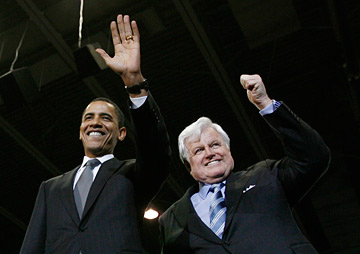

Ted Kennedy

Is change “scary” or is change “hopeful”?

As the Democratic convention opens, with a speech by Michelle Obama and an in-person appearance by Ted Kennedy, undecided voters wrestle with their feelings about change -- and the nominee.

  • more
    • All Share Services

Topics: , , , , ,

Is change

The dilemma facing Barack Obama on the eve of the Democratic convention was best expressed by Sondra Owens, a perplexed 43-year-old Colorado voter who works for a trade-show company: “I think people want change, but they’re afraid of change.”

Obama — whose family background and life history defies political convention — is a candidate who both inspires and disquiets. This Obama wariness was on display Sunday afternoon at a focus group featuring undecided Denver-area voters organized by the AARP. In a traditional focus-group exercise, the participants were asked to volunteer a word or phrase to describe Obama. The responses went like this: “Apocalypse,” “terrifying,” “scary,” “pizzazz,” “unknown,” “inexperienced,” “liberal,” “unsure,” “charismatic,” “unknown,” “hopeful,” “smooth,” “Internet,” “under-performing,” “change,” “hopeful” and “irresponsible.”

Words like “terrifying” and “scary” (which was Owens’ choice) help explain why the opening night of the Democratic convention, featuring Michelle Obama, is built around reassurance. If Obama is to take advantage of the voters’ ire at the president, their anger at the gas pump and the impression that John McCain is yesterday’s man, he cannot be perceived as callow and aloof. As Valerie Jarrett, a close advisor to the candidate and a close friend to the Obamas, said at a reporters’ breakfast Monday morning, “Michelle’s speech will really focus on the Obama family and [will be] a personal speech showing who she thinks Barack is as a husband and a father and why she believes that he has the qualities that uniquely prepare him to be president of the United States.”

A political convention has become an anachronism; the glory days of smoke-filled rooms, delegates in funny hats, and suspenseful roll-call votes are gone. Conventions are now excuses for both parties to bludgeon the television networks into running four nights of political infomercials. The elaborate and seemingly endless negotiations over whether Hillary Clinton will get a full roll-call vote on Wednesday night or whether the balloting will quickly be broken off for an Obama-by-acclamation confetti drop illustrate how ridiculously ritualized the whole quadrennial spectacle has become. So, in a sense, every reporter in Denver is on the television beat. And the journalistic danger lies in confusing the attitudes of the studio audience (the delegates) with the sentiments of Nielsen families (the voters).

The Democratic convention opens at a time when the heady optimism that Obama would transform the electoral map has given way to a gimlet-eyed realism about the difficulty of getting to 270 electoral votes. At the Monday breakfast sponsored by the Christian Science Monitor, Illinois Sen. Dick Durbin, the earliest proponent of an Obama candidacy, admitted, “Over the last week or 10 days, John McCain has had a 12-and-0 run in the basketball game.” Durbin and other leading Democrats believe that the selection of Joe Biden for vice president coupled with McCain’s inability to recall how many homes he owns had already changed the tempo of the game before the opening gavel of the convention.

The AARP focus group captured the confusions of a group of Colorado voters struggling to make a choice, but who mostly say that they are waiting for the presidential debates to clarify their decision. The words that participants used to describe McCain were not always lifted out of a GOP press kit: “Scary,” “strong,” “experienced,” “veteran,” “Bush Two,” “older generation,” “honest,” “Goldwater” and “repeat.” As Republican pollster Frank Luntz, who organized the focus group for the non-partisan AARP, summarized, “These voters have complaints about both candidates that prevent them from making an endorsement. They’ve got hang-ups about both of them.”

The hesitancy about Obama — at least in this focus group — had little to do with Hillary Clinton or wounds from the long nomination fight. (True, these were all independent voters who were not allowed to participate in the Democrats-only Colorado caucuses). Despite all the backstage rumblings between the Obama and Clinton camps, there is a growing sense that these ill-concealed frictions are mostly irrelevant to the voters who will actually decide this election. Though it did strain credulity when Valerie Jarrett said, “The people who actually have been involved in the conversations between Senator Clinton’s campaign and Senator Obama’s have a very strong, good, cohesive working relationship.”

But the Clintons — for all their successes and endurance — have never been the royal family of the Democratic Party. For nearly half a century, that honor has belonged to the Kennedys. At the 1992 Democratic convention, the torch was symbolically passed in a film clip unearthed from the archives that showed a teenage Bill Clinton, representing Arkansas in Boys State, shaking hands at the White House with JFK. Monday night an ailing Ted Kennedy, apparently against the advice of the doctors treating him for brain cancer, is now expected to speak to the convention on Obama’s behalf. It will be the moment when the last survivor of the Camelot generation formally blesses Barack Obama as the embodiment of liberal dreams in the 21st century.

Continue Reading Close

Walter Shapiro is Salon's Washington bureau chief. A complete listing of his articles is here.

Ted Kennedy rented a brothel in 1961

The FBI claims that a year before his Senate election, Kennedy rented a Chilean brothel while on fact-finding trip

  • more
    • All Share Services

Topics: ,

Ted Kennedy rented a brothel in 1961Edward "Ted" Kennedy, former U.S. senator from Massachusetts (D).

An FBI file contends that a young Edward M. Kennedy arranged to rent a brothel for a night while visiting Chile in 1961, a year before he was elected to the Senate.

The previously redacted State Department memo, dated Dec. 28, 1961, was released by Judicial Watch, a Washington-based organization that said it obtained it through a Freedom of Information lawsuit.

According to the memo, the Massachusetts Democrat made arrangements to rent the brothel “for an entire night” in Santiago earlier in 1961. “Kennedy allegedly invited one of the Embassy chauffeurs to participate in the night’s activities,” according to the memo.

One State Department official described Kennedy as “pompous and a spoiled brat,” according to the memo. Kennedy was making a fact-finding trip to several Latin American countries. “Kennedy met with a number of individuals known to have communist sympathies,” the memo said.

Kennedy was a 29-year-old assistant district attorney in Boston at the time of the trip. He was elected to the Senate in 1962 and served more than four decades until his death in 2009.

Kennedy’s family members had no immediate reaction to the release of the memo.

The documents from Judicial Watch provide no indication of the source of the allegations or whether the FBI believed the allegations were true. Judicial Watch said it waged a “tough” fight with the Obama administration for access to the previously secret documents.

Last June the FBI released more than 2,300 pages of documents from Kennedy’s file, many of them containing information about various death threats against Kennedy and his family. Some of the material was redacted by the FBI.

Some of the threats prompted investigations, some resulted in warnings to Kennedy or local law enforcement authorities. There is no indication any attempts were carried out.

Kennedy family members were given a chance to review and to raise objections to the documents before they were released last June. The FBI has additional documents on threats to Kennedy, possibly thousands more pages, that it plans to make public once the agency finishes reviewing them.

The family has no legal power to keep information withheld, the FBI has said, but the bureau does consider privacy concerns on a case-by-case basis.

Continue Reading Close

Carter: Kennedy was drinking before 1980 snub

The former president's newly released presidential diary includes an interesting observation about a famous moment

  • more
    • All Share Services

Topics: , ,

Carter: Kennedy was drinking before 1980 snubJimmy Carter, left, shakes hands with Sen. Edward Kennedy on the podium at the Democratic National Convention in 1980.

This week marks the publication of Jimmy Carter’s private journal of his presidency, “White House Diary.” The entries are often brief, but Carter does offer an interesting account of one of the most widely discussed moments of his doomed 1980 reelection effort: Ted Kennedy’s apparent snub of him on the final night of the Democratic convention in New York, just after Carter had delivered his acceptance speech.

“Afterward,” Carter writes in his diary, “Kennedy drove over from his hotel, appeared on the platform along with a lot of other people, seemed to have had a few drinks, which I probably would have done myself. He was fairly cool and reserved, but the press made a big deal of it.”

They sure did — and for good reason. Kennedy’s challenge of Carter for the ’80 nod was unusually bitter and protracted. Even though Carter won twice as many delegates in the primary and caucus season, Kennedy fought all the way to the August convention, attempting to convince delegates to support a rule change that would have allowed them to vote their conscience on the first ballot — instead of being forced to cast a ballot for the candidate they’d been pledged to during the primary season. Only when this effort failed did Kennedy back down and end his campaign (with what was probably the best speech of his career). So it was only logical that the press would watch the body language closely when the two men came together onstage after Carter’s acceptance speech two nights later — and Kennedy’s discomfort was obvious. As the Washington Post reported it:

When Kennedy did arrive, wearing that familiar tight-lipped smile his traveling press corps has come to call “the smirk,” he strode into the crowd of Democratic officials already on the podium, gave Carter a perfunctory shake of the hand, and walked away to the side of the platform.

There followed a comical ballet in which Jimmy and Rosalynn Carter and House Speaker Thomas P. (Tip) O’Neill Jr. (Mass.) all tried futilely to lead Kennedy back to center stage for an arms-up pose with the president.

When Kennedy went to the left side of the platform to raise a fist toward his Massachusetts delegation, Carter made a beeline to join him and struck the same pose. But Kennedy’s arm had come down a split-second before Carter’s shot up.

You can watch some of Kennedy’s snub of Carter in this video:

Carter has already rasied eyebrows while promoting his diaries. In a “60 Minutes” segment that aired over the weekend, he told Lesley Stahl that “we would have had comprehensive healthcare now, had it not been for Ted Kennedy’s deliberately blocking the legislation that I proposed” as president. “It was his fault,” Carter added. “Ted Kennedy killed the bill.”

Continue Reading Close
Steve Kornacki

Steve Kornacki writes about politics for Salon. Reach him by email at SKornacki@salon.com and follow him on Twitter @SteveKornacki

New FBI docs show Kennedy death threats

The FBI releases previously secret files concerning death threats against the late Sen. Edward Kennedy

  • more
    • All Share Services

Topics:

Most of the secret FBI files on the late Sen. Edward Kennedy being released Monday concern death threats against the longtime senator.

Alex Brown of the FBI’s records management division said the FBI would post some 2,000 pages of previously secret pages about the Massachusetts Democrat on the agency’s website.

The release of the documents has been highly anticipated by historians, scholars and others interested in the life and long public career of one of America’s most prominent and powerful politicians.

The Associated Press and other media organizations requested the documents through Freedom of Information Act requests.

Kennedy faced death threats when he ran for president in 1980 and before that in the years following the assassinations of his older brothers.

President John F. Kennedy was assassinated in Dallas on Nov. 22, 1963. U.S. Sen. Robert F. Kennedy was slain in Los Angeles on June 6, 1968.

The deaths of his two older brothers cast a long shadow on Kennedy’s life, and prompted fears he too would be targeted by an assassin’s bullet.

After his brothers’ assassinations, Kennedy wrote in his memoir “True Compass” released last year, that he was easily startled at loud sounds, and would hit the deck whenever a car backfired.

Kennedy, who served in the Senate for nearly half a century, died in August 2009 after a yearlong struggle with brain cancer. He was 77 and the last surviving brother of the famed political family.

——

Online:

http://foia.fbi.gov/hottopics.htm

Continue Reading Close

Coakley wins primary to replace Kennedy

The Massachusetts state attorney general won the Democratic nomination easily; she's likely to win the general too

  • more
    • All Share Services

Topics: , ,

Tuesday night, Massachusetts Attorney General Martha Coakley won the Democratic primary in a special election to replace the late Sen. Ted Kennedy. If all goes as expected, she’ll win the general election, held early next year, and be sworn in to the Senate.

Coakley was the front-runner going into the night, but her margin of victory was still impressive. In a four-way race, Coakley still managed to pick up a plurality of 47 percent, beating Rep. Michael Capuano’s 28 percent and the 13 percent and 12 percent that Alan Khazei and Stephen Pagliuca were able to pull in, respectively.

Beyond just giving Coakley the opportunity to take Kenedy’s place in the Senate, Tuesday’s vote represented a milestone for Massachusetts: This is the first time either party has nominated a woman for one of the state’s Senate seats.

Alex Koppelman is a staff writer for Salon.

Voters picking a successor for Kennedy

A primary's held in the race to replace Ted Kennedy in the Senate

  • more
    • All Share Services

Topics: , ,

Voters are heading to the polls in Massachusetts Tuesday, in the first step towards picking a longer-term replacement for the late Sen. Ted Kennedy. This vote is just the primary — the general won’t be held until early next year — but given the Democratic advantage, it will all but decide the final outcome.

The race has flown under the radar thus far, largely because state attorney General Martha Coakley has consistently been favored in polls. She’s running against Rep. Michael Capuano, Boston Celtics co-owner Stephen Pagliuca and Alan Khazei, who started the community service organization City Year.

There is one interesting dynamic to the race. Former President Bill Clinton endorsed Coakley recently. That pits him against former Gov. Michael Dukakis, the Democratic presidential nominee in 1988; Dukakis is backing Capuano.

Currently, Kennedy’s seat is held by Paul Kirk.

Alex Koppelman is a staff writer for Salon.

Page 1 of 13 in Ted Kennedy