Bill Richardson

Obama in New Mexico: No Latino voter left behind

In the most closely contested state in the nation, it will all come down to who is better organized -- and whether Obama can get Hispanic voters to the polls.

  • more
    • All Share Services

Topics: , ,

Obama in New Mexico: No Latino voter left behind

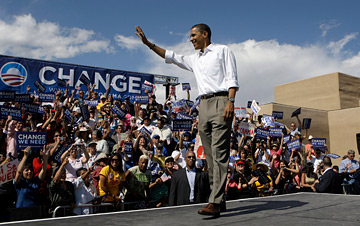
For a few hours Thursday, Barack Obama doubled the size of this town. About 9,500 people live here, in the heart of Hispanic northern New Mexico; around midday, about 9,500 people were crammed into a historic plaza near the Rio Grande for a rally, according to campaign aides and local officials. And if Obama’s strategy to win the White House through the West is going to work, his supporters are going to have to get used to pulling off that kind of turnout. It looks like New Mexico — and its five electoral votes — are going to go to whichever side does a better job organizing.

No state has seen presidential elections as consistently close as New Mexico the past two cycles — Al Gore won it by 366 votes in 2000, and George W. Bush took it back by 5,988 votes four years later, the margin still less than 1 percent of the total vote. Now Obama leads John McCain in most recent polls by a few points, but Democrats and Republicans alike say they think the final margin could be as tight as it has been in the past. Both campaigns are advertising heavily here; the Wisconsin Advertising Project estimated McCain spent $214,000 on TV in New Mexico the week after his convention, Sept. 6 to 13, while Obama spent $155,000 in the same time period. But with fewer than 3 million residents, grass-roots organizing might make more of a difference.

Latinos will almost certainly put whoever wins over the top; the state’s electorate is about 40 percent Hispanic. McCain and Obama are each blaming the other for failed immigration reform legislation in Spanish-language ads here, though both of them are making some dubious claims in the messages. (In New Mexico, with a large native-born Hispanic population whose roots date back to the 16th century, and where many Latinos watch English TV, immigration may not resonate as much as economic issues.) “The Hispanic vote in New Mexico, Colorado and Nevada is gonna decide this election,” Gov. Bill Richardson told the crowd before Obama spoke. “And Hispanics are gonna vote for Barack Obama, right?” Obama’s campaign had made an effort to connect with the local Latino crowd: A mariachi band played before the rally got started, and inside the security perimeter vendors were doing a brisk business in tamales, flautas and burritos. It might have worked. “He represents the middle class, he’s a minority,” said Tommy Martinez, 23, a school counselor from Española who just registered at his new address to make sure he could vote in November. “McCain just seems like he’d be more of the same.”

Obama’s visit this week, and what he did while he was here, underscored the way this election could be different from the last two. Instead of focusing on Albuquerque or Santa Fe — the state’s biggest cities by far, and the home to most of the Democratic base — the campaign headed north in search of the small-town Latino vote (though Gov. Richardson did host a $28,500-per-person fundraiser for Obama back in Albuquerque later Thursday). On his way to the rally in Española (at which he arrived nearly two hours late), Obama stopped in Bernalillo, population 6,600. “We are committed to aggressively reaching out to rural voters,” the campaign’s state director, Adrian Saenz, told me.

That’s because the rural parts of the state are where Obama has the best chance to find more votes than John Kerry got last time. Polls show Latinos in New Mexico (and in other battleground states) are backing Obama over McCain by enormous margins, so Obama’s campaign is focusing on turning out as many of them as possible. The relatively densely populated northern part of the state — where some counties are more than 60 percent Hispanic — is the top target. “There’s real pressure on what you do in the Hispanic community,” said Democratic pollster Paul Maslin, who worked for Richardson’s presidential campaign. “Every extra point that we can get in terms of either turnout or voter preference … cushions against that more conservative Anglo population.”

Already, Obama has 34 offices open around the state. “We only have 33 counties in New Mexico,” marvels the state Democratic Party chairman, Brian Colón. Places like Hatch, N.M., which officially calls itself a village, and where only 1,644 people live, have field operatives and volunteers working there, contacting residents and finding potential supporters. “What we’ve built in these battleground states is what would be considered a very large Senate or governor’s race in these states,” Obama’s campaign manager, David Plouffe, told New Mexico reporters this week.

Four years ago, in contrast, Kerry never had more than five offices. (McCain’s campaign, working with the state Republican Party, has five open now, and the party spokeswoman, Shira Rawlinson, says more will open soon.) Saenz, who worked on Hispanic outreach for the Democratic Party’s field organization in 2004, says there’s barely any comparison between the two efforts. “We’re a lot further ahead organizationally,” he said. “Our staff was on the ground and our offices around the state were up and running a lot earlier this year than they were in 2004.”

So far, though, that work hasn’t yielded immediate results. As of last week, there were about 13,000 more Democrats registered to vote than were registered in 2004 — an increase of about 2 percent, more than enough to make up for the margin of victory four years ago, but not enough to make the state seem like a safe bet for Obama. Two weeks ago, the campaign had Richardson kick off a “30/30″ drive to register 30,000 more voters in the 30 days before the registration deadline of Oct. 7, and officials say they’re on pace to meet that goal. Early voting, which begins Oct. 18, could account for more than half the ballots cast, which would make it easier for both campaigns to focus on finding people they’re counting on by Election Day.

What Obama’s campaign seems to be modeling itself after, consciously or not, is Bush’s winning effort here in 2004. “We had success in 2004 because we, frankly, put together a more well-oiled turnout operation than Kerry,” said Scott Jennings, who ran the state for Bush in that campaign but has since moved back to his native Kentucky (after a stint in the White House). “We really just didn’t confine our campaigning to the most populous area, which is Albuquerque. We turned out the vote in those rural areas.”

What New Mexico and neighboring Nevada and Colorado represent, for Obama, is an alternate route to victory in November. If he holds all the states Kerry won four years ago, wins Iowa (where he’s up big) and wins two of those three Western states, he’ll be the next president. “For the Hispanic community, I want you to start actually voting your numbers,” Obama told the crowd in Española. “Start flexing your muscles. Right here in New Mexico, you’ll be the difference maker. Don’t stay home — just remind yourself, ‘Sí se puede. Yes we can.’” Chances are he’ll be back to help make that happen.

Continue Reading Close

Mike Madden is Salon's Washington correspondent. A complete listing of his articles is here. Follow him on Twitter here.

Richardson — not charged, but not exonerated

A U.S. attorney pours cold water on the New Mexico governor's celebration

  • more
    • All Share Services

Topics: ,

The cloud that’s been hanging over New Mexico Gov. Bill Richardson recently, and cost him his shot at being Commerce secretary, appeared to be lifted yesterday. That’s when the Associated Press broke the news that Richardson won’t face charges stemming from a federal probe of pay-to-play allegations. Now, the cloud is back.

On Thursday, a Richardson spokesman, Gilbert Gallegos, took a little victory lap, saying in a statement that the governor is “gratified that this yearlong investigation has ended with the vindication of his administration.”

That’s not the way the U.S. attorney sees it, though. Greg Fouratt sent a letter to defense attorneys, the AP reports, in which he said the fact that no charges were filed “is not to be interpreted as an exoneration of any party’s conduct.” He also said the investigation “revealed that pressure from the governor’s office resulted in the corruption of the procurement process.”

It’s not great form for a prosecutor to be talking guilt out of court when there weren’t even any indictments, but that’s not likely to matter politically. Rather than being able to go on from here free and clear, Richardson will have to deal with that letter hanging around his neck for some time.

In another statement, this one released Friday, Gallegos said Fouratt’s letter “is wrong on the facts and appears to be nothing more than sour grapes.”

Continue Reading Close

Alex Koppelman is a staff writer for Salon.

Richardson won’t face charges in federal probe

The New Mexico governor was part of an investigation into a pay-to-play scheme

  • more
    • All Share Services

Topics: ,

New Mexico Gov. Bill Richardson appears to have successfully weathered the federal investigation that cost him a spot as secretary of Commerce. The Associated Press reports that Richardson and former top aides will not be charged in the investigation, which was looking into an alleged pay-for-play scheme.

Decisions about charging high-ranking political figures are generally made in consultation with main Justice back in Washington, D.C., which typically has final say. That appears to be what happened here, as the AP reports the decision “was made by top Justice Department officials.” The AP’s source doesn’t appear to be happy about it, saying, “It’s over. There’s nothing. It was killed in Washington.”

Alex Koppelman is a staff writer for Salon.

Bill Clinton to the rescue

The former president's trip may be successful in securing the release of two American journalists

  • more
    • All Share Services

Topics: , , , ,

Update: Clinton’s mission was successful, and Kim Jong Il has pardoned the two journalists. See this post for more.

In a surprise visit, former President Bill Clinton arrived Tuesday in Pyongyang, North Korea, to meet with the isolated nation’s leader, Kim Jong Il. While North Korea’s nuclear program and recent spate of missile tests have caused growing consternation around the world, the main purpose of Clinton’s trip was to negotiate for the release of two U.S. journalists currently imprisoned there.

ABC News is now reporting that Clinton also met with the jailed reporters, Laura Ling and Euna Lee. A government source described the meeting as highly emotional but told ABC that those on Clinton’s team in North Korea are hopeful the journalists could be released as early as tomorrow.

Clinton has a loose connection to the jailed reporters. Both work for Current TV, a news and media venture headed by Clinton’s former vice-president, Al Gore. Ling and Lee were arrested on the border between North Korea and China in March. In June, they were sentenced to 12 years of hard labor for what North Korea said was their illegal entry into the country, as well as engaging in undefined actions deemed hostile to the communist country.

The White House has thus far remained reserved when discussing Clinton’s trip. North Korean media said Clinton shared a message from President Obama, but White House Press Secretary Robert Gibbs released a statement in which he said, “While this solely private mission to secure the release of the two Americans is on the ground, we will have no comment … We do not want to jeopardize the success of former President Clinton’s mission.”

However, Sen. Lindsey Graham, R-S.C., seemed somewhat confused by the decision to send Clinton. On the “Today” show this morning, he said of Clinton’s visit that “I don’t know what this is,” though he expressed hope that the visit could lead to progress on limiting North Korea’s nuclear arsenal.


There is a long history in the U.S. of notable political emissaries traveling across the globe to try to free hostages.

Perhaps the most memorable diplomatic mission was the Rev. Jesse Jackson’s 1999 trip to Belgrade to ask for the release of three U.S. soldiers held as prisoners of war by then Yugoslav president (and war criminal) Slobodan Milosevic. The trip was controversial because Jackson made the journey without the blessing of the Clinton White House. That he actually convinced Milosevic to release the soldiers after the Clinton administration had been unable to do so made Jackson’s fame as a hostage-release negotiator grow. The civil rights leader has worked as a diplomat in similar circumstances numerous times over his career: He was able to get hostages released from Syria in 1984, from Cuba in 1987 and from Kuwait and Iraq in 1990 — all without official presidential or congressional approval.

New Mexico Gov. Bill Richardson, who had been discussed as a possible liaison to negotiate the return of Lee and Ling, brokered the release of U.S. hostages from North Korea in the 1990s. Richardson has also helped secure the release of hostages from Iraq, Cuba and Sudan and most recently met with Venezuelan President Hugo Chavez to seek his support in getting a Colombian Marxist guerrilla group to release three U.S. contractors they’ve detained since 2003. Colombian commandos eventually freed the hostages, along with Ingrid Betancourt, in June 2008.

And in one of the most embarrassing hostage situations the U.S. ever faced, President Jimmy Carter proved unable to negotiate with Iran for the release of 52 Americans held after the overthrow of the shah during the Iranian revolution. A daring military operation to free the hostages also failed. Iran eventually released the hostages once President Ronald Reagan took office. Later in his presidency, Reagan suffered a major political scandal when it was revealed that his administration had sold arms to Iran in an attempt to gain the release of seven American hostages being held in Lebanon by Iranian terrorists.

Continue Reading Close

Vincent Rossmeier is an editorial assistant at Salon.

Will third time be the charm at Commerce?

Former Washington Gov. Gary Locke is reportedly President Obama's new choice to head the department.

  • more
    • All Share Services

Topics: , ,

President Obama struck out with his first two picks for Commerce secretary, as both New Mexico Gov. Bill Richardson and Sen. Judd Gregg (R-N.H.) withdrew their nominations for the post. Now, he’s reportedly hoping to do better with a fairly obscure choice — former Washington Gov. Gary Locke.

Locke, who left in office in 2005, served two terms and opted not to run for a third; he was the first Chinese-American governor in U.S. history.

Alex Koppelman is a staff writer for Salon.

Richardson speaks

The New Mexico governor explains his decision to drop out of the running to be commerce secretary, and says his political career isn't over.

  • more
    • All Share Services

Topics: ,

One day after the sudden announcement that New Mexico Gov. Bill Richardson’s nomination to be commerce secretary was being withdrawn, Richardson offered additional details during a press conference. It did not go off without a hitch.

Richardson maintained that the decision to withdraw was his, and said he came to make that choice because an investigation into state contracts given to CDR Financial Products Inc., whose president is a Richardson donor, had gone on longer than he expected it to — he’d hoped it would be done in December, removing the cloud from over his head before confirmation hearings were to begin. The governor said, as he had in a statement on Sunday, that the country couldn’t afford any delay in confirming a new head for the department. “Sometimes your own dreams and plans must take a back seat to what is best for the nation,” he told reporters.

Still, Richardson made clear that he doesn’t believe this is the end of his political career. Referencing a statement from Barack Obama in which the president-elect said he “look[s] forward to his future service to our country and in my administration,” Richardson said, “I still believe I have a future in public service.”

There was one odd note Monday afternoon. When one reporter asked Richardson — who’d previously said he would not take any questions related to the CDR investigation — whether he had a lawyer, the governor responded, brusquely, “I am not getting into any more questions,” and the press conference was over.

Continue Reading Close

Alex Koppelman is a staff writer for Salon.

Page 1 of 12 in Bill Richardson