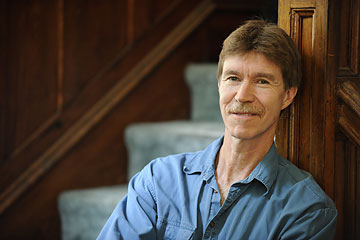

The four-time National Magazine Award winner talks about capturing the story of sport's most crucial time, just before the game starts.
SI Pictures
Listen to the interview with Gary Smith
Subscribe to Conversations: iTunes RSS
Gary Smith is Sports Illustrated’s heavy hitter. Four times a year, he delivers a piece of long-form journalism about sports, although as often as not his pieces are about the world outside of sports, but close by. “Beyond the Game,” his first collection of these stories was called.
His second collection just hit the stores. It’s called “Going Deep: 20 Classic Sports Stories.” He’s still going beyond the game.
A 1996 story about a young Tiger Woods isn’t so much about golf as it is about a young genius and his relationships, to the father who brought him this far and the world that awaits him. A story about Smith going to a high school football game with his son right after 9/11 isn’t so much about high school football or 9/11 or even his son. It’s about where sports fit in a person’s life. See what I mean?
“Beyond the Game” and now “Going Deep.” And that’s it. There’s no shelf of Gary Smith books. He’s a magazine writer. And he’s probably the best in the business. Not the sports business. The magazine business. He has won four National Magazine Awards, the mag equivalent to the Pulitzer Prize. Nobody else has won as many.
His genre’s getting a little archaic. Pieces two and a half months in the making and 8,000 words in the reading might seem out of step in our age of instant analysis by 500-word blog post. But it’s never a waste of time to slow down and let Smith, 54, draw you into a story. That’s his trademark, an invitation to the reader, often by direct address, often in the form of a rhetorical question.
We spoke by phone, Smith calling from home in Charleston, S.C. Come on in and listen to him talk. You hear Philly? He’s from Wilmington, Del., went to college at La Salle and got his start writing sports for his hometown News-Journal and the Philadelphia Daily News. Hear a little drawl? He says nobody’s ever mentioned it before, but you might get a whiff of what two decades of living in South Carolina can do to certain vowel sounds.
Why these 20 pieces?
You know, it’s a feel. One of the parameters was we wanted to get the four stories that won National Magazine Awards in there, and then the three that either a movie’s been done about or the rights have been bought for and are supposed to be done about. And then just kind of from there looking at a mix of some people that you really know, or think you know, and then people you never heard of, and just kind of go on a trail you never might have expected yourself to.
It’s interesting how it goes back and forth from Tiger Woods and Muhammad Ali, the biggest people in the world, and these people on the fringes of sports. I’m wondering which you like writing about better.
Usually it works out best with the unknown people because most of all they give you much more time and access. It’s quite rare to get a celebrity to give you the kind of access and time to do what I do.
There’s a theme you keep coming back to that I really like, which is that moment before the game. That TCU photograph that takes up the inside of the dust cover, the TCU football team about 15 minutes before the start of a Cotton Bowl game against Jim Brown and Syracuse. The piece itself is a meditation on that moment. And you keep coming back to that. You come back to it in the story about taking your son to a high school football game, Jimmy Valvano drinking in that moment before a game. I’m wondering, what is it about that moment, and is that moment even more important in sports than what I call “the ball going through the basket”?
Yeah, I think it is, and I think a lot of people who have been in athletics of any kind feel that way too. So much is about how you’re prepared in your head, or your fears in your head. What’s running through your mind before you walk out there. The ante just gets raised higher and higher the higher the stakes are. So it’s just things about yourself that you know or don’t know, in a way, that come into play in pressure situations. So yeah, I think it’s very important.
This might be a strange question, but do you feel that way as a writer? Do you have that moment as a writer?
Oh, there’s definite discomfort when it’s not coming together in your head and you can’t quite get how you either want to make the first words fall into a rhythm or just the idea of what’s going to crystallize how you’re going to start the story. Yeah, that can be a quite uncomfortable time.
I had a story that I was writing for this magazine years ago, and it was when Salon was having a lot of troubles and nobody’s job was safe, and I was about to ask my boss for something kind of big. I had a big story that I needed to write that day, and I kind of had it in my mind that if this story was really good I had a pretty good chance of the boss saying yes, and if it wasn’t I’d have a pretty good chance of needing to get my résumé out. I remember walking to work that day and kind of feeling like a starting pitcher, or a boxer before a match, trying to kind of quiet my mind.
That’s cool.
So the question is, these are lessons I had taken from sports without even realizing it until that day. Are there any lessons like that that you’ve pulled out of all this, that you’ve put in your own life? Beyond the obvious, like “try really hard.”
I guess the No. 1 thing is trust yourself. I described it as discomfort when you can’t find the words or the way into the story. The discomfort is less than it was years ago because I trust that something’s going to come here. Just relax, keep chewing and chewing here. That feeling of much more self-trust is probably the biggest difference, and I’m sure that’s what an athlete wants to have in his head before he walks into the arena.
But a lot of that comes with time, and for so many athletes, it’s such a short flameout, it’s like a mayfly’s life span. And for them to reach that point of self-trust, it’s really a precious few, when you look at the number of people who want to be athletes, how many had the time to develop that in that short of a life span. Fortunately in writing I’ve had the luxury of more time to develop that feeling.
You’re pretty accomplished as a long-form magazine writer. You’re kind of “the guy.” Do you ever think, “Maybe I’m complacent here. Maybe I should be writing books or movies, something where I don’t have that confidence”?
Yeah, I’ve put my hand at, done some fiction on the side. I don’t think it’s good enough yet to do anything with, but I’ve hammered away at that. I’ve played around with a screenplay. So it’s not a matter of not exploring different forms. Decent chance I will, at some point. At this point I’ve just been enjoying this so much. I’m kind of waiting for the moment to feel like I don’t like doing this. Each story feels new and different, so I’ve kind of trusted that feeling. But I’m open to other possibilities down the road at some point. Who knows.
Is that why there hasn’t been a dozen of these stories that have grown — I mean, you’re a third of the way to making this a book, or a fifth of the way, whatever it is. Is that why there’s not a dozen Gary Smith books?
There’s been a number of times there’s been interest in turning it into a book. I always just kind of hesitate before doing it. Not because — really, I feel like I could do that. I have so much information sometimes — it wouldn’t take that much more gathering to have enough to turn it into a book. But there’s a real feeling of, “So, I’m going to spend the next year and a half doing something that I’ve already thought through and really chewed on and then found a way to compress into this form, and now I’m just going to expand it basically?”
It doesn’t feel like there’d be enough new adventure, enough new learning in it for me. That’s something that is important to me, finding a way to kind of grow with each one of these things.
To hear more of this interview, including Smith describing his techniques for reporting and writing stories, listen to the audio podcast.
Is gay literature over?
In an era of same-sex marriage and "Modern Family," the role of gay writers is changing. An expert explains how
Gore Vidal, Tony Kushner and James Baldwin (Credit: Library of Congress/Carl Van Vechten/Reuters/Phil McCarten/Miami Dade College)
Gay life in America has utterly transformed itself since World War II. In the 1950s, homosexuality was a crime. Now, openly gay people are everywhere in popular culture, gay kids are coming out as early as elementary school and we can get even get married in a half-dozen states (including, soon, Washington). One of the most crucial, but least-talked about, reasons for this change is gay literature. Starting in the 1940s, a coterie of bold writers — Gore Vidal, James Baldwin, Armistead Maupin and Tony Kushner, among many others — played a central role in creating what we now think of as gay life. Their words gave voice to a segment of the American population that, for much of its history, was hidden away.
In his new book, “Eminent Outlaws,” novelist Christopher Bram uses a series of complex portraits of America’s most influential gay literary lions to argue for their position in the pantheon of American culture. The book covers expansive territory, charting the tumultuous relationship between Gore Vidal and Truman Capote, whose passionate hatred for one another lasted until the latter’s death (Vidal called it a “good career move”). It describes Tennessee Williams’ tortured relationship with his sexuality and gradual descent into alcoholic misery, James Baldwin’s struggles against racism and Edmund White’s eloquent reactions to the terror of AIDS. For anybody interested in gay culture, “Eminent Outlaws” offers a crucial and fascinating overview of decades of American literary history. It also raises the question: In an era when being gay is considered mainstream, does gay writing still matter?
Salon spoke to Bram (who is also the author of “The Father of Frankenstein,” which was later turned into the film “Gods and Monsters”) over the phone about Gore Vidal’s importance, the death of the gay bookstore and the problem with gay men today.
As you point out in the book, literature has had an outsize role in the evolution of gay culture. Why do you think that is?
For the longest time, there were no gay characters or story lines in television or in the movies, so people had nowhere else to go but books for stories of gay life. After WWII there was suddenly a slew of them. It was surprising how many came so quickly. People could and wanted to write about it and the publishers would publish it. In my book I emphasize Capote’s “Other Voices, Other Rooms” and Gore Vidal’s “The City and the Pillar,” but there were others. The mainstream houses backed away from gay material in the ’50s but it was picked up by smaller presses, like Greenberg and Guild. Once it started it couldn’t stop.
Why do you think the gay literary explosion happened right after World War II?
It was partly WWII itself. Gay boys who had grown up in the middle of nowhere entered the service, and found out they weren’t alone. Alan Berube, in his book “Coming Out Under Fire,” does a great job of painting this sudden awareness and huge change. Gay people also wanted to read about each other, and after WWII censorship for books loosened. Before, cities would ban any book with sexual content, and after WWII people could write about sex, even gay sex.
Gore Vidal is the major thread connecting the book. Do you think he’s the most important figure in gay literature of the last 50 years?
Yes, but almost by accident. It’s not a role he wanted. “The City and the Pillar” is a very gay book published early on in 1948. It sold very well but he got kicked in the teeth for writing it, and after that he played a little more coy. He adopted the strategy that there’s no such thing as a homosexual, there’s only a homosexual act; homosexual is an adjective and not a noun. He wrote “Myra Breckinridge” in the ’60s, which is this wonderfully polymorphously perverse novel about a transsexual who rapes a straight man at one point. It’s over the top and out there and was a huge bestseller. Then he started writing historical novels, which hardly dealt with homosexuality. But one of the most amazing things he wrote from a gay political point of view is the essay “Pink Triangle, Yellow Star,” which was sparked by a very foolish bizarre essay by Midge Decter about gay men and their identity. He tore her essay to shreds, but he also argued that Jews and homosexuals had a lot in common, that they were both minorities that are in the same boat.
In the last few years we’ve seen the disappearance of a lot of gay bookstores around the country. What do you think this says about the state of gay literature?
That is a major change and it’s an important and worrisome one. There are a couple of factors causing it. Independent bookstores have been in trouble for a while, struggling to compete first with super-chains and then Amazon and the Internet. Now the whole book business is going to transition, and even the super-chains are in trouble. Gay bookstores were always just keeping their heads above water. But I don’t think it says so much about gay books in particular as it does about the book business.
Edmund White once wrote that “‘Will & Grace’ killed gay literature.” Do you think he’s right — that the rise of gay TV and movies has made gay writing less appealing?
I think it’s reduced the gay readership by 10 or 15 percent — not a huge amount. And those were the people who didn’t really enjoy reading anyway. For them, it was their only way to get gay stories. Now they don’t have to. Independent film has dried up the same way indie bookstores have, so there’s not as much gay film as there used to be just 4-5 years ago, but the change in TV is phenomenal. These shows matter-of-factly include gay story lines and characters and do really good jobs with them. They’re not just here as comic relief, they’re really fully fleshed out, well-drawn characters. These TV shows are following in the footsteps of Armistead Maupin’s “Tales of the City” by including gay characters in this larger world.
Larry Kramer has very forcefully argued that young gay people these days don’t respect their elders or their history. Do you get the sense that young gay men today are less interested in gay culture and literature than they were in the past?
Not really. I don’t think the current younger generation is different from mine or even Larry’s. In my generation, we hated our elders. We might like Christopher Isherwood, but there was a dislike of the older generation: “They got it all wrong, we’re going to get it right.” I think that’s a natural generational dynamic; as time goes on you learn to keep what was good from the older generations and drop what was bad. I like the generations being different. Every generation wants to carve out their own space and to some extent it’s going to mean rejecting the older generation.
But Larry Kramer isn’t alone in feeling hurt by this. What do you think spurs this particular kind of anger among older gay men?
You’re getting older and you know you’re going to die, and you’re not happy about that, so you take out your anger on the generation coming behind you. I teach at NYU, so I work with people in their early 20s and I expect us to have nothing in common but I’m always surprised by the books they like, the movies they like, the things we do have in common.
I also think older gay men are pissed off that young gay men seem entitled and don’t seem to know what gay life was like in the ’50s, ’60s, ’70s, and especially the ’80s, during the first wave of the AIDS crisis.
Why should they know it? When they are aware of it, I’m pleased but I don’t expect them to. They’re lucky they didn’t grow up with the hardships Larry’s generation grew up with. My generation didn’t have it as harsh as Larry’s did, but I had it a little harsher than yours. It’s only natural. You just kind of have to accept that.
In his famous essay in the Atlantic, Andrew Sullivan argued that we’re witnessing the “end of gay culture,” that it’s splintering and dissolving as a result of mainstream acceptance.
Old gay culture wasn’t that solid to begin with, and [literary gay men] were always a minority within a minority. Even when gay books were the only game in town, there were plenty of gay people who didn’t read. For them being gay was about sex and going to bars and dancing. There’s still gay culture around and it takes different shapes and forms. Gay bars don’t play the same role in gay life they once did 10-15 years ago. The Internet has changed that too. I miss the gay bookstores, but I like the difference and the variety.
Do you think there’s such a thing as a gay sensibility in literature?
When Jeff Weinstein, the New York culture critic, was asked if there was a gay sensibility and if it affected culture, he said, “No, there’s no such thing as a gay sensibility and yes, it does affect culture.” I feel that way. The only thing holding these men together is that these were men who were sexually attracted to men who would write about it and about how that mixed with the rest of their lives. For some writers, [their gayness] was just one more ingredient in the stew, like Armistead Maupin. For some, sex and love with other men was everything, like Edmund White. But even he mixed things up. His new book is about the friendship between a gay man and a straight man (though I think his best writing is his sexual writing).
Speaking of Edmund White, he has very strong feelings about writers, like Susan Sontag, who were famous but did not come out of the closet.
I think if she had actually written as a lesbian about lesbian life it would have given a whole other dimension to her work and she would have been a much more interesting and exciting writer than she was. But I just think of her as a writer [not a gay writer]. The other writer he talks about is Harold Brodky. Being unable to write directly about gay life made his prose weird and baroque and really blocked him as a writer. For me, their being in the closet becomes its own punishment.
A friend of mine recently told me that he thought we just don’t have the kinds of great gay literary writers that we used to. I think we do, they’re just not known as primarily gay writers. Do you think that’s true?
There’s good stuff being done by younger writers than the old war horses. It just hasn’t gotten the attention it deserves. Paul Russell just did an amazing book last year called “The Unreal life of Sergei Nabokov,” following Vladimir Nabokov’s gay brother from pre-revolutionary Russia to Paris in the time of Cocteau to Nazi Germany. Peter Cameron’s last book, “Someday This Pain Will Be Useful to You,” was very smart and beautifully written. Bob Smith, a comedian, did a wonderful novel called “Remembrance of Things I Forgot,” about a gay man who travels through time to help his family and discovers he’s been pursued by that arch-villain Dick Cheney. And then there’s Rakesh Satyal, and the novel he published two years ago, “Blue Boy,” about a gay 12-year-old boy in an Indian family in Cincinnati.
What gay books would you recommend as must-reads to a gay kid coming of age right now.
You could do far worse than Armistead’s Maupin’s “Tales of the City”; the entire series would be a great education in itself. Maupin imagines and records this world in San Francisco where gay people are just one more piece of the puzzle and accepted as such. And there’s “Giovanni’s Room” by James Baldwin. It’s set in Paris in the 1950s, about a gay man who almost comes out but doesn’t. It’s very painful, beautifully written and it would show him what we’ve come away from. I’ll be selfish and recommend one of mine, “Surprising Myself.” It was my first novel, published in like 1987, and it’s set in New York in the ’70s — the sexual golden age.
Spoiler alert! What makes a great ending?
Books with terrific conclusions are hard to find, but they're even harder to talk about
The endings of novels are, in their own way, as crucial as the endings of years, but they are much less discussed. Any bibliophile can rattle off at least a handful of famous first lines (“It was the best of times, it was the worst of times…;” “It is a truth universally acknowledged…; ” “It was a bright cold day in April, and the clocks were striking thirteen,” and so on), but ask someone to quote a memorable closer and chances are all they can come up with is F. Scott Fitzgerald’s “So we beat on, boats against the current, borne back ceaselessly into the past” (from “The Great Gatsby”) or James Joyce’s rhapsodic “…and yes I said yes I will Yes.”
The trick of a good ending, of course, is that it must capture and equal everything that has gone before. The line “He loved Big Brother” (from a novel that ends as masterfully as it begins) means very little until you understand exactly who Big Brother is. A first line or opening scene need only arrest a reader’s attention and stoke her curiosity; a final scene or paragraph is expected to provide that sensation so rare in real life: completion. The better the book, the more nuanced and persuasive, the more difficult this is. We want a novel to swell with a sense of limitless possibility at the start and in the middle, but we also want it to zero in to a point of inevitability as it ends.
For this reason, last lines, like first ones, often suffer from a bad case of Trying Too Hard. Any writer can swoop up from the particularities of character or story to assert a magisterial generality and come across as terribly grand. If you like the 100,000 words that come before it, this tactic sorta works. Yet so many endings sound a note of profundity without actually being profound. (I confess that, lovely as Fitzgerald’s famous last sentence is, it doesn’t strike me as any truer than his equally famous remark about there being no second acts in American life.)
Better the last line or final scene that’s more modest in its language yet still packs a wallop; the success of such endings, when they succeed, is fully earned. Take the closing of “The Marriage Plot,” by Jeffrey Eugenides, one of my favorite novels of 2011. The last word, in a witty riposte to “Ulysses” (for this is a book that’s partly about other books), is “Yes,” but it has a very different import. Alas, only those of you who have already read the novel will understand what I mean.
The main drawback to swapping notes about favorite endings is the spoiler problem. The last line of Sarah Waters’ sublime 2009 ghost story “The Little Stranger” is like a key that unlocks the entire narrative, but I can’t tell you why in case you haven’t yet read it. Earlier this year, researchers demonstrated that readers enjoyed stories more when they knew in advance how they would end, but the belief persists that an untimely revelation of plot points will ruin the experience.
Even if we set such objections aside, when you wish to make the case for a particular ending, you still have to summarize the novel for whoever hasn’t already read it, and what summary is ever as good as the book itself? An exception, which can be related without giving much away, is the ironic last scene from Matthew Kneale’s excellent historical novel, “English Passengers,” a book, published in 2000, that captures the absurd hubris and brutal practice of colonialism in Tasmania. One of the supporting characters is a British scientist intent on proving the inferiority of nonwhite races by examining their skulls. By the novel’s last page, he is dead, and via a series of mix-ups, his own bones are displayed in an exhibition in a London museum, marked “Unknown male, presumed Tasmanian aborigine, possible victim of human sacrifice.” Yes, it’s essentially a joke, but one that distills the self-delusion of racialism in a single placard, and one that’s perfectly in tune with the novel behind it.
What are your favorite fictional endings, Salon readers? Share them in the comments thread below.
Further reading:
The Association for Psychological Science on how stories aren’t spoiled by spoilers
Salon’s review of “The Marriage Plot” by Jeffrey Eugenides
Writing class from hell
As "Seminar" hits Broadway, novelist Ben Marcus judges the tyrannical writing teachers of stage and screen
Alan Rickman appears at the curtain call for the opening night performance of the Broadway play "Seminar," on Nov. 20, 2011. (Credit: AP/Charles Sykes)
“Seminar,” a play starring Alan Rickman as a preening, acid-tongued teacher running roughshod over a group of tender aspiring writers, opened a few weeks ago on Broadway. Reviews have prompted all the usual observations about the difficulty of dramatizing both writing and reading, activities so internally momentous yet so physically inert. Why, then, do people keep doing it? And do the depictions of writing classes in stage, film and television — from “Wonder Boys” to “Bored to Death” — bear any relationship to real life?
To hash this out, I invited Ben Marcus — a novelist and an associate professor at Columbia University’s School of the Arts, where he teaches fiction writing — to see “Seminar” with me and talk afterward about the ways writing workshops are depicted in the performing arts. His first novel was acquired by the writer, editor and teacher Gordon Lish, considered to be the inspiration for the character played by Rickman, and Marcus also attended one of Lish’s legendary seminars, conducted in private homes, like the class in the play. (Marcus’ fourth book, the novel “The Flame Alphabet,” will be published in January.)
We found Theresa Rebeck’s play amusing and pointed — right down to a reference to the bi-coastal literary magazine Tin House — despite the fact that it doesn’t bear much resemblance to any writing class we’d ever encountered. That, we concluded, might be for the best.
When characters are discussing writing in a dramatic work like “Seminar,” the things they say are so sweeping compared to the more detailed focus of an actual writing class. But what also struck me in this play is how the concept of writing and of being a writer is so intensely romanticized.
Also, the students have no ability to determine their own value for themselves. That’s the great conceit the whole play is riding on, that these people can’t begin to make a decision for themselves. That makes them funny, silly and ultimately vulnerable.
I noticed some of that with Gordon Lish. There were degrees of vulnerability around him. On one hand, it was easy for some people to blame him for his forcefulness, but with people who weren’t quite as vulnerable, I think that they thrived and got a lot more out of it. They got to listen to him talk inside and out about a piece of writing and to see that he could be deeply perceptive and that he cared about fiction more than anything else in the world.
The people who got caught up in the theater of winning his approval instead of, say, deriving their own system of self-worth, they didn’t seem to fare so well.
Would you say that some of the people who went to his seminars were like the characters in this play? Like a lot of writing students in movies and TV, they seem to be in the class for the sole purpose of getting a verdict on their work from some big-time authority figure.
In the students, I didn’t really recognize anybody I’ve ever seen. There are little bits here and there, but the thing I really didn’t recognize is the sort of blatant and publicly articulated desperation. There’s one character, the one who’s using his connection to his famous uncle, who is a very enjoyable stereotype. But anyone who behaved that way in front of any writing student I know — people would be horrified by that. Most people are self-aware enough not to behave the way that guy does.
But even if people don’t behave that way that doesn’t necessarily mean …
… that they don’t think that way, no. You could argue that it’s the play’s job to externalize that stuff because it’s funnier to see everybody acting on their demons and their craven desires. It’s more entertaining.
There’s stuff that, as the teacher, you don’t necessarily see. I once taught this class, maybe five years ago. It just never gelled. There was something strange about it. I just thought that I sucked because I couldn’t get them going. The semester ended, and I ran into someone who’d been in the class. That person then told me about this elaborate set of dramas that was going on among the students. There was a broken love triangle, someone who tried to kill someone else and they hated each other. It was just insane! I had no idea. They were consumed by their own drama.
Speaking of drama, the play takes the position that writing is a completely tortured experience.
Tortured and joyless, with no possible good outcome for anyone. One of the funny things that Alan Rickman’s character does is that he gives these predictions about everyone else’s future: This is what your life will be, in these funny monologues. The most talented one, who was writing the best work, he’s got a miserable future ahead, totally miserable. There’s no redeeming thing about it at all!
He’s going to end up like the Alan Rickman character.
A big difference that I would cite from Gordon Lish, is that he didn’t have any of the buffoonery of the Rickman character. He wasn’t self-important or grandiose, with the bragging, the travel and the overt sexual stuff. I think there was clearly a big ego there, but he was also very modest in person. His feeling was, “I will never do really great work, but maybe you will. If you think about these things, maybe you will. It’s too late for me.” The drama was about whether or not you could get behind his enthusiasms.
The thing he did that might be construed as abusive was that he was interested in pitting people against each other. Let’s say we have Smith and Dale: Smith might write something interesting and Gordon would say, “Dale, what’s your answer to that? How are you going to sleep at night knowing that your buddy here has written something so good?”
I think the pedagogical idea is that you might work harder if you feel competitive with your peers. Sometimes he would create competitions, but other times the students just weren’t biting.
What the Alan Rickman character does — his long, irrelevant, self-glorifying digressions about his adventures in various kinds of disaster tourism — well, maybe Gordon Lish didn’t do that, but I’ve certainly heard about a lot of writing teachers who do.
It struck me as a more old-fashioned, first-wave creative-writing model. The famous writer is trucked into the Midwestern university. He’s drunk all the time and he makes these pronouncements. You don’t even get your work read, but you sit at his feet and listen to these drunken tales and that counts as some kind of instruction.
I got my MFA about 20 years ago, a little more. Then, there wasn’t much of an established tradition of actual instruction. Now, 20 years later, if there are 12 students in the class, the students are getting back 11 copies of a submitted work, plus the instructor’s, with intensive line editing and one-and-a-half to two-page, single-spaced typed criticism — more criticism on this apprentice work of fiction than you get when you publish a book. This feedback machine has been created, giving students some pretty substantive criticism. That, I think, takes the spotlight away from the instructor as this Svengali figure who makes these pronouncements that are going to lead to some shattering revelation.
Enjoyable as those revelations are to watch on stage! Another thing you don’t see in the play is the idea that there are different types of literary traditions, each equally valid, the idea that good writing can be something other than opening a vein on the page. One of the characters writes a fake memoir about a transvestite Cuban gang member that completely deceives them all until she tells them with great amusement that she’s the one who wrote it. They all think it’s fantastic before that, but it’s still presented as a debased thing for her to do.
Well, she’s taking a sort of superficial bait by going for this supposedly gritty, real-world authenticity that the teacher wants. There’s a little bit of satire in there, right, because she can actually ape this form perfectly and she makes a successful piece of writing. It says something about how we value the personal stories behind the writers. If it’s a book about the streets, we want the writer to be …
… of the streets.
Yeah. You see that when you’re promoting a book. No one’s interested in talking about the actual book. They want to talk about the person who wrote it. What bad things happened to you that we can talk about? So the play does some funny satire about our desire for the “real” by also showing that someone can fake it. It’s just a style. It’s artificial and anyone can do it.
Then there’s the figure of the young woman who writes a lot about sex, and she’s very pretty and fully prepared to capitalize on that, and this generates a lot of bogus interest in her work. Now, that’s not an unfamiliar kind of writer, but sometimes the writers who fit that profile are actually really good writers as well.
They are.
They’re more mediagenic, and many people resent them for that, but that doesn’t mean that they can’t be talented, too. In the play, that character is sympathetic, very grounded. But she’s also a slapdash person who isn’t committed to doing good work. She’s likable, but she’s supposed to be a contemptible writer.
She didn’t have any gravitas at all. But then gravitas is often an awful thing to encounter when you’re teaching. It doesn’t correlate to anything. When it’s attached to really poor work, it’s torture.
Each of the students had to play a certain type, right? They all play really well. There is the glib, competent, self-promotional one. And there’s the sullen genius who refuses to show his work to anyone — but that’s where it all starts to fall apart. He, in the end, is immune to the praise that he’s so covetous of.
It’s meant to show his integrity, I guess.
Yet he was still there, still soaking it all in.
He’s the character who dissents from the seminar and has a distance from it in a way that the audience shares. He’s a skeptic about everyone else’s shtick, recognizing it as shtick, which is what the audience is doing, too.
It’s funny to see these types, but it would have been funnier if their writing didn’t correspond to their type in such an obvious way. Because, too often, the self-important, brooding genius type — that guy is bad. He’s so bad.
Yes! In real life, the guy who is melodramatic and idealistic and angry about the importance of writing, and just so grandiose about it, is also the person who lacks the subtlety or wit or humor or perspective to be a really good writer.
There’s really the biggest myth of all that’s propagated by the play, which is that somebody’s persona has a lot to do with the quality of their writing. That’s just never true. Sometimes, it’s the dull, plain person who turns in totally killer, electrifying writing. Sometimes the really dynamic, witty, amazing person just dies on the page after the first sentence. Or, sometimes the really talented person is just a complete sweetheart. Just a really nice person. The whole notion of equating somebody’s personality with what they’re capable of creatively just falls apart very, very quickly.
One of the characters takes a job as a ghostwriter, and that’s treated as a fatal deal with the devil. Once you take a step in that direction, you are doomed as an Artist. She couldn’t possibly learn anything from it. That doesn’t take into account how Hemingway’s early work as a reporter affected his fiction, let alone the fact that a number of revered novelists — Don DeLillo, Peter Carey — started out working in advertising.
It’s really a portrait of a certain kind of idealism that you can only have before you’ve done anything. It’s of a certain age and a certain stage.
But if you’ve never gotten past that stage, or have only seen it from the outside, it might seem like the way all writers are. Which is why the play convinces its audience, perhaps.
Everybody was laughing.
Laughing in a very knowing way, too! I get the impression that the image many people have of writing classes comes from this sort of depiction.
What’s funny to me is that, as far as I know, instruction in some of the other art forms doesn’t seem as available for satire and derision. Why aren’t we making fun of people making mud sculptures and the pretensions of teaching in the visual arts world?
That’s especially puzzling because when it comes to visual arts, you can actually show the audience what the characters are making.
And, oh my God, it’s even worse. I’ve seen it firsthand. They say things that, if you wrote them down — there’s nothing there. The kind of faux theory shit that comes up is so crazy and meaningless. It should be made fun of so much more! And yet, we don’t treat the formal study of painting as if it were a joke. We don’t question that someone might want to go to art school.
Or music school.
Boy, that just seems like it would be the last subject for comedy, right? A music class in graduate school. And yet, when it comes to writing classes: “Ha, ha, ha! What morons! They think they can get together and talk about writing!”
What is that? There’s the whole “Writing can’t be taught” thing. I was once at a dinner, and at the other end of the table there was a gray eminence writer, whom I won’t name, who said, when asked if he taught, “Writing can’t be taught.” And I, a smartass 20-something, leaned over and said, “You mean you can’t teach it.” Because how does he know? That’s like me announcing, “Cello can’t be taught!” because I can’t teach it.
I think a lot of stuff does get taught and it can be talked about. I think writing is a craft. Language is the medium and you make things with it. But, you’re right. This play isn’t for people like me. It’s for people who have a vague idea about what goes on in a writing class. It’s a rough enough sketch, and it’s funny enough. It would be dour to demand realism from that play. It would be ridiculous. It would just take the entertainment away. I would never go to a play that was accurate about teaching. My God!
How my book became part of the “satanic sex stabbing”
My werewolf guide was found at the scene of a gruesome crime, but what chilled me was the media panic that followed
Left, Rebecca Chandler (left) and right, Raven "Scarlett" Larrabee (Credit: thesmokinggun.com)
On the night I heard about my connection to a “satanic sex ritual stabbing,” I had just finished the dishes with my wife. It was about 10 p.m. on a Wednesday, my 2-year-old daughter was asleep in bed, and I was in the living room, casually catching up on email. “I assume you’ve seen this,” a friend wrote. The link took me to a headline on Gawker.com:
“Satanic Sex Ritual Threesome Not as Awesome as It Sounds.”
The post was accompanied by the menacing mugshots of two young, dark-haired Goth chicks. The first girl, Rebecca Chandler, defiantly faced down the camera with piercing eyes, her angular face tightened into a spiteful glare. The second, Raven “Scarlett” Larrabee, looked a little less aggressive, instead opting for a well-practiced look of high school derision, accentuated by wavy black hair that almost completely obscured the right side of her face. The pictures looked like casting photos from the clever feminist horror flick of the early 2000s, “Ginger Snaps,” about two teenage sisters coping not only with periods and puberty but the fact that one of them was slowly turning into a werewolf.
I know all about this film, and dozens of others like it, as I’m something of a werewolf expert. In 2009, along with fellow comedy writer Bob Powers, I wrote a humorous self-help book for werewolves, titled “The Werewolf’s Guide to Life: A Manual for the Newly Bitten.” It included friendly tips for lycanthropes to safely manage their condition, survive their “moons,” and live safe, productive, nonviolent lives. It included dozens of helpful graphs and charts and featured illustrations by the very funny cartoonist Emily Flake. This illustration, for example, demonstrates the perils of leaving one’s wedding ring on during a transformation:

But back to the blog post:
Last week, a 19-year-old guy from Arizona took the bus to Milwaukee to meet a girl (Chandler) he knew from the internet. On arrival, he discovered that she and her roommate wanted to have a kinky, possibly Satanic, threesome. So far, so awesome. And then came the part where he was stabbed and slashed 300 times.
Well, that just got a lot less funny. But the real sucker punch came when I got to the part about the reading material on their table.
According to Chandler, the sex and stabbing were both consensual, but “got out of hand” (at least, the stabbing did). Chandler also says that Larrabee did “the majority of” the cutting, and that Larrabee was “involved in satanic or occult activities”; in their apartment, the cops found a bunch of books that sounds like they were purchased at the local Hot Topic, including The Necromantic Ritual Book and The Werewolf’s Guide to Life.
That was my book. At a crime scene. Seized by police and entered into evidence at a bloody, murderous crime scene. A bloody, murderous satanic crime scene. A bloody, murderous satanic sexual crime scene.
My body went numb. Was there another “Werewolf’s Guide to Life” out there – like, an evil one? No, that was stupid. Of course it was my book. My stomach ached, and I grew dizzy. It was the same creeping nausea I used to get when I was bombing onstage as a standup comic, but this had an added horror. My joke wasn’t just being misunderstood; underneath my minor panic attack was far darker question: Could my humor book about nonexistent monsters inspire a real-life murder?
I called my coauthor Bob, and after rereading the article and several others, I was relieved to discover that the victim of the encounter was not dead, would apparently make a full recovery, and did not appear to be pressing charges. None of this information was apparent from any of the sensational headlines.
I began to calm down a little. Bob reminded me that our book is shelved in the humor section, and there is nothing in it that encourages violence. Even if one were deluded enough to believe it was true, it’s still 200 pages of instruction on how NOT to hurt yourself or others. If those two girls were into the occult (an assertion that is by no means proven), it’s possible they might also enjoy a funny werewolf book. But it makes about as much sense to include that book as evidence that a satanic sexual bloodletting took place as it would a VHS copy of “Teen Wolf Too” starring Jason Bateman. (And yes, “too” is the proper spelling.)
Over the next 24 hours, we watched powerlessly as the story went viral. MSNBC published a story ominously stating that police recovered “a copy of a necromantic ritual book titled ‘Werewolf’s Guide to Life.’”
They weren’t alone. Our book was repeatedly positioned in story after story as though it contained ancient satanic secrets, or was torn straight from the pages of Aleister Crowley’s diary. England’s Daily Mail featured the cover of our book under a headline that screamed: “Two female room-mates ‘tied up teenager and cut him 300 times during two-day satanic sex torture marathon.” The caption for the book’s picture read: “Odd books including ‘The Werewolf’s Guide to Life’ were found in the pair’s apartment.”
Glenn Beck went on the radio and amazingly used the incident to align Wisconsin satanism with the union organization in that state, the Occupy Wall Street movement, and an ancient god named Baal — and even threw in Hitler at the end, because that is an entirely normal and logical leap to make. The original title of Beck’s post, by the way, was “Man Killed in Satanic Ritual.” A correction added later thanked Internet commenters for pointing out his error.
Our book went on to be misrepresented in many different languages, including Chinese and Dutch, the latter of which (according to Google translator) claimed “The Werewolf’s Guide to Life” was “A book of black magic rituals.” No one mentioned that our book came out in 2009, maybe because the story doesn’t sound as sexy if the terrifying occult book found at the blood-drenched altar of Satan came out the same year as “Ice Age 3.”
We eventually found our sense of humor about it. I wrote an official response for our blog. Bob joked about it on Facebook, and we hoped it would help us sell thousands of books (so far, no luck).
But fun as it was to be swept along in this, it also kind of sucked. There may be no such thing as bad publicity, but the book these articles described certainly wasn’t ours. If you did happen to be looking for a step-by-step guide on how to murder people for Satan as part of a two-day sex binge, one look on Amazon would tell you our book wasn’t that.
Even worse than being misrepresented in the media was how lazy it all seemed to be. If the reporters charged with covering this story actually spent five seconds looking up what the book was about (they certainly had the time to do a Google search and steal an image of the cover), they could have mentioned it was filed under the “humor/parody” section. To be fair, some journalists, including the Smoking Gun, did. Gawker came close, questioning the book’s real-life satanic qualifications with the Hot Topic quip.
But as I read more of these stories, I came to the depressing conclusion that it wasn’t laziness to blame, it was tailoring. In story after story, the facts of the case actually seemed less important than the details that appealed to a particular website’s niche. Those that worked were pushed forward, and those that weren’t got held back. And if I were going to complain of shoddy treatment, I got off easy compared to what those girls had to endure. Just to pick one example, a website called BroBible ran the mugshots, of course, and then opened with these lines: “How kinky are these sluts? Better yet, how pathetic is the poor bastard who took a bus FROM ARIZONA to Milwaukee just to have sex with them?”
It’s safe to say that something strange and horrible happened that night in Wisconsin, but something strange and horrible is also going on when the images of two young girls who haven’t been convicted of any crime can be rocketed around the globe, and the facts of their lives ignored or twisted. What happened for sure was those of us clucking our tongues, gasping and laughing as we read this story weren’t getting the truth about those girls, not by any stretch. And that certainly isn’t a new phenomenon.
Earlier this year, the men known as the West Memphis Three were released after almost two decades in prison. Their story, popularized in the award-winning documentary “Paradise Lost: The Child Murders at Robin Hood Hills,” told the tale of three teenagers convicted of child murder despite a notoriously bungled investigation. Though the crimes were different, that story has a fair bit in common with the satanic-sex tale: The defendants had scary mug shots. They were “weird kids” who never seemed to have their act together. They were outsiders. In that particular case, the boys listened to scary-sounding music like Metallica, while Chandler and Larrabee read scary-sounding things like “Intro to Sigilborne Spirits” and — GASP — “The Werewolf’s Guide to Life.” But both stories thrived on a fundamental mistrust of what is different.
No one wants to look at the story of Chandler and Larrabee as the story of two people. Instead, it’s another piece of Internet content, and showing the whole truth takes the fun out of it. In the age of the hit count, this story had all the elements of a traffic monster: blood, sex, Satan, and a couple of evil-looking young girls straight out of central casting. Their mug shots made for a splendid movie poster, and our book was the cardboard standup in the lobby. Whatever really happened was so much less entertaining than what could have happened, so why not use technically true words that make the story what they wanted it to be?
Why use words like “poked” or “pricked” 300 times when you can say “slashed” or “stabbed”? Why mention that the victim went there of his own free will when you can say he was “lured by the promise of sex”? Why frontload the fact that he wasn’t pressing charges, or was recovering at home, when it’s so much more delicious to let the reader believe he’d been murdered? And what the hell, if there’s a book that sounds dangerous, why let people know that it’s supposed to be funny?
Whether Rebecca Chandler and Raven Larrabee are guilty of a crime, I don’t know. Was this the story of two cold-blooded, evil satanists whose ritual of sex, blood and murder was thwarted by police? Or was it a case of two relatively harmless wannabe wiccans who hadn’t mastered the concept of a safe word? Likely, the truth lies somewhere in between. But if we don’t know the answer to that question, it is worth asking: How good was this story? Was it worth the treatment those young women received as story after story about them filled with lies and half-truths spread all over the world? Because that’s what these ghastly novelty articles look like to me — a grievous wounding, by hundreds of little cuts.
My Brilliant Second Career: The surprising leap from Viagra sales to journalism
After I was laid off from a Fortune 100 company, I gave up the corporate dream -- and began pursuing my own
(Credit: Maisei Raman via Shutterstock)
Jon Stewart was particularly pithy that Thursday night in January 2009. For weeks, my husband and I had been witnessing the economic roller coaster on television. But now, as we watched Stewart joke on “The Daily Show” about the Fortune 100 companies who’d laid off workers, it was horrifyingly personal. I was among them.
For nearly a decade, I had the mother of all sales jobs as a pharmaceutical sales representative; I sold Viagra and other medicines to urologists, family practice and internal medicine doctors. That Thursday morning, I’d been instructed to sit at home by my phone from 9 to 9:30 a.m. and wait for the call that would determine my professional future. The phone rang at 9 sharp; my district manager, awkward and stuttering, read a prepared text to inform me that I had been terminated. Later, I learned that he’d lost his own job the day before.
So, after years making great money, enjoying “Cadillac benefits” and the opportunity to travel the country on someone else’s dime, I found myself at a crossroads: an unemployed 50-something woman whose only child had recently left for college 1,000 miles away. I had worked in healthcare marketing and sales for nearly 30 years. What was I going to do now?
The change not only threw my life path and family finances into question, but it also shook up the ground rules we had lived by in our two-and-a-half decade marriage. Since I could barely hard-boil an egg, my husband, a college librarian, had always done the cooking. But now it only made sense for me to take on that responsibility. Meanwhile, my husband had grown accustomed to having time alone in the evenings after a long day at the university. Now, he found me practically charging him at the door with the outdated words: “How was your day, dear?” Our marriage seemed headed back to the 1950s, a prospect we both found disconcerting.
During the dull, gray days of that Indiana winter, I sat alone in our big, quiet house, wondering what to do next. I completed the company’s outplacement training and perfected my résumé. But there were no jobs for me, despite my decades of experience; going back into pharma sales would be nearly impossible. My company cut nearly 4,000 reps that day, and competitors were doing the same thing.
The thought of carving out a new territory at this stage of my life was daunting. But there was one dream I’d been putting off in favor of the more stable and lucrative life in the corporate world: to be a writer. Long ago, I’d been a journalism major in college. During my last few years in college, I interned at a small daily, the Columbia City Post and Mail. The 1970s newsroom was straight out of a movie. Edwin, our police reporter, wandered in and out of the office in his rumpled suit, holding a lit cigarette with an inch of ash hanging off the end. Eloise, on the copy desk, lit me up when I turned in my first story with several misspellings.
As I applied for jobs that didn’t interest me, or that screamed “Wanted: Beautiful twenty-something with Ivy League education,” I couldn’t help thinking back to Fitzgerald’s fabled advice to Faulkner, “Write what you know.” I know it sounds hackneyed. And I know that no sane person would want to work for newspapers, which were folding all over the country. But maybe that’s what ultimately sold me on the plan: What did I have to lose?
Three decades after I walked out of the Post and Mail’s newsroom, I tried to find my way back in. I contacted the managing editor and offered a free biweekly column. I had been journaling on my own, and already had a ready-made stack of essays on everything from angst over job loss to my defiant hatred of pickles. The managing editor was excited to get new content. She told me she would try it for a few months.
Why write for free? That’s an easy answer. Small papers don’t have the budget for columns, and more than income at that point, I needed an audience. It’s the same calculation made by countless bloggers, hoping that once people read my material they’d eventually be willing to pay for more; it’s just that my forum was a bit more old-fashioned than the Internet and, it turned out, so was my content. I wrote about growing up in small-town Indiana in the 1960s. I wrote about the people and places that nurtured me, the strange and endearing characters of that village, like the piano teacher with the full concert grand in her living room or the perennially young manager of the skating arena who whipped around the rink in his white, sparkling skates to classic skating tunes like “Louie Louie.”
Sometimes, I wrote about nothing. I wrote about disposing of kitty litter that had frozen in a huge, obscene clump in a garbage bag in the snow. I wrote about learning to cook, and the various mistakes I made along the way. It was working: I started getting letters from people with whom my reflections resonated. People told me their own stories, and they asked me to write more.
I suppose that it’s strange that the success of my new job involved nostalgia for another time. But so much about our lives now is harried and ever-changing; I think my columns were a way to remember and take comfort in a not-too-distant past. I’m not sure if life actually was easier then; but in our memory, it certainly feels like it was.
Armed with new clips, I landed a real assignment at a local woman’s magazine, one that paid. More articles spawned more work, and I began to write for an increasing number of area and regional publications. Last July, I self-published a book, “The Luxury of Daydreams,” which earned solid local reviews and brought more income, which I supplement by writing Web content and editorial material for healthcare organizations, a remnant from my prior work life.
While I’ll never make the salary I earned, I am making a living. As an independent contractor I can turn down assignments I don’t like and focus on the ones I do. I’m no longer chained to the golden handcuffs of corporate culture. There is no annual territory restructuring, no competitive intel on the new erectile dysfunction drug. I control my destiny.
Work fulfillment does not, however, pay the bills. I drive an 11-year-old Accord with peeling paint and nearly 100,000 miles. Going out for dinner is a special occasion, instead of the way I cope with frequent exhaustion and stress from a rigorous and inflexible corporate culture.
Working for myself is challenging, but life can accommodate more change and growth than we realize. Just three years ago I made an excellent living selling promises of sexual fulfillment and freedom from incontinence. The money rolled in, but I always wanted a new purse, or shoes, or a vintage fountain pen. There was always a bonus next quarter, a carrot dangling on the end of a stick. Now, I’m cautious with every dollar I’ve earned. It’s not easy. But I’m no longer selling someone else’s dream; I’m living my own.
Page 1 of 56 in Writers and Writing
Demi’s last night out
One day you’re in
Pitch and catch
Whip-it
My debate with Charles Murray
More tips for literary lovers
U.S., China need a green peace, not a trade war
Santorum mangles the Founding Fathers
Chris Christie’s gay marriage headache 

