
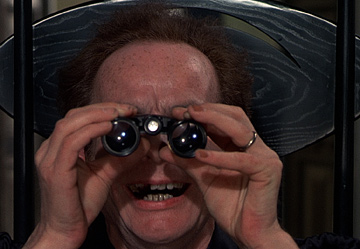


Courtesy of the Criterion Collection
Aldo Valletti in Pier Paolo Pasolini’s “Salò.”
A year or so before he was murdered in 1975, the Italian Marxist poet and filmmaker Pier Paolo Pasolini declared that the time had come when “artists must create, critics defend, and democratic people support … works so extreme that they become unacceptable even to the broadest minds of the new state.” It sounds like a noble and/or foolhardy statement of artistic radicalism at first, and when you read it again it also presents an irresolvable contradiction. Broad-minded people must support works that even the broadest-minded people find unacceptable.
Between that public pronouncement and his death in a squalid Roman suburb — apparently at the hands of a young male prostitute — Pasolini put this impossible principle into practice in his final film, “Salò, or The 120 Days of Sodom,” one of the most notorious works in the medium’s history. Certainly the European art-film tradition, with its tendency toward elegant, ironic, highly aestheticized appreciations of human life, has produced nothing so dry and bitter, so viciously sarcastic, so nihilistic, so beautifully made and so well-nigh unwatchable. “Salò” takes place in that art-film universe of country houses, beautiful gowns and modern art, of chamber music and fine furniture and daring philosophy. All of it, Pasolini suggests, is a cynical con, a thin veneer of culture that sets the powerful free to rape and torture and kill the powerless.
“Salò” is now available in a lovingly-packaged two-disc set from the Criterion Collection, complete with three accompanying documentaries and a book of brainiac essays that’s art-directed up the wazoo. (A 1998 Criterion release, later withdrawn due to copyright problems, attained fetish-object status on eBay, reputedly drawing bids as high as $1,000.) I suspect Pasolini would have loathed this development, which suggests that his film has been detached from the shock and horror that attended its original release and embalmed as a masterpiece. Then again, he might have cackled at the various levels of cruel irony involved, and mordantly pleased to learn that in the age of worldwide nonstop consumerism and media overload, of Abu Ghraib and Guantánamo Bay, the deepening nightmare of “Salò” has a strange new resonance.

At least officially, “Salò” is set in northern Italy in 1944 (the time and place of Pasolini’s early adulthood), where Mussolini and his supporters had fled the advancing Allies and set up a short-lived Nazi puppet state informally known as the Republic of Salò, for the lakefront town where it was based. Various atrocities and outrages reportedly did occur under the Salò regime, but Pasolini imports into this setting the basic fictional elements of the Marquis de Sade’s infamous “novel” — it may be too grand a word — “The 120 Days of Sodom,” an interminable and monotonous saga of aristocratic cruelty and perversity, all conducted in the name of freedom from bourgeois morality. On top of that is a structure borrowed from Dante’s “Inferno”; as the film progresses, Pasolini’s physically and morally impotent fascists — a duke, a bishop, a bank president and a magistrate — lead themselves and their victims on an allegorical descent into hell.
What you see on screen in “Salò” is certainly bad enough, as the four aristocrats, unable to find any genuine pleasure in their depravity, urge each other to commit ever-worse atrocities upon a group of abducted children. But aficionados of films like “Hostel” and the far edges of Japanese horror have definitely seen worse. Pasolini always maintained that he abhorred the film’s scenes of violence, but that they were necessary as the logical fulfillment of the social system he was excoriating — that is, both the system of the literal fascist era and that of the homogenized, consumerist state he saw emerging in mid-’70s Italy, which for him were two sides of the same coin. It might be more accurate to say that Pasolini saw fascism and consumerism as two aspects of the powerful and evil urge to dominate inherent in human nature; as Marxist atheist homosexuals go, he was always an ardent Roman Catholic.
What remains profoundly upsetting and unsettling about “Salò” after 33 years is that the pornographic and scatological and violent images it depicts — if you want a list of the specific outrages, find it somewhere else — emerge in a context of such rigorous formal beauty. With lavish production design by Dante Ferretti (later a collaborator with Fellini and Scorsese), costumes by Danilo Donati, music by Ennio Morricone, settings in spectacularly decaying Italian villas and the most austere, gorgeous camerawork of Pasolini’s career, “Salò” captures the Italian film industry at its postwar aesthetic height.
Most of Pasolini’s other films rely on naturalistic performances from proletarian non-actors, but in “Salò” he hires pros to portray his four central monsters with measured subtlety. As with the whole film, there’s an element of parody here; these would be “humanistic” performances if these characters behaved in any way like human beings. It’s French actress Hélène Surgère, though, who steals the show, playing an aging prostitute who tells Scheherezade-style pornographic tales in an effort to incite the men’s erotic interest. Pasolini’s script (written with Sergio Citti and the uncredited Pupi Avati) is arch and literary; his torturers sit around at night in their beautiful apartments, the walls lined with imitation Picassos and Légers, quoting Nietzsche, Maurice Blanchot, Simone de Beauvoir, Pierre Klossowski.
All this for a movie in which beautiful young boys and girls are physically and psychologically tormented, figuratively and literally made to eat shit. It’s useless to make an argument for or against “Salò,” and I’m certainly not here to tell you to see it. Arguably nobody should see it. If you decide to, you’d better have an idea what you’re in for and what you hope to get out of it. (The film remains banned in Australia, and as recently as 1994 the proprietor of a gay bookstore in Cincinnati was arrested for selling it.)
Pasolini himself called the film “profoundly enigmatic” and added: “Not to be understood, or even to be misunderstood, is an intrinsic dimension of this work.” I will tell you that it’s definitely not an erotic or an arousing film (unless you’re as sensually deadened as Pasolini’s fascist aristocrats), and that it’s a work rooted in fury and hatred, made by a man who loved his country and its people. I will also say that while “Salò” offers no redemption or escape from its hellish universe, there are a few glimpses of hope, a snatch of sunlight here or there suggesting that human life in the world can endure even this.
A few months after shooting the film’s final images of torture and murder — seen, terribly but mercifully, only through binoculars, while Orff’s “Carmina Burana” and then a swing band play on the soundtrack — Pasolini was run over several times with his own car, on the beach at Ostia. Mainstream Italian commentators saw a moral lesson in his death, as if Pasolini had fallen victim to the same rough-trade, sadomasochistic appetites seen in his film. A 17-year-old hustler named Giuseppe Pelosi confessed to the crime, only to recant in 2005, throwing the long-closed case into confusion. Others have suggested that Pasolini was killed by the Mafia, by a blackmailer or by neo-fascist thugs, or even that he orchestrated the murder himself as a final, Christlike artistic sacrifice.
If Pasolini’s final film is a mystery, a calculated and outrageous act, so too was his life. Killed by a hooker or by nameless enemies, it comes to the same thing in the end. You can put his most offensive and indigestible work in a pretty box and sell it, but like the one boy in “Salò” who’d rather risk death by German bullets than submission to Italian overlords, Pasolini forever evades our grasp.
