
Midrange gifts for the culture vulture
Hungarian art films, indie-rock wall decals and (of course) "The Godfather."
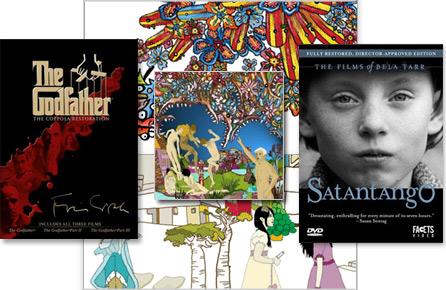
If there’s one single gotta-get for every movie buff this holiday season, it’s “The Godfather: The Coppola Restoration” ($49.99), new on DVD and Blu-ray from Paramount. Film history’s greatest crime saga has had a checkered career on home video, but this new version of all three films, personally supervised by Francis Coppola, is definitive. For the first time, “The Godfather” and “The Godfather Part II” on disc have the darker, richer color scheme and visible cinematic grain that early-’70s moviegoers saw on the big screen. (And for the first time ever, anywhere, they have 5.1 digital surround sound.) Includes all the DVD special features of earlier versions, plus a fascinating doc on the meticulous restoration.
Sometimes a a CD just isn’t enough. The celebrated indie band Of Montreal wants to provide an immersive environment for their new music: They have created two sets of “Skeletal Lamping” wall decals ($40 each), which will turn any room into an ultravivid wonderland. Also part of the package is a downloadable copy of the new CD, also called “Skeletal Lamping.”
It’s just possible that a seven-hour Hungarian film in black-and-white will sell slightly fewer copies on DVD than “Knocked Up” or “The Dark Knight,” but for the Tarkovsky-Bergman cinephile set, no 2008 release can touch Facets Video’s four-disc restoration of Bela Tarr’s 1994 masterpiece “Satantango” ($71.99). Sure it’s immensely long compared to any ordinary movie, but this hypnotic fable about a boggy, half-abandoned post-communist agricultural village invaded by a Christ-like con man, told via Tarr’s amazing extended takes, has too much melancholy gorgeousness to be boring (and one could say it owes its plot a little, or a lot, to “The Music Man”). Two other things you need to know: The cat doesn’t really get killed (Tarr himself took it home as a pet), and the set also includes Tarr’s version of “Macbeth” for Hungarian TV told in — count ‘em — two shots.
Pick of the week: Haunting, gorgeous “Oslo, August 31st”
Pick of the week: "Oslo, August 31st" is a wrenching voyage of discovery in Norway's suddenly trendy capital
“Oslo, August 31st” is, as the title suggests, an evocation of one day in the Norwegian capital, as experienced by a troubled young man who’s facing the end of summer and the end of his youth. It’s a marvelously constructed personal journey, both wrenching and bittersweet, whose emotional ripple effects stay with you for days and weeks afterward. While much of international art cinema can seem overly talky or conceptually alien to American viewers, this second feature film from Norwegian director Joachim Trier is a dynamic, even breathtaking visual experience without much dialogue or any philosophical heavy lifting, following the bony, handsome, exceedingly vulnerable Anders (Anders Danielsen Lie) through coffee shops, nightclubs and bodies of water, en route to an ambiguous final destination.
Continue Reading Close“Moonrise Kingdom”: Wes Anderson’s mid-’60s love story
Bruce Willis and Ed Norton are at their best in the rapturous summer fantasy "Moonrise Kingdom"
Tilda Swinton, Bruce Willis and Edward Norton in "Moonrise Kingdom" All the details of Wes Anderson’s rapturous and hilarious mid-1960s New England summer romance “Moonrise Kingdom,” taken one at a time, are plausible. Indeed they are more than plausible; they’re perfect, from the fitted uniforms and yellow canvas tents of the troop of “Khaki Scouts” headed by cigarette-smoking Edward Norton to the achingly picturesque island home where the brood of children belonging to Bill Murray and Frances McDormand sit around listening to the Leonard Bernstein recording of “A Young Person’s Guide to the Orchestra.” (I’m not going to bother questioning whether that record existed in 1965; some production intern probably spent half a day tracking down its history.)
Continue Reading Close“The Intouchables”: Racial comedy, French style
"The Intouchables" is the biggest foreign-language film of all time. Some critics say it's also racist
A still from "The Intouchables" Here’s a startling news item: “The Intouchables,” a lively if largely predictable Parisian comedy about a wealthy quadriplegic and his ne’er-do-well immigrant caretaker, has become the biggest international success in the history of French cinema. Indeed, according to some sources — and these things are notoriously difficult to measure on a global and historical scale — “The Intouchables” is now the biggest non-Anglophone film of all time, with a worldwide gross approaching $300 million.
Continue Reading CloseMale grooming: The movie
From beard contests to ball cream, Morgan Spurlock's "Mansome" goofs through modern-day male narcissism
Jack Passion in "Mansome" American men are bewildered about their place in the cosmos, or so we have been told repeatedly over the last 20 years. They don’t know whether to thread their eyebrows or wield a welding torch, and end up trying to do both at once (which is inadvisable). As comedian Adam Carolla laments in a scene from Morgan Spurlock’s documentary “Mansome,” the old-time certainties of gender identity have melted away: Women are flying fighter jets and men work at the hair salon; there are no longer “chick jobs and guy jobs.”
Continue Reading CloseMaggie Gyllenhaal on sexual liberation
The beloved indie star tells Salon about her "vibrator movie" and why she loves playing transgressive women
Maggie Gyllenhaal (Credit: Reuters/Mark Blinch) When I met Maggie Gyllenhaal about six weeks ago, she was enormously and gloriously pregnant, stretching out on a sofa with her shoes off and feet up in a Manhattan office building. (Since that time, Gyllenhaal and husband Peter Sarsgaard have welcomed their second daughter, Gloria Ray, to the world.) We were there to talk about “Hysteria,” the charming, lightweight feminist farce from director Tanya Wexler that explores a key event in the history of female sexuality: the invention of the vibrator by Mortimer Granville, a Victorian doctor who was seeking to cure the mysterious “female malady” that lends the movie its title.
Continue Reading ClosePage 1 of 233 in Andrew O'Hehir