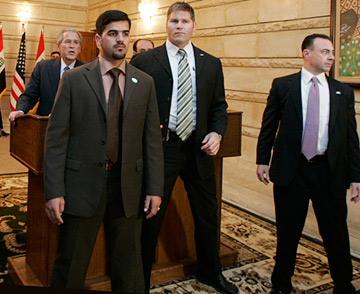

The shoe incident in Baghdad may look like the result of a security lapse, but actually, the people protecting public officials usually don't expect journalists to attack them.

Reuters/ Thaier al-Sudani
Bodyguards protect U.S. President George W. Bush after a shoe was thrown at him during a joint news conference in Baghdad December 14, 2008. An Iraqi reporter called visiting U.S. President Bush a “dog” in Arabic on Sunday and threw his shoes at him during a news conference in Baghdad.
Take a break, briefly, from replaying the clips of Muntader al-Zaidi’s footwear attack on President Bush. Stop and think about what it shows for a minute. Besides the simple fact that the guy hurled his shoes at the president of the United States, does anything else about the video stand out as a surprise?
Yes, that’s right — at the critical moment, there was not a single Secret Service agent standing close enough to take a shoe for the president.
The shoe attack may make for a simultaneously amusing and sad commentary on the final days of the Bush administration, but that’s in part because it didn’t end with anyone solemnly intoning the truly horrifying words “President Cheney.” Had al-Zaidi been armed with anything more dangerous than a loafer, though, everyone would be asking what went wrong with the elaborate system that’s supposed to protect the president — especially in Baghdad, which may be safer than it was after the U.S. invaded, but isn’t exactly Mayberry. But even though Bush escaped unharmed, why isn’t anyone asking that now?
Mostly because in this particular case, the system basically worked. There wasn’t an agent positioned to block the shoe — because Bush was giving a press conference in a secure room with Iraqi President Nouri al-Maliki. It may seem odd considering how much the Bush administration likes to claim the liberal media is out to get them, but the president isn’t as closely guarded when he’s alone with the press as he is when he’s out in public. The same goes for meetings with aides, lawmakers, constituents or anyone else who’s already had to pass through security screening just to get into Bush’s vicinity.
When presidents (or presidential candidates, or the president-elect) are shaking hands in a crowd at rally, they’ve usually got Secret Service agents pressed on all sides of them, close enough to get in the way of any trouble. But once people have gotten past the various gatekeepers who are in charge of access to the president, the Secret Service usually figures they’re safe enough to stand a few feet away during press conferences and meetings. Unless the security standards are looser in Iraq than they are in Washington (which seems hard to believe), by the time al-Zaidi was close enough to Bush throw anything at him, he’d already gone through a metal detector and had his bag and the contents of his pockets inspected. Since he didn’t have anything that seemed too dangerous, the Service probably wrote him off as relatively harmless. Instead, they got a quick lesson in what a hostile press corps really is. And al-Zaidi, as the video shows, got dragged out of the room. Even if al-Zaidi’s aim was better, Bush would probably have been more or less okay; if a rogue pretzel can’t kill him, a shoe isn’t going to.
Of course, given the way the Bush administration has reacted to threats in the past, what this probably all means is that future meetings with U.S. presidents will require removing your shoes and leaving them in the next room. (After all, you still can’t go through airport security fully shod, years after the attempted shoe bomber’s capture.) For now, though, he should be safe: Upon his return to the White House tonight, Bush is scheduled to speak at a Hanukah reception. Fortunately for the Secret Service, yarmulkes don’t fly quite as far as shoes.
The answer that’s been staring them in the face
Rick Santorum's CPAC performance demonstrates what separates him from previous Romney foes: Competence
Republican presidential candidate Rick Santorum speaking to the Conservative Political Action Conference in Washington, Friday, Feb. 10, 2012. (Credit: AP)
The timing of this year’s Conservative Political Action Conference worked out nicely for Rick Santorum, who took the stage Friday morning less than three days after his startling sweep of Minnesota, Missouri and Colorado. The room was full of activists who have been looking — and looking and looking and looking — for a “pure” alternative to Mitt Romney, with many more watching on television or online. Santorum’s breakthrough this week caught their attention, and here was his chance to make the sale.
Of course, Santorum is hardly the only Republican candidate who’s earned an audition for the role of chief Romney rival, and each one before him has proven spectacularly incapable of capitalizing on the opportunity.
Rick Perry surged to gigantic polling leads when he jumped into the race late last summer, then made a fool of himself in debate after debate and became an afterthought. Herman Cain supplanted Perry sometime during the fall, but fizzled when he couldn’t provide a simple, coherent defense of his signature 9-9-9 plan and after a bizarre sexual harassment saga. Then there was Newt Gingrich, whose erratic style and political past gave his (many) intraparty enemies an endless supply of ammunition — enough to destroy him once in December and then again when he somehow rose from the dead in January.
During all of this, Santorum did have one brief moment of glory, when he gained some last-second traction and won the Jan. 3 Iowa caucuses. But his victory wasn’t announced until weeks later, after he’d fared poorly in New Hampshire and while Gingrich was in the middle of his second surge. Only now is he enjoying the sort of attention and momentum that his Iowa showing should have produced.
Against this backdrop, Santorum’s performance at CPAC this morning was very effective in a very odd way. His speech was hardly great, but it wasn’t bad either. It was a generic, competently delivered articulation of the issues and themes conservatives have been stressing in the Obama era.
Santorum sniffed at “the politicization of science they call global warming,” blasted Obama’s healthcare reform law for killing freedom, promoted “supply-side economics for the working man,” and spent considerable time on “foundational principles” — the culture war issues that have suddenly become prevalent in recent weeks. And he took some shots at Romney — “the person in Massachusetts who built the largest government-run healthcare system in the United States – someone who would simply give that issue away in the fall, give the issue away of government control of your health.”
Again, in many ways this was a thoroughly average address, remarks that an entry-level political consultant could have drawn up for a candidate trying to curry favor with Tea Party Republicans and separate himself from a slippery opponent with an extensive moderate-to-liberal paper trail. But it was remarkable because everyone else who’s emerged from the GOP pack to vie with Romney has been incapable of delivering anything like it. Perry couldn’t remember the words, Cain could recite one slogan and nothing else, and Gingrich — the supposedly world-class debater — was either unable or unwilling to communicate a basic conservative case for himself and against Romney when they shared the stage.
For Romney, this is the real threat of Santorum’s candidacy: that for the first time a main challenger has emerged who lacks substantial personal and ethical baggage, whose policy views are largely consistent and in-line with those of the GOP base, and who is a competent communicator. If this sounds like a low standard, it is — and it says a lot about the 2012 GOP field that it’s taken this long for someone with such basic attributes to emerge (and that that someone is the guy who came to the race fresh off an 18-point reelection loss in a swing state).
Romney spoke about two hours after Santorum on Friday. His speech was also a competent expression of conservative grievances with Obama — “the poster child for arrogant government,” as Romney called him. But the message that Republican voters have been sending for more than a year now, in polls and in primary results like the ones we saw this week, is that they wonder if Romney really means it and that they’d prefer to have someone else representing them in the fall campaign. So it was probably not accidental that Santorum began his remarks by reminding the crowd that he’d been coming to CPAC for years — not just after he decided to run for president.
“I know you, and you know me,” he said. “And that’s important.”
The deadlock scenario
Mitt Romney’s week from hell has revived the most enduring fantasy of political junkies
Republican presidential candidate Rick Santorum listens as fellow candidates Mitt Romney, Ron Paul, and Newt Gingrich chat during a break in the Republican presidential candidates debate in Tampa, Florida, January 23, 2012. (Credit: Reuters)
Rick Santorum’s three-state sweep this week has revived speculation that the Republican primary season will end without a candidate securing the magic number of delegates needed for a first ballot nomination, resulting in a deadlocked convention in Tampa, Fla., this summer. (“Deadlocked,” and not “brokered,” is the proper description for this scenario, as Jonathan Bernstein recently explained.)
On CNN this morning, Sen. Jim DeMint said that the GOP race “could very well go to the convention,” while former RNC Chairman Michael Steele on MSNBC pegged the chances of a deadlock at “52-48.” Sean Trende of RealClearPolitics makes a solid case for why they could be right. The basic idea is that there seem to be clear geographic and cultural divisions in the results so far — with Mitt Romney doing well in the Northeast and West, Santorum cleaning up in the Midwest, and Newt Gingrich faring well in the Bible Belt. If those divisions persist and Ron Paul manages to gobble up a chunk of delegates, the primary season just might fail to produce a clear winner.
But as fun as the scenario is to imagine, there’s a good reason to be skeptical of the deadlocked convention talk: We’ve heard it many times before in the modern campaign era, without anything ever coming of it.
The last time there was true post-primary season suspense on the GOP side was in 1976, when Gerald Ford and Ronald Reagan both emerged from the last wave of contests in early June short of the magic delegate number. But there were still a number of state conventions scheduled before the August national convention in Kansas City, and because it was a genuine two-man race, there was never any doubt that someone would win a first ballot nomination. Still, the drama in Kansas City was real, with Reagan trying to expand his support by anointing Pennsylvania moderate Richard Schweicker as his running mate — a move that unsettled conservatives and helped Ford secure a 1,187-1,070 victory on the first ballot.
That was the last truly unpredictable convention that either party has staged. But at various moments in primary campaigns since then, we’ve heard the kind of deadlocked convention chatter we’re now hearing. Here’s a look at our brushes with convention excitement:
1976, Democrats: This was the race that changed the way the political world understood the nominating process. As the Democratic race began, it was a common assumption that there would be a deadlocked convention, which is why there was no rush to crown Jimmy Carter as the inevitable nominee despite his weekly victories in primary states — and why two candidates, Idaho Sen. Frank Church and California Gov. Jerry Brown, both felt comfortable entering the race months after the first primaries began. And when Church and Brown enjoyed immediate success, it only strengthened the view that the Democratic convention would turn to a non-Carter candidate — maybe someone in the race already, or maybe Ted Kennedy or Hubert Humphrey. This was how Democrats were used to doing business. But the primary season had been radically expanded under new party rules, and when he won Ohio in June, Carter claimed to have a delegate majority. It steadily dawned on party leaders that he was right and that there’d be no deadlocked convention.
1980, Republicans: Reagan entered as the clear favorite, but there was considerable trepidation among party leaders (and the GOP’s then-vibrant moderate/liberal wing) about his general election prospects; his far-right rhetoric called to mind Barry Goldwater, who just 16 years earlier had suffered an epic defeat against LBJ. Reagan was upset by George H.W. Bush (who ran as the moderate wing’s candidate) in Iowa, recovered in New Hampshire, then struggled in a series of contests in New England — where liberal Republican John Anderson fared surprisingly well. This stirred talk of a deadlocked convention — one in which former President Ford, then seen as the party’s most bankable national face, would either play the role of savior or kingmaker. Here’s how Godfrey Sperling presented the Anderson and Ford scenarios in a March 1980 Christian Science Monitor column:
Just off his “impossible dream” in New England — and with his new momentum, Representative Anderson wins in his home state on March 18 and follows that by picking up enough crossover votes to take the Wisconsin primary on April 1.
Mr. Anderson then finally gets to the national convention with about 400 delegates, but with Messrs. Reagan and Bush deadlocked and Gerald Ford, now in the contest, having only enough votes to help another but not himself.
At that point, Mr. Ford gives his support to his old friend and sidekick in Congress, John Anderson, who marches toward the 998 delegates he needs for the nomination.
[SNIP]
With the current inability of any one candidate to take command, former President Ford may well decide to get into the race — even though he has already missed the opportunity to enter more than half of the primaries.
The Ford rationale is one in which he gets enough delegates to become the beneficiary of a deadlock at the convention.
But if Mr. Ford could “decide” the nomination by turning his delegates over to another, would his choice be Congressman Anderson? The former President is also a very close friend of George Bush.
But none of this ever materialized. Soon thereafter, Reagan won a solid victory in Illinois that sidelined Anderson (who then bolted the party to run as an independent), rolled it into the next wave of states, survived a surprise Bush win in Pennsylvania, and cruised to the nomination with a massive delegate majority.
1980, Democrats: This was essentially a two-man race between Carter and Kennedy, with Brown making some early noise but amassing few delegates. So, as with Reagan and Ford in ’76, it was clear the race would be settled on the first ballot at the convention — and Carter, boosted by the rally-around-the-flag effect of the Iran hostage crisis, emerged from the primary season with a clear majority. But Kennedy had closed strongly and Carter’s poll numbers were declining. So Kennedy made a last-minute push to change the convention rules and free delegates from their commitments. It was a long shot, but it provided for at least some suspense at Madison Square Garden. When it was rejected, the race was officially over.
1984, Democrats: The primary season opened with expectations that Walter Mondale would wrap up the nomination in record time. Instead, Gary Hart scored a surprise (if very distant) second place finish in Iowa, rolled it into a shocking New Hampshire win a week later, and soon had Mondale on the ropes. But Mondale bounced back with some key Southern wins, and the two men spent the spring traveling the country and trading wins — with a third candidate Jesse Jackson, picking up a few hundred delegates of his own. A deadlock seemed possible, as this Joseph C. Harsch column from March ’84 made clear:
There is now a visible chance that Mr. Mondale will not get a first-ballot nomination. If the delegates committed to Gary Hart and Jesse Jackson, and the uncommitted delegates, should pool their resources, they might be able to head off a quick Mondale victory. If so, then what happens?
The Democratic convention could at that point be blown wide open. Almost anything could happen. Suppose a lot of delegates are by that time disenchanted with the three existing candidates and start looking around for a possible alternative. One already hears talk of Sen. Dale Bumpers of Arkansas or Gov. Mario Cuomo of New York. Both are mentioned as possible running mates for Walter Mondale, but also as possible alternatives for the top of the ticket
But when the final primaries were over in June, Mondale declared himself the winner, thanks to strong support from a newly created class of convention participants — the superdelegates. (It also helped Mondale that party rules at the time awarded Jackson a small number of delegates relative to his strength in many states.) But Hart refused to quit. “Welcome to overtime,” he declared the morning after the last June primaries. He spent the next five weeks pointing to polls that showed him running better against Reagan than Mondale and pleading with superdelegates to change their minds, but they wouldn’t budge, and when the convention opened it was obvious Mondale would win on the first ballot.
1988, Democrats: It looked like Democrats had an epic mess on their hands when Jesse Jackson unexpectedly crushed Michael Dukakis in the March 26 Michigan caucuses — a result that put Jackson in the lead in the national delegate count. Dukakis was a weak (accidental, really) front-runner, and by that point several other candidates and former candidates (Paul Simon, Dick Gephardt, Al Gore) were sitting on piles of delegates. Suddenly, it seemed like Jackson — who was demonstrating surprising support among white voters — might parlay his Michigan triumph into more victories and emerge from the primary season with the most delegates (but not enough for a first ballot nomination). From R.W. Apple Jr.’s March 29, 1988, New York Times story:
Democratic Party leaders expressed astonishment today at the Rev. Jesse Jackson’s landslide victory in the Michigan caucuses Saturday and confessed that they found it hard, after weeks of surprises, to predict how or when the party’s Presidential race would be decided.
For the first time, party professionals began actively contemplating the possibility that Mr. Jackson could emerge from the primary season, which ends in California and New Jersey June 7, with the most delegates.
One said that it was ”remotely, barely, distantly conceivable” that the party might actually end up by nominating Mr. Jackson. Others agreed that outcome was possible but, although they would not say it for attribution, almost none believed that a black candidate can be elected.
Paul Maslin, a highly regarded Democratic poll taker in Washington, commented: ”The party is up against an extraordinary end-game. If this guy has more convention votes than anyone else, how can we not nominate him? But how can we nominate him?”
It turned out they had nothing to fear. Party leaders closed ranks around Dukakis, who quickly beat Jackson in Connecticut, Wisconsin and New York, then rolled through the rest of the primaries without breaking a sweat.
1992, Democrats: Bill Clinton seemed to have the nomination wrapped up when he posted giant wins in Illinois and Michigan in the middle of March — this a week after Clinton had racked up a big delegate lead with a series of Super Tuesday wins. When his chief rival, Paul Tsongas, then suspended his campaign, the race seemed over. And then, out of nowhere, Jerry Brown won Connecticut, stunning Clinton in what remains one of the biggest primary season upsets ever. The result sparked genuine panic among Democratic leaders: Clinton had already weathered several scandals (Gennifer Flowers, Vietnam) and it was widely believed that Republicans would (in the words of Bob Kerrey) open him up “like a soft peanut” in the fall. The Connecticut result prompted some loud and public soul-searching: Is there anything we can do to stop this guy?
This set up the next contest, in New York, as a pivotal test for Clinton: Win and his campaign would be back on track; but lose again, and the floodgates might open. Already, names of potential white knight candidates (Mario Cuomo? Bill Bradley?) were being circulated, and Tsongas put out the word that he’d reenter the fray if Clinton lost again. Here’s how David Von Drehle summed it up in the Washington Post:
Yet while the Republicans are busy closing ranks around a candidate they despise in great numbers, the Democrats are furiously ripping the wings, legs and antennae from a front-runner they feel, well, squeamish about. They are unable to produce, halfway through the primary season, anything more than a crippled front-runner, an empty chameleon and sad hopes of a brokered convention.
But Clinton then won New York, and that was that.
1996, Republicans: There was a very brief window of deadlock talk after Bob Dole lost to Pat Buchanan in New Hampshire, casting doubt on Dole’s viability. But Buchanan was an unacceptable choice for most party leaders, which gave Lamar Alexander (who finished just behind Dole in New Hampshire) hope of emerging as the establishment’s preferred vehicle to take down Buchanan. But Steve Forbes, who was pouring tens of millions of his own dollars into the race, also hoped to play that role — and gained new credibility with wins in Delaware and Arizona after New Hampshire. The muddled picture that all of this created led to this kind of talk, captured in a New York Times story from late-February ’96:
Another possible result is that every victory by a candidate in one state will be canceled out by another candidate’s win somewhere else, and no candidate will amass enough delegates to avoid a brokered convention in San Diego in August.
“The scenario that’s emerging is the one that says, gee, maybe we’ll be deadlocked in San Diego,” said Mr. Ginsberg, the former Republican Committee official.
“That’s the one that captures the imagination. Deep in our heart of hearts, all of us would love to live through a brokered convention.”
Dole then won South Carolina by a convincing margin, killing Buchanan’s momentum and marginalizing the rest of the field once and for all. The Dole/Buchanan race that ensued wasn’t much of a contest.
2008, Republicans: Deadlock talk seemed sensible as the ’08 primary season opened; five candidates — Romney, John McCain, Mike Huckabee, Fred Thompson and Rudy Giuliani — were all bunched together in national polls, and all sorts of outcomes were plausible. Writing in the Boston Globe, Republican strategist Todd Domke summed it up this way:
If five candidates each win a fraction of delegates – 5 percent, 10 percent, 20 percent, 30 percent, 35 percent – there could be a deadlocked convention.
That would be like the GOP convention of 1860, when there were many factional, regional favorites. After three ballots, they settled on an Illinois attorney named Lincoln, a local “favorite son” since the convention was in Chicago. Once elected, he tried to achieve national and party unity by appointing his defeated foes to the cabinet.
We won’t be electing a political genius this time, but the campaign will be historic. And we best savor it by taking it seriously and humorously – as Lincoln once did.
But when January ended with McCain wins in South Carolina and Florida, the deadlock talk quieted.
Rick Santorum will pay for this
The rule of the GOP race so far: No one threatens Mitt’s White House dreams and gets away with it
Rick Santorum (Credit: AP/Jeff Roberson)
If one statistic explains why Rick Santorum was able to score such an impressive three-state sweep on Tuesday night, it’s this: In all three states that voted — Minnesota, Colorado and Missouri — his favorable rating with Republicans stood at over 70 percent, well above the numbers for Mitt Romney and Newt Gingrich.
There was a very good reason for this: Romney left him alone.
After suffering a lopsided defeat to Gingrich in the Jan. 21 South Carolina primary, Romney’s campaign and its super PAC friends steered their energy and resources into a blunt and relentless effort to tear him down. In ads, press releases and surrogate conference calls, the (many) low moments from Gingrich’s run as House speaker in the late ’90s were aired, and Romney himself used a debate to accuse his opponent of using “repulsive” and “inexcusable” campaign tactics. Gingrich fired back with venomous intensity, accusing Romney of having “a profound character problem” and branding him “a liberal who was pro-abortion, pro-gun rights, pro-tax increases and pro-gay rights” as Massachusetts governor.
Romney got the better of this fight, in that he killed Gingrich’s post-South Carolina momentum, netted a commanding victory in Florida, and rolled into February in a strong position to leave Gingrich in the dust once and for all. But the Romney-Gingrich sniping also allowed Santorum to stand above the fray while pitching his message to Republicans in Minnesota, Colorado and Missouri, states that are culturally and demographically suited to Santorum and his message.
With no one attacking him — and with Romney, whose campaign evidently believed that a February sweep could be attained at minimal expense, spending little money — Santorum flourished under the radar in all three states. Polling in advance of Tuesday’s contests was limited, and it only became clear in the final 48 hours that Santorum was poised for a big day. And even then, it seemed unlikely he’d win all three, much less by the margins he ended up enjoying.
In his victory speech, Santorum crowed that “tonight, we had an opportunity to see what a campaign looks like when one candidate isn’t outspent five or 10 to one.” Which is true enough, but it also points to the main reason to doubt that Santorum’s trifecta will vault him into serious contention for the nomination: He’s got Romney’s attention now — which means that he’s in for the same well-funded abuse that Gingrich endured as soon as he won South Carolina. Actually, the abuse began on Monday, when Romney’s campaign realized that Santorum was going to do well the next day. But now it will intensify, with Santorum in position to use his impressive show of strength to further marginalize Gingrich and to emerge as the right’s consensus alternative to Romney.
Apparently, Santorum will now make a play in Michigan, which will hold its primary on Feb. 28. The state is an appealing target for him; it’s filled with the kind of blue-collar and middle-class voters Romney has struggled with elsewhere, and it contains a surprisingly sizable chunk of conservative evangelicals. It is Romney’s native state, but polls have shown the former Massachusetts governor is at least theoretically vulnerable. After that, Ohio and the Southern states that will vote in early March could also be good targets for Santorum. On paper, he could do some serious damage to Romney in the weeks ahead.
But the GOP campaign will look a lot different in these states than it did in the ones that voted Tuesday night. Expect Romney to engage Santorum directly, as he did with Gingrich (the next debate is in two weeks), and expect his campaign and his super PAC allies to spend heavily, flooding the airwaves with the sorts of negative attacks that helped do Gingrich in. Romney’s surrogates will get in on the act too. When Michigan’s primary arrives in three weeks, it’s just about impossible to imagine Santorum enjoying a 70 percent favorable rating in the state. Romney and his campaign are used to this by now: Every challenger who has suddenly surged into contention has fallen back to earth quickly.
Of course, some of those challengers made it awfully easy for Romney. Rick Perry’s epically bad debate performances last fall turned him into a joke even among Republicans, deflating national poll numbers that had once hovered around 40 percent. And Gingrich — well, where to start? It also helped that the GOP’s opinion-shaping class, whatever it thinks of Romney, is largely united in the view that Gingrich would be a disastrous general election candidate. So when Romney essentially mugged him after South Carolina, most party elites were content to sit on their hands and pretend they didn’t see anything; almost no one spoke up in Newt’s defense.
Santorum is not as easy a mark. He’s basically a competent candidate whose policy views are generally consistent and in line with those of the party base. The biggest knock on him, one that probably prevented him from breaking out earlier in the race, is that he came to the race on the heels of a landslide Senate reelection defeat in a key swing state. But now that he actually does have some traction, that might not matter for much. And if Romney comes after him in this month’s debate, Santorum — unlike Gingrich — will probably be able to defend himself effectively and land some punches of his own. It’s possible, then, that a Romney assault on Santorum won’t produce the same dramatic results as the Gingrich takedown did. A key question is whether party elites will sit on their hands again this time, or if some of them will rally to Santorum’s side and put the heat on Romney for running a negative race.
So while Romney will undoubtedly make Santorum pay for his victories this week, it remains to be seen just how steep the price will be.
Don’t worry, they still can’t stand Obama
Why the startlingly low turnout in Republican primaries so far is probably a red herring
(Credit: Reuters/Jessica Rinaldi)
If the contests that have taken place so far are any guide, then Republican turnout in Minnesota, Colorado and Missouri today won’t be anything to write home about. It’s been one of the most discordant aspects of the 2012 campaign: The first three years of Barack Obama’s presidency were marked by an angry awakening of the GOP base, but those same Republican voters seem oddly unexcited about the opportunity to finally select an opponent for the president. Here, courtesy of NBC’s First Read, are the turnout figures for the five states that have voted so far:
IOWA
2008: 118,411
2012: 121,503
+2.6%NH
2008: 233,464
2012: 248,485
+6.4%SC
2008: 443,203
2012: 601,215
+36%
FL
2008: 1,925,911
2012: 1,669,647
-13%NV
2008: 44,325
2012: 32,930
-26%
There are other signs that Republicans aren’t as engaged as they were four years ago. An ABC News/Washington Post poll this week found that just 55 percent of GOP voters say that are “certain” to vote when their state’s nominating contest is held; at this same point in ’08, that number was 68 percent.
On the surface, these sorts of numbers run counter to everything we’ve been seeing and hearing since January 2009, when conservative activists and voters mobilized a fierce, loud and relentless resistance to Obama’s presidency. Surely, the thinking went, they’d throw themselves into the ’12 primary race, instead of sleeping through it like they seemed to in ’08. Plus, this time around there’d be no Democratic contest to attract eligible non-Republican voters in open primary states; with all of the action on the GOP side, turnout would have to swell, wouldn’t it?
Needless to say, there’s now plenty of talk about the potential general election implications of this seemingly unmotivated Republican base, and the possibility that the enthusiasm gap that was supposed to harm Democrats could actually work in their favor — or at least not be much of a factor. And while it’s very possible there’s something to this talk, I’d offer a different theory: The low turnout figures are actually consistent with what we know about the Obama-era GOP and probably don’t portend anything for the fall.
After all, the GOP base’s 2009 awakening was primarily a response to the election of a Democratic president. While the term that the right embraced for its resistance (the Tea Party) was new, the phenomenon wasn’t; just ask Bill Clinton. But there was a twist this time, with the right deciding that Obama’s election was enabled by Bush-era Republican leaders, whose routine sellouts of conservative principles had given the movement a bad name and helped produce the depressing domestic conditions that made victory so easy for Obama. So they launched a two-front war, one against Obama and one against the “establishment”-types who had led the GOP off course. The indispensable ingredient, though, was Obama’s election.
In this sense, the low turnout figures could be a reflection of the intraparty war. That Romney is regarded with suspicion by many conservatives is well-established at this point; his Massachusetts record and his strained efforts to present himself as a born-again Reaganite make him seem like the very sort of Republican official the base rebelled against in some high-profile 2010 primaries. Romney has tried hard — very, very hard — not to give the right any new ammunition, and he’s largely succeeded. But that doesn’t mean he’s generated any real enthusiasm; his strategy has always been to be the “good enough” candidate — the one conservatives will eventually accept when they realize he’s inevitable and that they have no other options.
And that’s the other story of the GOP campaign so far: Conservatives really haven’t found any other options. They’ve flirted with various possibilities, but all of the would-be alternatives have shown themselves to be seriously flawed in one way or another, and none has shown much staying power in the polls.So what’s there for the average Tea Party-era Republican to be excited about in the GOP race? As right-wing blogger Erick Erickson put it recently: “Today, after a lot of reflection on this race, I can honestly say my position has not changed and I would honestly prefer Ace of Spades’ sweet meteor of death than any of the candidates left in the race.”
But when the primary season finally ends and the Republican Party has a nominee, Republicans like Erickson will be left with a choice: the GOP candidate or four more years of Obama — the guy whose election made them so furious in the first place and whose presidency they’ve spent the past few years desperately trying to undermine. And rest assured, the GOP base is as sour on Obama as it’s ever been; Gallup’s latest weekly tracking poll gives the president a 10 percent approval rating among Republicans and a 6 percent score among conservative Republicans. Even Clinton, a man who inspired so much animosity from Republicans that they impeached him, enjoyed more cross-party support at this point in his presidency. And so did every other president since Ronald Reagan.
There’s still nothing quite like the right’s Obama-phobia. So while a surprising number of Republicans may be sitting on their hands now, here’s guessing they won’t be in November.
Rick Santorum’s odd “badge of honor”
Don’t look now, but he could have a very big night tonight – and the Romney campaign is spooked
Rick Santorum (Credit: AP/Ed Andrieski)
February is supposed to be Mitt Romney’s month, but there’s a real chance that tonight will belong to Rick Santorum. Three states are holding nominating contests, and Santorum is well-positioned to win two of them — with an outside chance of posting a clean sweep.
Polling from PPP released late last night gives the former Pennsylvania senator a 45 to 32 percent lead over Romney in Missouri, which is conducting a non-binding primary. Newt Gingrich failed to qualify for the ballot in the state, and Ron Paul is running a distant third with 19 percent. Santorum is also ahead in the caucus state of Minnesota, where PPP shows him 9 points up on Romney, 33 to 24 percent, and just 10 points (37 -27 percent) behind the former Massachusetts governor in Colorado. Gingrich is running in third in both of those states.
Perhaps the most significant finding is that Santorum, who has mostly stayed in the background as Romney and Gingrich have traded vicious insults, enjoys favorable ratings of over 70 percent among Republicans in all three states — significantly higher than the scores for Romney and Gingrich. And Minnesota and Colorado are both particularly conducive to his emphasis on social and cultural issues, with activist-oriented caucus electorates in which the sorts of Christian conservatives who propelled him to his Iowa victory holding disproportionate sway.
It’s true that no convention delegates will be directly awarded through today’s contests, but there’s a clear opportunity for Santorum here. Look at it this way: In late December and early January, Gingrich’s numbers crashed and Santorum surged to his unlikely Iowa win*, setting up what briefly seemed like a two-man race between Romney and Santorum. But Santorum lost his momentum in New Hampshire, allowing Gingrich to get back in the game in South Carolina, where he was boosted by some serious super PAC assistance and the lack of attacks from Romney and the GOP establishment. But just about nothing has gone right since then for Gingrich, who seems decreasingly relevant by the day.
So the timing of today’s contests is fortuitous for Santorum. If he can post a series of breakthrough showings, it could help him supplant Gingrich as Romney’s chief rival. There’s still a theoretical opening for a conservative alternative to Romney to do some real damage in early March. With some wins today, it could be Santorum — and not Gingrich — who gets to play that role.
The Romney campaign clearly recognizes this potential. As soon as the South Carolina primary was over, they launched a relentless assault on Gingrich, determined to bury him once and for all, while leaving Santorum alone. But yesterday, they started attacking Santorum too, leading one of Santorum’s strategists to declare, “It’s a badge of honor that Romney has decided to try to destroy us.” He’s right, of course. It’s a sign of progress for Santorum that he’s again relevant enough to force the front-runner to issue nasty press releases. But if Santorum wins big tonight, the abuse will get a lot worse. Which means he should probably enjoy those 70 percent favorable ratings while they last.
Page 1 of 2637 in War Room

A passport to utopia
“The Fault in Our Stars” and “There Is No Dog”: Not kids’ stuff
Ricky Gervais: My conscience never takes a day off
Lessons of a very sexy pirate costume
America’s failed promise of equal opportunity
Is gay literature over?
A voice that touched us all
Whitney Houston dies at 48
Didn’t she almost have it all?
Porn’s taboo transsexual stars 

