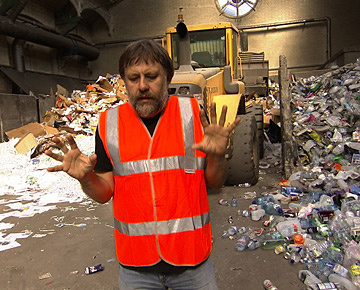

From Cornel West in the back seat to Slavoj Zizek at the dump, "Examined Life" offers quick, witty, out-of-context doses of today's leading philosophers.
Astra Taylor knows she’s a little over her head in the whimsical, earnest series of conversations with philosophers that makes up her film “Examined Life.” But the young filmmaker uses that fact to disarm us, putting herself clumsily into the frame during a stroll in New York’s Washington Square Park with inscrutable post-Heideggerian feminist philosopher Avital Ronell, who declares that she would like to interview Taylor, rather than the other way around.
As the scene continues, Taylor apologizes for the shallowness of trying to present an introduction to several important contemporary philosophers in an 85-minute feature film. Rather preeningly, Ronell quips that it’s fine that the other philosophers in the film are restricted to 10 minutes each, but she should not be subjected to such an indignity, and then launches into an extended monologue about the healthy uses of anxiety and meaningless in the postmodern world. It’s good to feel bad, more or less. OK, she doesn’t actually say “postmodern,” but she might as well. Meanwhile, Taylor’s camera wanders around the park, capturing the book-readers and iPod-listeners and park-bench smoochers and frolicking dogs in the middle distance while Ronell keeps talking. One of these people has just been made to look like an ass, and it isn’t Taylor.
I’m not suggesting that Taylor set out to sandbag or ironize her subjects in “Examined Life.” In fact, I’m quite sure she didn’t. But as with Taylor’s previous film, “Zizek!” (whose subject, the Slovenian madman Slavoj Zizek, appears here at a London garbage dump, claiming that mankind isn’t alienated enough from the natural world), the movie has a philosophical element of its own that is not free of guile. By conducting her conversations in public spaces, and removing her interlocutors from desks and offices and book-lined studies and other appurtenances of intellectual authority, Taylor introduces a degree of playfulness and unpredictability that becomes the movie’s M.O. Trying to rehabilitate the concept of revolution while rowing in the Central Park lake, post-Marxist philosopher Michael Hardt literally runs aground on a half-submerged boulder. I’m far more sympathetic to Hardt’s intellectual project than I should admit, but, really, what can you say?
Cornel West, perhaps America’s only celebrity philosopher, serves as a sort of muse or chorus to the film. He’s the only one whose interview is chopped into fragments, and he does all his talking from the back seat of a car as it creeps or roars through Manhattan traffic. It’s a great setting for West’s hyperbolic, high-velocity rant, in which he defends philosophy as first of all a self-interrogation, an attempt to negotiate with death, desire and dogmatism. It’s a brilliant performance, larded with a spectacular level of name-dropping — from Plato to Vico to Goethe to Melville to Beethoven to Chekhov to Charlie Parker — and best appreciated, I suspect, for its style rather than its substance.
“Examined Life” has a certain flavor of intellectual game show or high-concept magazine article about it, and I say that with affection. (Taylor has also worked as a journalist, including at least two articles for Salon.) Drag these people out into the real world, urge them to riff rapidly about the issues nearest and dearest to them and, at least by implication or context, make them compete with each other. In fact, there is known bad blood between two of Taylor’s subjects, queer-theory pioneer Judith Butler and University of Chicago political philosopher Martha Nussbaum, although that’s not mentioned.
You could view this format as manifestly unfair to those philosophers who are unfamiliar or uncomfortable with becoming pop-culture performers as West has done, or you could decide that that’s part of the job description for a public intellectual these days, and they’d better sharpen up. Be that as it may, Nussbaum is an eminent thinker on the page, but comes off as pretty dull while walking along the shoreline of Lake Michigan, opining on the limits of the 18th-century social contract. Anglo-Ghanaian philosopher Kwame Anthony Appiah wanders through a Canadian airport, uttering bland generalities about globalization and the value of cosmopolitan tolerance and generally making you glad you don’t have to sit next to him for an entire flight. I’m sure Michael Hardt regrets that rowboat ride, although he did get to see a whole bunch of Central Park’s basking turtles (the descendants of abandoned pets).
On the other side of the coin, I’ve always found Judith Butler’s books and articles almost unreadable, but Butler is charming, prickly and graceful while strolling the streets of San Francisco’s Mission District alongside painter and disability-rights activist Sunaura Taylor (the filmmaker’s sister), discussing what it means for a person in a wheelchair to “take a walk.” Coming between the overly obtuse Ronell and the overly obvious Appiah, ethicist and animal-rights advocate Peter Singer functions as a highly effective blunt instrument, walking down Fifth Avenue and calmly informing the camera that we have an unmet responsibility to starving children and tormented animals that is being undercut by selfish consumerism.
When Taylor returns to West in the back seat of that car for the film’s ending — yes, philosophers have a responsibility to combat nihilism and point the way toward a meaningful life, he says — we eventually notice that she herself is driving the car, which could be low-budget practicality and could be some kind of philosophical witticism. After delivering his final bons mots, West gets out of the car at Union Square to head for the subway, and about three seconds later is accosted by a young and attractive blond woman who wants to say hello. Like pimpin’, philosophizin’ ain’t easy.
“Examined Life” is now playing at the IFC Center in New York. It opens March 6 in New Orleans and San Francisco, April 3 in Boston, April 10 in Portland, Ore., April 17 in Denver, April 23 in Ithaca, N.Y., April 24 in Seattle and Coral Gables, Fla., May 1 in Los Angeles and Santa Fe, N.M., and May 15 in Santa Cruz, Calif., with more cities to be announced.
Why wait for October for breast cancer awareness? There couldn’t be a more perfect moment for director Lea Pool’s new documentary “Pink Ribbons Inc.” — a searing, passionate and deeply human examination of the warping of a cause.
It’s been a shaky year for the pink. In January, the Susan G. Komen Foundation, the undisputed center of the breast cancer universe in its be-ribboned, Schiaparelli-hued incarnation, made the spectacular misstep of attempting to withdraw funding for breast cancer screenings at Planned Parenthood. Though the howls of public outrage forced the foundation to back off – and prompted the resignation of its vice president for public policy, Karen Handel — the debacle was just the latest and most grotesque move from an organization ostensibly devoted to women’s health. There was the ill-advised, high-profile partnership with Kentucky Fried Chicken, a name not exactly synonymous with good health. There was a saturation of merchandising, including a perfume of questionable toxicity. No wonder registrations for this year’s Race for the Cure are down, as Komen continues to be dogged by questions about its integrity.
Now comes another blow to what author Barbara Ehrenreich (who has written with fabulous brio about her own experiences in the trenches) shudderingly calls “breast cancer culture.” Based on Samantha King’s book “Pink Ribbons Inc.: Breast Cancer and the Politics of Philanthropy,” the new documentary manages to be devastatingly persuasive about the futility of buying, say, an auto manufacturer’s “Warriors in Pink” gear as a gesture toward stamping out disease, while remaining profoundly sensitive to the good intentions of someone who might. Pool’s cool juxtapositions are incredibly convincing — in the way she presents the spirited, moving testimonials of pink-clad women running and walking at various events for “the cure” right beside the glib hucksters at the Fuze Tea and Yoplait event booths, oblivious to the piles of garbage rising in their wake.
Interspersed throughout, there are interviews with everyone who’s anyone in breast cancer. There’s Ehrenreich, who blisteringly attacks the “sentimentality” of cutesy breast cancer campaigns by saying, “I’m not six years old.” There’s Dr. Susan Love, who questions why, with billions of dollars going toward “the cure,” we’re still using “slash, burn and poison” treatments and spending next to nothing on investigating the causes of the disease. There’s Susan G. Komen CEO and founder Nancy Brinker, who ominously says, “There’s not enough pink” saturating our culture. And, hauntingly, there are the members of an Austin, Texas, support group for women with Stage 4 cancer, who describe the exhausting pressure of having a disease with such an upbeat, “Yes we can!” identity. “You’re the angel of death,” says one. “You’re the elephant in the room.” Put together, the film makes an exasperating, infuriating argument for why we must, as Susan Love says, “learn to ask questions and not just raise money and hand it over.”
Reducing breast cancer – a complex disease with different manifestations – into a single entity for which there could be a single, magic bullet “cure” may sell T-shirts and mammogram machines. But it doesn’t begin to address the insidiously complicated nature of cancer or why it strikes women in the first place. Yet there’s money to be made in the notion of a “cure” – a slippery word you will be hard pressed to find anyone in the world of cancer treatment ever using. But “Race for the No Evidence of Disease” just doesn’t have the same easy ring to it. Nor does the expensive, unsexy environmental and social change required to identify and eliminate the roots of cancer.
There was once a time, in the distant past, when breast cancer was not a cheerful lipstick shade. It was not warm or soft or fuzzy. It was not an opportunity for gratuitous ogling wrapped up in the guise of “saving the boobies.” And it sure as hell wasn’t the best thing to happen to consumerism since Christmas. But as the film makes clear, while the disease itself remains as vicious and harrowing as ever, the response to it has evolved. And what began as activism about a serious women’s health issue has morphed into an excuse to go shopping.
As “Pink Ribbons, Inc.” author Samantha King tells Salon, “People now understand disease through the lens of consumption. I talk to people who can’t really think of doing good work outside of selling or buying stuff. That’s not their experience. They haven’t been exposed to alternatives.” She goes on to explain, “Thirty years ago, it would have been unfathomable that breast cancer could generate this much support and attention and corporate funding. There was a lot of feminist awareness in the ’80s around breast cancer and women’s health. And some very smart people caught on to that and appropriated it and turned it into a marketable product.”
As the film tidily illuminates, ever since the Reagan era of corporate philanthropy, “cause marketing” has become a massive growth industry. With women representing 80 percent of consumer dollars spent, wrapping one’s products and services in the guise of taking care of the ladies is just “business as usual.” If that business includes breast cancer drug manufacturers who also happen to be in the business of pesticides and pink-ribboned cosmetics that contain unregulated chemicals like formaldehyde, well, what’s the problem? And if there’s a grand gesture to be made in bathing the Empire State Building in bright pink light or littering Times Square with pink ticker tape, who cares if that has squat to do with the frightening reality of illness?
One of the most revealing moments of the film comes when an upbeat marcher for the cure declares her reason for being there. “You feel helpless and you want to do something,” she explains. But what if that something is worse than nothing? What if it’s doing more to line a CEO’s pocket than to assure that fewer women will suffer and die from this monster? What if, instead, it’s subjecting women with cancer to what Ehrenreich calls “the horrible tyranny of cheerfulness”?
As King tells Salon, “Raising money doesn’t automatically equate change. In fact, the way that this particular fundraising phenomenon works is to reinforce the status quo. It funds the same kinds of research that ask the same kinds of questions instead of research that might look into prevention or reduce the incidence rate.” But she understands the insidious appeal of pink. “People are really busy,” she says, “and this stuff is fun and makes you feel nice. But that kind of solidarity and community is fleeting, and it doesn’t sustain a political movement. I hope this film changes the conversation around what it really means to do good.”
American men are bewildered about their place in the cosmos, or so we have been told repeatedly over the last 20 years. They don’t know whether to thread their eyebrows or wield a welding torch, and end up trying to do both at once (which is inadvisable). As comedian Adam Carolla laments in a scene from Morgan Spurlock’s documentary “Mansome,” the old-time certainties of gender identity have melted away: Women are flying fighter jets and men work at the hair salon; there are no longer “chick jobs and guy jobs.”
I get that Carolla is just cracking wise, from inside the bubble of his own lame version of post-rockabilly guy-shtick — he is interviewed inside a garage, with what looks like an orange Camaro behind him in the middle distance — and that if you brought up the fact that those old-time “chick jobs” paid 40 to 80 percent less than “guy jobs,” he’d get all irritated with you for being a drag. He’s still an idiot, though, even if he’s an idiot in quotation marks. That’s kind of the problem with “Mansome,” which tries to tackle the enormous subject of contemporary male vanity as an assemblage of whimsical anecdotes, which are often entertaining in themselves but studiously avoid any semblance of intelligent analysis or historical understanding.
It’s pointless to come down too hard on a film like “Mansome,” because like all Spurlock’s work (including “Super Size Me” and “Where in the World Is Osama bin Laden?”) it’s driven by a good-hearted frat-boy humor that seems fundamentally sincere. It’s more first-person journal and travelogue than it is cultural archaeology, and as such it’s basically OK. Spurlock gets to interview some of his celebrity pals about their attitudes toward masculinity and grooming: Paul Rudd is slightly ill at ease, Judd Apatow is charming, and Zach Galifianiakis steals the show, of course. (When asked to rate his looks on a scale of 1 to 10, Galifianakis responds confidently that some people find him “a strong 2.”)
Spurlock documents his own decision to shave off his trademark porn-star ‘stache, thereby reducing his 5-year-old son to torrents of tears. (It was definitely a mistake, Morgan.) He meets various kooky characters who have some tangential relationship to his theme, including a California suburbanite named Jack Passion who describes himself as a professional “beardsman,” meaning he travels the world exhibiting his Hagar-the-Horrible facial thatch in competitions. (Anthrax rhythm guitarist Scott Ian responds: “Beard and mustache competitions, for want of a better word, are kind of gay.” I laughed, and I know that’s wrong.) Then there’s the elegantly coiffed and tailored Manhattan clothing buyer who describes himself as the “dictionary definition of a metrosexual,” perhaps making up for his teen years as a Sikh immigrant outcast in middle America. And the entrepreneur who has introduced a lotion-y product called Fresh Balls: The Solution for Men. (Yes, it is what you think it is.)
In fairness, Spurlock is at least half aware that all the jokes and episodes of “Mansome” never add up to anything, except perhaps the conclusion that neither male narcissism nor male grooming is anything new, but that they have been coded in different ways at different times. Masculinity is no less a troubled construction than is femininity, and it’s just as easily whipped about by the tides of commerce and fashion. The aristocratic dandies of the 18th century make Spurlock’s New York Sikh metrosexual look like a shoeless Dust Bowl farmhand, and every Important Man of the 19th century, regardless of background or affiliation — King Leopold II! Karl Marx! The pioneering Ambrose Burnside! — had his own tonsorial signature that required extensive maintenance.
Now, I’m not denying that there’s something specific and contemporary about the version of male narcissism wrought by consumer capitalism, with its tendency to turn things once seen as immutable, such as gender or sexual identity, into fluid and exchangeable commodities with no fixed meaning. (Speaking of Karl Marx, it was he who wrote that, under capitalism, “all fixed, fast frozen relations, with their train of ancient and venerable prejudices and opinions, are swept away … All that is solid melts into air, all that is holy is profaned.”) It was to address that question on a pop-sociological level that the term “metrosexual,” first introduced to America a decade ago in this Salon article by Mark Simpson, was originally invented. (Simpson’s coinage was instantly stolen by marketers, of course, and turned into a pretty-boy Frankenstein monster who was, in turn, burned by the resentful villagers.)
Some of that big-picture stuff comes up almost by accident in “Mansome,” but Spurlock doesn’t even pretend to pay attention. He’s just a guy! He’s confused like the rest of us! He makes his little boy cry and watches pro wrestler Shawn Daivari (a Minnesota native who plays the anti-American “heel” called Sheik Abdul Bashir) shave his back all the way down to his butt crack. He sticks for far too long with an embarrassing framing device in which Jason Bateman and Will Arnett go to a spa and engage in uneasy homoerotic banter. He chops up the movie into irrelevant chapters about beards, mustaches, hair and so on, as if those things were unrelated. When he goes to get his own hair cut, it’s at some pseudo-old-fashioned place in downtown Manhattan where the wood fixtures are way too polished and the barbers are conspicuously overdressed. It’s kind of endearing and kind of asinine.
“Mansome” is now playing in Atlanta, Boston, Chicago, Cincinnati, Dallas, Detroit, Houston, Los Angeles, Minneapolis, New York, Philadelphia, Portland, Ore., San Francisco, Seattle and Austin, Texas, with more cities to follow.
Here’s the short version of humanity’s relationship with water, as delivered by hydrologist Jay Famiglietti in Jessica Yu’s compelling and often gorgeous documentary “Last Call at the Oasis”: “We’re screwed.” Yes, we should all install low-flush toilets and plant gardens that require less watering, but conservation is simply insufficient to cope with a global fresh-water crisis that involves many interlocking factors: overpopulation and overdevelopment, depletion of groundwater, climate change, and widespread contamination.
Solving the human race’s worsening water problem requires overcoming what Yu’s film terms the “Hydro-Illogical Cycle,” which is defined by the belief that because most of the Earth’s surface is covered in wet stuff, there’s no problem. As one horrified woman proclaims in a hilarious segment that explores the possibility of marketing recycled and purified sewage water (to be sold under the brand name Porcelain Springs), “This says to me that there’s some shortage I don’t know about. When they show those photographs from space, there’s a lot of water!”
“Last Call at the Oasis” is the latest social-advocacy documentary from Participant Media, whose previous output includes “An Inconvenient Truth,”“Food, Inc.” and “Waiting for ‘Superman,’” along with many other less obvious (and less successful) films. Like most of those movies, it’s adapted from existing material in another format, in this case journalist Alex Prud’homme’s book “The Ripple Effect.” At its best, Participant has been able to marry a message-delivery system to a genuine cinematic experience, and that’s definitely what Yu — an eclectic talent whose work includes the documentary “In the Realms of the Unreal” and the narrative feature “Ping Pong Playa,” along with numerous TV episodes — delivers here. “Oasis” packs in a lot of dire information, but it wraps it in often-spectacular images and cutting-edge graphics, moving from Las Vegas to rural Michigan to the Australian outback to the nearly depleted waters of the Jordan River, where the traditional baptismal spot of Jesus has become a fetid swamp contaminated with sewage from a nearby Israeli town.
While the discussion in “Last Call at the Oasis” is never directly about partisan politics or ideology, and although Yu relies mostly on the testimony of respected scientists, this film probably faces a version of the “Inconvenient Truth” problem. It’s largely preaching to the converted, in the sense that if you fail to accept certain basic premises — that climate change is a scientific fact, for example, and that fresh water is a limited and fragile resource that is nearly maxed out on a global scale — then you’ll just blow this off as left-wing fearmongering. In one especially effective section, Yu shows us file footage of Sean Hannity and Sarah Palin ostentatiously taking the side of Latino farmers in California’s Central Valley who were denied irrigation water because of an endangered fish called the Delta smelt. Then she has a scientist explain the larger context: Yes, the smelt is an insignificant species in and of itself, but you can’t consider it on its own. In fact, it’s a key indicator species in an enormous interlocking ecosystem that extends from the rivers and estuaries of the inland West to San Francisco Bay and the Pacific Ocean. If the smelt dies, that tells us the whole system is dying.
“Last Call at the Oasis” follows a familiar pattern seen in Participant productions and other social-issue docs, but it does so with such panache and visual variety that I really never felt lectured at. About three-quarters of the film lays out an immensely complicated set of problems and argues that they’re all connected. Agriculture and overdevelopment in the West and Southwest have drained the regions’ reservoirs and aquifers nearly dry, while in many wetter heartland areas the groundwater has been poisoned with exotic industrial toxins and antibiotic-laced cattle manure. Americans’ growing use of all sorts of supplements and pharmaceuticals — many with unknown long-term effects — has created a problem for municipal sewage treatment facilities, which are set up to remove trash and organic waste, not unknown chemical compounds.
Then, of course, Yu has to make the case that it’s not too late for us to clean up this precious resource — along with sunlight, the one absolutely necessary component of life on Earth — and learn to share it better. Erin Brockovich leads a campaign on behalf of poisoned homeowners in Midland, Texas, that leads to new regulations on hexavalent chromium in drinking water. (Yu does not fail to mention that Midland is George W. Bush’s adopted hometown.) The Israeli town stops pumping poop into a Christian holy site, and a coalition of Jordanian, Palestinian and Israeli activists work on a plan to share the Jordan River’s water. Many people, the marketing firm discovers, can be convinced to try Porcelain Springs. (The water we drink every day is recycled sewage, too — we just don’t know where or when it happened.)
If anything, the real downside of “Last Call at the Oasis” comes after the movie is over, when you think back over the rather thin optimism of the last 20 minutes. Sure, Los Angeles will supposedly start piping recycled tap water by the end of this decade, and that’s great and all. But that does nearly nothing to address the fact that only about 1 percent of the planet’s water is drinkable, and 80 to 90 percent of that is used to grow food, often in agricultural regions (like the Central Valley of California) that would otherwise be barren. In case you’re wondering about desalinating seawater, by the way, the answer is no. (It’s like the hydrogen-car solution to the energy crisis, an expensive boondoggle that won’t work.) So we need to figure out how to use a lot less water, very quickly, with a rapidly growing population. Or we just shrug our shoulders and agree with Famiglietti’s two-word prognosis.
A time capsule loaded with smack from the bohemian underbelly of JFK-era America, Shirley Clarke’s 1961 film “The Connection” is an illustration of how much things change, and how much they stay the same. I’d be stretching to call “The Connection” a great film — it’s mannered and edgy, in a way that’s partly deliberate but also distinctive to its period — but it’s an important one in cultural and historic terms, despite being largely unknown. Watching this ensemble drama about a multiracial group of New York jazz musicians and beat philosophers in a run-down apartment, waiting for their drug dealer to show up, is like traveling back 50 years in time, only to encounter the same people you might meet on the street today (at least, in certain neighborhoods of Brooklyn, San Francisco, Austin and so on). At one point, the characters even debate the illusory distinctions between “hipsters” and “squares.”
A Park Avenue society girl turned Greenwich Village beatnik, Clarke was the pioneering female director in the early history of American independent film, good friends with John Cassavetes, Frederick Wiseman, Jonas Mekas and other downtown legends of the period. If her name and her films have virtually disappeared from history, that’s partly due to institutional sexism, no doubt, and partly to bad luck and bad timing. Milestone Films, which is releasing this version of “The Connection” restored by the UCLA Film & Television Archive, will go on to release Clarke’s 1960s documentaries “Robert Frost: A Quarrel With the World” and “Portrait of Jason,” an interview with a black gay street hustler, along with her 1985 comeback film “Ornette: Made in America,” about jazz legend Ornette Coleman. (Clarke died in 1997.)
“The Connection,” Clarke’s first feature, was a high-profile project, the screen adaptation of a 1959 Living Theater play by Jack Gelber that had become a cause célèbre despite scathing reviews, attracting uptown artistic types like Leonard Bernstein, Salvador Dalì and Lillian Hellman to take a walk on the wild side. Clarke and her producer, Lewis Allen, funded the film’s $177,000 budget — not so meager, at the time — through the then-unknown tactic of collecting small sums from a large number of investors, establishing a model that endures in micro-budget and mid-budget filmmaking to this day. (Weirdly enough, as Manohla Dargis has reported in the New York Times, former Republican presidential candidate Rick Santorum’s parents were among the investors, along with Norman Mailer and architect Philip Johnson.)
But once completed, “The Connection” only screened twice at a single theater on Manhattan’s 45th Street before being closed by New York State’s censorship board. I’m not sure which is more amazing: the fact that New York had a censorship board in the early ’60s that could control what movies the public saw, or the reason for the seizure of “The Connection,” which was two or three uses of the word “shit” (as a synonym for drugs). By the time some edits were made and the ban lifted, public interest had faded, largely because of a swath of unrebutted hostile reviews. Bosley Crowther of the Times, a noted get-off-my-lawn crank of the time, wrote an especially peculiar one in which he praised the actors, the live jazz soundtrack and Clarke’s “bold direction,” but described the film overall as “deadly monotonous, in addition to being sordid and disagreeable.”
I won’t pretend not to understand what Crowther was talking about. “The Connection” remains much better known among jazz fans for its soundtrack album featuring pianist Freddie Redd and saxophonist Jackie McLean (who play live in the film, as they did onstage), than it is among movie buffs as, you know, a film. Clarke should certainly get credit for exploring the faux-documentary format decades before it became a film-school gimmick (the story-within-a-story premise was already present in Gelber’s play), but the first 10 minutes or so of “The Connection” are decidedly awkward. Squaresville white filmmaker Jim Dunn (William Redfield) wanders around in his high-waisted chinos, trying to convince the group of crashed-out junkie hipsters to “act natural” and “be themselves,” and assuring them that he’s studied the documentaries of Robert Flaherty and knows what he’s doing. (A dig at the old-school variety of documentary film, before cinéma-vérité, I guess.) It’s clear that the addicts would rather relate to Dunn’s hipper African-American cameraman, J.J. Burden (an early role for future Hollywood character actor Roscoe Lee Browne), who is rarely seen but makes occasional oracular pronouncements.
In the interests of art, Dunn has apparently agreed to finance a major purchase from a smack dealer named Cowboy, but for most of the movie we are obviously encouraged to ponder the similarities between drug culture and Beckett’s “Waiting for Godot,” and to wonder whether Cowboy will ever show up at all. Prowling the dingy, open flat restlessly — it looks disconcertingly like a group household I actually lived in, 20-odd years ago — Clarke’s camera introduces us to the all-male assemblage, in fragmentary interviews. Leach (Warren Finnerty), a wiry, whiny fellow who looks and acts alarmingly like the young Steve Buscemi, is the official tenant. He is troubled by a painful boil on his neck, which may symbolize the fact that the other denizens suspect him of being gay. As his black friend Sam (Jim Anderson) will tell him later, he’d be more relaxed if he could “get with the whole homosexual scene.”
There’s also Ernie (Garry Goodrow), an embittered-genius West Coast white jazzman who has hocked his horn to buy junk, and Solly (Jerome Raphael), an educated, middle-class Jewish guy who has thrown it all away for philosophical reasons, or none at all. McLean, Redd, bass player Michael Mattos and drummer Larry Richie get fewer lines, but every so often pick up their instruments to deliver angled, edgy blasts of early-’60s hard bop. Today these characters would presumably be obsessed by some other cultural form — hip-hop or Scandinavian black metal or YouTube clips or hockey fights or something else I’ve never even heard of — and they’d be able to badger Cowboy with illiterate texts every few minutes. But they’d basically be the same guys; Gelber’s characters are drawn so sharply that many 21st-century viewers will identify people they know or used to know (perhaps even people they used to be).
When Cowboy finally arrives (played by Carl Lee, who would become Clarke’s longtime partner), he turns out to be the archetypal “hip Negro” in Ray-Ban shades, sporting a blazing white outfit and a messianic mien, and bringing with him an old-lady evangelist, as comic relief and cover story. He brings other kinds of blessings too, the kind that allow this cast of semi-lovable, self-destructive losers to get through another day. The central conflict faced by the characters in “The Connection” doesn’t have much to do with heroin, though — that too is a symbol or synecdoche. It goes way back before Clarke’s time, not to mention ours. If this film has something to say to us now — and I emphatically think it does — it’s about the costs and opportunities that come with “dropping out” of mainstream society, in the name of political-cultural-aesthetic rebellion. It asks a question that has no answer, one that every disgruntled young dreamer — every potential Shirley Clarke, of every generation — must face on her own.
“The Connection” is now playing at the IFC Center in New York, with other cities and DVD release to follow.
Prostitution isn’t just the world’s oldest profession. It’s also a longtime focus of cultural obsession, across many historical periods and on every continent, from the poetry of Catullus to the woodblock prints of 19th-century Japan. There’s such a long history of male artists, writers and filmmakers who depict prostitution in erotic, romantic and sentimental terms that it’s only natural to approach Austrian documentarian Michael Glawogger’s “Whores’ Glory” with suspicion. Indeed, in the film’s opening scene, Glawogger’s camera directly engages the lurid allure of sex work, showing a group of scantily clad young women in a Bangkok brothel called the Fish Tank as they try to attract clients: Pretending to make out with each other, pressing their breasts and buttocks against the window, using a laser pointer to pick out likely-looking men on the street. But those are just the opening moments of a long journey, a daring, novelistic and unforgettable account of the real lives of female prostitutes in three very different countries and social contexts.
If “Whores’ Glory” successfully resists romanticizing the lives of women who sell their bodies to make a living, Glawogger also does not surrender to what you might call the vulgar Marxist alternative, in which such women are interchangeable victims in a vast, mechanistic sexual economy, stripped of any agency or personality. Indeed, if there’s an ideological point (and a smidgen of hopefulness) to be found in “Whores’ Glory,” it lies in the film’s insistence that the women Glawogger meets in Thailand, Bangladesh and Mexico remain defiantly individual, even in the face of a system of sexual and economic exploitation they cannot (or at least do not) resist. Indeed, “Whores’ Glory” has a surprising double focus on the women’s economic lives and on their spiritual and religious pursuits. If one is inevitably reminded of Marx’s famous remark that religion is the opiate of the masses, one might also remember that his preceding comments were not nearly so harsh: “Religious distress is at the same time the expression of real distress and the protest against real distress. Religion is the sigh of the oppressed creature, the heart of a heartless world, just as it is the spirit of a spiritless situation.”
Right after that scene with the girls from the Fish Tank strutting over the Bangkok street, Glawogger introduces an extraordinary epigraph from Emily Dickinson, one that convinced me right away that this movie was something unusual. “God is indeed a jealous God,” Dickinson wrote. “He cannot bear to see/ That we had rather not with Him/ But with each other play.” Indeed, we have already seen brief vignettes of women in the three countries talking startlingly about their relationship to the divine. In Reynosa, a battered Mexican border city across the Rio Grande from McAllen, Texas, the street hookers all seem to pray to La Santissima Muerte (the Most Holy Death), a demonic female entity who seems to coexist with God and Jesus in their version of Roman Catholicism. In the City of Joy, a filthy warren of stone buildings in Faridpur, Bangladesh, a young woman tells the camera that she resists clients who demand oral sex by telling them that Allah did not make her mouth for that purpose; it is the mouth she uses to recite the suras of the Quran.
It’s details like those that make “Whores’ Glory” both a wrenching journalistic exploration of real life and something close to great cinema. This film, which took four years to complete, is the third installment in Glawogger’s series of documentaries about work in the era of globalization, which began in 1998 with “Megacities” and continued with “Workingman’s Death” in 2005. (I’m coming late to his work but what I’ve seen so far is absolutely remarkable — and you can see it for yourself in a retrospective that just concluded in New York and will soon reach other cities.) While the fluid camerawork of Wolfgang Thaler is never ostentatious, this film has considerable artistic ambition, with a score by Pappik & Regener (members of the German band Element of Crime) and soundtrack songs by PJ Harvey, CocoRosie and other indie-type artists. I suppose some viewers will find those ingredients intrusive or distracting, but sometimes the music (and Monika Willi’s remarkable editing) serve to create a little dreamlike distance from what we’re seeing on-screen. Without that distance, “Whores’ Glory” might be too difficult to sit through, quite frankly.
Compared with the dire conditions found in Faridpur and Reynosa, the women who work at the Fish Tank have almost middle-class lives. They live in modest but clean apartments, often have outside boyfriends, come to work by taxi, and punch in on a digital clock like industrial workers all over the world. On the other hand, the universal commodification of sexuality in Bangkok and the relentless capitalism of contemporary Asia seem to permeate almost every aspect of their lives. Perhaps it’s surprising that many of them spend their leisure hours hanging out with “bar boys” — coiffed and styled young men who work as prostitutes for an older female clientele — but on the other hand, this is a world where no one believes in romantic love, and everything is for sale.
In Bangladesh, social and religious taboos mean that the prostitutes generally won’t perform oral or anal sex (both of which are routinely available in Thailand). But the women of the City of Joy are virtual prisoners, often sold to madams after their first menstrual period and expected to live out their lives there, first as sex workers, then as madams and finally as servants. On the dusty back streets of Reynosa, where groups of profane, hard-bitten women turn tricks out of tiny sidewalk-level apartments, it’s a drive-by Darwinian free market for every possible sexual act or display, along with drugs, liquor and almost anything else that can be bought or sold. Both these sections of the film are tough to watch, at times, but Glawogger’s interviews with the prostitutes (and sometimes with their clients) always reveal things you aren’t expecting.
In Thailand and Bangladesh, what happens between the women and their johns remains behind closed doors, but in Reynosa, Glawogger persuades a prostitute and her client to let him film their interaction from beginning to end, an utterly businesslike encounter that’s about as sexy as buying half a pound of roast beef at the deli counter. It’s a moment of physical nakedness, but not nearly as revealing as when we see the same woman a bit later, smoking crack with a friend who is avidly trying to seduce her and talking about how visions of the Holy Death have eased her fear of mortality. There’s no judgment in “Whores’ Glory” — certainly not of the working women it depicts, and not even especially of their bewildered clients, who seem to vacillate from misogynist hostility to wistful romanticism and back again. There is, however, tremendous compassion, and more than a few moments of piercing clarity, as when a Bangladeshi hooker who looks no older than 15 tells Glawogger that women are fundamentally sad creatures. “Who can explain why this is true?” she wonders. “Is there no other path?”
“Whores’ Glory” is now playing at the Cinema Village and Lincoln Plaza Cinema in New York, and the Northwest Film Forum in Seattle. It opens May 25 in San Francisco, June 15 in Boston, June 22 in Philadelphia and July 6 in Atlanta and Washington, with other cities and home-video release to follow.