
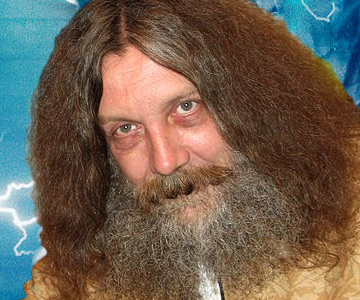

With this week’s wildly anticipated release of “Watchmen,” everyone from IGN to the New York Times has noted one name that is conspicuously absent from the movie’s credits: Alan Moore. That is, the man who wrote the work upon which the film is based and whose dark vision transformed the contemporary comic book form into a literary fun house. Moore has made clear his intentions to boycott “Watchmen,” which is not all that surprising, since he has more or less disowned previous cinematic adaptations of his comics like “From Hell,” “V for Vendetta” and “The League of Extraordinary Gentlemen.” Last fall he spoke to the Los Angeles Times about the “Watchmen” movie, noting that he would be “spitting venom all over it for months to come.”
Thrown out of school at the age of 17 for selling LSD, Moore found solace in the counter-culture, reading the works of William S. Burroughs and Thomas Pynchon as a substitute for an institutional education. He began his storied career in the late ’70s, writing a strip called “Maxwell the Magic Cat” for the Northants Post, near his native Northampton, England, before working on the popular “2000 AD” comic. His breakthrough into the mainstream began with his revitalization of “Swamp Thing” in 1983; around the same time, he also wrote “V for Vendetta,” a serial set in a post-apocalyptic Britain that criticized the overtly repressive Victorian throwback of Thatcherite politics. With “V” and his later work, Moore changed the face of comics. His talent for unflinchingly showing people what they really are has made him an inspiration for everyone from Joss Whedon to “Lost” producer Damon Lindelof to director Christopher Nolan, who has noted the influence of Moore’s “Batman: The Killing Joke” on “The Dark Knight.”
Moore has long since abandoned the world of tights and superpowers, opting instead to concentrate on mysticism, myth and history. His 2004 prose novel, “Voice of the Fire,” is a macabre examination of magic that covers thousands of years of existence in his native Northampton. His long-awaited follow-up, “Jerusalem,” also spans the breadth of known history; he has said that the manuscript runs close to 750,000 words. Moore is also still enmeshed in his “League of Extraordinary Gentlemen” series, weaving together a spectacular, witty patchwork of literary characters and styles to illustrate his “unified field theory of fiction.”
Unlike his evil “Watchmen” protagonist Ozymandias, Moore does not feel the spirits of history move him to fight injustice or destroy the world. Rather, he seeks to do what he has always done: to push the boundaries of fiction by making murky waters clearer, and imparting his understanding to his readers. Salon spoke to Moore by phone while he was working on the third volume of “League of Extraordinary Gentlemen” (which will be published this April) about his career, his favorite psychotic characters and “Watchmen’s” bad influence on the comics world.
A former editor of yours told me that you are infamous for writing an 80-page script for something like a 24-page comic.
Well, for the 3rd volume of “The League of Extraordinary Gentlemen,” the actual manuscript was something like 250 pages for each 72-page chapter. I think it’s possibly getting worse instead of better. The way I work, and the way I was taught by people like Steve Moore and British comic writers of that ilk, was that if you fully visualize the scene for the artists, then that would be sufficient to inspire the artist to do a picture that they otherwise might have not intended. Even though the readers will never get to read those pages of description that I cram into my stories, I’d like to think that they will still get the benefit of them because the artist will have translated those pages of often vague and rambling instructions into a concise picture.
I found that it pays to pay attention to all of the little details. In the latest “League” I’ve gone through the trouble of rewriting a number of Bertolt Brecht’s songs for “The Threepenny Opera.” I didn’t think it was fair game to take Brecht’s songs and reproduce them, because if I’m getting paid to write this thing, I should be writing all of it, so instead I reworked all of the lyrics of the songs throughout the narrative, which is a lot of trouble, but it’s also quite a lot of fun and adds to the finished product.
You’ve received a lot of acclaim for the “League of Extraordinary Gentlemen” series and the way you take characters from literature and translate them into comics. You started “League” as a Victorian story, but by the end of the 2nd volume, it became clear that it extends the whole breadth of fiction.
It certainly has outgrown our original intentions for the series, which was going to be a fantastic Victorian romp with all our favorite characters in it. I think that somewhere during the first issue when I realized and I said, hold on, I’ve got Robert Louis Stevenson’s Mr. Hyde in Edgar Allen Poe’s Rue Morgue, having just killed off Emile Zola’s Nana and I thought, This is fantastic, what if I really go overboard with this? By the end of that second book, when we’d done the whole fictional world, I’d started to see that we had something huge coming together. I think it was when I had Babar the elephant going past the hut of Mr. Kurtz out there in the Belgian Congo from “Heart of Darkness.” It was starting to look like it was becoming a “unified field theory of fiction.”
It’s our fictions that drive us forward most of the time. They may even be our mad nightmare fantasies, but they do seem to play their part in propelling us forward as a species. And I suppose that “League of Extraordinary Gentlemen” is an attempt to talk about these fruits of our imagination and examine them in a different way than that which was put forward in the original books.
You say something like that in the beginning of “Lost Girls.” “The truth is the reflection of the fiction that we see.”
If you look at that incredible burst of fantastic characters that emerged in the late 19th century/early 20th century, you can see so many of the fears and hopes of those times embedded in those characters. Even in throwaway bits of contemporary culture you can often find some penetrating insights into the real world around us.
I’ve heard you wrote “V for Vendetta” to criticize Thatcher’s Parliament, but it really seemed less like a modern tale and more like a romantic knight from a medieval tale.
When we were putting together that character, we wanted to make him almost the quintessential romantic anarchist hero. I’d noticed that in British comics, in general, we seem to have a much greater sympathy for villains. A lot of the characters that populated British comics in the ’60s were psychopathic villains or criminals and in our folklore there are a lot of characters like Robin Hood or Guy Fawkes fighting against the authority. We thought we might try to boil all of them into the character of “V for Vendetta.” We wanted to talk about these two ancient principles of fascism and anarchy and although, yes, it was written in the early 1980s, it was intended to be something as universal as we could make it.
You don’t really give any clear statement in “V” about whether or not the whole thing is worth it. In the end, Finch just walks away while the country crumbles into anarchy. There’s a real moral ambiguity to the whole story.
And the same thing goes for the end of a lot of my works. I mean, I think that the end of “Watchmen,” where you’ve got the whole fate of the world basically being left in the hands of a semi-literate copy boy … I believe the ending quote is “I leave that entirely in your hands,” which I think was me talking to the reader. Because I don’t think that it is the purpose of fiction to actually dictate a political/moral reality. I feel really uneasy about that. I think that’s why I introduced a lot of the moral ambiguities into “V for Vendetta” in the first place. Some of the fascists are sympathetic and some of V’s actions are very, very questionable. It’s not my job to tell people what to think. If I can actually in some way help the readers’ own creative thinking, then that’s got to be to everybody’s benefit.
One of your most popular characters, Rorschach from “Watchmen,” also turned out to be the most likable. Why do you think that is?
Rorschach is the least morally compromised of all the characters. He is also psychotic, which, again, raises an ambiguity to the thing. Maybe the most psychotic character could be the most morally pure and morally directed and maybe the most apparently enlightened character, Ozymandias, could be in the end the most damned and the most appalling. That’s sometimes how things work out.
“Watchmen” had a major impact on comics and the way they portray violence, turning the industry toward something grittier. Is that what you intended?
I don’t think we knew what to expect. We thought we were just doing an interesting twist upon the superhero story and it was only around about issue No. 3 when we suddenly realized that the way that we were telling the story was becoming very interesting and multilayered with a lot of new things that we had never done before. At that point perhaps we did start to have high hopes for what the book might achieve — maybe naively we thought, “Once everybody has seen ‘Watchmen,’ this will open the door for other people to free their imaginations up and do equally progressive works that will take the medium into countless other directions.”
But that isn’t the way the culture tends to work. You’ll get something like Harvey Kurtzman’s excellent “Mad” comics that, while being wonderful in itself, will condemn the humor comics genre to 50 years of magazines that are named after some form of mental illness and which feature stuff that is pretty much the same as “Mad.” But I guess that is always going to happen. You’ve just got to keep hoping for these kind of influence breakthroughs and the stuff that follows on from them is probably only of secondary consequence, you know. I mean, if “Watchmen” hadn’t come along, something else would have come along that would have been as violent or as dark and that would have done much the same thing to a lot of the comics. I’m more or less just beating myself up about it.
“Watchmen” is widely regarded to have brought an aura of realism to comics.
I think that more often it’s a more supposed physical realism rather than any kind of emotional realism. Yes, books like “Watchmen” did make it fashionable to show grimly the consequences of violence, which I suppose initially was a good thing because it’s better that people know that violence results in terrible injury and pain and suffering than that they think that it’s just something that, you know, people get a sock on the jaw and they are unconscious for a couple minutes and then they come around and they are taken off to the police station.
But I think that when you are talking realism in comics you have to realize it’s an ongoing process, especially emotional realism. That when the comic book industry started you had characters who were, let us say, one-dimensional in that they only had one quality. They were good or that they were bad. By the 1960s Stan Lee with Marvel Comics had the brilliant idea of two-dimensional characterization where they are still good or bad but now they have some kind of, perhaps a medical complaint or some sort of emotional suffering. What we were trying to do with “Watchmen” was to make it at least three-dimensional. So that the characters that we were talking about were complex human beings that weren’t defined by one simple set of behavior patterns. With some things like Todd McFarlane’s “Spawn” or a lot of these modern comics, they will show greater violence because they know that actually that is what a lot of the audience wants, for prurient reasons, not trying to show the emotional depth and complexity of the characters.
I want to ask you about “From Hell.” You apparently looked up a plethora of primary sources and wrote this horrifying take on 1888 London, and the Jack the Ripper murders. I read it from front to back in about three days and it is the only book where, after I was finished, I put it down and I cried.
I wanted it to be devastating. I wanted to do a book that was, in its way, just as devastating as the actual events that it was talking about. I wanted to try and turn the basic ideas of the Jack the Ripper story, and the way that it’s generally been presented, to turn those notions around. Because all too often, Jack the Ripper is the inspiration for a lot of the stalk-and-slash movies that make up such a large chunk of our cinema even today and I’ve never liked that kind of film. I’ve never liked the treatment of Jack the Ripper that I’ve seen where there is kind of a ghastly prurience to it. Where you get the sensation that the creator of the work and the audience to some degree are becoming excited by the idea of this monster stalking and eviscerating women. So we wanted to try and take a huge view of those crimes, to examine all of the threads of meaning that bleed out from those events, so that the actual killings are not the greater part of the work by any means. Yes, they are presented with absolute forensic detail, which is something we can only get away with in comics, and yet it was almost as if by studying those events so intensely we were able to take a tissue sample from which we could diagnose an awful lot about Victorian society and Western society in general.
You seem like such an intelligent man, with a lot of great ideas. I just was wondering why you decided to drop out of school and deal acid during your youth.
Well, no, it was because I decided to deal acid that I was expelled from school. Sadly, I found that as an acid dealer I was complete rubbish. I was taking far too much of my own product and I couldn’t really keep the business side of things straight at all, then, very summarily got expelled.
None of my education really comes from school. The only place where I was finding any information that really intrigued me was through my contact with what we then referred to as the counterculture. That entire hippie psychedelic scene that existed then which was producing incredible music, incredible culture, incredible writings and the whole impetus was to expand your mind, as they said. So I found that once I’d been expelled from school, I was compelled to educate myself and I found this a very entertaining and easy process. In the course of a few decades of living, I found that I’d absorbed far more information than I would’ve done if I’d been in an academic institution.
All too often education actually acts as a form of aversion therapy, that what we’re really teaching our children is to associate learning with work and to associate work with drudgery so that the remainder of their lives they will possibly never go near a book because they associate books with learning, learning with work and work with drudgery. Whereas after a hard day’s toil, instead of relaxing with a book they’ll be much more likely to sit down in front of an undemanding soap opera because this is obviously teaching them nothing, so it is not learning, so it is not work, it is not drudgery, so it must be pleasure. And I think that that is the kind of circuitry that we tend to have imprinted on us because of the education process.
Well, if you’ve proved anything, it’s that the medium of comics can …
Take up the slack. Well this has been to some degree my hoped-for ambition over these years. It seems to me to be a responsibility of culture to become as informative as possible and give people a source of information in a form they will be drawn to. Just as the education system can equate learning with work and work with drudgery and program people against the idea of learning, I can … well, everybody knows that comics are entertainment. If you can present something that’s colorful, that’s entertaining, that looks like the kind of thing that people would seek out for enjoyment, then you are much more likely to get people to respond to it. I’m sure there are lots of people out there who although they couldn’t actually give you a clear idea of their country’s history over the past couple of hundred years, but they probably could give you a detailed description of the continuities of whatever comic book or television show they are most obsessed with. We have an enormous capacity for absorbing all of this trivia, so if you can spike the entertainment with genuine information — whether that be moral information or historical information, magical information — then it actually stands a chance of being absorbed by the public.
I’m assuming “Lost Girls” was part of that education?
Oh, very much so. “Lost Girls,” it represents a culmination of 16 years’ work or more. “Lost Girls,” as in a lot of the work I attempt, was meant to try to address what I saw, and what Melinda [Gebbie, Moore’s wife and “Lost Girls” coauthor] saw, as a problem in the way our perceptions work and the way that we see certain parts of our being, notably our sex drive and our sexual imagination, that there seemed to us to be a kind of disconnect between people and their sexual imagination. It seemed to us that most modern pornography, it has exactly the opposite effect from the liberation that we were hoping to achieve in that it tends to make people feel guilty and ashamed and lonely and dirty. We wanted to make the enjoyment of pornography into a valid cultural act that people could enjoy and be proud of enjoying. We shall see how that pans out.
One of the last mainstream comics you ever wrote was “Batman: The Killing Joke.” “The Dark Knight” seems to have drawn a little creative fuel from that.
Like the first one they made, by the admission of the writer and the director, drew a lot of creative energy from that. I suppose that maybe nobody’s had a good idea in the meantime. [chuckles] It’s a bit disappointing. With the actual work, I did the best job with what I had at the time. I wanted to work with Brian Bolland and vice versa. Brian said that he’d like to make it a book about the Joker so I was accommodating Brian with that, and Brian did a fantastic job. I have to say it’s not one of my favorite works. Pretty far from it, actually. I was doing it at roughly the same time I was doing “Watchmen”; a lot of my storytelling ideas are identical to the ones in “Watchmen.” I was pretty much under the influence of the other book, and also I thought that it was very, very nasty.
I’ve got no problem with nasty scenes as long as they are for a purpose. There are some nasty scenes in “Watchmen,” but “Watchmen” is an intelligent meditation on the nature of power so it is actually talking about something which is relevant to the world in which we all live. Whereas in “The Killing Joke,” what you’ve got is a story about Batman and the Joker, and while it did draw interesting parallels between these two fictional characters, at the end of the day that’s all they are, fictional characters. They’re not even fictional characters that have any bearing on anyone you’re likely to meet in reality.
You made the villain such a pitiful figure. In the comics for years, he was a psychotic maniac who kills indiscriminately, just does terrible, terrible things, and you made him so pitiful and sad.
I suppose that’s what I was saying. Well, psychotic murders — the key word there is “psychotic,” which is, as far as I know, an illness. This is not to say that people shouldn’t be entitled to feel rage or the lust for revenge when something happens to them at the hands of somebody like this, but you’ve got to remember at the end of the day it’s not strictly speaking that person’s fault. That something has happened to them, they have made some bad decision in their life, and while all of us are responsible for our actions, sometimes people get broken and it is increasingly difficult for them to know their own actions. So I suppose that if there was anything actually being said in “The Killing Joke,” it was that everybody has probably got a reason for being where they are, even the most monstrous of us.
A constant theme in your work is the change that happens from period to period.
I think that, like my interest in other time periods, where we thought differently and did things differently, in a lot of my work you’ll find a character with a fourth-dimensional perspective coming up. You’ve got Dr. Manhattan in “Watchmen,” you’ve got William Gull in “From Hell,” who is having these strange flash forwards to the future.
They’re like ghosts.
But at the same time it is almost trying to give a fourth-dimensional perspective of our experiences as individuals and our experiences as a society. With “Jerusalem” and with my previous novel “Voice of the Fire,” it tends to jump about all over time and plunge into very, very different mind-sets in very, very different periods, some of them completely alien to our present mind-set. And I think that that’s useful because it enables us to have sense of the continuum that we are in, not just this particular chunk of it; this hour that we’re living through now, this week, this few years, or even this 70-80-year period we’re living though now. It enables us to be able to see the continuum that we are in as something that has a back story and has a future. To see the story that we are in in the way that I as a writer and I presume most of the writers see the story that they are writing. When I’m putting a story together, I generally know the ending and a couple of the points halfway through, and I’ve got sort of an idea about the beginning, and although I do write the story one sentence at a time, when I’m thinking it up, I’m thinking it up all at once. It might be useful to us if we could get a sense of structure regarding the way we look at not only our lives, but the lives of our towns, communities, nations and the world.
