
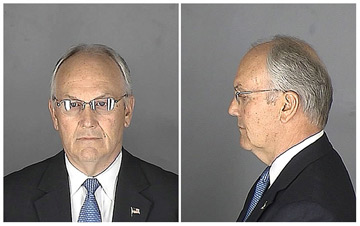



Larry Craig’s mug shot in “Outrage.” Photo courtesy of Magnolia Pictures
Almost 30 years ago, during the political season of 1980 that would end with Ronald Reagan’s landslide election, a congressional sex scandal briefly drove Reagan, sitting President Jimmy Carter and the American hostages in Tehran off the front page. Rep. Bob Bauman, R-Md., a rising star in conservative politics whom many saw as a future House speaker, was arrested for soliciting sex from a 16-year-old male prostitute. Bauman apologized to his wife and family, announced he was seeking treatment for alcoholism and unspecified personal problems, and disappeared into rehab without addressing any of the obvious questions arising from this arrest. He lost his seat to a little-known Democratic opponent in November, and made a short-lived effort to run again in 1982. That was the end of his political career.
Bauman has had a successful career since then as a tax attorney specializing in offshore-banking issues (and, lately, as a conservative blogger), so he didn’t change his politics much after leaving Congress. He did, however, eventually come out as a gay man, and wrote a 1986 autobiography called “The Gentleman From Maryland: The Conscience of a Gay Conservative.” For many Americans, the Bauman case was their first peek inside the Washington closet, a phenomenon that filmmaker Kirby Dick says has subtly — or not so subtly — deformed American political discourse for the last several decades.
Dick’s new film, “Outrage,” created a momentary news blip after its Tribeca Film Festival premiere, largely based on the circumstantial evidence Dick arrays about a number of possibly closeted politicians, most notably Florida Gov. and presumptive 2012 presidential candidate Charlie Crist — who, whatever his sexual orientation may be, looks more like a photographic negative of a human being than a real one — along with former Sen. Larry Craig, R-Idaho, former Louisiana Rep. Jim McCrery, and former New York Mayor Ed Koch. But allegations that those men were leading concealed double lives have circulated for years, as rumors and in print, and “Outrage” is more than just gay-positive gotcha journalism in the mode of blogger Mike Rogers (a prominent voice in the film).
As in his previous film, “This Film Is Not Yet Rated” (about the super-secretive motion-picture ratings board), Dick is trying to launch public debate about a semi-official organ of American hypocrisy. Although the Bauman case is not mentioned in “Outrage,” one of the startling aspects of the film is how little seems to have changed since 1980. Gays and lesbians are more prominent and more widely accepted in American life than ever before, but Craig’s 2007 arrest for propositioning an undercover cop in a Minneapolis-St. Paul airport bathroom echoed Bauman’s arrest to an eerie degree. A beloved conservative leader, faced with public humiliation and the obvious unraveling of his political career, desperately prevaricates, backtracks and apologizes. Despite ample anecdotal evidence about Craig’s private conduct over the years, we’re still waiting for the confessional memoir.
Dick argues, in fact, that the political closet has grown more oppressive in recent years, largely thanks to the Republican Party’s fervent embrace of anti-gay policies, which has sent lesbian and gay conservatives scurrying for cover. He agrees that politicians, whether gay or straight, out or closeted, are entitled to some degree of personal privacy. A politician who is cheating on his wife with a man is not inherently more newsworthy than one cheating with a woman. But a politician who is voting for a rabidly anti-gay agenda while seeking out anonymous gay sex partners in bathrooms, in his view, is a dangerous hypocrite and very likely a disordered personality. In voting against his own natural interests, that politician is directly damaging gays and lesbians, and depriving the entire country of an honest debate about policies and attitudes on homosexuality.
In addition to his film’s unwilling subjects — which also include Rep. David Dreier, R-Calif., a not-quite-closeted figure whose presumed homosexuality has clearly cost him a chance to advance in the Republican hierarchy — Dick has assembled a veritable who’s-who of gay politicians, activists and journalists. These include former Arizona Rep. Jim Kolbe (who came out when threatened with outing in 1996); Rep. Tammy Baldwin, D-Wis., the only openly lesbian member of Congress; former New Jersey Gov. Jim McGreevey, who resigned after coming out in 2004; Rep. Barney Frank, D-Mass., the first openly gay member of Congress; playwright-activists Larry Kramer and Tony Kushner; blogger Andrew Sullivan and many more.
I met Kirby Dick in the Manhattan offices of Magnolia Pictures, the distributor of “Outrage.” A handsome, composed fellow who looks and sounds much younger than his age (he’s 56), he had the conservative suit and the practiced, sound-bite demeanor of somebody who’s been spending a lot of time in Washington.
Your film got a lot of attention at Tribeca because of the conclusions you seem to draw about politicians like Charlie Crist and Larry Craig. But this movie really isn’t about outing specific people who may not be telling the truth about their sex lives, is it?
No, it absolutely isn’t. When the press covered Mark Foley and Larry Craig, I think the country looked at those as isolated instances. This film looks at the closet as a whole, and how it’s existed in American politics over the last several decades, and how it contorts American politics. I’m interested in it as a system, and the damage that it does, not only in the hypocrisy of certain individuals.
Still, a lot of people are going to ask: Why is it important to out closeted politicians? Why should we care about their private lives?
My film is not about outing closeted politicians. It’s about reporting on the hypocrisy of closeted politicians who vote anti-gay. That’s the bright line that I draw. In many cases, these politicians would normally vote pro-gay. But because of the rumors swirling around them, they run in the opposite direction. Their votes not merely harm millions of gays and lesbians across the country, but they’re also voting against their own beliefs, solely to protect the closet. That’s contorting the American political process.
Lots of married politicians cheat on their wives and it’s not necessarily newsworthy, except in special cases like Bill Clinton or Eliot Spitzer. Is there anything different about cheating on your wife with a man rather than a woman?
There may be no difference. If a politician is married and cheating on his wife with a woman and passing a law against adultery, that’s hypocrisy. If they’re not passing a law against adultery, then I personally don’t think that should be reported on. Some people do, and that’s an open debate. As I’ve said, this is my bright line: If a politician is in the closet, is having sex with someone of the same sex, and is passing laws that hurt gays and lesbians, then that’s hypocrisy.
You also seem to argue that the closet produces a specific kind of hypocrisy, or that it produces a profound personality distortion that makes the hypocrisy more severe.
It does. People have made this calculation to go into the closet, and oftentimes they have lied to their constituency for decades. They absolutely do not want this light to be shone on them, and they’ll do anything to prevent it, including voting much more strongly against gays and lesbians than they really want to. Most anybody who’s in the closet — if they had their choice, if they could be out, if there were no homophobia in this society — would naturally vote pro-gay and pro-lesbian.
So this leads me to ask whether there are closeted politicians who do not vote against gay issues.
Oh, yes. Absolutely. There’s a number of them, and there may be even more who are so closeted I don’t know about them. But that is not the focus of my film. There is an argument to be made that perhaps one’s sexual orientation should never be a private issue, if you’re a public official. Because you’re voting on issues of sexual orientation. If these politicians who are not hypocrites would come out, they’d be very important role models. Like Jim McGreevey, who at times did act hypocritically, but by coming out made a very important step to address the closet in this country.
One of the most interesting elements of the film comes when you address this question of personal derangement or distortion. When you talk about politicians like Larry Craig or Charlie Crist, who consistently have denied being gay in the face of persistent rumors and at least some evidence — Craig has been married for years, and Crist recently got married — some intriguing questions come up. Assuming that those guys are gay, do you have any theory or any speculation about what goes on in their minds?
Well, I would speculate that there’s a great difference between Charlie Crist and Larry Craig. I imagine, not knowing Crist, that he’s very comfortable with his homosexuality. That may not be true with Larry Craig. Here’s a person who grew up in a very conservative era, in the ’50s, in a conservative state. He realized early on the intensity of the homophobia, and from the time he was aware that he was gay, did everything he could to make sure no one found out.
This is something that’s been with him. I think, from very early in his formative years. I think he made the calculation that the safest way for him to have sex was to have it anonymously. So he travels a lot, he goes to a lot of bathrooms. His face is not particularly recognizable, and no one would imagine that a senator would be having sex in bathrooms. Again, this is speculation, but he may have gotten away with it for a long time. Mike Rogers [of BlogActive.com] spoke to someone who claimed to have had sex with Larry Craig in the Union Station bathroom, only a few blocks from the Capitol. So this seems to be an M.O.
This is really tragic. I mean, if he wants to have sex that way and he’s not disrupting other people’s lives, I’m not going to be judgmental. But I would imagine he wouldn’t want his sex life limited that way. What he’s afraid of is that if he develops a relationship with someone and that ends, then he’s vulnerable to whatever that person might say. That said, all the politicians I report on in my film are victims of homophobia themselves. I think that’s very important to realize.
You show that great scene from Tony Kushner’s “Angels in America,” or rather from the HBO movie version, where we see Al Pacino as Roy Cohn, telling his doctor that he’s not a homosexual. He’s a “heterosexual man who sleeps with men,” because to be a homosexual is to belong to a weak, oppressed and powerless group. Is that your best guess about how someone who’s really deep in the closet might think about it?
Well, it could be that. In the film, Rich Tafel has an interesting comment relating to that. He was executive director of the Log Cabin Republicans, and he was surprised when he started talking to people in the closet who came to him and said, “You think it’s strong to come out and be open. I actually think I’m stronger than you. I’m putting my political ambition first, I’m not putting anything about my personal life first. That’s what it takes to succeed in politics.”
As contorted and twisted as that is, there’s some truth to that. If you’re willing to put your ambition first, in politics or any other field, that may help you succeed. But it damages you psychologically. Living in the closet you have to protect the closet, and it ends up damaging millions of gays and lesbians across the country.
You also argue that the mainstream media has, in effect, enabled the closet for many of these politicians. When people get arrested in sex scandals, whether it’s Larry Craig or Eliot Spitzer, that obviously makes headlines. But otherwise there’s a great reluctance to explore people’s private lives, or maybe to see why they’re relevant.
Yeah, it’s interesting. In general, historically and even now, there’s an “ick factor” in the mainstream media around stories that have to do with gay sexuality. It’s been the gay press who, for decades, has wanted these stories told, and has demanded that the mainstream press cover them. They want parity between gay sexuality and straight sexuality across society, even when it comes to a scandal.
I’m not going to say the press is homophobic. It’s more a veiled form of homophobia. Like much of D.C., the media that covers politics is less homophobic than society as a whole. They’re concerned it’s an issue that will turn off their readership, I’m sure that’s in play. There are concerns about privacy, and I’m sure that’s well meaning. Reporters and documentary filmmakers do have to go into people’s private lives at times, they do sometimes have to do things that will hurt those people. But that’s their job. If they don’t do it, it will be worse for the country.
You make the observation in the film that Washington is a very gay city. I think to anybody who has worked there, gay or straight, that’s really obvious. But it doesn’t get talked about much.
Yeah, and I think it should be. As Kirk Fordham, a former chief of staff to Mark Foley, says in the film, if they kicked out all the gay and lesbian staffers from Congress the way they kick gays and lesbians out of the military, then Congress would grind to a halt. Why not celebrate that?
I wonder if we’ll see more politicians occupy that ambiguous middle ground, like David Dreier, who has repeatedly been outed by journalists but just doesn’t talk about his private life. Or even Jim McCrery, who was outed by the Advocate in 1992 and never directly responded to it. [McCrery remained in Congress until 2009.]
Well, the middle ground was more in play before the Republicans decided to use anti-gay hysteria to further their political ends. We’ve heard stories about politicians going to gay bars in the ’80s and early ’90s. Nobody reported on it and nobody much cared. There was no anger about it. People do all kinds of things in D.C., and other people just let them do it. But once the Republican Party turned on gays and lesbians, gay and lesbian politicians felt they would be targets and had to go into the closet.
When you interview formerly closeted politicians who come out, like Jim Kolbe, it almost seems like they’ve had this born-again experience …
That’s a good way to put it, yeah.
Many of them become really active on gay issues, and it seems like some of them shed their conservative ideology altogether.
Yes and no. Some move to the left on other issues, but I don’t think that Jim Kolbe’s positions, for instance, have shifted that much. He was always a mainstream or middle-of-the-road Republican, not a right-winger. He supported the ERA, for example, and I’m pretty sure he never wanted to vote for the Defense of Marriage Act. What happened after he came out was that he was allowed to vote the way he believed. He describes it as a near-religious experience, the weight of decades of lies was now lifted off his shoulders.
See, this is not a partisan film. This is really focusing on the issue of the closet, and the damage it does to gays and lesbians. I think one of the most important things that could happen to the gay rights struggle would be a prominent out gay Republican running for a major political office. That would do so much to change things.
Could the Republican Party, in its current form, tolerate that?
Well, I think there’s a huge discussion within the party right now about whether this is hurting them more than it’s helping them. There’s no question that gays and lesbians are a very powerful constituency, a very wealthy constituency, a very focused constituency. I think they’re losing out, purely in terms of political calculation, by not having that constituency more behind them.
“Outrage” opens May 8 in many major cities, with wider national release to follow.
