
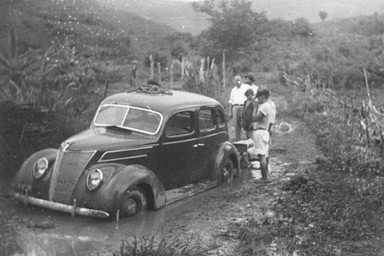

The empire ends with a pullout. Not, as many supposed, a few years ago, from Iraq. But from Detroit.
Of course, the real evacuation of the Motor City began decades ago, when Ford, General Motors and Chrysler started to move more of their operations to harder-to-unionize rural areas and suburbs, and, finally, overseas. Even as the economy boomed in the 1950s and 1960s, nearly 50 Detroit residents a day were packing up and leaving their city. By the time the Berlin Wall fell in 1989, Detroit could count tens of thousands of empty lots and over 15,000 abandoned homes. Stunning Beaux Arts and modernist buildings were left deserted to return to nature, their floors and roofs covered by switch grass. They now serve as ornate birdhouses.
Still, in mythological terms, Detroit remains the ancestral birthplace of American capitalism. In years to come, the sudden disintegration of the Big Three will be seen as a blow to American power comparable to the end of the Raj, Britain’s loss of India, that jewel in the imperial crown, in 1948. Forget the possession of a colony or the bomb, in the second half of the 20th century, the real marker of a world power was the ability to make a precision V-8.
There have been many dissections of what went wrong with the U.S. auto industry, as well as fond reminiscences about Detroit’s salad days, about outsize tailfins and double-barrel carburetors. Last year, the iconic Clint Eastwood put the iconic white autoworker to rest in “Gran Torino.” But few of these postmortems have conveyed how crucial Detroit was to U.S. foreign policy — not just as the anchor of America’s high-tech, high-profit export economy, but as confirmation of ourselves as the world’s premier power. (In linking Detroit’s demise to the blowback from President Nixon’s illegal war in Laos, Eastwood came closer than most).
Detroit supplied a continual stream of symbols of America’s cultural power. It also offered the organizational know-how to run a vast industrial enterprise like a car company — or an empire. Pundits love to quote G.M. president “Engine” Charlie Wilson, who once famously said that what was good for America “was good for General Motors, and vice versa.” It’s rarely noted that Wilson made his remark at his Senate confirmation hearings to be Dwight D. Eisenhower’s secretary of defense. At the Pentagon, Wilson would impose G.M.’s corporate bureaucratic model on the armed forces, modernizing them to fight the Cold War.
After G.M., it was Ford’s turn to take the reins. John F. Kennedy tapped Ford president Robert McNamara and his “whiz kids” to ready American troops for a “long twilight struggle, year in and year out.” McNamara used Ford’s integrated “systems management” approach to wage “mechanized, dehumanizing slaughter,” as historian Gabriel Kolko once put it, from the skies over Vietnam, Laos and Cambodia.
Perhaps, then, we should think of the ruins of Detroit as our Roman Forum. Just as Rome’s triumphal arches still remind us of its bygone imperial victories in Mesopotamia, Persia and elsewhere, so Motown’s dilapidated buildings invoke America’s slipping supremacy.
Among the most imposing is Henry Ford’s Highland Park factory, shuttered since the late 1950s. Dubbed the Crystal Palace for its floor-to-ceiling glass walls, it was here that Ford perfected assembly-line production, building up to 9,000 Model Ts a day — a million by 1915 — catapulting the United States light-years ahead of industrial Europe.
It was also here that Ford first paid his workers $5 a day, creating one of the most prosperous working-class neighborhoods in America, filled with fine arts-and-crafts style homes. Today Highland Park looks like a war zone, its streets covered with shattered glass and lined with burned-out houses. More than 30 percent of its population lives in poverty and you don’t want to know the unemployment numbers (more than 20 percent) or the median yearly income (less than $20,000). There is one reminder it wasn’t always so. A small plaque outside the Ford factory reads: “Mass production soon moved from here to all phases of American industry and set the pattern of abundance for 20th Century living.”
To grasp how far America has fallen from the heights of industrial grandeur — and to understand how that grandeur led to stupendous acts of folly — you could tour another set of ruins. But these ruins don’t lie in the Rust Belt but in the deep Brazilian Amazon rain forest. There, overrun by tropical vines, sits Henry Ford’s testament to the belief that the American Way of Life could easily be exported, even to one of the wildest places on the planet.
Ford owned forests in Michigan and mines in Kentucky and West Virginia. He had control over every natural resource needed to make a car except rubber. In 1927, he obtained an Amazonian land grant the size of a small American state. Ford could have set up a purchasing office and bought rubber from local producers, as other rubber exporters did. But he had more grandiose ideas. He felt compelled to cultivate “rubber but the rubber gatherers as well.” He set out to overlay Americana on Amazonia. He had his managers build Cape Cod-style shingled houses for the Brazilian workforce. He urged them to tend flower and vegetable gardens and eat whole wheat bread, unpolished rice, canned Michigan peaches and oatmeal. With suitable pride, he dubbed his jungle town “Fordlandia.”
It was the 1920s and his managers enforced alcohol prohibition, or at least tried to, even though it wasn’t a Brazilian law. On weekends, the company organized square dances and recitations of the poetry of Henry Longfellow. The hospital offered free healthcare for workers and visitors alike. It was designed by Albert Kahn, the renowned architect who built a number of Detroit’s most famous buildings, including the Crystal Palace. Fordlandia had a central square, sidewalks, indoor plumbing, manicured lawns, a movie theater, shoe stores, ice cream and perfume shops, swimming pools, tennis courts, a golf course and, of course, Model Ts rolling down its paved streets.
The clash between Henry Ford — the industrial giant who produced identical products, the first indistinguishable from the millionth — and the Amazon, the world’s most complex and diverse ecosystem, was Chaplinesque in its absurdity, producing a parade of mishaps straight out of a Hollywood movie. Think “Modern Times” meets “Fitzcarraldo.” Brazilian workers rebelled against Ford’s Puritanism and nature rebelled against his industrial regimentation. Run by incompetent managers who knew little about rubber planting, much less social engineering, Fordlandia was plagued by vice, knife fights and riots. The place seemed less “Our Town” than Deadwood, as brothels and bars sprawled around its edges.
Ford managed to wrest control over his namesake fiefdom. But because he insisted his managers plant rubber trees in tight rows — back in his Detroit factories, Ford famously crowded machines close together to reduce movement — he created conditions for the explosive growth of bugs and blight that feed off rubber, which laid waste to the plantation. Over the course of nearly two decades, Ford sank millions into making his jungle utopia work the American way, yet not one drop of Fordlandia latex made its way into a Ford car.
Today, the ruins of Fordlandia look like those in Highland Park and other Rust Belt towns, where life centered on a factory has been abandoned to weeds. There is an eerie resemblance between Fordlandia’s rusting water tower, broken-glassed sawmill, and empty power plant and the husks of the same structures in Iron Mountain, a depressed industrial city on Michigan’s Upper Peninsula, which also used to be a Ford town.
In the Amazon, Kahn’s hospital has collapsed and the jungle has reclaimed the golf course and tennis courts. Bats have taken up residence in houses where American managers once lived, covering their plaster walls with a glaze of guano. No commemorative plaque marks its place in history, but Fordlandia, no less than the wreck of Detroit, is a monument to the titans of American capital — none more titanic than Ford — who believed the United States offered a universal model for humanity.
It would be easy to read the story of Fordlandia as a parable of arrogance. With a surety of purpose and incuriosity about the world that seems all too familiar, Ford rejected expert advice and set out to turn the Amazon into the Midwest of his imagination. The more the project failed on its own terms — to grow rubber — the more Ford company officials defended it as a civilizational mission. Yet Fordlandia cuts deeper into the marrow of the American experience.
Over 50 years ago, Harvard historian Perry Miller gave a famous lecture titled “Errand Into the Wilderness.” He tried to explain why English Puritans lit out for the New World, as opposed to, say, Holland. They went, Miller suggested, not just to escape the corruptions of the Church of England, but to complete the Protestant reformation of Christendom that had stalled in Europe. The Puritans sought to give the faithful back in England a “working model” of a purer community. Put another way, central to American expansion was “deep disquietude,” a feeling that “something had gone wrong” at home. With the Massachusetts Bay Colony just a few decades old, a dissatisfied Cotton Mather began to learn Spanish, thinking that a better “New Jerusalem” could be raised in Mexico.
The founding of Fordlandia was driven by a similar restlessness, a chafing sense, even in the best of times, that “something had gone wrong” in America. When Ford embarked on his Amazon adventure, he had already spent the greater part of two decades, and a large part of his enormous fortune, trying to reform American society. His frustrations and discontents with domestic politics and culture were legion. War, unions, Wall Street, energy monopolies, Jews, modern dance, cow’s milk, both Theodore and Franklin Roosevelt, cigarettes and alcohol were among his many targets and complaints. Yet churning beneath all these imagined annoyances was the fact that the force of industrial capitalism that he had helped unleash was undermining the world he hoped to restore.
Ford preached with a pastor’s confidence his one true idea: Ever-increasing productivity combined with ever-increasing pay would relieve human drudgery and create prosperous working-class communities, with corporate profits rising on the continual expansion of consumer demand. “High wages,” as Ford put it, to create “large markets.” By the late 1920s, Fordism — as this idea came to be called — was synonymous with Americanism, and was envied the world over for having apparently humanized industrial capitalism.
But Fordism contained the seeds of its own undoing. Breaking down the assembly process into smaller and smaller tasks, combined with rapid advances in transportation and communication, made it easier for manufacturers to break out of the dependent relationship established by Ford between high wages and large markets. Goods could be made in one place and sold somewhere else, removing the incentive employers had to pay workers enough to buy the products they made.
Ford sensed this unraveling and tried to slow it in ever more eccentric ways. He established a series of decentralized “village-industries” in Michigan. The villages were designed to balance farm and factory work and rescue small-town America. Yet his pastoral communes were no match for the raw power of the changes he had played such a large part in engendering. So he turned to the Amazon to raise his City on a Hill, or in this case, a city in a tropical river valley, pulling together the many strains of his utopianism in one last desperate bid for success.
Nearly a century ago, journalist Walter Lippmann remarked that Henry Ford’s drive to make the world anew represented a common strain of “primitive Americanism,” reinforced by a confidence born of unparalleled achievement. Lippmann followed with a question meant to be sarcastic, but was, in fact, all too prophetic: “Why shouldn’t success in Detroit assure success in front of Baghdad?” We have seen the ruination that befell Detroit. Whither Baghdad? Whither America?
