
Sonia Sotomayor

When old white guys attack

Forget her actual record -- Jeff Sessions and the angry GOP just know Sotomayor wants to keep the white man down

  • more
    • All Share Services

Topics:

When old white guys attack

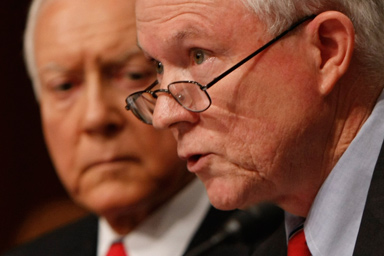
Jefferson Beauregard Sessions III can see the future.

The theory that Sessions and his fellow Republicans appear to be working under when it comes to Sonia Sotomayor, President Obama’s pick for the Supreme Court, boils down to this: ignore how she’s ruled in the 3,000 or so cases she’s heard in her 17 years as a federal judge (except, of course, in the one the white guy lost), and instead, focus on a few lines in a handful of speeches she’s given — and voilà, you, too, can have a peek at Sotomayor’s future tenure on the high court. Her actual rulings so far — very few of which came up at Tuesday’s first day of question-and-answer with the Senate Judiciary Committee — won’t help you discern her judicial philosophy. But those speeches will, no matter what she’s done as a judge or what she says in her confirmation hearings. Because as Sessions explained, only once she’s on the Supreme Court will her true, white-man-hating thoughts finally be unshackled.

“Philosophy can impact your judging,” Sessions, an Alabama Republican and his party’s leader on the Judiciary Committee, told Sotomayor. “I think it’s much more likely to reach full flower if you sit on the Supreme Court … than it will on a lower court, where you’re subject to review by your colleagues in the higher court.”

Armed with that prescience, Sessions and his colleagues were free to mostly disregard everything Sotomayor said Tuesday. Which was probably helpful to them, since nearly everything she said directly rebutted the assumptions behind their questions. “I want to state upfront, unequivocally and without doubt, I do not believe that any ethnic, racial or gender group has an advantage in sound judging,” Sotomayor said in response to a question from the committee’s Democratic chairman, Patrick Leahy of Vermont, who asked her about some of the GOP talking points early on, in order to give her a gentle lead-in to those topics. “I do believe that every person has an equal opportunity to be a good and wise judge regardless of their background or life experiences.”

Nevertheless, barely 10 minutes later, Sessions was asking her this: “Do you think there’s any circumstance in which a judge should allow their prejudices to impact their decision-making?” Sotomayor — who didn’t get to the point where she was virtually assured a seat on the Supreme Court by being born yesterday — knew how to answer that one. “Never their prejudices,” she told Sessions. But he kept at it. “Aren’t you saying there that you expect your background and — and heritage to influence your decision-making?” he asked. “That’s troubling me. That is not impartiality.”

The obvious point — that the background and heritage of old white guys influences their decision-making all the time, too — would not have been the politically sound one to make. So Sotomayor played it cool. “My record shows that at no point or time have I ever permitted my personal views or sympathies to influence an outcome of a case,” she said, and would wind up saying again and again, in more or less the same words, throughout the day. “In every case where I have identified a sympathy, I have articulated it and explained to the litigant why the law requires a different result. I do not permit my sympathies, personal views, or prejudices to influence the outcome of my cases.” A few hours later, Sessions flat-out told reporters he didn’t care what she’d said. “I don’t know — this is the confirmation process, so we got a statement from a day of the confirmation process that contradicts a decade or more of speeches.”

That was more or less how the whole day went; Republicans hurled increasingly pointed questions at Sotomayor, the nominee calmly parried them, and the Republicans mostly ignored her. (Democrats chimed in between the GOP rounds to offer her softballs, though Dianne Feinstein of California and Russ Feingold of Wisconsin both pressed her — gently — on issues relating to the Bush administration’s claims to unlimited executive power after the 9/11 attacks.) She mocked Sessions’ reliance on a brief YouTube clip, but in a peaceful, nonconfrontational tone that seemed to discombobulate the Alabama senator. “Judge,” Sessions sputtered, “I would just say, I don’t think it’s that clear.” When Arizona Republican Jon Kyl began his questions by brusquely asking if he could pick up a line of interrogation about gun control, Sotomayor answered him cheerily, “Sure. Good afternoon, by the way.” (Yes indeed, that famous Bronx warmth you’ve heard so much about was on full display.)

By the sixth hour of the hearing, South Carolina Republican Lindsey Graham had dispensed with the formalities altogether. “If I may interject, Judge, [lawyers] find you difficult and challenging more than your colleagues,” Graham blurted, without irony. “Do you think you have a temperament problem?” A minute later, he had turned, weirdly, to personal advice: “Maybe these hearings are a time for self-reflection.” Graham also cautioned Sotomayor to “appreciate the world we live in,” in which she could say something about a “wise Latina” and still expect to win a seat on the Supreme Court — since white men wouldn’t be able to get away with similar remarks. And he led her through a ritualized denunciation of al-Qaida, asking how women would be treated if the jihadists had their way.

What made his performance even stranger, though, was that Graham is likely to vote for Sotomayor’s confirmation. “Now, let’s talk about you,” he told her, just before haranguing her about her temperament. “I like you, by the way, for whatever that matters. Since I may vote for you that ought to matter to you.”

But the Senate is, in general, kind of a weird place, and Graham isn’t the only reason. For proof, just look at Orrin Hatch, the Utah Republican who engaged in a colloquy with Sotomayor about nunchuks, or Iowa Republican Chuck Grassley’s improvised line after an anti-choice protester disrupted the session again: “People always say I have the ability to turn people on.” Two days of hearings — well, one day of Senate bloviation, and one day of hearings — have only given the impression that the whole thing is pure political theater. Sotomayor spends her time fitting her opinions into narrow brackets that tell the Senate what it wants to hear, and the lawmakers, in turn, spend their time asking questions hashed out by aides in advance that are mostly geared toward scoring points with voters, not with the nominee.

If anything, actually, Sotomayor has shown herself to be even more conciliatory toward the Republicans going after her than is the pragmatic president who nominated her. At one point, nudged by Kyl, Sotomayor distanced herself, quite firmly, from Obama’s theory that empathy helps judges make their minds up in the 5 percent of cases where the law doesn’t indicate a clear winner. “I wouldn’t approach the issue of judging in the way the president does,” Sotomayor said. In response to Feingold’s questions, she also indicated Obama may be in for a surprise if he thinks a Justice Sotomayor will rule in favor of any of the Bush-inspired legal arguments the administration has been making in terrorism cases. “A judge should never rule from fear,” she said. “A judge should rule from law and the Constitution.”

For the most part, though, the very nature of a Supreme Court confirmation hearing keeps anything too substantive from being discussed; the nominee always begs out of debating legal points that might come up if she winds up on the court, pleading a possible conflict. If her patient, unruffled testimony Tuesday is any indication, Sotomayor appears to play that game as well as any of her predecessors. Sessions may not be the only one who can see the future — so far, anyone watching the hearings would feel comfortable predicting that this whole process ends with her on the court. 

Continue Reading Close

Mike Madden is Salon's Washington correspondent. A complete listing of his articles is here. Follow him on Twitter here.

Have attitudes toward women gotten worse?

That's what a NYT Op-Ed suggests. But maybe the Internet has just provided a forum for nastiness

  • more
    • All Share Services

Topics: , , , , , ,

On Sunday in a New York Times editorial titled “The Mismeasure of Woman,” former Portfolio editor in chief Joanne Lipman — whose magazine folded six months ago, almost to the day – argued that women have been toiling under the collective delusion of progress. We have fooled ourselves by defining our gains “too narrowly.” We have focused on the “numbers at the expense of attitudes.” Lately, there has been a lot of noise about the Shriver Report, with its cheerful pronouncement that, in 40 percent of families, women are the primary breadwinners; about the “He-cession” that has hit men harder than women (hardly positive news, but certainly thought-provoking); about Pelosi and Clinton and Sotomayor and the 17 female senators and 74 women in the House. But none of that is indicative of the actual state of the female union, not when (as Lipman points out) Hillary Clinton can still be mocked for her “cankles” and Keith Olbermann can call Michelle Malkin “a big mashed-up bag of meat with lipstick on it.” “In recent years,” writes Lipman, “progress for women has stalled. And attitudes have taken a giant leap backward.”

Since the article published, Lipman has been taken to task for her tendentiousness and factual inaccuracies, for her “gratingly pompous” tone and “insanely massive overwhelming ego” — her ego, I have to confess, was refreshing — as well as her bizarre argumentative mash-up connecting 9/11 to the supposed flame-out of female advancement. (This argument, a colleague of mine pointed out, was first made by Susan Faludi, though I would say not very convincingly then, either.) But what of Lipman’s declaration that cultural attitudes toward women have regressed? Have they gone the way of the caveman in recent years?

It’s unlikely there’s a woman who writes for a living, or whose work has made her subject to public judgment of any kind — hell, it’s unlikely there’s a woman living in America today — who would argue with the assertion that the “conversation online about women” is “just plain ugly,” as Lipman writes. She tells readers that she has been called “a witch and a bimbo.” Most women, at some point in their lives, publicly or privately, have been insulted similarly, or worse. (When I wrote for Salon about my faulty iPhone, the reaction was overwhelmingly sexist, with letter writers calling me, in various colorful phrases, a dumb girl.) The Internet, of course, is a magnifying glass for all forms of vituperation, with bloggers and commentators drawing on a rich fund of misogynist language. And the sexist talk of male media personalities, including many of the supposedly liberal persuasion — Keith Olbermann and David Letterman and Chris Matthews and Bill Maher — is often shocking, especially when they are criticizing women reviled by their fellow liberals, like Michelle Malkin or Sarah Palin (or Hillary Clinton). 

This sort of abuse needs to end. But are the attitudes on display new? Didn’t the Internet just provide a novel, free, easy-access, anonymous pasture for the age-old dinosaur of sexism to roam? Perhaps more to the point, do such attitudes, even if they are more public or available or distributable than they once were, indicate a corresponding stall-out of progress? Might they actually be a result of progress? During the presidential election, in an essay I wrote about Hillary Clinton, I argued that the success of her candidacy had brought long-latent fears about women and power to light. The criticism is loudest when the successor is approaching the throne. Seventy-seven cents on the male-earned dollar, or the dearth of women in corporate boardrooms, are indeed pitiful statistics, but I’m not sure they indicate backsliding, or even that progress has ground to a halt. What about the proliferation of feminist Web sites and mommy blogs? What about those women in Congress? What about all the “great news” with which Lipman opens her essay? The picture may not yet be rosy, but I’d still say we are inching along.

Lipman is right to argue for an overhaul of “popular perceptions” vis-à-vis women. In order for women to, well, progress there needs to be a change in the way we are perceived. But for this to happen, we must put an end to the notion that we are fundamentally different or “Other” — a few short steps to “inferior.” Tossing out  Lipman’s own gender “exceptionalisms,” as Jezebel’s Anna North calls them, would be a start. Lipman tells us that women are risk-averse (and thus hesitate to ask for things, like raises), that they tend not to laugh at their mistakes, that they are “built to withstand hardship and pain,” and that they “are less likely to define themselves by their job.” I am a ninny about pain, and if I lost my job, my identity would suffer. I know I’m not alone. Friends who work as accountants and software executives and real estate agents in the Midwest, where I was raised — women who, unlike me, have children and houses and husbands — would feel the same. My mother, who runs a marketing company, tells me her female employees do in fact ask for promotions and raises, often with a greater sense of entitlement than the men. You might say that Lipman’s own attitudes about gender are as antiquated as the more poisonous ones she decries. 

Continue Reading Close

White voters and Obama’s slide in the polls

What role does race play in who likes the president? A statistical look at when and why his white support slipped

  • more
    • All Share Services

Topics: , , , , ,

White voters and Obama's slide in the polls

Barack Obama made his name by telling us that there aren’t two separate Americas, black and white, but just one United States. Still, knowing the color of a voter’s skin offers a fair amount of information about how that voter feels about the president. Among white voters, it’s been dropping since this spring. Joan Walsh discusses some of the likely reasons, and some of the possible inflection points, in her blog; here, we’re simply going to look at the numbers, and then look at what was happening in the political world while those numbers were being collected. Using Gallup polling data, the following charts show how President Obama’s approval rating broke down among white, nonwhite, black and Hispanic poll respondents, and how those figures changed as specific key events occurred.

Jan 20: Barack Obama is inaugurated as president.

Date White Nonwhite Black Hispanic
Jan 19-25    63    78    86    74
Jan 26-Feb 1    61    80    90    75
Feb 2-8    59    79    92    73
Feb 9-15    58    81    91    77

Feb 17: The president signs the stimulus package into law.

Feb 18: President Obama proposes his mortgage relief plan.

Feb 19: Rick Santelli delivers his rant on the trading floor of the Chicago Mercantile Exchange.

Date White Nonwhite Black Hispanic
Feb 16-22    56    78    91    76

 Feb 26: The White House releases its bold budget proposal.

Date White Nonwhite Black Hispanic
Feb 23-Mar 1   58    79    94    73
Mar 2-8    55    80    96    77
Mar 9-15    55    79    90    74
Mar 16-22    58    77    92    70
Mar 23-29    54    79    95    74
Mar 30-Apr 5    57    75    91    70
Apr 6-12    54    79    92    75

Apr 15: Protesters mark Tax Day by attending Tea Party events around the country.

Date White Nonwhite Black Hispanic
Apr 13-19    55    82    94    79
Apr 20-26    57    85    96    85
Apr 27-May 3    58    84    92    84
May 4-10    58    84    92    84
May 11-17    56    83    91    85
May 18-24    57    82    91    78

May 26: Obama nominates Sonia Sotomayor for the Supreme Court.

May 27: Sotomayor’s “wise Latina” comments emerge.

May 27: Newt Gingrich attacks Sotomayor as “racist.”

May 28: The president calls criticisms of Sotomayor “nonsense,” but adds, “I’m sure she would have restated it.”

Date White Nonwhite Black Hispanic
May 25-31    56    81    90    79

June 2: Sen. Pat Leahy, chairman of the Judiciary Committee, calls attacks on Sotomayor “unbelievable” and “vicious.”

June 4: The president delivers his speech to the Muslim world in Cairo.

Date White Nonwhite Black Hispanic
June 1-7    55    83    95    82
June 8-14    54    79    94    75
June 15-21    54    79    94    75
June 22-28    52    83    94    81

July 1: Unemployment reaches 9.5 percent.

Date White Nonwhite Black Hispanic
June 29-July 5    52    82    96    81
July 6-12    51    78    91    75

July 13: The Senate Judiciary Committee begins confirmation hearings for Sonia Sotomayor.

July 15: Sen. Tom Coburn tells Judge Sotomayor, “You’ve got some ‘splainin’ to do.”

Date                
White Nonwhite Black Hispanic
July 13-19    51    81    94    79

July 20: The first notable disruption of a congressional home district meeting occurs, when a Birther hijacks Delaware Rep. Mike Castle’s attempt to discuss healthcare with constituents.

July 20: The arrest of Henry Louis Gates, Jr. at his Cambridge, Mass. home becomes public.

July 21: The president comments on the arrest in a press conference, saying the police acted “stupidly” in arresting Gates.

July 22: Liz Cheney attempts to justify Birtherism on CNN, saying, “People are uncomfortable with a president who is reluctant to defend the nation overseas.”

July 24: Obama says of his comments on the Gates arrest, “I could’ve calibrated those words differently.”

Date White Nonwhite Black Hispanic
July 20-26        47    79    95    72

July 28: Birther frenzy reaches an approximate peak.

July 28: The Senate Judiciary Committee votes to confirm Sonia Sotomayor.

July 29: Obama redoubles his healthcare sales pitch, holding public meetings in Raleigh, N.C., and Bristol, Va.

July 30: Professor Henry Louis Gates Jr. and Sgt. Joseph Crowley go to the White House for a beer with the president and vice president.

Date White Nonwhite Black Hispanic
July 27-Aug 2        46    76    94    68

Aug 3: Members of Congress on recess find hostile, combative crowds at town halls.

Aug 6: The full Senate votes to confirm Sonia Sotomayor.

Aug 7: Sarah Palin worries, in public, about “death panel” measures in the healthcare reform proposals.

Date White Nonwhite Black Hispanic
Aug 3-9        47    79    96    77

Aug 11: William Kostric brings his 9 mm pistol to the president’s town hall meeting in Portsmouth, N.H. He carries a sign saying, “It is time to water the tree of liberty” and seems to touch off a trend of bearing arms to town halls.

Date White Nonwhite Black Hispanic
Aug 10-16        46    73    92    69

Aug 22: Obama denounces “outrageous myths” about healthcare reform.

Date White Nonwhite Black Hispanic
Aug 17-23        45    72    91    67
Aug 24-30        43    71    86    67
Aug 31-Sept 6        45    74    91    68
Continue Reading Close

Gabriel Winant is a graduate student in American history at Yale.

Happy Wise Latina Day!

Sonia Sotomayor -- and "extraordinary moment for our nation" -- celebrated at White House reception

  • more
    • All Share Services

Topics: , ,

Clunk, clunk, clunk. Say what you will about the perticklers of health care reform or the New Haven firefighters’ test. What I hear today is the sound of yet another barrier falling. And today, I especially like the sound of this: ”It is this nation’s faith in a more perfect union that allows a Puerto Rican girl from the Bronx to stand here now.”

Award-winning journalist Lynn Harris is author of the comic novel "Death by Chick Lit" and co-creator of BreakupGirl.net. She also writes for the New York Times, Glamour, and many others.

She’s in

Obama congratulates and welcomes Sonia Sotomayor to the big bench

  • more
    • All Share Services

Topics: , ,

The newest member of the Supreme Court was welcomed to the bench today by the man who appointed her. President Barack Obama held a brief ceremony in the East Room of the White House to congratulate Justice Sonia Sotomayor.

There’s nothing earth-shattering in either of their prepared statements, but this little segment from her remarks is worth reading:

Mr. President, I have the most heartfelt appreciation for the trust that you’ve placed in me by nominating me. And I want to convey my thanks to the Judiciary Committee, led by Chairperson Leahy, for conducting a respectful and timely hearing, and to all members of the Senate for approving the President’s selection. I am so grateful to all of you for this extraordinary opportunity.

I am most grateful to this country. I stand here today knowing that my confirmation as an Associate Justice of the Supreme Court would never have been possible without the opportunities presented to me by this nation. More than two centuries ago, in a Constitution that contains fewer than 5,000 words, our founders set forth their vision for this new land. Their self-proclaimed task was to form a more perfect union, to establish justice, and to secure the blessings of liberty for themselves and their posterity. Over the years, the ideals at the heart of that document have endured, as subsequent generations have expanded those blessings, these rights and freedoms to more and more Americans.

It’s standard operating procedure to marvel at the Constitution and how great and open and opportunity-filled America is. Lots of politicians and appointees say such things. It just rings a little more true when the first Latina Supreme Court justice, rather than the latest hotshot Federalist Society lawyer, says it.

Bring on her wise Latina jurisprudence. Now, please, get to work, Justice Sotomayor.

Thomas F. Schaller is professor of political science at the University of Maryland, Baltimore County and the author of "Whistling Past Dixie: How Democrats Can Win Without the South." Follow him @schaller67.

Conservative PAC: Sotomayor vote means “rowdy” immigrants

"Americans for Legal Immigration" calls Sotomayor a racist, says her confirmation will lead to raucous celebrations

  • more
    • All Share Services

Topics: ,

WASHINGTON — A conservative group wants its members to be alert — Sonia Sotomayor’s confirmation to the Supreme Court could lead to very dangerous things.

“We just received word that the [National Council of] La Raza supporters are jubilant and arranging immediate celebrations and festivities for their wins,” Americans for Legal Immigration PAC, a vehemently nativist group that’s been active fighting attempts to reform the immigration system in recent years, said in an e-mail Thursday afternoon. “Those of you in areas of dense illegal immigration might have a rowdy night on your hands.”

Sotomayor, of course, was born in the Bronx, and besides, Puerto Ricans are U.S. citizens — so strictly speaking, she has nothing to do with immigration at all. But why should that get in the way of a good scare? “What do you think Obama and the Globalists plan to do to Americans next?” the e-mail asks. (Americans such as… Sotomayor, presumably.)

“Resistance to Sotomayor’s nomination was considered light by Senate staffers due to their ability to convince most Americans that resistance was futile,” the e-mail continues. “We expect this same PSYOPS technique to be used in the push for Amnesty next. Many thanks to all of you that called, e-mailed, faxed, and fought bravely. If more of our fellow Americans had joined us we could have prevailed.”

The group is soliciting comments from its members on the Sotomayor vote here, if you want to read more in the same vein. 

Continue Reading Close

Mike Madden is Salon's Washington correspondent. A complete listing of his articles is here. Follow him on Twitter here.

Page 1 of 10 in Sonia Sotomayor