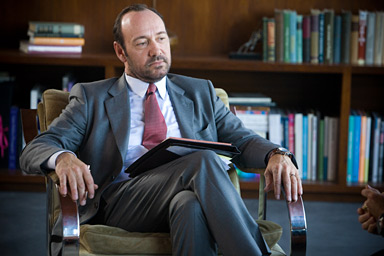
The two-time Oscar winner talks about his move away from Hollywood and his new role as a pothead Dr. Phil type
Kevin Spacey in "Shrink."

Roadside Attractions/Jihan Abdalla
Kevin Spacey in “Shrink.”
One way of looking at Kevin Spacey’s film-acting career is that most of it happened in another century and he has moved on. A two-time Oscar winner in the ’90s — for best supporting actor in “The Usual Suspects” and best actor in “American Beauty” — Spacey has literally and figuratively left Hollywood behind, devoting most of his energies to directing the Old Vic Theatre in London, where he has lived since 2003.
As Spacey has told various interviewers, he didn’t see how his movie career could possibly top what he had already accomplished, and he was tired of living in hotel rooms and making three or four films a year. From his days at Chatsworth High School in Los Angeles (where he played Captain von Trapp opposite Mare Winningham’s Maria in “The Sound of Music”), theater was his first love. In the same year when he won his Academy Award for “American Beauty,” he also won a Laurence Olivier Award for his role in the London-Broadway revival of Eugene O’Neill’s play “The Iceman Cometh.” (Truthfully, it might be the most memorable stage performance I’ve ever seen.) In retrospect, it looks as if two roads lay before him at that moment and he chose the one less traveled. So it is that the man once viewed as the greatest American film actor of his generation was recently ranked at No. 10 on the Daily Telegraph’s list of “the 100 most powerful people in British culture.”
It’s also possible that Spacey returned to the boards because he could see his Hollywood future stretching out before him: a middle-aged character actor, Oscars and all, who was too ambiguous for leading-man roles and was always likeliest to be asked to play a con man, a salesman, a stalker or some other double-edged dude with a secret. In some ways that was a result of Spacey’s powerful acting technique — he leads you astray with suggestion and misdirection, hinting at an inner life that is never fully revealed — and he also contributed to it with his famous refusal to discuss his personal life. I knew better than to ask Spacey personal questions when I met him for coffee in a resort-hotel atrium during the Sundance Film Festival last January (and I wouldn’t have been that interested in the answers anyway).
Spacey has kept one oar, or maybe half an oar, in film acting, and his latest role is a dilly, playing the depressed pothead celebrity psychiatrist Henry Carter in “Shrink,” the debut feature from young director Jonas Pate. A likable Los Angeles-made indie with overtones of “Six Feet Under,” “Half Nelson” and “Crash,” “Shrink” offers a roster of wonderfully eccentric characterizations, shoehorned into a dramatic structure that’s just a little too formulaic. Playing a character who could easily become caricature — the high-level shrink whose life comes apart in the wake of personal calamity — Spacey puts on a veritable clinic on how to deliver profound emotion without histrionics. The tremendous scene he has with an uncredited Robin Williams (as a sex-addict patient) should be required viewing for every acting student in the world. (You can check out the “Shrink” trailer at the bottom of this page.)
Carter’s only tethers to reality, in his deepening sinsemilla haze, are a mistrustful African-American girl named Jemma (terrific newcomer Keke Palmer), whom he’s taken as a do-gooder pro bono case, and a slackerish former patient named Jeremy (Mark Webber, an actor I always enjoy). Screenwriter Thomas Moffett crafts crisp, funny dialogue, but to my taste he’s way too eager to bounce these characters off each other in a series of increasingly melodramatic “Crash”-style coincidences, rather than allowing their stories to play out in more laid-back fashion. Still, “Shrink” is a debut well worth catching, loaded with an oddball supporting cast — Saffron Burrows, Jack Huston, Robert Loggia, Griffin Dunne and, so help me, Gore Vidal — and depicting a cross section of L.A. society not often seen on screen.
In addition to voicing the robot who is Sam Rockwell’s only companion (sort of) in Duncan Jones’ sci-fi cult success “Moon,” Spacey has several new films in the pipeline. He will costar with George Clooney and Ewan McGregor in “The Men Who Stare at Goats,” supposedly an Iraq-war film with a paranormal twist — don’t ask me! — and will play ill-fated Washington lobbyist Jack Abramoff, a dark-edged Spacey character if ever there was one, in George Hickenlooper’s upcoming “Casino Jack.”
In person beside the incongruous indoor pool in Park City, Spacey was not dark or mysterious in the least, but crisp, polite, soft-spoken and utterly professional.
Kevin, you play a psychiatrist in the film, and I guess he’s a distinctive, 21st-century breed of psychiatrist. Talk about this guy a bit.
I suppose you can put him in the same category as the Dr. Phils and these kinds of characters of the world. Thank God, he doesn’t have a television show. He’s become quite well known, quite quoted, popular, sells lots and lots of books. We meet him at a point of his own personal crisis and tragedy, and the film is about can he a) help himself and b) help any of his patients. But he’s certainly far more screwed up than most of his patients, as it turns out.
The movie is about how the lives of eight or so people intersect because of what he does. In particular, one young girl who is given to him as a pro-bono client by his father, who is also a therapist, played by Robert Loggia. He resists, and this young girl doesn’t want to go to therapy. Yet when they’re brought together somehow they manage to break through, both to each other and to themselves. So the film is about how ultimately this girl Jemma, played by Keke Palmer, ends up being the best thing for him to get to the next step of his life.
She’s really wonderful in the film, I thought. Was it fun to work with a young actor who has that much talent?
She was great. She’s just a firecracker and she’s fun to be with, we laughed a lot. We had a sort of ongoing contest on who could crack each other up more at the end of a scene. We’d have these really serious scenes and then one of us would try to do something to crack the other up, to sort of keep the tension light. I think she’s remarkably talented. Her instincts are really admirable and she trusts what she can do. I think Jonas [Pate] did a really great job in shaping her.
It’s always such a challenge in an ensemble film to give equal weight to developing each characterization. Dallas Roberts, Mark Webber, Jack Huston and Robin Williams also play important roles in the film. They’re all archetypal figures that we have come to know and either love or loathe in the world of Hollywood.
I assume that one of the things that attracted you to this project was that idea, getting to do this ensemble work with so many different actors and characters.
Yes. That, and it also is not about the side of Los Angeles that we see so often, which is so completely shallow and uninteresting, at least to me. The glamour and all that stuff that is, in a way, an appendage to the work that people in that town try to dedicate themselves to. People get caught up in that world and I think that this is a deeper look at the turmoil and the problems that every human being goes through no matter what their position or fame or wealth, and tries to get underneath that into some really genuine emotional landscape.
I suppose that’s similar to the journey that your character takes. He’s gotten caught up in being not just a psychiatrist for celebrities in some cases, but also in his own right a celebrity psychiatrist. In addition to suffering a personal tragedy, has he also lost sight of …
I think he gets to a point where he thinks he can’t do any good for anybody, including himself. And then he begins what one only could call a rather unhealthy regime of self-medication.
There’s an awful lot of pot smoke in this film.
Indeed there is.
With all this marijuana intake and all the sleeping in places that aren’t his actual bed, I was thinking that this guy probably isn’t smelling that great.
Oh, no, he showers. He’s not a bum. He definitely cleans himself up, but he does get messy. No doubt he gets messy.
One of the things they talk about in acting class is the “obstacle” that a character faces. A psychiatrist who is himself going through a profound depression, that’s a pretty big obstacle to deal with. On one hand, that’s a great challenge, and on the other, how do you make that into something fresh instead of a cliché?
Look, clichés are clichés because they’re true. It’s just how you approach them and how you ultimately explore them. Clichés that are badly done become, “Oh, that’s a cliché,” because it’s obvious. But it isn’t obvious if it’s trying to explore different territory or come at something from a slight different angle. Last night I saw the movie for the first time with an audience. I was very excited by the reaction that the audience had to the humor of the film, to its tone.
When they’re laughing at things that aren’t jokes, but are character revelations, then I’m very excited. That to me means they really are following the story, they really are following these characters. They’re laughing out of recognition and not just out of, “Oh that was a funny joke.” You just never know. Until you get something in front of an audience, that’s the moment that something really does get birthed.
As you said, Robin Williams is a small part in this movie. He plays one of your clients, a Hollywood director who’s having some issues with sex addiction or maybe with alcoholism. To me, watching you and Robin work together was one of the real joys of this movie. You could put that scene on the wall in an acting class, as an example of how to do this job.
What was important to me about that scene — and Robin was really willing to go there — was that his character is ironic, his character says funny things, makes jokes. So there’s a certain side of his character that’s the Robin Williams you expect and the Robin Williams that you enjoy. I also felt it was hugely important that Carter slap him down and say, “Cut it out.” Throughout that scene you see Carter, through his reactions to this fun and games, to the inability of Robin’s character to talk honestly about what he’s going through. I think that was an interesting way to go, that I actually do stop him from doing that sort of stuff. In a way, Robin gets to go somewhere new. That was a great scene, which sort of evolved in the day that we shot it.
After two Academy Awards and so many leading and supporting performances in so many films, you must get shown a ton of scripts. How would you describe your approach to finding the right role in the right film?
I first would have to disagree with you. I don’t get shown a ton of stuff and that’s a myth, that anyone who wins an award can get any movie going. That just isn’t true. Partly what you’re offered is what you’re available to do and partly what you’re offered is what they don’t offer to somebody else first. The myth that one can do whatever they want or that you can pick and choose your projects is actually exaggerated. You pick and choose your projects that you’re offered and that you’re available to do.
Over the last six years my full-time job has been running the Old Vic Theatre in London. I have not been available to do anything I might have wanted to do because my first responsibility is there. But with respect to what I do, for me, does it offer me an opportunity to work with people I admire? To go somewhere maybe I haven’t gone, to experience something that will be new for me? And in some cases it’s just, hey, this is a really, really good money gig and I’m gonna go do this for a couple of weeks, but, you know, it’s not where my passion is. I can exist in both worlds and still look at myself in the morning.
Does it help you psychically, to have that theater job in London? Is that something that roots you in your life, especially if you take film roles for the money?
I can only tell you that it’s the best decision I’ve made in my life, and it changed my life in all the ways I wanted it to change my life. After 12 years primarily focusing on the film world — and it going better than I ever could have imagined — I didn’t want to spend 10 years doing the same thing, so I just decided to, in a way, flip it. I was sneaking plays in before. Now I’m sneaking in movies.
“Shrink” opens July 24 in New York and Los Angeles, with wider national release beginning July 31.
A voice that touched us all
Like Michael Jackson, another icon lost to addiction and fame, Whitney was an awe-inspiring, genre-crossing pioneer
Whitney Houston performs during the Billboard Awards at the MGM Grand in Las Vegas on Dec. 7, 1998. (Credit: AP)
On Thursday night, Whitney Houston appeared at the Kelly Price & Friends Unplugged: For The Love of R&B pre-Grammys event. Amateur YouTube footage of the singer’s performance hinted at hysteria: Audience members screamed her name and flashbulbs exploded as she crooned the Christian hymn “Jesus Loves Me” in a sultry lower register as a duet with Price. The version of the song was gentle and tempered, although Houston’s beatific looks and animated gestures imbued it with quiet jubilance.
The performance feels sickeningly eerie on the heels of Houston’s death Saturday at 48. Both the song and her duet partner were links to the singer’s decorated past: Price featured on her Grammy-nominated 1999 single “Heartbreak Hotel” and a studio version of “Jesus Loves Me” appeared on the soundtrack of “The Bodyguard,” the 1992 album which made Houston a megastar. What’s more, she looked healthy and sounded strong; there were no warning signs that the brief appearance would be her last. (Though the photos of her returning to the Beverly Hills Hotel on Friday night tell a different story.) Houston, whose reputation was marred by a turbulent marriage to R&B star Bobby Brown (and a disastrous reality show about their lives together) and well-publicized struggles with addiction, finally seemed well enough to reboot her singing career.
Despite erratic public behavior and increasingly unsteady live performances, Houston always had fans who rooted for her recovery, who wanted her to recapture her powerhouse voice and magnetic personality. Born into music royalty — her mom was the gospel icon Cissy Houston, her cousin Dionne Warwick and her godmother soul great Aretha Franklin — the New Jersey native cut her teeth singing gospel in church, modeling and acting. By the time she earned a record deal, Whitney (like Madonna, Prince and Michael, one name was enough to identify her) was an enviable combination of glamorous and casual. On 1985’s “Whitney Houston” and 1987’s “Whitney,” her spin on contemporaneous soft rock, R&B, soul and gospel was mature but not stuffy or beholden to formality; on early hit singles, she struck a balance between playful longing (“How Will I Know,” “I Wanna Dance With Somebody,” “So Emotional”) and serious balladry (“Didn’t We Almost Have It All,” “Saving All My Love For You”). To little girls growing up in the ‘80s, Whitney Houston and Madonna were the artists you emulated and sang along to (loudly); they were the powerful, confident women you heard on the radio all the time, the pair you strove to be like.
However, Houston was also more than likely the artist your mom (if not grandmother) liked, which helped her ease gracefully into an adult career. That period arguably started with her dual starring acting role/soundtrack appearances on 1992’s “The Bodyguard,” a movie in which Kevin Costner played her protector. If her ‘80s tunes made her a household name, her interpretation of the Dolly Parton-penned “I Will Always Love You” sent her into the stratosphere. To this day, Houston’s soft-rock re-do of the country hit endures as an awe-inspiring performance: octave-dancing vocal prowess, nuanced emotional longing and the kind of subtlety hard to find in today’s mainstream music, in the form of her dramatic pause near the end of the song before she launches into the climactic, “And I…will always love youuuuu… .”
Houston would never top “The Bodyguard” and its monstrous success. (Besides “I Will Always Love You,” the soundtrack spawned the torchy hit “I Have Nothing” and a disco-soul remake of Chaka Khan’s “I’m Every Woman.”) And although she continued to evolve into a graceful R&B singer and rack up winning singles — throughout the 1990s, hits came from the soundtracks of “Waiting To Exhale,” “The Preacher’s Wife” and “The Prince Of Egypt” and her 1998 solo album, “My Love Is Your Love” — her problems with drugs and a chaotic marriage soon took a toll on her public persona. Rumors of substance abuse swirled around her — something not helped when marijuana was found in her and Brown’s luggage in 2000 — and in a 2002 interview with Diane Sawyer, a defensive Houston uttered these infamous sentences: “Crack is cheap; I make too much money to ever smoke crack. Let’s get that straight, okay? We don’t do crack, we don’t do that. Crack is wack.” The latter catchphrase caused an uproar and did irreparable damage to her reputation.
But Houston persevered — and eventually came clean about her private turmoil. In a 2009 Oprah Winfrey interview, a calmer Houston — her voice noticeably raspier and lower — was open about abusing cocaine and marijuana, and admitted the post-”Bodyguard” era was tough: “By ’The Preacher’s Wife,’ [doing drugs] was an everyday thing. … I would do my work, but after I did my work, for a whole year or two, it was everyday.” Her marriage to Brown was troubled, she told Oprah, including a time when he spit in her face in front of their daughter, Bobbi. The couple divorced in 2007.
In recent years, Houston’s fortunes ebbed and flowed. 2009’s “I Look to You” debuted at No. 1 on the Billboard charts, and the song “Million Dollar Bill” also hit No. 1 on the Billboard Hot Dance Club Play charts, but lukewarm-to-critical reception marred her 2010 world tour and she entered outpatient rehab as recently as May 2011. Still, in her recent public appearances she seemed upbeat and healthy; it seemed plausible she could follow in the footsteps of Tina Turner, who rejuvenated her career after extricating herself from an abusive domestic situation.
But with her premature death, it’s hard not to compare Houston to Michael Jackson, another ‘80s megastar who died young, crippled by addiction and the burdens of fame. Like the King Of Pop, Houston was a pioneer, one who broke open racial barriers so that other soul/R&B artists could have a shot at mainstream success. “The Bodyguard” was Houston’s “Thriller,” the career albatross from which she could never escape. And just as MJ reinvented the concept of the male pop star, Houston did the same for women. She was vulnerable and girlish, but never let those qualities undermine her talent, something fellow huge-voiced diva Mariah Carey took to heart. And Houston exuded confidence in every aspect of her career — of course because of her voice, but also because of her expressive interpretations. She could have bludgeoned listeners over the head with just the sheer power of her voice — but instead, Houston approached her songs like an actress inhabiting a character, squeezing emotion from every lyric with sincerity, grace and elegance.
Why shouldn’t Demi Moore be “stressed”?
A 911 call sends her to the hospital -- and brings out class resentment
Demi Moore (Credit: AP/Victoria Will)
At 10:49 Monday night, a 911 call summoned an ambulance to the home of actress and producer Demi Moore. Within half an hour, a team was on the scene, had assessed her condition, and taken her to a local hospital. That’s about double the amount of time it took for Internet critics to take aim at her.
In a cryptic statement Tuesday, a spokesman for Moore announced, “Because of the stresses in her life right now, Demi has chosen to seek professional assistance to treat her exhaustion and improve her overall health. She looks forward to getting well and is grateful for the support of her family and friends.” She has since dropped out of the biopic “Lovelace,” where she was set to play Gloria Steinem.
You don’t have to be wearing a tinfoil hat to suspect there’s more to the story than “exhaustion.” Exhaustion doesn’t usually merit a 911 call. And an anonymous source who claims to have seen the incident report told E! Tuesday that Moore was “shaking” and otherwise “acting like she was suffering from a seizure,” which certainly sounds like something serious went down – and may have been part of a larger problem.
But from the moment the news broke, there was skepticism that a beautiful, wealthy woman — even one whose recent divorce proceedings render her Twitter handle painfully obsolete — could have it all that bad. The very first response on E! was a weary “Stress? What stress? I swear, these Hollywood socialites wouldn’t last a minute in the real world!” TMZ, where the story originally broke, had similar sentiments. “Stress? WTF! Obviously she hasn’t been out in real America lately,” wrote one disgusted commenter. On People, a commenter complained, “I am exhausted too. Where is my article in People?” while another said, “For rich people it’s called exhaustion. For the rest of America it’s called working a full time job, plus overtime, running a household, raising kids and paying your bills. Now I know why I am exhausted.” A commenter named Lucy added, “Try working 2 jobs, 60 hours a week, looking after your own household with no hired help and tell me about exhaustion! ” And at ABC News, a woman named Ann wrote, “I look frail and tired EVERY DAY. I am fed up with rich has-beens being a piece of ‘news.’” Wow, all that real-world stress and exhaustion sure makes people angry.
The idea that a lady with an army of handlers to clean her mansion, iron her designer clothes, and mix up her cleanse shakes is stressed out may justifiably stick in the craw of anyone trying to wring one more winter out of that crappy pair of Payless boots. The story, for Moore’s detractors, is black and white: Entitled woman with a jet-set lifestyle hits a bumpy patch when her marriage to her handsome TV star husband flatlines, can’t handle the “real” world, and has the luxury of retreating to some zillion-dollar-a-week oasis where she is no doubt right now getting a caviar and gold leaf facial – all while the rest of us are picking off-brand Cheerios out of the carpet.
Divorce, sickness, job insecurity and family obligations happen to the rich and poor, the famous and the obscure. And very, very few among us have the resources of a “Charlie’s Angels: Full Throttle” star. There are no medals or cash prizes handed out for enduring hardship without a personal trainer or Kabbalah retreat. But it’s certainly not as if a celebrity’s choice to “seek professional assistance” creates a shortage of it for everybody else. Some movie star’s in treatment? Oh well, dammit, now where are the rest of us supposed to go? She’s doing something for her health? Gosh, what a bitch.
If, for whatever reason at all – the end of your marriage, the disappointment of a professional flop, the plain old chemistry in your brain – you were at the end of your rope, wouldn’t the absolute best and smartest thing in the world be to get whatever assistance you possibly could? Or does having a big bank account somehow render an individual impervious to heartbreak or depression? Because I’ve got to say, based on what we know of celebrity, it does not.
There’s still far too much stigma attached to the issues of mental and emotional health and illness. And the idea that anyone, regardless of fame or income, isn’t supposed to be affected by profoundly life-changing events is absurd. Worse, it perpetuates the myth that getting help is for the weak. Just because you can afford “exhaustion,” there’s still no shame in having it — and there’s no shame in getting treated for it. Sure, most of us have to get through storms on the strength of our own, decidedly low-budget, counsel and support. But we still find it in our own ways, because we need to in order to survive. And those who don’t aren’t stronger or more “real” – they just tend to become angry commenters on the Internet.
The death of the celebrity memoir
We can thank Snooki for something: Finally, this annoying publishing trend looks like it is fizzling out
(Credit: sgame via Shutterstock)
In a recent essay for the Daily Beast, Michael Korda, the storied former editor in chief of Simon & Schuster, warned the public to stay away from celebrity memoirs, decrying the majority of these books as “dull, homogenized, bland and sanitized.” He ought to know, for as he goes on to explain, he spent much of his professional life trying to persuade movie stars to write their autobiographies. (One of the ironies here is that Korda, while a celebrity only in the book world — which means not much of a celebrity at all — is famous for writing divertingly about almost any topic, including himself. This piece is no exception.)
A growing awareness of this truth might explain why sales of celebrity memoirs have fallen off of late. According to the Guardian newspaper in Britain, a whole raft of celebrity-authored books tanked in the U.K. last year. In the U.S., as well, there have been several notable failures, particularly by cast members from the reality TV show “Jersey Shore.” Could the public finally be wising up?
Of course, the cause might just be the low caliber of the celebrities in question. I didn’t recognize any of the names the Guardian held up as fizzling memoirists — except for Alan Partridge, who isn’t even a real person. “I, Partridge” was in fact written by the actor-writer-director Steve Coogan, who created the character of Partridge for a television series parodying B-list chat-show hosts and other effluvia of the media world. His book is a parody of celebrity memoirs, and reportedly the only “significant” title in a genre whose sales have dropped 60 percent in the past year.
However, I suspect it’s mostly just wishful thinking that has some observers pegging the celebrity memoir as a fading trend. It’s hard for me to say for sure, though, because I seem to have a much lower than average interest in the people who write them. To be honest, apart from a couple of episodes of “Queer Eye for the Straight Guy,” back when it first came out, I’ve never watched a reality TV show. (My feeling is that if I’m going to be entertained, I’ll go to professionals.) So I still don’t really know who Snooki is, and when I asked friends and acquaintances to fill me in around the time her book came out, they all said. “You’re lucky. You’re much better off not knowing.”
Most celebrities are actors of some kind, and my (somewhat limited) experience writing movie and television journalism has led me to conclude that actors are some of the least interesting people in the arts. That doesn’t mean I’m not regularly awestruck by the work they create; I just really don’t want to listen to them talk about it. Or about their personal lives. And I certainly don’t want to read about either one. The more famous and rich an actor is, the more controlled, frictionless and therefore insipid his or her life is likely to be. As Korda writes, “Years of standing in the limelight portraying other people for large amounts of money does not usually lead to a high degree of self-examination, let alone self-criticism.”
I’m not talking about creative visionaries like Patti Smith or innovators like Tina Fey, real writers whose ability to reflect thoughtfully on their own work and lives is unquestioned. Their books don’t exist for the sole reason that the people who wrote them are famous and know some other famous people; often, they aren’t even thought of as celebrity memoirs in the first place. The true celebrity memoir is “written” (that is, ghostwritten for) what used to be called “entertainment personalities,” namely, movie and television stars.
A movie star, like a politician, has usually spent much time, effort and money to construct a public persona, and, as Korda explains, such people are “seldom likely to want to deface their images, or to puncture the balloon of their egos merely to sell books.” (The money to be made on even a successful book is dwarfed by the fees for starring in Hollywood movies.) For this reason, most famous actors’ memoirs are bland and cautious, but even if they were willing to “tell the truth” — the thing, according to Korda, that every book publisher hopes for — that truth is unlikely to be worth the price of a hardcover book.
The example he uses is the film actor Glenn Ford, whose memoir the agent, Swifty Lazar (a more entertaining character than any actor Korda mentions), once tried to peddle. Ford had co-starred and been infatuated with Rita Hayworth (the Angelina Jolie of her time). But they’d never slept together, which put him in a fairly similar position to every other guy in America except Orson Welles. Who cares? And if Ford had slept with Hayworth? Is that really enough to justify the other 250 pages of a no-doubt tedious book chronicling Ford’s childhood in Canada and early theater work in Santa Monica? Sort of a moot point, that, since Ford clammed up at the very mention of the Hayworth non-affair.
Perhaps reality-TV stars have arisen to fill the candidness deficit created by people who are famous for some good reason. That movie star or top athlete is never going to ‘fess up about his or her private quarrels and most humiliating intimate or professional moments; they don’t have to. But reality-TV stars exist for the sole purpose of having embarrassing experiences in the public eye. They aren’t just willing to talk about this stuff: it’s their job. They’ve got nothing else to talk about.
Again, I’m the opposite of an expert in this department, but I do have a certain perspective to offer. Because I don’t watch reality TV, my impression of it is constructed entirely from conversations with people who do watch it. With the exception of a handful of contest shows like “Project Runway,” I’ve never heard anyone speak of the characters in reality TV shows without contempt. Often they will go on and on about how awful these people are. Whatever lofty anthropological reasons some of them may offer for watching the shows, from my perspective it seems that their chief appeal lies in giving viewers someone to look down on.
But while Americans may take great pleasure in collectively groaning over whatever risible antics Snooki gets up to for a half-hour every week, it’s no surprise that this would not translate into sales of her book. Surely people buy celebrity books not because they’re anticipating a satisfying literary experience, but rather to own a tangible piece of that individual’s stardom. (Also: Autograph tours are an obligatory element in the publication of any celebrity-authored title, so they get a chance to meet their idol face-to-face.) It’s another way of expressing one’s fandom. If the whole point of Snooki is hating on her, why would anyone want to purchase a bookful of that?
Celebrity memoirs make some commenters very, very angry. Although the genre has been around (in one version or another) for at least a century, the latest iteration is often held up as Exhibit A in arguments for the disgraceful state of book publishing. I can’t get too worked up about this. It makes as much sense as ranting about the abundance and popularity of books on any topics that don’t interest me personally (i.e., golf — lotta golf books out there).
Besides, the indignation seems misdirected. Publishers publish these titles because (until recently, at least), they do sell. For all the hopeful talk of declining enthusiasm for the genre, it’s worth noting that “Kardashian Konfidential” has sold well over 100,000 copies. Paris Hilton’s “Confessions of an Heiress,” published in 2004, has sold over 1 million worldwide.
Doesn’t the problem here lie instead with the buyers of such books? (Seriously: Since I have such a hard time imagining why anyone would do so, if you have bought one of these celebrity memoirs, would you be so generous as to explain your motives in the comments thread?) Every time someone told me I was fortunate in not knowing who Snooki or Kim Kardashian are, I couldn’t help wondering why they chose to know so much about her themselves. Perhaps they secretly enjoy their own theatrical disgust with the state of American culture and society.
If we really wanted these annoying figures to go away, the solution is pretty simple: Stop paying attention to them. I’m here to testify that this is very easy to do. You, too, can know next to nothing about the Situation or Tila Tequila (whoever they are!), if they really bother you that much. A blank expression will pass over your face when their names are mentioned in conversation, and when you see placards announcing their forthcoming appearances at chain bookstores, you’ll frown vaguely, shrug and keep walking toward the shelves with the real books.
Further reading
Michael Korda on the dullness of Hollywood memoirs
The Guardian on flagging sales of celebrity memoirs
The Hollywood Reporter on the failure of Nicole “Snooki” Polizzi’s “A Shore Thing.”
How to sell furniture to celebrities
I worked at a luxury store in LA where people like Jennifer Lopez and Sharon Stone shopped. Here's what I learned
(Credit: minerva86 via Shutterstock)
I spent the first eight months of 2004 in Los Angeles selling expensive furniture to rich people. In the center of the store sat a colossal white sofa, extremely uncomfortable, which could be purchased for $8,000. No one bought it. A full set of silverware would set you back something like $15,000. No takers. A mink throw – $7,500 – also did not sell. Another mink throw, available for $5,000, actually did sell. In fact, I sold it. My single biggest commission. A frosty rich lady once bought an entire set of handcrafted Italian dishes: my second biggest commission. On the whole, though, I wasn’t a very good salesman. I sold lots of tablecloths. Glasses, too. I sold a lot of glasses.
One thing I learned: Rich people like a little pushback. They enter a store acutely aware of their wealth and what it means in this context, and this knowledge, by definition, is tied up with their sense of self-worth, for better or worse. They want you to be serious and professional with them, but they also want you to be able to slap their hand when they go astray. Mostly, they want you to care, even if they’re talking about decorative pillows. They want you, in short, to be like Jeeves, or Bruce Wayne’s Alfred. They’re the boss, sure, but if you’re not in control, they’ll eat you alive.
“Will this candlestick work with that table?” they’d ask, and I’d sigh wearily. Feigning nonchalance despite my terrifying ignorance, I would not look at them when I talked. With regard to the candlesticks, I’d talk to the table itself — explain that it depended on the context, depended on the room. I’d ask questions about the windows, the paint, the ceiling, and then, eventually, I’d pretend to grasp the situation. At that point I’d declare that, yes, the candlestick would work on that table. They’d buy the candlestick, not the table. Of course, if I were a great salesman, I wouldn’t have asked questions, would have just demonstrated how such a table only worked with four of those candlesticks, especially when accompanied by certain handmade placemats and napkins, etc. They’d see a fictitious version of their life, conducted at that particular table, and they’d attempt to acquire it by buying it all. And, as with a great dentist, it’d all happen without them realizing that someone was working on them.
Bridget Fonda, who had married film composer Danny Elfman and had stopped appearing in movies, shopped there compulsively. I have vivid memories of loading cumbersome decorative pots into the trunk of Elfman’s Maserati. Zach de La Rocha, the former frontman of Rage Against the Machine, apparently had a lot of time on his hands, too, because he drove his cool Mercedes over all the time and drank coffee at the cafe attached to the store by himself. He looked desperately bored and was always alone. Nicole Richie was not alone when she came to the cafe, nor was Kevin Costner. Victoria Beckham wore her sunglasses indoors, throughout lunch. David Schwimmer came a few times, alone, and was precisely as bitter and patronizing as you’d expect him to be. Gary Oldman was completely banal, just a middle-aged man shopping for furniture with his impossibly gorgeous 20-something lady friend.
Sharon Stone was bitchy and magnificent, a bombshell even without her makeup. I liked her sass. Unfortunately, when she came in I was wearing my apron. We were supposed to wear these short black aprons, but sometimes they were more humiliating than other times. She was there to buy a Missoni bathrobe for someone and she kept trying to tell me that this guy was a titanic, an ogre. He was like the yeti, but bigger. We had a XXXL robe, but she still wasn’t convinced it was big enough. I’m 6-foot-2, built like Zach Galifianakis, but when I put the robe on for her and stood on my tippy toes, she just winced, told me he was at least twice my size.
Eventually, she gave in and bought the robe, plus several $250 coral-encrusted pillows.
The brittle-thin and very short character actress Linda Hunt — you’d recognize her if you saw her, she’s everywhere on TV, often with a prominent spot on unmemorable shows like “NCIS Los Angeles” — entered with her wife, who resembles Joan Didion. Hunt might have been the most appealing person I met that whole year in Los Angeles. She was grandmotherly, hilarious and familiar, even a little flirtatious as she chided me for trying to upsell her into buying a pair of $450 wicker chairs. Still, she wavered — she loved the chairs, really loved them, but she kept doubting herself, saying they were too big for someone her size. Then she’d acknowledge, with help from her wife, that the chairs would probably be used mainly by other normal-size people. In the end, I think she said something to the effect of, “I’m sorry, I know it’d be a good commission for you, but I just can’t do it,” and left empty-handed. She never learned my name, but she talked to me like I was a human being, like we were both human beings. When she left, I wanted to chase her out and buy her a beer.
Most people, learning that I was a writer, assumed I wrote screenplays and would give me their cards, begin talking about their film projects. I’d have to explain that I wrote for the page, for reading. At which point they would halt, midstream, and gaze at me with delight, like I was some charming curio in an antique shop, a lovely anachronism. Then they would walk away.
Jennifer Lopez didn’t ask me what I did outside of the furniture store, fortunately. She was pleasant enough, but her then-fiancée, Marc Anthony, stood to the side, glowering, and I was immediately possessed by a visceral hatred for him. She wore a white hat pulled down low on her head to prevent people from recognizing her, but when she leaned across the counter and locked eyes with me and I realized who she was and then briefly and involuntarily gawked at her, mouth ajar, she smiled sweetly, no doubt accustomed to stunned shopkeepers. You hope you’d remember that these people are just people, after all, people who have to floss and deal with bad traffic, who wear uncomfortable shoes and regret it, but then they’re in front of you all of a sudden asking you questions and it slips your mind. Like so much in Los Angeles, it’s humiliating. Lopez walked around the store and I followed, hypnotized by the pendulum swings of her hips. What I thought to myself was: “I am looking at Jennifer Lopez’s ass.” That was the depth of my insight.
She told me that she wanted many, many dainty English teacups. But our dainty English teacups weren’t quite dainty enough. Instead she bought 50 napkin rings. Or, she picked them out and Marc Anthony paid for them. He had a black American Express card, which signifies an ominous degree of wealth, and, looking at it, I noticed that his name was not “Marc Anthony” at all. He had a string of names and none of them were “Marc” or “Anthony.”
A week later, the two of them were married in a small ceremony with about 50 guests. Then the napkin rings made sense.
A week before her divorce from John Stamos became public information Rebecca Romijn-Stamos entered five minutes before closing with a tall gay man who wore comically long and pointy shoes. I didn’t recognize her. It’d been a long day, a long six months in Los Angeles, and I was deeply tired. The two of them were fondling the $5,000 mink throw, as so many people did, so I flatly asked if they wanted me to put it on hold for them. That was usually how I scared people away from the blanket. But she said yes, she wanted it to be put on hold. This struck me as nonsense, because no one wanted a $5,000 mink throw. So I handed her a yellow HOLD card and a pen and said that if she put her name and number on the card, I’d attach it to the blanket and I’d call if someone else made a move for it in the next couple days.
Then I went back to counting my till.
She started writing and then stopped, looked up at me, and said, “Wait, you’re going to leave this card out here? I’m not going to write my number on it.”
I put the money down, looked back at her. It took a couple more seconds before I realized who she was. I told her I’d hold the blanket for one day without the hold card. Then I gave her a business card with my name on it and said if she still wanted the blanket tomorrow, she could call me. As a teenager, I had scrutinized her airbrushed body in Victoria’s Secret catalogs, but when she’d stood right in front of me, I had no idea who she was.
The next day, I answered the phone and Rebecca Romijn-Stamos asked for me. By name. “I’ve decided to take it,” she said.
“OK,” I said and imagined her lying on the throw. Then I thought about all the many hands I had seen fondling the blanket before.
She picked it up the following day, without the aid of her clown-shoed decorator. I had wrapped it up and placed it in a huge bag, which I passed to her once I’d run her credit card and taken a duplicate. A couple of days later, her publicist announced that she and John Stamos were getting a divorce. Then the mink throw made sense.
Personally, I wanted everything in the store. I wanted the objects and I wanted the people. I wanted to eat them all up, gnaw on their bones. At first, I didn’t care about it all, thought it a lot of silliness, but soon enough I was fantasizing, actively, daily, about owning those gorgeous Italian wine glasses, they were $50 each, and about the house where I’d put my immense and uncomfortable sofa. I imagined the parties on my private beach, shaded by the French marquee that no one else in L.A. owned. Or, no one except Bridget Fonda.
While driving home to the apartment I shared with two roommates in Silverlake, I’d pick out the famous guests that would come to my beachfront house, pictured myself drinking a martini in the setting sun as the sea breeze rippled through my white suit. These things had never seemed relevant before. Now, I felt mortified by my sensible late ’90s Volvo, my cheap cellphone. Somewhere nearby, someone was sharing a platter of immaculate sushi with Sarah Michelle Gellar, who’s a year younger than me and prettier in person, while I was consuming starchy blocks of Trader Joe’s faux-sushi. What I needed, evidently, was a Maserati, a beachfront house in Malibu. What I needed was a better pair of sunglasses, and a life appropriate to those glasses. Until then, I was not alive, I was auditioning for life.
Updike wrote, “Celebrity is a mask that eats into the face,” but after living in L.A. for a while, the proper reply became obvious: With a mask like that, who needs a face?
In late August, I quit my job and packed my worldly possessions into my sedan and drove north for dreary and obsessively modest Seattle, where I still live. The AC was broken and it was at least 115 degrees in the plains of central California. The wind didn’t cool me down, just turned my car into a convection oven, but I dared not close the windows. Stereo all the way up, I locked in the cruise control at 25 miles an hour above the speed limit. And while I did, officially, ride off into the sunset in the end, there was — I’m glad to report — no epiphany, no heart-pounding climax. Like some great shimmering mirage, the entire fantasy merely evaporated from view. I wasn’t even out of California before it was gone.
Attention celebrities: Just stop with the Hitler references
Mario Batali apologizes after comparing bankers to Hitler. So why do people keep making Hitler comparisons anyway?
Mario Batali
Celebrity chef Mario Batali can get away with flamboyancies like wearing his coveted orange Crocs and riding his Vespa around the West Village. But what he can’t pull off is haphazardly comparing Wall Street executives to Hitler, as he did Tuesday at a Time magazine panel.
“The ways the bankers have kind of toppled the way money is distributed and taken most of it into their hands is as good as Stalin or Hitler and the evil guys,” Batali said. The ritual post-Hitler reference apology followed soon thereafter: “It was never my intention to equate our banking industry with Hitler and Stalin, two of the most evil, brutal dictators in modern history.”
So why is the Hitler reference so hard for public figures to avoid? You’d think it would be the first rule of celebrityhood, handed to all dreamers as they get off the bus in New York or Hollywood: Whatever you say, leave Hitler out of it. (Unless you’re making one of those Internet viral videos of Hitler reacting to pop culture news.)
But Batali’s blunder is just the latest in the last six months. Megan Fox was quickly dismissed from her “Transformers” role in June, after comparing director Michael Bay to the father of fascism. “He wants to be like Hitler on his sets,” she gaffed. Stephen Spielberg was less than thrilled.
In August, Kanye West, while onstage at the Big Chill Festival in the U.K., made the perplexing connection between his numerous haters and Hitler’s. Just last month, Hank Williams Jr. lost his “Monday Night Football” gig for suggesting if President Obama and House Speaker John Boehner spent an afternoon on the links, it would be like “Hitler playing golf with Israeli Prime Minister Netanyahu.”
Some Hitler referencers think they are trying to make sophisticated points, or have the hubris to believe they can walk the third rail without getting electrocuted. “Hitler was a Frankenstein, but there was also a Dr. Frankenstein. German Industrialists, the Americans and the British. He had a lot of support,” said Oliver Stone. “Hitler did far more damage to the Russians than the Jewish people.” He ended up apologizing. John Galliano, the Christian Dior designer, likely believed he was being daring when he said he loved Hitler. He lost his job and a French court fined him $8,400 for using anti-Semitic language.
And who knows what Lars von Trier was thinking in May when, promoting “Melancholia” — and as Kirsten Dunst sat next to him in agony — said, “I understand Hitler,” and “He’s not what you would call a good guy but I’m … I understand much about him and I sympathize with him a little bit.” He got booted from the Cannes Film Festival.
While many of these celebrities are known for unpredictable commentary, the conundrum lies in the near epidemic level at which Hitler is freely referenced without context, rhyme or reason. It seems that for these celebrities, to mention Hitler usually turns out to be like using a machine gun to scratch an itch. It’s retroactive, dangerous and self-destructive. And yet these instances keep growing in number.
Los Angeles psychiatrist Soroya Bacchus sees narcissism at the heart of the matter.
“Kanye West, Megan Fox, and celebrity chef Mario Batali (among many others) all share one common personality trait – narcissism. When a person, celebrity or not, has narcissistic tendencies, they are more prone to identify with people in positions of power,” she said. “When Kanye and other celebrities make Hitler comparisons without regard, it’s because they feel they exist on a similar plane to him in terms of influence rather than identifying with his belief system.
“The ego-driven mind causes celebrities to see themselves as being as powerful as men like Hitler, and therefore imbeds the belief system that they have a right to reference him – often without regard for normal social stigmas.”
Not everyone, however, agrees that Hitler should be off-limits for historical comparison.
Laura Kipnis, author of “How to Become a Scandal: Adventures in Bad Behavior,” has an easier time letting Batali off the hook. In her opinion, his comment wasn’t so far out of context.
“I have a hard time mustering criticism about Batali’s remarks because I basically agree with him: the bankerati are evil, and the names Hitler and Stalin are available synonyms for evil. To try to enforce greater precision in political speech in the current context, the age of shock jocks and Ann Coulter, seems almost quaint.
“If the criticism is that Batali isn’t being historically nuanced enough, because Wall Street business guys aren’t actually genocidal maniacs, OK, but they’ve certainly caused enough immiseration.”
But public relations veteran Howard Bragman, the vice chairman of Reputation.com, says there’s an easier lesson to learn. “I wish some of these celebrities would read publications that have covered the other celebrities that made this same mistake and learn from it. Using a Hitler comparison is almost always a mistake. It’s never funny and it’s never a good point of comparison.”
On the other hand, he said, Batali might be thankful he made his gaffe this week — when folks like Joe Paterno, Rick Perry and Herman Cain have been in slightly hotter water.
Page 1 of 181 in Celebrity
A match made on Craigslist adult services
Can’t see the forest for the wood
The things I carry
When I lost the ability to type
Pop art, the beaded edition
The beautiful banality of high school
The unemployed meet MacArthur’s tanks
Demi’s last night out
One day you’re in
Pitch and catch 

