
Peter Jackson prot

TriStar Pictures/David Bloomer
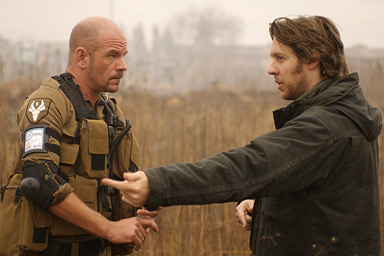
David James (left) and director Neill Blomkamp on the set of “District 9.”
Neill Blomkamp won’t turn 30 until next month, but he’s such a bright and likable guy it’s tough to hold his success against him. At an age when lots of aspiring filmmakers are maxing out their friends’ platinum cards, or banging out screenplays in North Hollywood studio apartments, Blomkamp came under the mother-hen protection — and considerable financial clout — of “Lord of the Rings” impresario Peter Jackson.
Jackson and Blomkamp spent several years trying to put together a film version of the Microsoft video game Halo (Blomkamp actually made three digital shorts to promote a 2007 game release). When financing for that fanboy wet dream finally fell apart, Blomkamp began working on a long-percolating idea: Take an archetypal science-fiction story — in this case, the story of humans’ first contact with extraterrestrial aliens — and set it against the explosive social realities of contemporary Johannesburg, South Africa, his hometown. (Blomkamp’s family emigrated to Canada in the late ’90s.)
Amid the late-summer doldrums of studio leftovers, Blomkamp’s resulting feature-film debut, “District 9,” stands out as the science-fiction film of the year. (That’s with all due respect to J.J. Abrams’ enjoyable exercise in “Star Trek” meta-nostalgia.) Consider the fact that it was shot in South Africa without recognizable acting talent, on a budget that wouldn’t furnish Michael Bay’s assistant’s trailer, and it might be the sci-fi surprise of this entire decade. Blomkamp cut his teeth in the entertainment industry doing digital effects for such TV series as “Stargate SG-1″ and “Smallville,” and, yes, there’s ample technical wizardry on display. But “District 9,” thankfully, is a lot more than kickass digital fight scenes. It’s a grimy, consistently surprising and fundamentally human-centric science-fiction yarn, reminiscent of the dystopian, semi-realistic 1970s tradition.
Furthermore, it’s a movie in which a star is born: Sharlto Copley, a friend of Blomkamp’s from their teen years in Johannesburg, gives an amazing tragicomic performance as a mustachioed, second-rate Afrikaner bureaucrat named Wikus van der Merwe, who becomes — well, let me stop myself right there. I feel the hot, stinky breath of the spoiler police, so let’s just explain that Wikus is employed by MNU, a shadowy private corporation hired by the South African government to manage the increasingly unruly Johannesburg townships where a million or more insectoid aliens have been contained since their spaceship mysteriously beached itself above the city 30 years earlier.
Wikus’ MNU overlord, who just happens to also be his father-in-law, has appointed him to move the increasingly undesirable and violent interlopers out of Johannesburg and into a not-so-glorified concentration camp many miles outside the city. Unsurprisingly, the removal project goes terribly awry — and at least some of the aliens’ secrets are revealed — but along the way Wikus morphs from a smug, callous, sycophantic moron into one of the more unlikely motion-picture protagonists you’ll ever see.
Both as cinema and as storytelling, “District 9″ capitalizes on the uncertain boundaries between fiction and reality that characterize contemporary media, and for that matter the whole contemporary world. Blomkamp insists he’s got no specific allegorical, ironic or didactic message to deliver, but one might describe the movie as overloaded with potential metaphorical meaning. It’s presented as a propagandistic TV documentary about what went wrong in District 9, where Wikus — a white representative of a black government — went in with heavy military backup to uproot the one group in South African history to be treated worse than blacks were under the previous apartheid regime.
There’s even some footage Blomkamp shot documentary-style on the streets of Johannesburg, where he walked around asking residents of various races how they would feel if aliens were settled in their overstressed, socially divided, crime-ridden city. As Blomkamp explained when I met him at the New York offices of Sony Pictures, Johannesburg — depicted in the bleak, dry South African winter as an oppressive wasteland of shantytowns, fast food outlets, walled luxury compounds and grim government fortresses — is both the film’s main character and its reason for existing in the first place.
Neill, here you are with your debut feature film coming out, and it’s produced by Peter Jackson. It’s kind of an amazing situation for a first-time director.
Yeah, I’m aware of how lucky I’ve been. I’m in a very good position.
Are you also OK with the fact that — I’m guessing here — maybe 30 percent of the opening-night audience is going to think that Peter actually directed the movie?
Yeah, I think so. I mean, that’s fine. As long as the film is good and I’ve done what I’ve wanted to do, then Hollywood is going to be open to me making more films. There’s no question that Pete’s name is going to draw more people to the film, and that’s completely acceptable. It shines a spotlight on the whole movie.
You have this fascinating premise, where we’re thrown into this world in which aliens have lived on Earth for 20 or 30 years, and they just happen to be confined to the Johannesburg townships, in a situation very reminiscent of apartheid. Talk about how your background, growing up in that time and place, influenced this story.
Well, I think there’s no question that the movie is a condensation of all the elements in Joburg that had an effect on me when I was growing up. Which means it couldn’t have been set anywhere else. In my mind, the film doesn’t exist other than in Joburg. It was like, Johannesburg first, and “District 9″ grew out of that. There are many different levels you can break it down into. From a photographic standpoint, there was what I wanted to convey about Johannesburg, which is that it’s almost this burnt, nuclear wasteland, at least in winter. It really is like that.
Then there’s this constant sense of an urban prison, with razor wire and electric fences and armed guards everywhere. It’s a very oppressive-feeling city. I wanted to capture the essence of that, and I thought it was really cool to put science fiction in that environment. I wanted to see science fiction in that city. I mean, I lived there, and you don’t come across cities like that much, especially not in the First World. They don’t exist.
So that was the primary reason for making “District 9.” No allegories, no metaphors, nothing. Just science fiction in Joburg. Then, as the idea began to unfold, I started to realize that actually this includes all the topics that have formed my outlook on the whole world. My upbringing in that city had a massive effect on me, and I started to realize that everything to do with segregation and apartheid, and now the new xenophobic stuff that’s happening in the city, all of that dominates my mind, quite a lot of the time. Then there’s the fact that science fiction is the other big part of my mind, and I started to realize that the two fit well together. There’s no message, per se, that I’m trying to get across with the movie. It’s rather that I want to present science fiction, and put it in the environment that affected me. In the process, maybe I highlight all the topics that interest me, but I’m not giving any answers. You can take from it what you will.
Now, you left South Africa when you were a teenager, right?
Yeah, I was around 18 when we moved to Vancouver. It was 10 years ago, or a little more than that.
So does this story take place in contemporary South Africa, or further back, closer to the apartheid era?
It’s the present. It’s totally the present. I’ve gone back every year, so it’s not like I went back a decade later and was shocked by the changes. I’ve watched the city’s gradual changes. It’s more like this is an alternate reality of contemporary Joburg. In my mind, a black government is in control, and I assume that the white government — with apartheid ending in 1994 — did the same thing to the aliens.
Given your background in digital effects and advertising, people may expect a film that is highly technical, dominated by CGI and explosions. Now, you’ve got all that stuff, but the basis of the film is really a remarkable human character. You get this terrific performance from Sharlto Copley, who I guess has been your collaborator all along.
I would say he’s been more my friend than my collaborator. He was interested in similar things, and he’s a few years older than me. When I was coming into high school, he was leaving high school. He was closer to the film industry in South Africa than I was, and I’ve wanted to be in film since I was, like, zero. So when I moved to Canada we stayed in touch just because we were friends, and we were interested in the same stuff.
But Sharlto is also like Sacha Baron Cohen — he’ll just totally, relentlessly fuck with you. So I knew that if I was trying to create this realistic character, based on a lot of improv, he would be a really, really good person for that, even though he’s done no acting.
He’s never acted before? That’s pretty amazing.
He’s done a few Borat-style shows where he’s just gone out and messed with people, but he hasn’t actually done acting. This was a complete first for him. I filmed some test footage and showed it to Pete, and Pete said, “Clearly he’s very talented,” and signed off on casting him in the film, and here we are.
Sharlto plays this guy, Wikus, this Afrikaner bureaucrat who seems at first like kind of an imbecile.
Oh, he is an imbecile. [Laughter.] He is totally out of his depth.
He has been assigned to move the alien population from one ghetto to another, basically. Or, to put it more honestly, from a ghetto to a concentration camp. And it all goes wrong.
Yeah, it goes horribly wrong. Wikus is someone who is like an indirect racist, I suppose. His indirect oppression of the aliens, through being a company yes man, along with 50,000 other employees — agreeing with everything his company does and never questioning it — has resulted in their current situation in Johannesburg. He’s comfortable with that kind of oppression, he even makes jokes about the conditions the aliens live in. Then an event happens in the film that catapults him down a path that ultimately leads him away from his peers, his friends and family. He finds himself dealing with what the aliens have been dealing with for the last 30 years, and becomes a complete outcast. The question becomes what he’s going to do to rectify things, or get himself back where he was before, and that’s where the compelling human element of the story comes from.
There’s a very dark comic side to this story, in which blacks and whites come together to treat another group worse than blacks were ever treated under apartheid.
I was pretty aware of that. I thought that was a pretty funny concept. Another part of recent South African history that isn’t world news is that the collapse of Zimbabwe has introduced millions of illegal Zimbabwean immigrants into South African cities. So you have impoverished South African blacks, hoping for a better life in their own country, faced with an influx of millions of impoverished Zimbabweans who have come to South Africa to build a new life for their families. Now you have this powder-keg situation, with black against black, which is highly bizarre.
When we started filming the movie, we had this terrible situation where we woke up one morning to find out that Johannesburg was eating itself alive. Impoverished South Africans had started murdering impoverished Zimbabweans, necklacing them and burning them and chopping them up. That’s a very serious piece of contemporary South African society that also finds its way into the film: some impoverished citizens wanting other impoverished citizens out.
There’s an ingredient here that will definitely push some people’s buttons. I’m talking about the way you depict these really scary Nigerian crime lords who are running things in the townships. They’re violent and brutal, they’re obsessed with voodoo and magic. You know, these images are pretty uncomfortable, especially for Americans who tend to be so careful in public discussions of race: Here’s a white guy from South Africa making a movie with scary, murderous black African villains.
Sure, I’m totally aware of that. I know those buttons are going to be pushed. Unfortunately, that’s the reality of it, and it doesn’t matter how politically correct or politically incorrect you are. The bottom line is that there are huge Nigerian crime syndicates in Johannesburg. I wanted the film to feel real, to feel grounded, and I was going to incorporate as much of contemporary South Africa as I wanted to, and that’s just how it is.
You’re too young to have seen movies from the ’70s the first time around, but I was really reminded of the gritty, social-realist sci-fi parables we used to see back then. “Soylent Green,” for example, or the first few “Planet of the Apes” films.
Yeah, “Soylent Green” is really great. “Soylent Green” and “Silent Running.” Yeah, totally, I love those. My actual, real favorites, though, are not the films about contemporary society but more the ones about human psychology: “Alien” and “Aliens,” “Blade Runner,” “2001.” But, I mean, the entire spectrum of science fiction — I’m a fan of all of it. I’m just happy participating in that environment. It’s all I want to do.
“District 9″ opens Aug. 14 nationwide.
“The Fault in Our Stars” and “There Is No Dog”: Not kids’ stuff
Two new young adult novels are smarter, better-written and more emotionally complex than most adult fiction
Why should you, an adult, bother with a novel intended for an audience aged 14 to 18? If you’re among the ever-growing adult readership for YA (young adult) fiction, you’re probably not even asking that question anymore. And no doubt John Green, whose most recent YA novel, “The Fault in Our Stars,” became a bestseller on Amazon even before he finished writing it (pre-orders were enabled when he settled on a title), doesn’t especially need readers with the legal right to vote. But if you were to skip “The Fault in Our Stars” — or another new novel, by YA luminary Meg Rosoff, “There Is No Dog” — because you assume that such books are less intelligent, well-written or emotionally complex than their adult counterparts, you would be most miserably mistaken.
Both of these novels ask questions as difficult as those posed by any serious writer: Why do we suffer, why must we die, and what meaning can be found in any of it? More important, they are not afraid to respond to these questions unflinchingly. These books are often — very often — funny, but they aren’t frivolous. I can think of a dozen acclaimed contemporary adult novelists who blunder through this territory, wallowing in sinkholes of sentiment, tangling their narratives in thickets of saccharine fabulism. It makes no sense that the maudlin goo that is “Extremely Loud and Incredibly Close” should be classified as a work for adults, when “The Fault in Our Stars,” a far more mature rumination on the same themes, is regarded as a children’s book. Likewise, why should grown-ups be subjected to the cutesy “The Life of Pi” while teenagers get to revel in an astringent fable like “There Is No Dog”?
“The Fault in Our Stars” is told in the first person, with the sort of fresh, irreverent voice that inevitably gets compared to Salinger’s Holden Caulfield. This story, however, comes from a character infinitely more appealing than Holden. Her name is Hazel Lancaster, and she is dying. The thyroid cancer that will eventually kill her is being held in abeyance by an experimental drug, but she still needs an oxygen tank, and she spends a lot of time worrying that she’s an emotional “grenade” for her parents. “There is only one thing shittier than biting it from cancer when you’re 16,” she observes, “and that’s having a kid who bites it from cancer.” She’d prefer to limit the damage.
And yet, who could help but love her? Certainly not Augustus Waters, a survivor of osteosarcoma with a replacement leg he calls Old Prosty. The two meet at a support group, where they are suitably skeptical about the inspirational mottoes and the covert competition to end up among the 20 percent who’ll still be alive in five years. A tender, bookish, wisecracking romance ensues, fueled in part by the couple’s shared enthusiasm for a novel, “An Imperial Affliction,” Hazel’s favorite, yet something she mostly “can’t tell people about, one of those books so special and rare and yours that advertising your affection feels like a betrayal.”
“An Imperial Affliction” ends in the middle of a sentence, and while Hazel thinks she knows why, she still wishes she could find out what happens to its characters. The author, who has written nothing else, lives reclusively in Amsterdam. The two young people hatch a plan to visit him and extract the answers to Hazel’s questions. It’s a quest complicated by the difficulty of traveling with oxygen tanks and prosthetics, but enabled by the sort of favors Hazel sardonically refers to as “cancer perks.” There will be grenades, but not in the places where you expect them.
The sparkling, satirical “There Is No Dog” extrapolates from a clever premise: If this world — “not just full of suffering” but “full of perversity, of things that go horribly wrong more or less at random. For the hell of it” — has a creator, the only deity messed up enough to have made it must be a teenage boy. His name is Bob, and he’s petulant, self-absorbed and hormone-addled. Most of the actual work gets done by the middle-aged Mr. B, a put-upon administrative second banana who spends his time frantically trying to limit the damage caused by Bob’s moods and negligence.
Bob got punted this job (“miles off the beaten track in a lonely and somewhat run-down part of the universe”) by his feckless mother, Mona, who won it in a celestial poker game. His initial efforts at creating light consisted of “fireworks, sparklers and neon tubes that circled the globe like weird tangled rainbows,” all of which Bob regarded as “very cool” even though they didn’t work. (The functional aspects of the solar system were executed by Mr. B while Bob napped.) Creating humanity in his own image (“one big fat recipe for disaster”) is this creator’s crowning misdeed and results in a long history of Bob falling in love with mortal women, an emotion whose agonizing ups and downs trigger bizarre weather and other natural disasters. “There is No Dog” begins just as a lovely assistant zookeeper named Lucy comes to Bob’s amorous and catastrophic attention.
Rosoff gets an impressive amount of mileage out of what might otherwise seem like a joke. This is largely due to a lively extended cast of characters who include Lucy’s mother, the dispirited vicar who pines for her, Mona’s terrifying poker buddy and his thoughtful daughter, Estelle. There’s also Bob’s neglected pet (“I don’t ignore him! Just last night I made him bring me some food!”) the Eck, an endearingly hapless “penguiny” creature, the last of his kind, in danger of being eaten by Estelle’s father.
It’s debatable whether Rosoff’s shrewd, trim prose might not occasionally fly just over the heads of teen readers. (Lucy’s mother is memorably described as “having the air of an expensive pony — sturdy, alert and well-groomed.”) But it’s rather thrilling to know that stylists of her caliber have dedicated themselves to writing for young readers, and that it doesn’t even seem to occur to her to pander to them. Not much in today’s culture inspires hope for the future — or at least not credibly so — but I count the knowledge that so many teenagers read and love books like “The Fault in Our Stars” and “There Is No Dog” as one of the bright spots.
Robert Harris’ sci-fi thriller, ripped from the business headlines
A hedge fund's efforts to generate huge profits backfires in Robert Harris' "The Fear Index." Wait, this is fiction
(Credit: Dr. Jost Hindersmann)
Most thrillers do not send me hustling off to Wikipedia for a refresher course in the Stoic philosophy of the first century A.D. Greek sage Epictetus. But that’s where I found myself before commencing this review of “The Fear Index,” by Robert Harris. I wanted to be sure I was properly grounded before straying into treacherous territory: the nature of being in our phantasmagorical high-finance, high-tech era.
I certainly had no time to brush up while actually reading the novel. “The Fear Index” is a perfect exemplar of the species “taut thriller.” It’s a book whose pages cannot be turned fast enough; a mystery with just a dash of science fiction and plot twists ripped from the business news headlines of the past year. Beware taking this book to bed with you, because you will stay up too late. (And your dreams will be queasy.)
But in the haste to turn those pages lies a danger: the chance that you might miss how surprisingly profound “The Fear Index” is, in its contemplation of modern financial markets and the “digitalization” of modern life. With his previous novelistic excursions to ancient Rome (“Pompeii,” “Imperium”), and reimaginings of history (“Fatherland” — set in a Germany where Hitler won World War II), Robert Harris long ago proved himself capable of mixing high intelligence with action and a swiftly moving movie-script-ready plot. “The Fear Index” takes his game to the next level: It is a riveting meditation on the reality of now, complete with a trail of bodies and streaks of madness — both algorithmic and human.
Which brings us back to Epictetus. The heart of “The Fear Index” is the story of how a hedge fund’s attempts to generate unprecedentedly huge financial returns from stock market bets executed by a super-smart computer program go horribly wrong. (Sound familiar? Didn’t we just live through that?) The program is the brainchild of physicist Alexander Hoffmann, and the key to its successful operation is its ability to sniff out traces of fear in the markets. Where there’s fear, there’s volatility, and where’s there volatility, there is the opportunity to cash in.
About a third of the way through the novel, Hoffmann explains to a group of prospective investors (the 1 percent of the global 1 percent!) that the times are ripe for a trading strategy based on fear, because contemporary society has never been so fearful, a fact for which we can blame our online, networked lives.
“Our conclusion is that digitalization itself is creating an epidemic of fear, and that Epictetus had it right: we live in a world not of real things but of opinion and fantasy. The rise in market volatility, in our opinion, is a function of digitalization, which is exaggerating human mood swings by the unprecedented dissemination of information via the Internet.”
Epictetus nailed it. The mood-swingingness of our universe is a truth apparent to anyone who follows the zigs and zags of modern financial markets (or the Republican primary race, for that matter). Computer-driven trading strategies are not reacting to fundamental economic realities; they’re bouncing out buy and sell orders every nanosecond based on price shifts that are themselves generated by emotional reactions to news headlines. A German foreign minister says something nasty about Greece, and markets plunge as London, New York and Shanghai all freak out. Moments later, a soothing press from a central banker sends prices skyrocketing again.
It’s a crazy way to run an economy. And it’s not fiction. Harris underlines this point by interpolating into the plot actual testimony before Congress by current Securities Exchange Commission Chairwoman Mary Schapiro explaining the notorious “Flash Crash” of May 2010. On May 6, the Dow Jones industrial average fell 1,000 points in a matter of minutes before suddenly rebounding. Computers were largely to blame. More such shenanigans are on the way! It’s a sign of how murky our digitally mediated markets are now, how inscrutable to human understanding, that science fiction offers just about as good an explanation of what is going on at the New York Stock Exchange as do the most highly paid market analysts.
Epictetus had it easy. We are no longer capable of understanding what we have wrought. That’s a job only the algorithm can do.
More from Hoffmann:
“When Hugo and I started this fund, the data we used was entirely digitalized financial statistics: there was almost nothing else. But over the past couple of years a whole new galaxy of information has come within our reach. Pretty soon all the information in the world — every tiny scrap of knowledge that humans possess, every little thought we’ve ever had that’s been considered worth preserving over thousands of years — all of it will be available digitally. Every road on earth has been mapped. Every building photographed. Everywhere we humans go, whatever we buy, whatever websites we look at, we leave a digital trail as clear as slug slime. And this data can be read, searched, and analyzed by computers and value extracted from it in ways we cannot even begin to conceive.”
The most terrifying part of “The Fear Index” is the sinking sensation, as you turn the last page, that we haven’t seen anything yet. We are incapable of comprehending the totality of the data we produce. We’ll design ever more complex computer programs to do that for us. And they’re going to make a big mess.
A comic take on torture
A new graphic novel depicts a hapless fashionista who gets accused of funding terrorism
In this funny, sometimes sobering tale of the American Dream gone wrong, Boyet Hernandez, a fey-but-straight Filipino fashionista, arrives in the U.S. in 2002 to set his sights on the fashion world. He’s got a fresh degree from FIM, the Fashion Institute of Makati, a sewing machine, and a small stipend from his parents back home. Possessing only the proverbial dollar and a dream, he’s determined to hang his own clothing line on the gilded runway. But due to a combination of naiveté and blind ambition, Hernandez, who was raised Catholic, has the misfortune to accept funding from the wrong patron: the flamboyant and charismatic Ahmed Qureshi — an “angel” investor with some sartorial sense, mysterious millions, and a rather-too-vague global business.
The rest is history, so to speak, recounted from prison, a no man’s land that’s easily parsed as Guantánamo or one of its ugly cousins. As “From the Memoirs of a Non-Enemy Combatant” unfolds, Boyet, or Boy, as he’s called, is charged with consorting with terrorists, perhaps more. (In the mode that’s become uncomfortably familiar, it’s not really clear what he’s there for or how long he’ll stay.) Mustering his courage and earning a pen and paper for good behavior, he gives us a tour of prison living, recounting the twists of fate that brought him to be charged with being an enemy of America. As an ingénue caught in terrorism’s ugly web, Boyet poses as the friendly, gossipy voice of all that has gone wrong with deportation and detainment.
With flashing but surely sharp scissors, Gilvarry’s plot cuts some strategic holes through the horror of the last decade. And at its best moments the absurdism produces effects as shimmery and strange as the fashion garments that Boy hungers after. We take the ride with the unfortunate kid, whose name reminds us that he could be almost anyone. What would it be like for an ambitious fashion-minded not-quite-grown-up to find himself in some dark island prison? There’s something quite remarkable about this Yves St. Laurent–loving voice narrating its own fall into the grungy uncomfortable cells, and there’s comedy — albeit sad comedy — to be gained from a suspected terrorist spending all of his imprisonment pining after a copy of W magazine. There is, of course, something dangerous, too, about this gambit: It’s simply too airy to match its subject. In the end, when the toll is exacted, Gilvarry’s project feels like a well-crafted velouté that just about evaporates. Fashion is all well and good as a way in to make light, but in the end, torture is a heavy subject for comedy.
I couldn’t help thinking of Camus’s “The Stranger,” a completely different sort of prison narrative, to be sure, and wishing for a little more of its masterful gravitas. That said, is the fact that Gilvarry is brave enough to make fun of torture a sign that our national flirtation with torture is receding or passed? As readers, we may hope so, but a return to innocence on such a subject now seems as unreal as a W photo shoot.
The cruel truth about love
A new novel sheds a depressing light on romance as it explores one couple's inability to connect
Insecurity and uncertainty rule the day in David Szalay’s third novel, “Spring,” which zeroes in on an uneasy, fledgling relationship between two woefully up-in-the-air 30-somethings in present-day London. Canadian-born Szalay, anointed one of the 20 best British novelists under 40 by the Telegraph in 2010, doesn’t shy away from anything, including awkward sex, in his vivisection of this unpromising affair. The result is an intense portrait of the challenging complexity of really connecting with someone. In some ways it’s like a bleak answer to Alain de Botton’s “On Love,” a more playful, whimsical novel about the often painful vicissitudes of romantic relationships.
Szalay’s main character, James, is a born entrepreneur and risk taker who has made and lost several fortunes since he decided to skip university at 17 — including, on paper at least, a multimillion-pound killing on an Internet start-up that succumbed to the dot-com bust. Now he’s involved in shady horse racing fixes, though he finds himself no longer yearning for extravagant wealth so much as middle-class stability, even in his personal life. Unfortunately, he’s a poor judge of character. This leads him into business dealings with a stalker; a sleazy, ultra-conservative horse trainer; and a self-destructive misfit schoolmate. It also contributes to his persistent, hopeless pursuit of skittish Katherine Persson, a Cambridge University graduate who is currently working in a posh Park Lane hotel, in a dissatisfying managerial job that’s intellectually beneath her, with vague hopes of someday opening her own resort. Katherine, separated from her philandering photographer husband, Fraser King — whom she met while he was staking out a celebrity in the hotel lobby — is uncertain how she feels about Fraser or James.
James worries constantly “that things are not okay,” his moods fluctuating with Katherine’s willingness to see him. Even when she is brutally honest about her wishy-washy feelings, James somehow fails to recognize that things are neither OK nor destined to be. She dodges his kisses and pares down planned weekends together to “the pathetic rind of Sunday evening.” Worse, she greets his early confession of love with a series of sighs and “several frozen seconds” of silence before responding, “I can’t say the same, James. I can’t say the same.” Szalay captures both the clueless nature of infatuation (love is blind) and a disconnection so profound that nothing transmits between this couple without static and distortion.
Fortunately, flashbacks to Katherine’s initial passion for her husband and James’ high-flying days whizzing around town in a new Aston while checking in on his bankers and tech teams “to make sure everything was okay” let some air into what might otherwise be a suffocating narrative. So, too, do deft switches among the various characters’ perspectives, including that of the morally bankrupt horse trainer, who seems to have wandered in from a Dick Francis novel.
As T. S. Eliot noted in “The Waste Land,” there’s a cruelty to spring, “mixing / Memory and desire.” Szalay turns vernal rejuvenation into a source of further sadness, “the way everything is moving on, starting something new.” Even the changeable spring weather is, like Katherine, “still making up its mind what to do.” This study of frustration and ambivalence — of a woman who worries about passion being a thing of the past for her and a man unable to feel his feelings, never mind express them — is insightful but (sigh) depressing.
The teen mom dilemma
A memoir and a novel both provide fresh, personal takes on the problems of young pregnancy
Eleanor Crowe, the fictional protagonist of Han Nolan’s novel “Pregnant Pause,” the daughter of missionaries, likes smoking, drinking and “base-jumping” (leaping off tall places with a parachute). She has, according to her boyfriend, Lam, “a cute way about her that guys like and girls are jealous of,” not “dumb-pretty” but “smart-pretty, like sexy-lawyer pretty.”
Gaby Rodriguez, the author of the memoir “The Pregnancy Project,” soon to be a Lifetime movie of the same name, lives in Toppenish, Wash., population 9,000, 75 percent Latino, with a casino and a discount movie theater where second-run movies cost $3; where 98 percent of the students at her high school qualify for free lunch and teens compete with their parents for jobs at Dairy Queen and Taco Bell, and in migrant labor.
When Eleanor announces she is pregnant at 16, it is taken for granted that “her future” can’t include a child until well after college and a suitable marriage. When Gaby, the youngest daughter of a woman who has seven children between the ages of 14 and 35, and 31 grandchildren by the time Gaby is in her early teens, does the same, it is greeted as the expected outcome for a girl like her.
Abortion isn’t an option considered by either girl: “[M]y parents would more likely kill me if I had an abortion than if I were just pregnant, because that’s very against their religion,” says Eleanor (emphasis mine). Gaby, who describes herself as “very pro-life” says she “really had no idea what Planned Parenthood did” until she walks into their office at 16; after reading their literature, she decides it is “designed to make girls feel okay about getting abortions.” But while Eleanor’s pregnancy is real, Gaby’s is not: As part of her senior project, she decided to fake a pregnancy, with the help of her boyfriend, Jorge, her mother, the school superintendent, and a belly sculpted from clay and padded with fabric.
Each girl faces both stereotypes and discrimination: some quite similar, others inflected by each girl’s very different class and cultural expectations. Although Eleanor’s parents work with African AIDS orphans as their life’s work, they see their daughter’s pregnancy as shameful. Eleanor and Lam marry, are given summer jobs at the camp his parents run to force obese children to lose weight, and are paid with lodging in a “one-room cabin heated with wood, with the kitchen up the hill in the main house, and the bathroom a hornet-infested latrine six cabins away” — not exactly comfortable for a pregnant woman who visits the latrine several times a night. As part of the deal, Eleanor has to “pretend I’m twenty (yeah, lying — what a great example), and we have to be married and pretend the marriage came before the baby, so it doesn’t look like I got knocked up by accident or anything.” Another counselor, Jen, mocks her for her perceived stupidity about birth control and alleged sluttiness — though she’s got where she is with one partner and a broken condom — and informs her, “If I had a baby, my dreams would just go down the toilet.”
Although Eleanor herself is seen as damaged goods, her baby — assumed to be that much-sought-after commodity, a white, healthy infant — is much in demand. Lam’s parents, who lost a child in infancy, want to raise the child as their own; her parents would like her to give the baby to “perfectly prim, older sister, Sarah — just hand it over like a sack of potatoes.” After all, says Sarah, “We’re young and we live in a beautiful home.”
Nolan ends her novel with a surprising but very satisfying and believable twist that profoundly underscores the idea that demanding “perfection” in parents or children can be its own fatal flaw, and that sometimes passion, determination and a woman’s connection to her own child can mean more than a perfectly groomed nursery.
While many of Gaby Rodriguez’s friends and family decide her teenage pregnancy is unremarkable — “they’re used to teen moms,” says one classmate to her best friend — it is likewise assumed that she has “ruined her life.” Gaby points out, “Pregnant or not, I was still in school and getting great grades. I was in the top 5 percent of my class, with a 3.8 grade point average. With everything they knew about me, why would they be so quick to write me off as another statistic?… Didn’t they believe in me enough to know that, even if I were pregnant, I’d still find a way to go to college and achieve my dreams for me and my baby?”
Although young mothers are statistically less likely to finish high school and go to college, it may be comparable, she says, to the four-minute mile, which was once thought to be an impossible goal for a runner. But within three years after the first runner came in at four minutes, 16 others did the same. Why not see the academic plans of women like, say, President Obama’s mother — who earned a doctorate and raised two children, one of whom became president — as “the four-minute mile of teen pregnancy”?
Gaby removes her fake stomach at an assembly in front of all her classmates and a single local reporter. By the next morning, her story has spread across the wires, and she’s fielding competing offers from “Good Morning America” and the “Today” show, culminating in a contract for said Lifetime movie and this very memoir, helped along by credited ghostwriter Jenna Glatzer. At the assembly, she writes, there were “about seven girls” who were actually pregnant. “I hoped they would know I wasn’t trying to embarrass them or betray their trust,” she writes, “but that I was honestly trying to give them a voice.”
Gaby Rodriguez is sharp and compassionate; no one could credibly accuse her of naiveté or the desire to exploit teen parents, with whom she is intimately familiar through her family and community. But one can’t help but wonder why outsiders saw her — a teen who could have been pregnant but ultimately was not — as such an extraordinary mouthpiece for understanding teen mothers. Might it have more than a little to do with exactly the kind of prejudice she described in her book? No one was clamoring to interview her when she was one of eight presumed teen mothers at the school. Why did it take revealing she was not a teen mother for her to gain the authority to “give a voice” to those who were?
“The Pregnancy Project,” in this light, brings to mind “Black Like Me,” the 1961 book by John Griffin, a white man who impersonated a black man in order to describe the prejudice he encountered in the South. In part, the revelation comes from seeing how the exact same person can be treated so differently, depending on the circumstances. But at the time, Griffin surely benefited in part from white readers who conferred more authority on a white author. One can’t help but wonder if Rodriguez similarly gained moral authority to talk about a group of women who experience prejudice once it was established she was not a member of the group. In her book, she quotes a teen mother on a message board who writes: “When you get pregnant as a teenager, a lot of people give up on you and treat you like garbage, no matter how smart or nice or hard-working you were before. Nobody wants to ‘encourage teen pregnancy’ so they feel it’s their duty to make you suffer.” That writer remains anonymous.
Page 1 of 123 in Fiction
Our non-withdrawal from Afghanistan
“We don’t need someone to think”
How rough it’s gotten for Mitt
The Grammys’ most memorable moments
A passport to utopia
“The Fault in Our Stars” and “There Is No Dog”: Not kids’ stuff
Ricky Gervais: My conscience never takes a day off
Lessons of a very sexy pirate costume
America’s failed promise of equal opportunity
Is gay literature over? 

