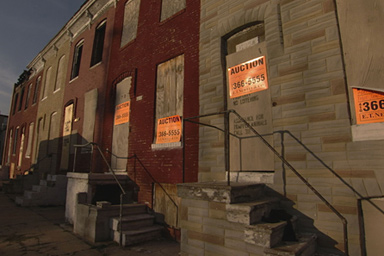

A chilling new investigative film spins a yarn of real-life tragedy -- and points the finger at Gramm and Greenspan
Image from "American Casino."

Argot Pictures
An image from “American Casino.”
If you’re having a hard time getting your head around exactly what happened in the historic meltdown of America’s home-mortgage market, you’re not alone. As the wife-and-husband investigative team Leslie and Andrew Cockburn suggest in their new documentary, “American Casino,” nobody fully understands it: Not the bankers and brokers who sold subprime mortgages (often using deceptive tactics or disingenuous language), not the Wall Street wizards who carved them up into ever more esoteric financial instruments, not the free-market wise men like former Fed chair Alan Greenspan or former Sen. Phil Gramm, and certainly not the ordinary citizens who believed they were fulfilling the American dream and wound up losing their homes, their financial security and their self-respect.
Actually, the Cockburns meet one guy in “American Casino” who understands the whole mess better than most, a California real estate investor named Jeff Greene who smelled the end of the housing bubble around 2006 and bet $1 billion against the mid-decade exuberance of Wall Street. Sitting in his walled and gated beach compound in Malibu, Greene calmly tells the camera that the opportunity for his successful hedge bet (which has yielded $500 million so far) involved massive pain for millions of homeowners.
We meet some of those people too; the Cockburns focus in particular on the African-American community of Baltimore, a city devastated by the tidal wave of foreclosures. Of course foreclosed properties can be found in virtually every neighborhood of every town and city, and at every income level. But Latinos and African-Americans are several times more likely to be affected than whites, and while the problem is undeniably complicated, that almost certainly reflects the enduring legacy of racism. In the 1990s and 2000s, neighborhoods that had previously been “redlined” by traditional lenders became targeted by unregulated and unscrupulous vendors of subprime mortgages, who neither knew nor cared whether borrowers were likely to default on those loans. As we now know, the results were toxic.
One of the film’s sad ironies is that middle-class homeowners like Denzel Mitchell, a Baltimore high-school teacher, or Patricia McNair, a family therapist, might well have qualified for conventional loans from normal banks. (One survey mentioned in the film suggests that at least half the people who applied for subprime mortgages in 2006 could have qualified for prime mortgages.) Instead, they were enticed into too-good-to-be-true first and then second mortgages that adjusted sharply upward, which they couldn’t realistically afford. Both people are aware that their own lack of financial sophistication is partly to blame for their predicament, but that does nothing to lessen the heartbreak as McNair and her husband have to leave the appealing family home where her adult children grew up, or as Mitchell must abandon his organic vegetable garden and the Tuskegee Airmen-themed bedroom for his little boys.
But if you want to blame somebody for what happened to Mitchell, McNair and millions of other Americans, the place to point the finger is at the fervid deregulation advocated by Greenspan and enacted by Congress under the whip of Gramm and other free-market ideologues. Such laissez-faire reforms created a wide-open marketplace where bankers and brokers could sell whatever extortionate mortgage deals they wanted to whomever they wanted, while lying to consumers about what they were getting and lying to lenders about the borrower’s income and assets. Meanwhile, as one anonymous former Bear, Stearns banker tells the Cockburns, Wall Street securities dealers carved up packages of mortgages into abstruse, “fourth-dimensional” instruments to be sold to “idiots.”
“American Casino” is of necessity a fragmentary tale; it was being filmed in 2008 as the crisis broadened and deepened, with events unfolding too fast for the Cockburn cameras. But while the mortgage crisis still awaits a rigorous deconstruction along the lines of Alex Gibney’s “Enron: The Smartest Guys in the Room,” this film stands as an intimate, terrifying document that renders an incomprehensible slice of recent history in human terms. While the stories of Denzel Mitchell and Patricia McNair made me want to weep, the film’s most memorable images stem from the Sisyphean task of Jared Dever, a bright and handsome local official in Riverside County, Calif., whose job is to control the county’s mosquito epidemic, largely caused by the fetid, abandoned swimming pools behind foreclosed suburban homes.
Dever patrols a nightmarish, new-but-decrepit landscape straight out of the fiction of J.G. Ballard, carefully checking empty houses for signs of meth labs or marijuana grow zones before attacking the pools, whose algae-green water is full of abandoned patio furniture, tires and sports equipment, along with millions of mosquito larvae and the minnows who live on them. I’m not sure that hosing down the whole subdivision with Malathion is any kind of answer. Civilization didn’t leave much of an imprint on that place. Now that the bankers have sucked out all its supposed economic value, we might as well drain the pools, knock down the houses and let the coyotes and rattlesnakes take over.
“American Casino” is now playing at Film Forum in New York. It opens Sept. 11 in Denver and Pittsburgh and Sept. 18 in Los Angeles, with more cities to follow.
The civil rights battle ignored by the U.S. media
The documentary "Black Power Mixtape" tells a counter-history of the 1960s, through the eyes of foreign journalists
A still from "The Black Power Mixtape 1967-1975"
It was tough enough to track the social and political upheaval of the 1960s through domestic news coverage, let alone to pay attention to what the rest of the world was reporting. But journalists from abroad were fascinated by the roiling changes — and often saw it quite differently.
Though U.S. network coverage of civil rights cruelties helped rally the country against the worst offenders in the South, coverage of revolutionary groups such as the Black Panther Party more often took J. Edgar Hoover’s extremist stance that it was the most dangerous internal threat to the U.S. Rarely did it look at the accomplishments of its free breakfast programs, community organizing and determination to stand up to police harassment and brutality.
Swedish newsmen and filmmakers who didn’t follow the FBI line came to America to learn what they could, looking at life in largely segregated black America, talking frankly and seriously with black leaders and closely following their trials.
Footage of the era, said to have been sitting in a Swedish basement for three decades, became the eye-opening documentary “The Black Power Mixtape 1967-1975” making its U.S. television debut on PBS’ “Independent Lens” Thursday night as part of its Black History Month series.
The modernist title owes in part to filmmaker Göran Hugo Olsson using modern-day commentary, from musicians in many cases, to accompany the found footage. Talib Kweli, Erykah Badu and Ahmir “Questlove” Thompson of the Roots add their contemporary revolutionary musing among commentaries by professors and historians.
The wealth of Swedish footage owes in part to the Panthers’ desire to see their movement as an international one, or one that certainly relied on support from outside the U.S.
It is the Panthers’ Embassy in Algeria where Eldridge Cleaver holds court, for example, far from the threat of FBI invasions. Martin Luther King Jr.’s visits to Stockholm to meet King Gustaf VI Adolf that are well preserved, and King’s traveling partner Harry Belafonte recalls the meeting.
Some of the earliest footage in the film shows a young Stokely Carmichael speaking in Stockholm in 1967, stating in the simplest terms the recent history of black movement in the U.S., carefully stepping beyond the nonviolent action approach by King.
“In order for nonviolence to work, your opponent has to have a conscience,” he points out coolly. “The United States has none.”
In some ways, it is the footage of Carmichael, the Student Nonviolent Coordinating Committee and honorary “prime minister” for the Panthers, that is the revelation of “The Black Power Mixtape.” How suppressed has his voice been over the years, even at a time of black history mining?
It’s certainly eye-opening for modern-day commentator Kweli, who exclaims, “He has so much passion and fire inside of him,” yet remains quite cool. “He seemed like a regular dude.”
After telling reporters in Stockholm, “I’m not as patient as Dr. King,” Carmichael takes over a Swedish interview of his own mother in Chicago to get to the point: The family’s struggles and limited opportunities can be boiled down to the fact that they are black.
One gets the sense that Swedish journalists enjoyed visiting black ghettos, where they tried to get a taste of life as they paused for interviews with Huey P. Newton and Kathleen Cleaver.
The coverage was noted in the U.S. as well, when TV Guide in a cover story complained about its negativity. Swedish reporters interviewed the story’s writer, balancing it with the view of director Emile de Antonio, who dismisses TV Guide as “an absolute nothing magazine.”
Officially, Sweden had been so critical of America’s role in Vietnam that the U.S. pulled its ambassador from Stockholm in 1968 and ended diplomatic relations with the country altogether for a time in 1972, after Prime Minister Olof Palme compared the bombings of Hanoi with the worst atrocities of Nazis.
Whatever the diplomatic relations, Swedish journalists certainly took the black revolutionaries more seriously and were plainly excited to be the first TV reporters to talk to an imprisoned Angela Davis. Still, because they worked from the same script, the question soon boiled down to: Do you have to use violence to reach your goals? Davis, receiving her first media visitor, was plainly annoyed by this, in just about the only footage that’s in color rather than black-and-white.
“When somebody asks me abut violence, I just find it incredible,” she says. “What it means is that the people who ask have no idea what people have gone through, what black people have experienced in this country since the time the first black person was kidnapped from the shores of Africa.”
The revolutionary tone of the film may provide grist for those on the right who erroneously see PBS as some kind of government-funded left-wing propaganda machine. When was the last time Louis Farrakhan was given a forum to talk about white devils?
But “The Black Power Mixtape” qualifies as a social history of a revolutionary movement, one quashed by a mid-1970s drug infusion to black neighborhoods that film participants are quite sure was caused by the government.
More than that, the modern voices in the film are resolute that lessons of the past need to be learned as the struggle goes on.
Wind power: Renewable resource, or another corporate scam?
A fascinating new film about one small-town political fight takes on the pseudo-green wind industry
A still from "Windfall"
In telling the story of a small-town political fight over wind power, Laura Israel’s fascinating documentary “Windfall” at first seems like another entry in the long laundry list of post-”Inconvenient Truth” doomsayer environmental films. Indeed, “Windfall” has some of the rural, homespun feeling of Josh Fox’s Oscar-nominated “Gasland,” which helped ignite a national debate over the natural-gas extraction method known as fracking. Israel’s film also offers a direct riposte to Bill Haney’s “The Last Mountain,” in which Robert F. Kennedy Jr. is seen promoting wind power as a clean alternative to the dirty and destructive combination of mountaintop-removal coal mining and coal-generated electricity.
Viewed through a long lens, “Windfall” is about much more than the hidden costs and unexpected side effects of wind-power generation, or about a citizens’ uprising in the tiny town of Meredith, N.Y., in the Catskill region 150 or so miles northwest of Manhattan. (Mind you, both are gripping stories.) It’s about the American tendency — and very likely the human tendency — to look for magic-bullet solutions to complicated social and economic problems, where none are available. It’s a microcosmic version of the political divisions — between left and right, environmentalists and free-marketers, corporations and citizens — that have virtually paralyzed our republic. It’s a reminder that whenever a virtually unregulated industry (as in this case) offers capitalists a chance to defraud the little guy and make a bundle, they’ll do it. It’s a tantalizing case study that suggests ordinary people still have the power to steer a course between faceless bureaucracies and greedy capitalists, but only just — and only if they can find a way to overcome their differences and work together.
In the abstract, wind power sounds like a good thing to nearly everybody. It relies on an essentially infinite resource, carries little or none of the obvious environmental downside of coal or oil, and presents no Fukushima-style doomsday scenario. Wind generation has become a major focus of venture capital; Israel includes video of a hearing a few years ago at which T. Boone Pickens told a congressional committee that he could imagine, in the relatively short term, 20 to 25 percent of the country’s electricity demand being fulfilled by wind and other renewables. I have no way to evaluate that claim, but the experts Israel consults in the film think it’s hokum. Given the inherently inconstant nature of wind, they argue, it’s not a stable or permanent solution to our energy crisis, and is unlikely ever to amount to more than a drop in the bucket.
Setting aside the discussion of whether it’s worthwhile to pursue wind power in the first place — and we shouldn’t really set that aside — there might be locations in the Great Plains states, the Southwest and the high western deserts where wind farms, even on the enormous scale imagined by Pickens, would do no great harm. But as people in Meredith and numerous other communities in the wind-friendly rural Northeast and Great Lakes region have discovered, living anywhere near those gargantuan wind-harnessing engines is quite a different matter. These days, the typical industrial wind turbine is around 400 feet high — the height of a 40-story building, or twice the length of a jumbo jet. The blades alone can weigh upward of 35 tons, and the entire assembly anywhere from 150 to 400 tons (resting on a platform of concrete and rebar, which itself may be 30 feet deep and weigh several hundred tons). It’s an enormous construction site, culminating in a high-voltage electrical device, that emits a 24/7 whoppa-whoppa-whoppa noise and incessant low-frequency vibration, and is topped with a brilliant flashing light. By daylight, there’s the nightmarish strobe effect — the vast rotating shadow that falls across an entire neighborhood when the turbine is between you and the sun. (While the question of whether it’s actually unhealthful to live near a turbine is unresolved, it’s definitely unpleasant.) If your neighbor put one up in her backyard without asking permission, how would you feel?
As it happens, I have a personal interest in the events and location of “Windfall,” because I spend summers in a town just a few miles from Meredith. But nothing about the town or its surrounding area (in Delaware County, N.Y., one of the poorest and least populated counties in the Northeast) is untypical of rural America. Meredith has a mix of longtime residents and big-city emigrants, and its longtime dairy-farm economy has largely collapsed in recent years, partly replaced by an unstable mixture of tourist-oriented businesses, craft initiatives and boutique organic farming. These social tensions came to the fore, predictably, during the wind-power debate, with the major landowners and dairy farmers on one side — hoping for the rather skimpy royalties paid by the corporate investors in wind — and many “recent” New York City arrivals, convinced that the region’s economic future depends on its unspoiled landscapes, on the other. (I use the scare quotes because anyone who’s lived in Delaware County less than 30 years is often viewed as a newcomer.)
People on both sides of the issue in Meredith assumed at first that the anti-turbine forces were an elitist minority, partly because the town board had always been dominated by the same landowning families, and partly because wind-power companies had signed people up to secret agreements that forbade them from discussing anything about the relationship. What ensued was a fascinating lesson in democracy (and a version of the same lesson the Tea Party and its supporters may learn later this year). After 826 people — more than half of Meredith’s total population — signed a petition opposing the town board’s pro-development policy on wind turbines, it turned out that the people who thought of themselves as the “real” residents were in the minority, and the jig was up for the wind industry in this one tiny corner of America. Yet as one newly elected board member reflects at the end of the film, nobody came out of this fight feeling good. A formerly harmonious community is now bitterly divided, and the Mitt Romney-style venture capitalists of wind power will just move on to the next town and sell their pseudo-green poisoned chalice to somebody else.
“Windfall” opens this week at the Quad Cinema in New York and the Facets Cinémathèque in Chicago. It opens Feb. 9 at the Art House Cinema 502 in Ogden, Utah, Feb. 24 at the Clinton Street Theater in Portland, Ore., and March 2 at the Northwest Film Forum in Seattle, with other cities and festival screenings to follow. It’s also available on-demand from cable, satellite and online providers, including Amazon, iTunes and VUDU.
Sundance opens with “riches to rags” story
The festival begins with the incredible true story of the tycoon, the beauty queen and their massive dream house
A still from "The Queen of Versailles"
PARK CITY, Utah — According to the mayor of this ski-resort town, which is a famous outpost of crunchy liberalism smack in the middle of the most Republican state in the union, it took the arrival of thousands of outsiders for the Sundance Film Festival to get the place back to normal. Last year the Utah Legislature passed a resolution declaring climate change a hoax, as Mayor Dana Williams told us before a Thursday night screening. Since then, Mother Nature has retaliated: It has barely snowed in the Wasatch Range this winter, leaving the region’s fabled slopes almost bare. But a day that began with drizzling rain and temperatures in the 50s ended with a healthy dose of the white stuff, while we all sat inside in overheated auditoriums watching movies.
Sundance has ditched its former tradition of having one main opening-night film, instead screening four different pictures, two American (a narrative feature and a documentary) and two foreign (ditto). This is all to the good, and avoids invidious comparisons with more Hollywood-centric festivals — but there’s little doubt this year that photographer-turned-filmmaker Lauren Greenfield’s documentary “The Queen of Versailles” was first among equals. The unbelievable-but-true story of Florida real-estate tycoon David Siegel and his ex-beauty-queen wife Jackie, who nearly went broke while trying to build the biggest house in the country, is like a Theodore Dreiser novel for our time, infused with the vivid, vulgar spirit of reality TV. It often had the sold-out Eccles Center howling, but also has elements of profound tragedy and allegory.
After everything starts to go south for the Siegels, Jackie has to take their enormous brood of children — or some of them anyway; I believe they have eight — back to her upstate New York hometown on a commercial flight. (Previously, they had gone everywhere in their private jet, of course.) But she’s still baffled when she gets to the Hertz counter at the airport in Elmira, N.Y., and asks, “Who’s my driver?” She grew up in modest middle-class circumstances and hasn’t been nosebleed-rich for that many years, but she has totally forgotten that regular people don’t have chauffeurs.
And the thing is, I never felt that Greenfield was mocking Jackie, who comes across as a likable, commonsensical middle-aged mom (albeit one with considerable, um, cosmetic enhancements) and is in many respects the heroine of the movie. She really is an ordinary person who has led a life that goes beyond the unlikely or the bizarre to the flat-out impossible. Her previous jobs included cocktail waitress and nursing-home attendant, and here she is pumping out kids and managing a 26,000-square-foot house for a sour and distracted rich guy 30 years older than her. (That’s not the uncompleted house modeled after the Palace of Versailles; that one was supposed to be 90,000 square feet.) By the end of the film, with most of the household staff laid off, Jackie’s job includes wandering around scraping dog crap off the carpeting in room after room, and discovering how many of her children’s pets have died from neglect.
David Siegel, who made his enormous fortune by selling time-share vacation rentals in places like Florida and Las Vegas (and Park City) to working- and middle-class people who couldn’t quite afford them, is apparently suing Greenfield over his portrayal in the film. Specifically, he objects to the Sundance brochure describing “Queen of Versailles” as a “riches-to-rags” story, and while I’m no lawyer, I suspect he’d have a better case if that weren’t exactly how he puts it in the movie. What David really doesn’t like, I suspect, is seeing himself on-screen as a brooding old cuss with no life outside his work and no time for his own children. He shuts himself up in a cluttered den with a widescreen TV and stacks of papers, trying to find a way to rescue both his Orlando dream house and his Vegas condo tower, now deeply underwater. (Time-share lending was essentially a species of subprime mortgage, and when credit dried up so did Siegel’s business.)
Still and all, Greenfield does allow us to see Siegel’s human qualities, especially the fact that he’s chasing the same ersatz vision of luxury, the same unattainable simulacrum of the good life, that he’s been selling to poor people one Vegas weekend at a time. He’ll probably never finish his Versailles, but even if he does it’ll have cockroaches and the same ghastly paintings of his family in pseudo-medieval finery. Siegel and his wife are of course entirely unaware that their attempt to build a replica of Versailles in Florida, and fill it with “Louis XIV-type antique furniture,” is a cruel and altogether too appropriate historical joke. But that’s really not their fault; they live in a country that has become a parody of itself.
Pick of the week: The amazing American journey of Harry Belafonte
Pick of the week: Day-O! How the singer-activist blended Caribbean shtick and fierce political passion
Harry Belafonte (Credit: HBO)
For several generations of people too young to remember the civil rights era, Harry Belafonte may seem like a baffling figure, familiar mainly from protest marches seen on television and Caribbean-shtick pop songs heard on grandma’s car radio. Who is this elderly African-American celebrity with the Italian-sounding name and the aristocratic demeanor? Why did he become famous in the first place, and why does he sometimes come off as the self-appointed radical conscience of black America? Most famously, Belafonte ignited immense controversy both within and without the black community by repeatedly suggesting that Colin Powell and Condoleezza Rice were the “house slaves” of the George W. Bush administration.
Those inflammatory remarks are not mentioned in “Sing Your Song,” the rich and fascinating new documentary about Belafonte’s life and times, which was written and directed by Susanne Rostock but has clearly been authorized and approved by Belafonte and his family. We learn a great deal about Belafonte’s central role as a towering figure of the early-’60s civil-rights movement, when he was confidant and advisor to Martin Luther King Jr. But also unmentioned are his visits to Fidel Castro in Cuba and Hugo Chávez in Venezuela, his warm relations with the Soviet leadership before the fall of communism, or his assertion that George W. Bush was a greater terrorist than those who perpetrated the 9/11 attacks.
For the record, I believe that Belafonte’s remarks about Bush are entirely defensible, if impolitic. What he has to say about Barack Obama’s first term can only be imagined, because the current president’s name, startlingly, is never uttered. (His father’s is; Barack Obama Sr. first came to the United States from Kenya by way of a Belafonte-sponsored scholarship.) I don’t bring up Belafonte’s past associations or overseas visits in order to red-bait him (as his ideological opponents have done exhaustively over the years). My point is that “Sing Your Song” is a vital document of American history, which I recommend to everyone, and also an attempt to massage the patriotic legacy of a complex and polarizing figure.
One thing Rostock’s film makes abundantly clear is the fact that Belafonte had the opportunity to become a high-profile and sometimes strident social activist because his first incarnation as a celebrity was about as wholesome and non-polarizing as a black man could possibly be. Born in Harlem but largely raised in Jamaica by his grandmother, Belafonte ultimately brought the island’s folk songs back to America as mid-’50s pop-calypso hits like “Matilda,” “Man Smart (Woman Smarter)” and of course “Banana Boat Song,” which you’ve definitely heard even if you don’t know what it’s called. (Irrelevant footnote: Belafonte’s story speaks to me personally in all sorts of ways, but partly because it parallels that of my own father, who was born in the same month of 1927 a few dozen blocks to the north, and then was sent back to his own grandmother on a somewhat colder island.) With his trademark tight pants and unbuttoned shirt, the muscular Belafonte became a sex symbol to millions of white women and girls at a time when interracial marriage was still impossible in many states, and toured with a mixed-race folk group to cities where black audiences had to watch from the balcony.
I realize this is stretching a little, but Belafonte in the ’50s — viewed strictly as a cultural archetype — was something like an early version of Obama, an articulate and handsome light-skinned African-American who spoke standard English better than most white people did. (To this day, Belafonte’s pronunciation of the word “theater” is redolent with cultural specificity; he says it as Bette Davis or Lynn Redgrave would have.) But as Belafonte himself explains it in the film, his path to stardom was at least partly calculated. Near the beginning of his performing career as a folk singer, he remembers, his idol Paul Robeson came to see him backstage at the Village Vanguard and told him: “Get them to sing your song, and they’ll want to know who you are.”
If anything, “Sing Your Song” may convey the impression that Belafonte’s career as a pop singer and stage and film actor — a shameless ham, it must be said — was simply a means to an end, a tool to be used against Jim Crow and apartheid and other forms of racism and injustice around the world. While I suppose it’s true that Belafonte’s close working friendship with King, or his later relationships with Nelson Mandela and Jean-Bertrand Aristide, may weigh more in the scales of history than “Banana Boat Song,” he honestly may be selling himself a little short. Sure, some of Belafonte’s calypso numbers may be cheesy, but he was a generous singer with a huge spirit, who pioneered multiculturalism and “world music” long before anyone used those words. The performers he introduced to mainstream audiences included Odetta, Nana Mouskouri and, most famously, Miriam Makeba — and his 1962 album “Midnight Special” featured a then-unknown harmonica player named Bob Dylan. (In the movie, you’ll watch him perform “Hava Nagila” on network TV in 1959, which became part of his concert repertoire for years. You can think that’s silly or think it’s awesome; I vote for both.)
Belafonte’s early association with Robeson (who was without doubt a communist) will raise in some viewers’ minds the long-cherished right-wing assumption that Belafonte was or is a treacherous Red seeking to destroy the American way of life. Even bracketing the fact that the two things are not connected — most American communists were not traitors, just as most American Muslims do not support terrorism — the evidence is pretty thin. Even the right-wing investigative site Discover the Networks can go no further than claims that Belafonte was “aligned with the Communist Left” and that he “views America as an evil and profoundly racist nation.” Depending on your definition of “evil,” those vague and disputable terms could be used to describe all kinds of people, from Cornel West to Noam Chomsky to Roger Ebert (to me).
“Sing Your Song” never addresses these allegations directly, other than sourcing most of the FBI’s files on Belafonte to a shadowy figure named Jay Richard Kennedy (aka Samuel Solomonick), a one-time Communist Party insider turned showbiz executive and government informant. Kennedy was Belafonte’s manager for several years — while his wife served as Belafonte’s therapist! — and the two of them apparently fed the FBI some ludicrous “Manchurian Candidate” line about Belafonte being a double agent “controlled by Peking.” My Internet searches suggest that at least one academic is trying to write a book about Kennedy/Solomonick, and I can’t wait to read that one.
I don’t support everything Belafonte has ever said or done, but he’s a hugely important American dissident who’s been on the right side way more often than the wrong one, and who pioneered a path followed by many other activist celebrities, from Marlon Brando to Sean Penn and beyond. Even in this carefully staged self-portrait, we meet a man in his 80s who is aware of his failings as a husband and father (although his two youngest children, David and Gina, helped produce the film) and plagued by the thought that all his labors against tyranny and injustice have not nearly been enough. On one hand, he comes off as boundlessly optimistic, seeking to hand off the torch of rebellion to a new generation; on the other, since the 1980s he seems to have hardened and grown less tolerant of politics. He declined to attend Mandela’s inauguration as president of South Africa because of his rift with Bill and Hillary Clinton, and declined to attend Coretta Scott King’s funeral because Bush would be there.
With his physical health precarious, Belafonte keeps touring the globe, meeting with European hip-hop artists, L.A. gang members, prison inmates, Native American leaders and his own council of African-American “elders,” in search of some resolution or program that might reverse the global tide of neoliberal capitalism and pseudo-democratic police states. He’s a hero, all right, but not the kind who gets to ride triumphantly into the sunset at story’s end. More like the hero of a long-running tragedy, the kind of hero once summarized this way by the English socialist William Morris: “Men fight and lose the battle, and the thing that they fought for comes about in spite of their defeat, and when it comes turns out not to be what they meant.”
“Sing Your Song” opens this week at the IFC Center in New York and the Playhouse 7 in Pasadena, Calif. It opens Jan. 20 in Santa Fe, N.M.; Jan. 27 in Portland, Ore., San Francisco and Seattle; Feb. 3 in Denver; Feb. 10 in Albuquerque, N.M., and Bellingham, Wash.; Feb. 12 in Montgomery, Ala.; Feb. 17 in Hartford, Conn.; and March 16 in Minneapolis, with other screenings and venues to be announced.
Right-wing documentary targets Occupy
Exclusive: Film in the making from Citizens United is likely to portray protesters as anti-democratic anarchists
VIDEO
(Credit: AP)
Citizens United, which specializes in making documentaries with strong right-wing messages, is currently in production for a film about the Occupy movement, a spokesman for the group confirms to Salon.
The landmark 2010 Supreme Court case that loosened campaign finance restrictions was brought by Citizens United and centered on an anti-Hillary Clinton movie made by the group. Opposition to that ruling has been a consistent message of participants in Occupy movement.
The new film is to be called “Mic Check: The Untold Story of the Occupy Movement.” A participant at Occupy Wall Street recently received an interview request from a Citizens United producer that included this description of the film:
Never in living memory has such a small political movement received such disproportionate attention from the press. Never in living memory has a movement been so widely scrutinized and yet so deeply misunderstood. Is it possible both the left and right have made the error of thinking that the forces behind Occupy Wall Street are interested in democratic politics and problem solving?
In Mic Check: The Untold Story of the Occupy Movement, we’ll look at the roots of the Occupy movement and hear from it undeclared ‘leaders’. We’ll go inside the still existing encampments in Los Angeles and Washington D.C., into the frequently contentious street rallies and hear from participants about their protest, their goals and their vision for the future.
(Emphasis added.)
That bolded line is taken almost verbatim from a Weekly Standard article by Matthew Continetti, who argues that Occupy is an attempt “to establish a socialist utopia through revolutionary anarchism” and that the movement must be met with legal and ideological opposition.
The email from the Citizens United producer says that filming is scheduled to be complete by Jan. 13 and adds that she can “arrange a video crew to tape in nearly any city in the US if need be.”
Here’s a taste of the Citizens United style:
Page 1 of 39 in Documentaries
“We don’t need someone to think”
How rough it’s gotten for Mitt
The Grammy’s most memorable moments
A passport to utopia
“The Fault in Our Stars” and “There Is No Dog”: Not kids’ stuff
Ricky Gervais: My conscience never takes a day off
Lessons of a very sexy pirate costume
America’s failed promise of equal opportunity
Is gay literature over?
A voice that touched us all 

