
Robert Reich
Obama: Show courage on healthcare
When the president addresses Congress next week, it's time for him to be specific about what he wants
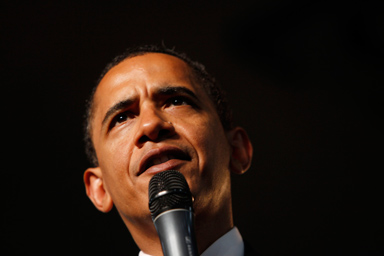
President Barack Obama conducts a town hall meeting on health care reform, Thursday, June 11, 2009, at Southwest High School in Green Bay, Wis. Congress returns next week to one of the fiercest and most important debates in recent memory — whether and to what extent the nation will provide healthcare to all Americans, and how we will rein in the soaring costs of healthcare overall. But do not expect unusual courage from this Congress in standing up to demagogic lies and money-toting lobbyists. An unusually large portion is facing close races in 2010, both in primaries and in the general election. Republicans have many primary challenges from the right. A record number of Democrats, who took over Congress in 2006, hail from traditionally Republican or swing states and districts.
In order to get anything meaningful through this session of Congress, then, the president will have to give congressional Democrats far more leadership and more cover. Doing so is harder now than before the recess, when he was still basking in the afterglow of a honeymoon and 60 percent favorabilities. Yet it’s not too late. Addressing a joint session of Congress next Wednesday is a good idea but Obama can’t rely solely on his exceptional rhetorical skills. He’ll need to twist arms, cajole, force recalcitrant members to join him, threaten retribution if they don’t come along.
Most important, he’ll need to be specific about what he wants — especially about three things. I hope he says the following next Wednesday, and makes clear to individual members that he means business.
1. I will not stand for a bill that leaves millions of Americans without healthcare. It’s vitally important to cover all Americans, not only for their and their children’s sakes and not only because it’s a moral imperitive, but because doing so will be good for all of us. One out of three Americans will experience job loss and potential loss of health insurance for themselves and their families at some point. One out of four of us who have health insurance is underinsured — unable to afford the preventive care we and our kids need on an ongoing basis. And those of us who don’t get preventive care can get walloped with diabetes, heart disease and other major illnesses that wipe us out financially, or force us into emergency rooms that all of us end up paying for.
2. The only way to cover all Americans without causing deficits to rise is to require that the wealthiest Americans pay a bit extra. The wealthy can afford to make sure all Americans are healthy. The top 1 percent of earners now take home 23 percent of total national income, the highest percentage since 1928. Their tax burden is not excessive. Even as income and wealth have become more concentrated than at any time in the past 80 years, those at the top are now taxed at lower rates than rich Americans have been taxed since before the start of World War II. Indeed, many managers of hedge funds, private-equity partners, and investment bankers — including those who have been bailed out by taxpayers over the last year — are paying 15 percent of their income in taxes because their earnings are, absurdly, treated as capital gains. We should eliminate this loophole as well, and use it to guarantee the health of all.
3. Finally, I want a true public insurance option — not a “cooperative,” and not something that’s triggered if certain goals aren’t met. A public option is critical for lowering healthcare costs. Today, private insurers don’t face enough competition to guarantee low prices and high service. In 36 states, three or fewer insurers account for 65 percent of the insurance market. A public insurance option would also have the scale and authority needed to negotiate low drug prices and low prices from medical providers. Commercial insurers now pay about 30 percent higher rates to providers than the government pays through Medicare, because Medicare has the scale to get those lower rates. A nationwide public option could get similar savings. And those savings would mean lower premiums, deductibles and co-payments for Americans who can barely afford health insurance right now.
We’ll see.
Europe’s austerity revolt
The message from France and Greece this weekend was clear. Will President Obama and Republicans listen?
Socialist Party candidate for the presidential election Francois Hollande delivers a speech during a meeting in Lorient, western France, Monday, April 23, 2012. (Credit: AP/David Vincent) Who’s an economy for? Voters in France and Greece have made it clear it’s not for the bond traders.
Referring to his own electoral woes, Prime Minister David Cameron wrote Monday in an article in the conservative Daily Telegraph: “When people think about the economy they don’t see it through the dry numbers of the deficit figures, trade balances or inflation forecasts — but instead the things that make the difference between a life that’s worth living and a daily grind that drags them down.”
Continue Reading CloseObama’s recovery challenge
The dismal jobs report proves the economy has stalled. The president needs to push back against GOP austerity
President Barack Obama turns as he finishes speaking at a celebration of Cinco de Mayo in the Rose Garden of the White House in Washington, Thursday, May 3, 2012. (AP Photo/Carolyn Kaster) (Credit: AP) The economy has stalled.
Friday’s jobs report for April was even more disappointing than March. Employers added only 115,000 new jobs, down from March’s number (the Bureau of Labor Statistics revised the March number upward to 154,000, but that’s still abysmal relative to what’s needed). We need well over 250,000 new jobs per month in order to begin to whittle down the vast number of jobs lost in the Great Recession. At least 125,000 new jobs are necessary each month just to keep up with an expanding population of working-age people.
Continue Reading CloseBehind our stalled recovery
The GOP's austerity obsession is responsible for the nation's economic slowdown
Rep. Paul Ryan, R-Wis.(Credit: AP Photo/Charles Dharapak) We’ll know more on Friday when the jobs report is announced, but Thursday’s report on America’s massive service sector – which make up about 90 percent of the economy – is sobering to say the least.
The Institute of Supply Management’s non-manufacturing index fell to a four-month low in April (53.5, down from 56 in March – still positive territory but just barely). New orders dropped to their lowest level in six months.
That doesn’t bode well, especially when combined with other recent data. The Commerce Department reports that the economy as a whole has slowed from the last quarter of 2011 when it was expanding at an annual rate of 3 percent, to 2.2 percent for the first quarter of this year. And last month’s unemployment report showing only 120,000 new jobs in March was downright alarming.
Continue Reading CloseA big day for the 1%
America's wealthiest made a killing on Wall Street today -- at the expense of the nation's under-employed workforce
Traders work on the floor of the New York Stock Exchange Tuesday, Feb. 28, 2012. World stock markets fell Thursday March 29, 2012 as signs of weakness in the world's two biggest economies kept investors at bay. (AP Photo/Richard Drew) (Credit: AP Photo/Richard Drew) The Dow Jones Industrial Average hit 13,338 Tuesday, it’s highest since December, 2007. The S&P 500 added 16 points. Wall Street will remember May 1 as a great day.
But most of these gains are going to the richest 10 percent of Americans who own 90 percent of the shares traded on Wall Street. And the lion’s share of the gains are going to the wealthiest 1 percent.
Shares are up because corporate profits are up, and profits are up largely because companies have figured out how to do more with less.
Continue Reading CloseDemographic suicide
Why Republicans can't stop alienating Hispanics, women and young people
In this April 10, 2012 photo, Republican presidential candidate, former Massachusetts Gov. Mitt Romney speaks in Wilmington, Del.(Credit: AP Photo/Evan Vucci) What are the three demographic groups whose electoral impact is growing fastest? Hispanics, women and young people. Who are Republicans pissing off the most? Latinos, women, and young people.
It’s almost as if the GOP can’t help itself.
Start with Hispanic voters, whose electoral heft keeps growing as they comprise an ever-larger portion of the electorate. Hispanics now favor President Obama over Romney by more than two to one, according to a recent Pew poll.
Continue Reading ClosePage 1 of 53 in Robert Reich