
Dazzling direction, Oscar-worthy performances and strong narratives -- the Brits are doing what the Yanks can't
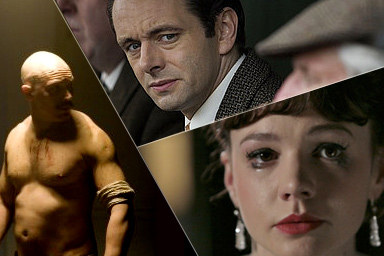
Stills from "Bronson", "Damned United" and "An Education"

From left, Tom Hardy in ”Bronson,” Michael Sheen in “The Damned United” and Carey Mulligan in “An Education”
Is it pure coincidence that three of the fall season’s best movies are opening right on top of each other — and that all three are products of Britain’s suddenly resurgent indie-film industry? I’m voting both yes and no. It’s coincidence in the sense that the film-release calendar seems to operate according to laws that aren’t just random but positively irrational: It verges on marketplace suicide to open these three movies at the same time, but here they are. What’s not coincidence is that the film biz in post-imperial, post-Tony Blair Britain is riding a hot streak, cranking out splashy, stylish, audience-friendly flicks that bear no resemblance to the fusty, fussy, Jane Austen-in-lingerie stereotypes of yore.
It’s tempting to point to the multiple Oscar winner “Slumdog Millionaire” — a film about which I have very mixed feelings — as a turning point in British cinema history, but the real story is a lot more complicated than that. No doubt Danny Boyle’s Digicam odyssey through the streets of Mumbai is a terrific example of how 21st-century British film has become globalized, both in terms of subject matter and audience appeal. Taken together, the three new movies reaching the American colonies this week — “An Education,” a study of teen girlhood in pre-swinging London; “Bronson,” the operatic, quasi-true story of “Britain’s most violent prisoner”; and “The Damned United,” about the legendary flameout of a ’70s celebrity soccer coach — seem to recall, almost deliberately, the glory days of British cinema.
Although the three films are sharply dissimilar, at least in broad strokes, all are built around memorable star performances, and all depict postwar Britain in a sardonic light, showing off various phases of its social decay. In two cases, the filmmakers aren’t themselves British — but that too is nothing new. “An Education,” a highly-touted Oscar contender with a captivating star turn from Carey Mulligan and a script by hipster icon Nick Hornby, has a Danish director (Lone Scherfig) and an American co-star (that would be Peter Sarsgaard, wonderfully unctuous as the disreputable older-guy love interest). Based on Lynn Barber’s memoir, “An Education” captures the very limited possibilities for female liberation in early-’60s London — with massive social change on the distant horizon, but not here yet — in exquisite detail.
“Bronson” is an explosive, theatrical, fourth-wall-busting project that will strike some viewers (like me) as prodigious and others as unbearably pretentious. It’s got another Dane, cult hero Nicolas Winding Refn, at the helm, spinning his camera willy-nilly around the thundering, drooling, ‘roided-up performance of Tom Hardy as the ultraviolent British convict who borrowed his monicker from the ’70s action star. No Danes are implicated in the making of “The Damned United,” an almost perversely provincial film that may not find a wide audience outside English émigrés and hardcore soccer fans. But it too has a delirious lead performance from Michael Sheen (Tony Blair in “The Queen”), and offers a wacky, compelling, magical mystery tour of English sports culture, circa 1974. If you simply start watching it without prejudice you’ll have a ridiculously good time.
Well before the 1970s explosion of rebellious American cinema that brought Francis Coppola, Martin Scorsese and Steven Spielberg to worldwide fame, London was the center of its own low-budget film renaissance, one that saw American expatriates like Stanley Kubrick and Joseph Losey working alongside young British upstarts like Lindsay Anderson, Ken Loach, Mike Leigh and Alan Clarke. (A certain Polish-French director who’s been in the news lately also worked in England in the ’60s.)
That moment isn’t widely remembered today, for a bunch of different reasons, and in the intervening years British acting and directing talent has overwhelmingly flowed toward Hollywood. Given the tepid, depressive state of American independent film right now, though, and the clear sense that things are sprouting up across the Atlantic like wildflowers after an English rainstorm, I’m betting it won’t be long before we see ambitious Yanks emulating Kubrick and Losey’s example. Urgently paging Andrew Bujalski, Antonio Campos and Azazel Jacobs: Go east, young men!
I’m not claiming that no good movies are being made in the United States; far from it. But the film industry and its marketplace seem segmented in a way that isn’t helping artists or audiences. There are a handful of brand-name Indiewood directors who can pretty much write their own ticket: Tarantino, the Coen brothers, the unrelated Andersons (Wes and P.T.). Below that we see a lot of clever, minor tweakage applied to familiar formulas: “(500) Days of Summer” or “Jennifer’s Body.” Lower still in the ecosystem, lo-fi, achingly sincere movies get made by the dozen. (Instead of supplying names and links, let’s just stipulate that that’s most of the films I’ve written about over the last five years or so.) They travel the festival circuit for a few months, and the better ones get released in theaters or via VOD, before being universally rejected by the media-saturated public’s collective immune system.
When exciting young directors like Bujalski, Campos or Jacobs emerge, out there on the underfed indie fringes, there seems to be no way to break out of the tiny club of aficionados who attend Sundance or South by Southwest and bring their work to a smart, film-literate general audience. Maybe those filmmakers and others have self-marginalized to some degree, making highly personal, idiosyncratic works and accepting that in a downsizing economy their future lies in self-distribution, social networking, digital downloads and so on.
But look across the ocean and behold: “An Education” is both cleverly packaged and wonderfully executed; it will get terrific reviews, do decent big-city business and plausibly garner at least a best-actress nomination for the irresistible Mulligan and a supporting actor nod for Alfred Molina (who plays the wanton teen’s suburban dad). Lone Scherfig, its director, is a 50-year-old Danish woman whose only international success came with “Italian for Beginners” in 2000. A year ago, the only way Scherfig could have found work in Hollywood was as a high-priced Euronanny (or maybe an upscale Scando-dominatrix); this winter, I garr-yan-tee that Harvey Weinstein leaps from the pool and scurries to the phone when she’s on the line. (Stephanie Zacharek will provide a full review of “An Education” on Friday.)
I’m dubious that Americans will cotton to “Bronson” in large numbers; it isn’t about the other, better-known Charles Bronson, and he isn’t in it (having been dead for six years). But it provides a glorious showcase for the amped-up talents of both star Hardy and director Winding Refn, who in another era would have ridden his grueling, violent, dark-side-of-Copenhagen “Pusher” trilogy straight to Hollywood. In its portrayal of the charismatic, sociopathic skinhead hero (né Michael Peterson), and its delirious soundtrack blending Puccini and Wagner with the Pet Shop Boys, “Bronson” owes a little or a lot to Kubrick’s “Clockwork Orange,” but if that’s a crime I wish more people would commit it.
As portrayed by Hardy, Bronson is a sort of body artist from downscale suburbia, a man with a certain anarchistic tenderness in his soul — he loves his mother, and various skanky prostitutes, and possibly a fellow prisoner or two — who finds his true calling in administering (and receiving) vicious beatdowns. He interrupts the action to address the audience (both the movie’s audience and a digitized audience in a theater), sing “Please Release Me,” perform other characters’ roles in partial drag and deliver second-rate philosophical bromides.
Some British viewers have complained that Winding Refn and co-writer Brock Norman Brock underplay the real-life prisoner’s calculated viciousness, and it’s perfectly true that “Bronson” is a hallucinatory dark comedy about a half-animal innocent, trapped in the Kafkaesque world of 1970s British society. Personally, I’m not worried about that, mostly because I never felt this movie was remotely meant to depict reality; it’s a rich, hilarious drug overdose dense with color and sound, blood and bad carpeting, and as one supporting character puts it, “ladies, gentlemen and gentlemen in ladies’ attire.”
As over-the-top self-assured idiots go, Hardy’s portrayal of Bronson gets stiff competition from Michael Sheen as English footballing (i.e., soccer) legend Brian Clough, a former star turned pretty-boy coach who spent 44 disastrous days at the helm of Leeds United in 1974, when it was England’s most loved and hated team. (Further coincidence: That’s also the year Peterson/Bronson first went to prison.) If you’re old enough and/or Anglocentric enough to remember those dire, violent years of British football, when it had already become pop culture but was a long way from the global merchandising empire of today’s English Premier League, then director Tom Hooper’s “The Damned United” will be totally addictive, from its period-newsreel and period-animation opening sequence.
Can viewers who don’t know or care much about sports or soccer history be convinced to see “The Damned United”? I have no idea, but those who give it a whirl will discover a delightfully comic and sympathetic portrayal of British life in the hardscrabble, ciggies-and-lager ’70s, fueled by Sheen’s portrayal of the mouthy, cocksure Clough, who modeled his arrogant public persona after Muhammad Ali. Clough’s Leeds debacle was the denouement of his long-running feud with former Leeds coach Don Revie (wonderfully played by Colm Meaney), a gruff father figure who had led the team to repeated glory — and to a nationwide reputation as thugs and cheaters.
By the time Clough took over at Leeds, full of rhetoric about transforming the team from widely loathed champions into universally beloved champions, he had driven away his lumpish right-hand man Peter Taylor (Timothy Spall, one of those British character actors who’s great in everything). As Taylor himself observes, Clough may be the “shop window,” but he’s the “goods in the back”; while Clough enchanted fans and played the media, Taylor actually worked out such on-the-field matters as players, tactics and strategy. It’s a classic and even charming yarn of vanity, hubris and redemption, played out against the bizarre, intense alternate universe of ’70s English soccer.
I guess you could remake “The Damned United” so that it was about college football in Texas, and somebody will probably try. I can foresee a few problems: 1) It will no longer be a more-or-less true story, passed down among generations of fans; 2) it will be made in a country that views its own cultural traditions through a massive scrim of sentimentality, instead of with a bemused mixture of love and horror; and 3) it will just totally suck in so many different ways I can’t count them.
“An Education” opens Oct. 9 in New York, Los Angeles and other major cities, with wider release to follow. “Bronson” opens Oct. 9 at the Angelika Film Center in New York, Oct. 16 at the Laemmle Sunset 5 in Los Angeles, Oct. 23 in Philadelphia and San Diego, Oct. 30 in Denver and Nashville, and Nov. 20 in Boston, with more cities to follow. “The Damned United” opens Oct. 9 in New York and Los Angeles, with more cities to follow.
Oscars: Hollywood’s war against itself (continued)
Oscar voters picked the lowest-grossing winner in history -- artistic integrity or commercial suicide?
I’m grateful to have been thoroughly and completely wrong about the best-picture race — as were a great many other supposedly knowledgeable stooges — for a whole bunch of reasons. First and foremost, Kathryn Bigelow’s historic sweep was a genuinely moving and surprising capper to one of the most tedious Oscar broadcasts in recent memory. All that industry hand-wringing, a much-touted new production team, and what do we get? Interpretive dance numbers set to fragments of the nominated scores. Seriously? If they’d hired the Sparkle Motion dance team out of “Donnie Darko,” it couldn’t have been any lamer. (Actually, that would been a lot more fun to watch.)
Although I have mixed feelings about “The Hurt Locker” itself, and about the cultural-psychological reasons for its ascendancy, Bigelow herself is a genuine and strange cinematic genius who has paid her dues several times over and richly deserves her moment of triumph. (Is “Hurt Locker” her best film? Probably not. Her second-best? Not even sure about that.) I wish producer-screenwriter Mark Boal hadn’t complicated Bigelow’s big moment on the stage of the Kodak Theatre by persistently tugging on her elbow, like a kid in a department store who needed to use the john. That was odd.
Did it take a grueling, ¿Quién es más macho? war thriller for a female director to win a pile of Oscars? I know there are counter-arguments — mainly, there just haven’t been that many Oscar-scale movies made by women — but I kind of think, yeah, it did. This may have more to do with the Academy’s recent preference for “serious,” male-coded film genres than with simplistic sexual discrimination. Hollywood legend Joseph L. Mankiewicz won back-to-back writing and directing Oscars in 1950 and 1951 for “A Letter to Three Wives” and “All About Eve,” but it’s difficult to imagine such female-centric movies garnering those kinds of honors today.
Taking the longer view, this year’s Oscar campaign and its conclusion offered some crucial flashes of insight into how the Academy works in the 21st century, which is a whole lot different from the way it used to work. Although this goes against nearly everything I believe about life on Planet Earth, I have concluded that Academy voters as a group are less cynical and calculated than I thought — but also that there is a conflict or schism between the membership and the needs and desires of the Academy’s leadership, or at least its image-management and P.R. teams.
I exchanged e-mails late on Sunday night with a critical colleague, one who’d made the same misguided assumptions that I had about the inevitable victory of “Avatar,” notwithstanding the accolades heaped upon “Hurt Locker” by every critics’ group and industry trade organization. Our fundamental error, we concluded, lay in believing that after several years of victories by mid-budget Indiewood pictures the Academy’s collective thinking, and voting behavior, would at some point return to “normal.” What we meant by normal, of course, was an ingrained institutional preference for big-budget spectacle. But that old normal is dead, and here’s the new normal: Hollywood’s central trade group doesn’t like its own movies that much.
Allow me to quote an esteemed expert: “One thing that’s become clear is that the film industry feels no confidence about the cultural significance of its own products. Hollywood’s self-appointed division of self-importance, the Academy of Motion Picture Arts and Sciences, passed up the chance to honor one of the most ambitious and successful films the American movie factories have ever made in order to hand out hardware to a mid-budget, semi-independent production made in Jordan without movie stars.”
OK, the expert is not all that esteemed. It’s me, and other than replacing “India” with “Jordan,” that’s taken verbatim from the article I wrote last year about the Oscar victory of “Slumdog Millionaire” and the shunning of “The Dark Knight.” If anything, the contrast is even starker this time around. “Avatar” is, of course, a much bigger hit than TDK, and its use of motion-capture technology and 3-D clearly points toward the Hollywood future. “The Hurt Locker” is a genuine indie production, financed and made entirely outside the studio system, which grossed less than $15 million in the United States.
Comparing different eras of financial and cinematic history is rife with pitfalls, but that clearly makes “Hurt Locker” the lowest-grossing best-picture winner in Oscar history. (No. 2 is probably “The Last Emperor” from 1987, but when you adjust for inflation, Bernardo Bertolucci’s costume drama made almost three times as much money as Bigelow’s war epic.) It’s delicious and strange and at least potentially ironic that this happened in the year when the Academy expanded the best-picture category from five to 10 nominees, in an evident effort to make the competition more commercial and more attractive to mainstream audiences.
Honestly, the only conclusion I can draw is that Academy members are voting with their hearts. Who’da thunk it? Maybe an earlier generation of Oscar voters was more persuaded by box-office numbers, mass popularity and marketing muscle — or was simply more in tune with mass taste — but they evidently don’t give a damn about those things now. Personally, I’d have ranked a couple of other nominees above “Hurt Locker” — definitely “A Serious Man,” maybe “An Education” — but it’s an idiosyncratic film made by a genuine visionary. Even setting aside the history-making element of this vote (which was surely a consideration) it’s a respectable choice.
Now, the Academy brass, especially its marketing mavens and the shepherds of its lucrative contract with ABC, may take a more jaundiced view of the membership’s sudden attack of integrity and independence. Oscar’s long relationship with the wider moviegoing public has always been tempestuous, but both as a television franchise and a touchstone of cultural relevance, the Academy Awards cannot afford to be seen as some elitist, out-of-touch coastal bastion of indieness. If we allowed ABC execs a free spin in the time machine, and a chance to replace the last four or five years’ worth of Oscar-winners with movies heartland consumers actually paid to watch, they’d take it in a heartbeat.
Still, at least in terms of water-cooler controversy, this year’s Oscars were largely successful. Mind you, the telecast was a misbegotten mishmash, and the toxic, unfunny repartee of Alec Baldwin and Steve Martin made Hugh Jackman’s 2009 song-and-dance numbers look like the height of showbiz professionalism. But viewership was up, reaching the best numbers since the “Crash on Brokeback Mountain” showdown of 2006, and the huge roster of nominated films yielded contradictory but complementary results: Multiple nominations for hugely popular films, and an underdog victory. A lifetime achievement award for Jeff “The Dude” Bridges (let’s be honest; that’s what it was), and shocking proof that Sandra Bullock is not just a human being but a funny, warm and generous-spirited one as well.
But the repercussions of “The Hurt Locker’s” victory over “Avatar” go well beyond Kathryn Bigelow’s historic breakthrough, and well beyond questions of which movie you or I like better, or which one made more money. It’s another salvo in Hollywood’s peculiar, long-running war against itself, a war unlikely to have any winners.
Oscar 2010: Carey Mulligan’s charm offensive
With dimples like weapons, the star of "An Education" plays a stronger, wiser kind of ingenue
Carey Mulligan in "An Education"
At one point in Lone Scherfig’s “An Education” Carey Mulligan, as a 16-year-old schoolgirl whose yearning for culture and sophistication is being stroked by an older man, sits in a posh supper club flanked by this new beau and his two ultra-sophisticated friends. Mulligan’s character, Jenny, is a bright girl bucking the constraints of her suburban upbringing; this is early ’60s, pre-swinging London, an era when nice girls supposedly didn’t (though in actuality they often did). But it’s not really sex Jenny is after; what she’s seeking is much harder to define. She speaks schoolgirl French, sneaks cigarettes with her friends, and spends hours stretched out dreamily in her room, listening to Juliette Greco records — records that, in those pre-Amazon days, actually had to be brought back from France in a suitcase by a human being, or at least special-ordered from your local record shop. Jenny is hungry for the world, and that supper-club scene in “An Education” nails it: Sitting at the table with her new friends, her hair done up — or, rather, undone — in the nondescript center-part hairdo of schoolgirls everywhere, she’s the teenage equivalent of a plane ready for takeoff. Her simple plaid shift dress is accessorized with a dainty heart locket, a cigarette poised delicately between her fingers and — the killer detail — dimples.
Mulligan’s performance is touching because it isn’t about overcoming teen awkwardness. Jenny is far from ungainly, either in her bearing or her way of expressing herself. As it turns out, she’s more poised — more straightforward, more principled, essentially more all-around grown-up — than the man with whom she’s become involved, David (Peter Sarsgaard). David is a rather shady deal maker who gets by on his smooth manners. (He also happens to be Jewish, and one of the movie’s flaws is that instead of seizing the opportunity to puncture anti-Semitic attitudes in early ’60s Britain, Scherfig instead plays into them.) David’s equally suave friends, Danny and Helen (Dominic Cooper and Rosamund Pike), are climbers too, and for a time the three of them treat Jenny as something of a mascot. Under Helen’s tutelage, Jenny learns how to wear the right dresses and twist her hair up into a perfect lacquered chignon. At one point she remarks to Danny that, when it comes to art, she’s still not sure “what makes good things good,” and he reassures her — meaning it — that she does know, even when she doesn’t know why. Her instincts, in art if not yet in life, are sound.
Actors can’t (or shouldn’t) play instincts; they can only play people. And that’s the marvel of Mulligan’s performance here: She navigates the tricky territory of playing a young woman who’s sure of herself but doesn’t yet know it. This isn’t a dark performance, or a moody one. What’s wondrous is the sunny intelligence of it. At times Mulligan’s face appears soft, childlike: Her dimples are like stealth weapons — they appear out of nowhere, unbidden and striking. Mulligan was in her early 20s when the film was being made (she’s now 24), and in real life she’s certainly a grownup. But from certain angles Jenny’s face still shows traces of baby fat, remnants of childhood that aren’t yet ready to disappear forever. Maybe that’s what makes Jenny’s resoluteness so affecting. When she rails against the headmistress played by Emma Thompson, who has urged her to stay in school and work toward doing something useful, like teaching, the hellfire in her eyes is anything but childlike. Why, she demands, should she want to go through life doing something that’s “hard and boring”? (In the heat of the moment she’s mischaracterizing the profession, but she’s responding to the way Thompson treats a teaching career as a glum death sentence, not a challenge.) “This whole country is bored!” she continues. “There’s no life in it or color or fun.” In that moment, as Mulligan plays her, Jenny isn’t just a woman who’s stopped waiting for things to happen, but an historian of the future: Before long, strange and wonderful things will happen to her country — things like Jimi Hendrix, Ossie Clark, the Rolling Stones, not to mention the Beatles — and they’ll happen as a direct response to the boredom she’s talking about.
While Mulligan’s performance is completely intelligent and sensitive, it isn’t necessarily what you’d call delicately multilayered: It’s as direct as a bullet, which is what makes it so effective. That’s especially true in Mulligan’s sex scenes with Sarsgaard. Jenny has told David that she wants to remain a virgin until age 17, a choice he supports. He doesn’t move in on her or pressure her, but when, after her birthday, the moment has finally arrived, she sets down a few ground rules: “No baby talk. No ‘Minnie,’” she says pointedly, referring to the childish pet name he’s given her. “Treat me like a grownup.”
The experience of losing her virginity is something of a letdown, but Jenny isn’t surprised, saddened or disappointed: There’s something inside that tells her there’s something — someone — better out there, and before long, she’s on her way toward finding that. Mulligan is just at the beginning of her career, and with luck, there will be plenty of roles for her to grow into. But the performance she gives in “An Education” is the kind that an actor can give only once in his or her life. It’s about knowing what you want before you can even articulate what that something is, reaching out toward a murky future that feels like darkness but is really light.
The Oscar nominations: Trying to please everyone
Oscar noms spread the love: Sandra Bullock? Check! Giant alien prawns? Check! And, oh yeah, Jim & Kathryn too
Stills from "Precious," "Avatar" and "Up"
So what was the inflated Academy Awards best-picture category, expanded this year from five to 10 nominees, going to bring us? More populism or more existentialism? Was it going to open the door to animated films, to fantasy and science fiction, to foreign flicks and low-budget indies — or just to middle-of-the-road Hollywood sentimentality, calibrated to draw in heartland viewers who’ve increasingly tuned out the whole Oscar spectacle?
Given the Academy’s catholic desire to please all its contradictory and overlapping constituencies, it shouldn’t have surprised anyone that the answer was all of the above. And yet, somehow, it did. I think of the five extra nomination slots as the “Dark Knight” apology awards, but this year offered no exact TDK-cognate, i.e., no commercial-critical behemoth likely to be snubbed by the Academy members’ peculiar blend of middlebrow snobbery. (Just to be clear: I didn’t like “The Dark Knight” much, personally. But that’s irrelevant when it comes to the Oscars. Given its alleged seriousness, cultural impact and box-office firepower, a best-picture nom should have been automatic.)
So along with the predictable passel of nominations (nine apiece) for James Cameron’s “Avatar” and ex-wife Kathryn Bigelow’s “The Hurt Locker” — and I’m calling the divorce settlement here and now: Jim gets best picture; Kath gets best director — the Academy spread the love in all directions. Disney/Pixar’s “Up” was nominated for both best picture and animated feature. The family-football-Sandra Bullock vehicle “The Blind Side,” which has made a ton of money while leaving bicoastal critics in glycemic shock, also got multiple nominations. Lee Daniels’ “Precious: Based on the Novel ‘Push’ by Sapphire” got a best-picture nod along with two major acting nominations. The exquisite British female-coming-of-age film “An Education” was nominated for best picture, in a mild surprise, alongside a fully expected best-actress nomination for its irresistible ingénue star, Carey Mulligan.
In garnering best-picture and best-director nominations for his unspellable and borderline-unwatchable World War II pastiche, Quentin Tarantino becomes this year’s winner of the Martin Scorsese Way Too Late award, handed out annually to a director whose more worthwhile work has been largely ignored by the Academy. (Q.T. shared a screenwriting Oscar for “Pulp Fiction” in ’95.) In other news, it’s mighty peculiar that hardcore New Yorkers like Joel and Ethan Coen have become beloved figures in Hollywood, but there can no longer be any doubt. Their brilliant black-comic fable “A Serious Man” — a movie that gleefully and maliciously embraces the old cliché about being “too Jewish” for mainstream America — got a well-deserved nomination. But that surely wasn’t the big surprise among the gang of 10.
In a dinner conversation with critics last week at Sundance, we all agreed that one film among the best-picture nominees would be something nobody had expected. I remember a few possibilities mentioned: Wes Anderson’s “Fantastic Mr. Fox,” Pedro Almodóvar’s “Broken Embraces,” Steven Soderbergh’s “The Informant!” But of course once we’d mentioned them, they weren’t unexpected anymore, were they? Nobody brought up “District 9,” the sci-fi action-allegory made by South African expat Neill Blomkamp under Peter Jackson’s production aegis, which became a surprise late-summer hit. (Dept. of complicated Hollywood dis: The movie made by Jackson’s little-known protégé gets an Academy nod, while Jackson’s own prestige production, “The Lovely Bones,” pointedly does not.)
This year’s acting nominations ran remarkably true to form, leaving all the favorites in place: George Clooney and Meryl Streep in the leading roles; Stanley Tucci and Christoph Waltz fighting it out for the evil-guy supporting actor prize, and Mo’Nique all by herself, vacuuming some shelf space in the den for that statuette. Yes, I can hear the grumbling from the cinephile margins: Clooney was better in “Fantastic Mr. Fox” than he was in “Up in the Air”; Penélope Cruz was way, way better in “Broken Embraces” than she was in the musical megaflop “Nine”; the year’s best female performance, given by Tilda Swinton in French director Érick Zonca’s “Julia,” was never even on the Academy’s radar. Sure, yes, I agree on all counts. But when Zonca’s movies start showing up on the Oscar telecast, winning Oscars, it won’t be on NBC or ABC or A&E or any other TV network; it’ll be Web-streamed live from the back room of a Hollywood Boulevard liquor store in the middle of the night. Not that there’s anything wrong with that! That’ll be cool in kind of a different way.
I’ll consider the more niche-oriented nominations in due course, but my initial reaction is that the Academy has now avoided total disgrace in the foreign-language and documentary categories for two years running, which is an all-time record. “The Cove” and “Food, Inc.” were obvious documentary nominees, but it’s a wonderful surprise to see Anders Østergaard’s “Burma VJ” on the list. A thrilling and inspiring film largely shot by anonymous contributors inside Myanmar, it documents the doomed popular uprising against the Burmese military junta in 2007 — truly a one-of-a-kind viewing experience. It’s true that French New Wave foremother Agnès Varda’s delightful, autobiographical “The Beaches of Agnès” was left out, but you can’t call that a shocker.
Instead of the customary blend of cynical and/or sentimental foreign-language glop, this year’s Academy list includes at least two films, Michael Haneke’s “The White Ribbon” and Jacques Audiard’s still-unreleased “A Prophet,” that are clearly among 2009′s finest examples of world cinema. (I still haven’t seen the Israeli-Palestinian collaborative project “Ajami,” but I hear it’s terrific too.) Any lingering controversies in this category, such as the absence of Italian director Paolo Sorrentino’s explosive “Il Divo” or Korean director Bong Joon-ho’s “Mother,” predate Tuesday’s announcement by weeks or months.
Box office report: “Avatar” hits $2 billion
History's highest grosser has made made $1 billion more than any movie not by James Cameron
Sigourney Weaver in "Avatar"
“Avatar” won the box office derby for the seventh straight weekend, taking the record for the biggest seventh weekend gross ($30 million) from “Titanic” ($25 million). Dropping just 14 percent, the unstoppable monster has now grossed $594 million, meaning it will cross “Titanic’s” $600 million gross in the next two or three days, perhaps on Tuesday, when the Oscar nominations are announced. Early last week, James Cameron’s amazing hit surpassed “Titanic’s” worldwide box office gross to become the world’s highest-grossing movie. This weekend it crossed the seemingly unfathomable $2 billion mark worldwide. You can babble all you want about inflation, 3D and IMAX ticket prices, and what have you, but check out this little statistic: When “Avatar” reaches $2.239 billion, which it will in the next two or three weeks, it will have doubled the worldwide take of every other movie ever made except “Titanic.” It will also soon have a $1 billion lead over any movie not directed by James Cameron. There’s not much more to say at this point than “wow” and “don’t make a sequel,” so let’s move on.
Second place went to the Mel Gibson comeback vehicle “Edge of Darkness.” The Martin Campbell suspense thriller (remade from the director’s own 1985 BBC miniseries) pulled in $17 million. All eyes were focused on this one, as it was Gibson’s first starring role since 2002′s “Signs.” The opening isn’t terrific but it’s not terrible either. The film was advertised as a variation on “Taken,” but anyone paying attention to the preview could tell that it was more of a procedural investigation drama than a slam-bang thriller. The opening is right in line with Martin Campbell’s non-blockbuster debuts, just above the $16.3 million opening for 2005′s “The Legend of Zorro” and the $15.5 million debut of 2000′s “Vertical Limit.” Considering this picture cost $80 million (or about what the other two Campbell films cost), I’m sure Warner is hoping for something closer to “Vertical Limit’s” $69 million finish as opposed to “The Legend of Zorro’s” $46 million end total. Pardon the pun, but this was neither his brightest day nor his blackest night.
For Gibson, this is his lowest opening since “Braveheart” back in May 1995, and it’s actually a bit under the $17.4 million debut of “Maverick” back in May 1994. Of course, opening weekends have changed quite a bit even since Gibson semi-retired from acting back in 2002, and of course he’s had some major PR problems in the last eight years. On the plus side, the film had a solid 3x multiplier, so solid word of mouth is likely. Seventy percent of the audience came out for Gibson, meaning he still has a fan-base even when a film depends purely on him to sell it. The poster and trailer were flat at best, and, to be honest, I would have had absolutely no interest in this one if not for my love of all things Martin Campbell. We’ll see how Gibson fares with a project that has more to offer than just his star power.
Third place went to “When in Rome,” which pulled in $12 million. While the number isn’t spectacular, it’s actually a pretty solid opening for the two very untested leads, Kristen Bell and Josh Duhamel (let’s be honest, you probably never watched “Veronica Mars”). Considering how awful the marketing was for this one, Bell and Duhamel should get quite a bit of credit for this thing opening at all. After all, this apparent stinker easily topped the $9 million of “Leap Year,” which starred critical darling and “Enchanted” star Amy Adams. Kristen Bell is no Katherine Heigl, but this is a solid first step if she wants to climb higher in the rom-com genre. Fourth place went to “The Tooth Fairy,” which dipped just 28 percent for a $10 million second-weekend and a $26 million 10-day total. Not much more to say, but the film should reach its $48 million budget before home video. “The Book of Eli” dropped 44 percent, and its new total is just $6 million short of its $80 million budget. $100 million will be a struggle, but the Denzel Washington/Gary Oldman post-apocalyptic drama could still squeak in there.
“Legion” plunged 61 percent in its second weekend, but it has already exceeded its $26 million budget so no harm, no foul. Peter Jackson’s “The Lovely Bones” dropped another 43 percent, pulling in $4.7 million in its third weekend of wide release. Its new total is $38 million and Paramount can only hope for a slight uptick next weekend on account of Stanley Tucci’s likely Oscar nomination. “Sherlock Holmes” still ended up $3 million short of the $200 million mark. Warner must be pretty sure that it’ll get there, as they are advertising the film as a $200 million domestic grosser and a $400 million worldwide earner in the DVD/Blu-ray press release that went out this week. As of now, the domestic total is $197 million and the international numbers rest at $394 million. Also, for those who care, Joel Silver and Warner Bros. are fast-tracking a sequel to this one, having basically pulled director Guy Ritchie off “Lobo” in order to get him back to work in the dark alleys of Victorian London. I suppose the only question is what big star gets to play Holmes’ arch-nemesis. Oh, and pundits/critics, let’s lay off the gay panic next time around, OK?
“Alvin and the Chipmunks” is now at $209 million, which puts it in striking distance of the original’s $217 million U.S. total. “It’s Complicated” passed the $100 million mark over the last week and now sits at $104 million. “The Princess and the Frog” finally crossed $100 million just today, so a firm mazeltov to Disney. “Crazy Heart” pulled in another $2.2 million in its last weekend of limited release, and its total is now $6.5 million. Ironically, while next weekend will coincide with Jeff Bridges’ Oscar nomination, it will also put the country music/heartland drama smack dab into Super Bowl weekend, which may prove to be an issue for troubled Bad Blake’s national debut, although Fox Searchlight would certainly do well to buy a national ad spot or two during the game. “The Young Victoria” has quietly approached the $8 million mark, so its prospects should only brighten if Emily Blunt pulls of a somewhat unexpected best-actress nomination on Tuesday. Nearly surefire nominee Colin Firth’s “A Single Man” is at $5 million and fellow sure thing Carey Mulligan’s “An Education” is at $8.8 million.
“Up in the Air” lost 277 screens and 30 percent, but its total now sits at $73 million. With the expected nominations in nearly every major category, the George Clooney vehicle could very well reach $100 million, especially if it wins one or two major awards. As for best-director frontrunner Kathryn Bigelow, you can rent “The Hurt Locker” on DVD and Blu-ray. We can all blame Summit Entertainment’s non-existent marketing campaign and inability to mount a wide release for what should have been a mainstream pulse-racer over the summer. No more excuses, go rent or buy “The Hurt Locker” (and rent the equally under-seen “Whip It” while you’re at it).
That’s the major news for this weekend. Next weekend sees the wide release of the John Travolta action comedy “From Paris With Love” (directed by Pierre Morel, the helmer of “District 13″ and “Taken”), as well as the Amanda Seyfried/Channing Tatum romantic drama “Dear John.” There are 10 films opening in limited release, including the sequel to “District 13,” so expect a lot of puny totals and a few mighty per-screen averages.
Andrew O’Hehir’s best movies of 2009
I said: Bring me Filipina transgender hookers, opaque Jewish fables and class warfare! And here they are
Bottom left, clockwise: "Il Divo," "Bronson," "35 Shots Of Rum," "The White Ribbon," "Serbis," "Hunger"
All I have to say about 2009 in film is that I’m sure they’ll find movies to give those 10 best-picture Oscar nominations to, but it won’t be any of the ones on my list. That’s not a shocking development, but in this year of global recession, the distance between the massive pop-Hollywood spectacles and the little-noticed obscurities way out on the cultural margins seems to have widened into a yawning abyss.
Actually, though, this has been a pretty good year for the independent-film sector, at least in economic terms. I know, that goes against both perceptions and the headline news: the implosion of Miramax and the pseudo-indie, mid-budget bombs churned out by mini-major studios like Fox Searchlight (e.g., “Amelia” and “Whip It“). But it’s true anyway.
“Paranormal Activity” took this year’s Blair Witch Memorial Award for viral-marketed zero-budget hit — grossing well over $100 million to date — and “Precious: Based on the Novel ‘Push’ by Sapphire” has defied the film industry’s cumulative demographic and marketing wisdom to the tune of $40 million or so. If the major studios’ Indiewood specialty arms are dead or dying, old-fashioned film-festival acquisitions suddenly look like good business again.
My problem, which may be strictly my own, is that I found a lot of this year’s indie hits to be predictable, formulaic and fundamentally uninteresting. The top-grossing foreign-language film of 2009, to date, is “Coco Before Chanel,” a movie I saw and declined to review because it bored me too much. (Anne Fontaine is one of my favorite French directors, but I thought she was poorly matched to star Audrey Tautou and the orthodox biopic material.) Pedro Almodóvar‘s movie-movie noir “Broken Embraces” may wind up giving Fontaine’s film a run for the money, but while I found many of the individual elements in “Broken Embraces” beautiful — the photography, the seriocomic tone, the central performances of Penélope Cruz and Lluís Homar — it never congealed into a satisfying whole. (I’ve been told to see it again, and I plan to.)
One major foreign release still lies ahead: Michael Haneke’s austere black-and-white period piece “The White Ribbon,” already winner of the Palme d’Or at Cannes and the best-film and best-director prizes at the European Film Awards. While it’s a typically dark and enigmatic Haneke work that will surely attract some big-city viewers, it lacks the contemporary setting and the Lynchian combination of violence and mystery that made his “Caché” a surprise hit a few holiday seasons back.
One imported hit that I think is being oddly dismissed by so-called serious critics is Lone Scherfig’s “An Education,” a pitch-perfect pre-feminist coming-of-age fable that ought to make Carey Mulligan a movie star. It struck me as a lovely film with a depth of moral seriousness that’s partly masked by its sets, costumes and charm — and I’m afraid that even in the year of Kathryn Bigelow‘s unexpected resurgence, “An Education” is the victim of some latent sexism.
As for Bigelow’s “Hurt Locker,” anointed by critics’ groups from coast to coast as an Oscar front-runner, uh … how can I put this? I liked it. I’m a Bigelow fan from way back to “Near Dark.” Way worse things could happen than to see her on the stage of the Kodak Theatre clutching a statuette (and looking fabulous while her ex-husband glowers in the audience) come March. But “The Hurt Locker” just doesn’t speak to me the way the films on this list do. It was terrific, visceral cinema — but I don’t treasure the experience of seeing it, or yearn to repeat it. And let’s face it: While the acting was excellent, the film’s dialogue, what little there was of it, was Michael Bay-grade awful.
So what about the movies I did like? From the Hollywood-financial point of view, it’s a whole lotta nothing. Only two movies on my list grossed more than $1 million in the United States — and only one of those made it past $2 million. I’ve got two films by American directors, only one of them made in the U.S. I swear, none of this was deliberate. I’m not consciously trying to come off like that snotty, unshaven alt-weekly critic from 1989, talking up Balkan-dialect movies nobody but him has ever seen. (I wasn’t even that guy in 1989, or not exactly.)
I do think, however, that the aesthetic conservatism that dominates American cinema at the moment — expressed on the indie fringes by a talky, unadventurous and fatally dull strain of neorealism — has taken its toll on me. I’m like a junkie GI who’s come home from Saigon and discovered to his dismay that the shit on the streets just ain’t strong enough, man! Screw these movies where people with bad haircuts sit around and drone on about their relationships, humorously or otherwise! I want Filipina transgender hookers, imitation mid-’60s crime flicks, opaque Argentine class warfare, mean-spirited Jewish fables and the completely inappropriate glorification of violent British convicts! And here they are.
Seriously, though — I didn’t put any movies on this list because I respected them. Fuck that for a game of darts, as my late Uncle Liam said on many occasions. These are the movies that dazzled me this year, that disoriented me and shifted my reality prism and messed with my head. If in most cases hardly anybody else saw them or liked them, if the great humming and coughing steamroller of defective late capitalism squished them flat without even noticing, that is strictly not my fault. Happy happies, everybody. I’ll catch you on the flippety-flop.
“Hunger“ — British visual artist Steve McQueen’s debut feature, about the Bobby Sands-IRA hunger strikes of the early 1980s, is so implausible on so many levels it’s a wonder it works at all. Straddling the boundary between narrative and experimental cinema, between pure visuals and talky drama, between Terrence Malick and, say, Sean O’Casey, “Hunger” is in fact one of the decade’s true breakthroughs. Plus, people on all sides of the Irish-British debate disliked it, which suggests McQueen was doing something right.
“Bronson“ — Another fact-based British drama that isn’t anything like what you’d think when you hear that phrase. Nicolas Winding Refn’s operatic, visionary work about the legendary, ultra-violent English convict who took the name Charlie Bronson shamelessly breaks all the rules and wears a pathological obsession with Kubrick’s “Clockwork Orange” on its sleeve. I shouldn’t rank it remotely this high, but I will anyway.
“Il Divo“ — Rigorous, adventurous and explosive, Paolo Sorrentino’s remarkable film takes the cinematic bravado of Martin Scorsese and the technical wizardry of David Fincher and applies them to the indecipherable story of Giulio Andreotti, the fabled “Black Pope” of 20th-century Italian politics. Part of the dazzling renaissance of Italian cinema, which may look sudden from here but has been brewing for a while. (See “Gomorrah,” below.)
“A Serious Man“ — I blow hot and cold on the Coens, but even their weaker films (e.g., “Burn After Reading,” “The Ladykillers“) reward repeat viewings — and their better films reward them even more. This utterly delicious black-comic Jewish fable, set in a middle-class Midwestern suburb in the ’60s (a place that still carries buried undertones of Eastern European shtetl) is among their funniest and darkest films, both humane and ruthless in a way that’s highly Coen-specific. As the last shot faded to black, I sat up in my seat and said, “Oh my fucking God!” Which is precisely right.
“The White Ribbon” — Michael Haneke’s enigmatic and violent black-and-white yarn, set in rural Germany just before World War I, doesn’t open until Dec. 30. I’ll get to it then in more detail, but as is customary with the chilly Austrian-born director, “The White Ribbon” is a slippery fish. Ostensibly a parable about the roots of fascism, it’s also a tale of faith, punishment, love and the petty cruelties of ordinary life. It’s another of Haneke’s unresolvable shaggy-dog mysteries, and simultaneously the most beautiful, most chilling and most forgiving of them.
“The Limits of Control“ — People I know mostly either loved or hated Jim Jarmusch’s stylish and surprisingly political twist on the ’60s European crime film, driven by Spanish settings, Christopher Doyle’s gorgeous photography and Isaach De Bankolé’s iconic star presence and devastating wardrobe. Seriously, what’s not to like? But then, I don’t think this movie is about its conclusion (which some find dogmatic) or its reiterative-fragments-of-dialogue story. It’s more like a Bach fugue, and it’s about the moments, the silences, the faces and bodies and clothes, the endless cups of coffee. One of the indie pioneer’s best ever.
“Serbis“ — Based on the horrified word of mouth at Cannes in 2008, I didn’t see Filipino director Brillante Mendoza’s heartwarming family saga set in a dead-end porn theater until this year, when it had a very brief Stateside appearance. Last time I depend on gossip from a pack of prudish Europeans! Sure, the Family theater (yuk, yuk) is about the sleaziest place in the world — and the film includes one legendarily disgusting scene — but Mendoza’s portrayal of the struggling family behind it, and the diverse and colorful sex trade it supports, has tremendous lyricism and compassion.
“35 Shots of Rum“ — With virtually no audience outside France, Claire Denis has become that nation’s leading chronicler of social change and dislocation. This hushed, minimalist portrait of an Afro-French father and daughter on the Parisian fringes may be Denis’ loveliest and most challenging film. “35 Shots of Rum” builds slowly toward an enormous emotional payoff, and along the way offers one of the most heartbreaking and unlikely uses of a pop song in film history (the song in question being the Commodores’ “Night Shift”).
“Gomorrah“ — In adapting a nonfiction book by Roberto Saviano about the Camorra (or Neapolitan mafia), Italian director Matteo Garrone draws on his nation’s rich cinematic history for this big-canvas social drama that invokes Antonioni, Fellini and Francis Coppola. A spectacular big-screen accomplishment, whose gorgeous bleakness is well-captured in a brand-new two-disc special edition DVD from the Criterion Collection.
“The Headless Woman“ — Argentine director Lucrecia Martel’s gorgeous and deeply troubling ’70s class-warfare drama was booed at Cannes, which is way beyond ironic given its themes of blind privilege and willful ignorance. Martel tries to break through the language of conventional film and show us how her central character, an upper-middle-class blond woman (María Onetto), lapses into amnesia rather than face the consequences of her own borderline-criminal conduct. Like every other film on this list, “Headless Woman” compels a second viewing — and then compels you to recognize that it’s shown you things you still don’t understand. (Now available on DVD from Strand Releasing.)
Honorable mentions (alphabetical): Lars von Trier’s bloody, beautiful and fatally insane “Antichrist“ established, in case anyone was wondering, that he no longer has an American audience; Andrew Bujalski’s “Beeswax“ was ignored by both the hipster audience that used to like him and the grown-up audience that should; Almodóvar’s “Broken Embraces,” on which see above; Scherfig’s “An Education,” also discussed above; Terry Gilliam’s gorgeous and daring “Imaginarium of Doctor Parnassus,” with a wonderful last performance by Heath Ledger; Götz Spielmann’s twisty Euro-noir “Revanche“; Carlos Reygadas’ Mexican-Mennonite adultery drama “Silent Light“; Nina Paley’s irrepressible (and uncopyrighted!) feminist take on the “Ramayana,” “Sita Sings the Blues“; Pablo Larraín’s demented Pinochet-era disco fable “Tony Manero“; Zack Snyder’s brooding, black-comic “Watchmen.”
Check in tomorrow for Andrew O’Hehir’s picks for best movie of the decade.
Page 1 of 2 in An Education
Lessons of a very sexy pirate costume
America’s failed promise of equal opportunity
Is gay literature over?
A voice that touched us all
Whitney Houston dies at 48
Didn’t she almost have it all?
Porn’s taboo transsexual stars
The Internet makes magic disappear
The case for a global currency
Bridging the Irish-Italian divide 

