
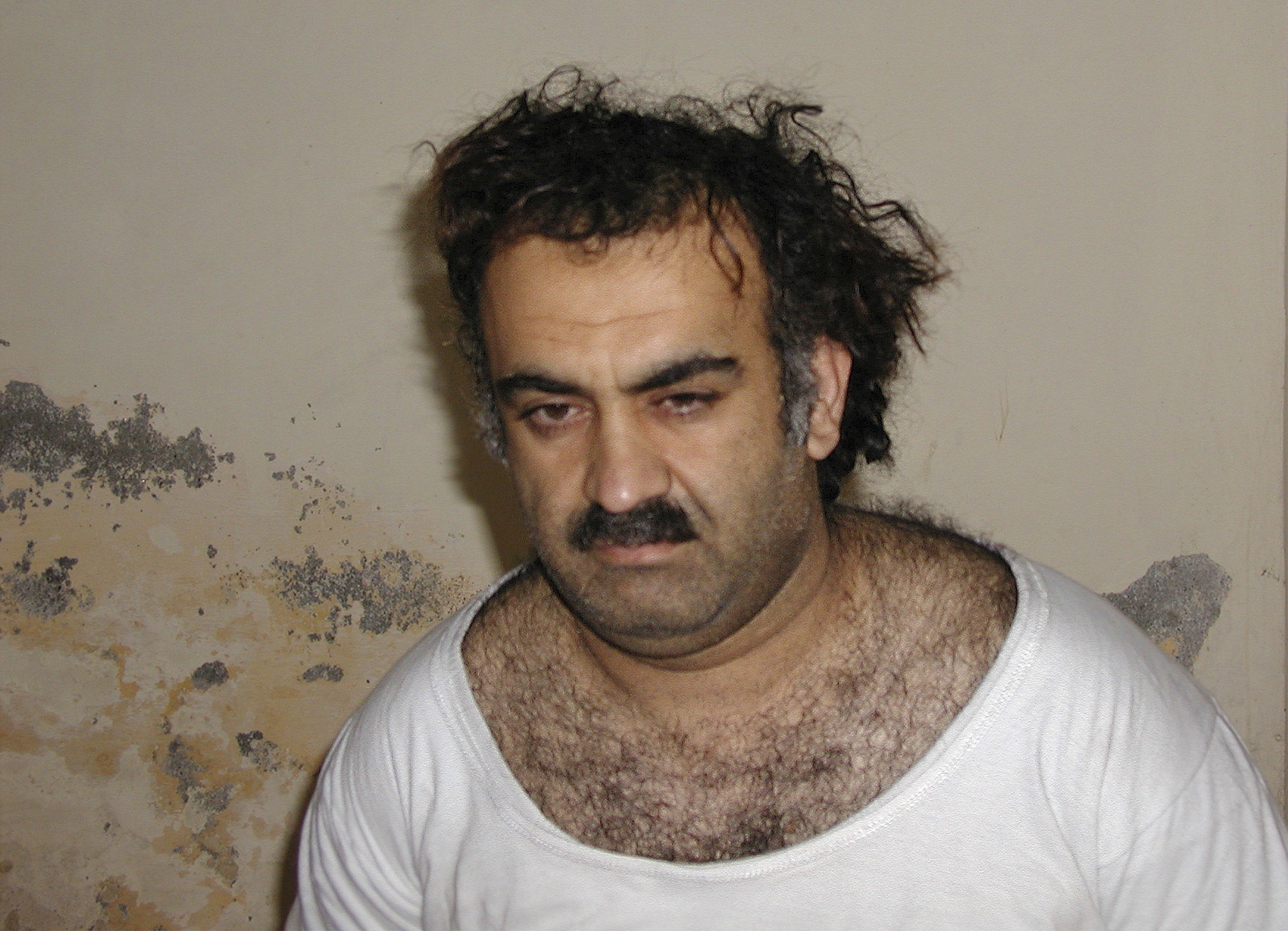

(updated below – Update II)
According to The Associated Press, Eric Holder will announce later today that Khalid Sheikh Mohammed and four other 9/11 defendants will be brought from Guantanamo to New York to stand trial, in a real criminal court, for the crimes they are accused of committing. This is a decision I really wish I could praise, as it’s clearly both politically risky and the right thing to do.
An open criminal trial under our standard system of justice, accompanied by basic precepts of due process, is exactly the just and smart means for punishing those responsible for terrorist attacks. It announces to the world, including the Muslim world, that we have enough faith in our rules of justice to apply them equally to everyone, including to Muslim radicals accused of one of the worst crimes in American history. Numerous family members of the 9/11 victims have long argued that real trials for the accused perpetrators are vital to providing real justice for what was done — I expect to have an interview later today with one of those family members — and holding the trial in New York, the place where 3,000 Americans died, provides particularly compelling symbolism. So this component of the Obama administration’s decision, standing alone, is praiseworthy indeed.
The problem is that this decision does not stand alone. Instead, it is accompanied by this:
Holder will also announce that a major suspect in the bombing of the U.S.S. Cole, Abd al-Rahim al-Nashiri, will face justice before a military commission, as will a handful of other detainees to be identified at the same announcement, the official said.
It was not immediately clear where commission-bound detainees like al-Nashiri might be sent, but a military brig in South Carolina has been high on the list of considered sites.
So what we have here is not an announcement that all terrorism suspects are entitled to real trials in a real American court. Instead, what we have is a multi-tiered justice system, where only certain individuals are entitled to real trials: namely, those whom the Government is convinced ahead of time it can convict. Others for whom conviction is less certain will be accorded lesser due process: put in military commissions, to which most leading Democrats vehemently objected when created under Bush. Presumably, others still — those who the Government believes cannot be convicted in either forum, will simply be held indefinitely with no charges, a power the administration recently announced it intends to preserve based on the same theories used by Bush/Cheney to claim that power.
A system of justice which accords you varying levels of due process based on the certainty that you’ll get just enough to be convicted isn’t a justice system at all. It’s a rigged game of show trials. This is a point I’ve been emphasizing since May, when Obama gave his speech in front of the Constitution at the National Archives and explained how there were five different “categories” of terrorism suspects who would be treated differently based on the category into which they fell:
If you really think about the argument Obama made yesterday — when he described the five categories of detainees and the procedures to which each will be subjected — it becomes manifest just how profound a violation of Western conceptions of justice this is. What Obama is saying is this: we’ll give real trials only to those detainees we know in advance we will convict. For those we don’t think we can convict in a real court, we’ll get convictions in the military commissions I’m creating. For those we can’t convict even in my military commissions, we’ll just imprison them anyway with no charges (“preventively detain” them).
Giving trials to people only when you know for sure, in advance, that you’ll get convictions is not due process. Those are called “show trials.” In a healthy system of justice, the Government gives everyone it wants to imprison a trial and then imprisons only those whom it can convict. The process is constant (trials), and the outcome varies (convictions or acquittals).
Obama is saying the opposite: in his scheme, it is the outcome that is constant (everyone ends up imprisoned), while the process varies and is determined by the Government (trials for some; military commissions for others; indefinite detention for the rest). The Government picks and chooses which process you get in order to ensure that it always wins. A more warped “system of justice” is hard to imagine.
That the Obama DOJ is now explicitly picking and choosing different levels of due process in the very same announcement — we can give that defendant a trial because we know we’ll win, but that one over there needs to go to a military commission because we’re less sure — highlights how manipulative this “justice system” is.
Former Air Force lawyer Morris Davis was the Chief Prosecutor of the Guantanamo Military Commissions system during the Bush years and resigned in 2008 to become one of its leading critics. Although he still believes that military commissions are a viable option for detainees captured on an actual battlefield — and even believes the President has the right to detain terrorism suspects indefinitely with no trial — he made the same point last week in a Wall St. Journal Op-Ed about the practice of picking and choosing the system of justice one receives based on how likely the state is to win:
In a preliminary report submitted to Mr. Obama in July, the Detention Policy Task Force recommended the approval of evaluation criteria developed by the Department of Defense and the Department of Justice. The task force stated its preference for trials in the federal courts, but added the decision would be based in part on “evidentiary issues” and “the extent to which the forum would permit a full presentation of the accused’s wrongful conduct.” A Washington Post editorial endorsed the proposal, arguing that there should be an alternative forum when a trial in federal court is “not an option because the evidence against the accused is strong but not admissible.”
Stop and think about that for a moment. In effect, it means that the standard of justice for each detainee will depend in large part upon the government’s assessment of how high the prosecution’s evidence can jump and which evidentiary bar it can clear.
The evidence likely to clear the high bar gets gold medal justice: a traditional trial in our federal courts. The evidence unable to clear the federal court standard is forced to settle for a military commission trial, a specially created forum that has faltered repeatedly for more than seven years. That is a double standard I suspect we would condemn if it was applied to us. . . .
The problem is trying to have it both ways: the credibility that comes from using federal courts with admissible evidence under the very strict rules of civilian tribunals, and military commissions for cases that are often comparable except for the fact that they depend on evidence (such as hearsay testimony) that is not normally admissible in civilian courts. What if Iran proposed the same for the three American hikers it is currently holding? We would surely condemn what we now stand ready to condone. . . .
Double standards don’t play well in Peoria. They won’t play well in Peshawar or Palembang either. We need to work to change the negative perceptions that exist about Guantanamo and our commitment to the law. Formally establishing a legal double standard will only reinforce them.
Obama is certain to be bombarded with all sorts of right-wing idiocy and fear-mongering as a result of his decision to bring 9/11 defendants into the U.S. in order to give them trials. Doing that is clearly the right thing to do: trials and due process is how civilized countries treat people who are accused of engaging in terrorism. Given how Democrats and Republicans will talk about this decision, media coverage will almost certainly fixate on the narrow question of whether (a) 9/11 defendants should be given trials in the U.S. or (b) we’re all now Endangered because these Omnipotent Monsters are being brought into our communities (in handcuffs, shackles, and maximum-security prisons). The AP article already includes this preview of the inane attacks on Obama certain to come:
It is also a major legal and political test of Obama’s overall approach to terrorism. If the case suffers legal setbacks, the administration will face second-guessing from those who never wanted it in a civilian courtroom. And if lawmakers get upset about notorious terrorists being brought to their home regions, they may fight back against other parts of Obama’s agenda.
In a just-posted New York Times article, Charlie Savage also notes that bringing an accused terrorist of Mohammed’s notoriety to the U.S. for trial is unprecedented and likely to provoke intense political controversy. In that “debate,” I’m squarely on Obama’s side, as is any person who believes in the most basic Constitutional precepts.
But the more consequential impact of Obama’s decision is likely to be overlooked: we’re now formally creating a multi-tiered justice system for accused Muslim terrorists where they only get the level of due process consistent with the State’s certainty that it will win. Mohammed gets a real trial because he confessed and we’re thus certain we can win in court; since we’re less certain about al-Nashiri, he’ll be denied a trial and will only get a military commission; others will be denied any process entirely and imprisoned indefinitely. The outcome is pre-determined and the process then shaped to assure it ahead of time, thus perfectly adhering to this exchange from Chapter 12 of Alice in Wonderland:
“Let the jury consider their verdict,” the King said, for about the twentieth time that day.
“No, no!” said the Queen. “Sentence first — verdict afterward.”
“Stuff and nonsense!” said Alice loudly. “The idea of having the sentence first!”
“Hold your tongue!” said the Queen, turning purple.
“I won’t!” said Alice.
“Off with her head!” the Queen shouted at the top of her voice.
How is that remotely just or fair under any definition of those terms? As Davis wrote: ”We need to work to change the negative perceptions that exist about Guantanamo and our commitment to the law. Formally establishing a legal double standard will only reinforce them.” There’s nothing ”pragmatic” or “moderate” about creating a multi-tiered justice system where only some people get trials; it’s both counter-productive and profoundly unjust.
UPDATE: Omar Khadr — the Canadian “child soldier” imprisoned at Guantanamo for the last seven years, since he was 15 years old, for allegedly throwing a grenade at an American soldier in Afghanistan (that’s apparently “terrorism”) and the subject of a difficult-to-watch video of him weeping like the child he is while being interrogated — will reportedly be one of those denied a trial and instead allowed only a military commission, according to Canada’s Canwest News Service (h/t sysprog):
Canadian-born terror suspect Omar Khadr faces continued prosecution in the U.S. military tribunal established in Guantanamo Bay, Cuba. . . .
The federal system offers the full panoply of defendant rights available to U.S. citizens under the U.S. Constitution, while civil rights groups have argued the military commissions at the U.S. naval base in Cuba do not meet that standard.
The decision regarding Khadr means that the Obama administration has, for now at least, rejected calls by his U.S. and Canadian defence teams for the repatriation of the Canadian-born terror suspect” . . . My view is, he should be prosecuted,” said navy Capt. John Murphy, chief prosecutor in the military commissions system.
So even for 15-year-olds who we imprison for seven years with no charges, we refuse to give them a trial. And note how the Canadian press account stresses our multi-tiered system of justice and how their citizen is receiving second-tier due process — an observation that one can be sure will repeat itself worldwide.
UPDATE II: In his Press Release, Eric Holder says his decisions today were “based on a protocol that the Departments of Justice and Defense developed” whereby he “looked at all the relevant factors and made case by case decisions for each detainee.” In other words, there’s no categorical determination driving the process (e.g., all those who attack military targets get commissions and all those who attack civilian targets get trials). To the contrary, federal prosecutors choose, in their sole discretion, the level of due process each defendant gets (including ”none” – as in: indefinite detention with no trial), and Holder himself emphasized that “it is important that we be able to use every forum possible to hold terrorists accountable for their actions.”
There’s supposed to be one justice system for everyone — not multiple ones from which prosecutors can pick and choose based on assurances of ongoing imprisonment. Highlighting how dangerous this is, the DOJ’s investigation of al-Nashiri was originally classified as a standard criminal case, but — as his counsel pointed out today — he was assigned to a military commission because there simply isn’t sufficient evidence to convict him in a real court.
Vividly illustrating the perverse mentality behind all of this, here’s a question asked today of President Obama by AP’s Jennifer Loven:
President Obama, how can you assure the American people that a trial of Khalid Sheikh Mohammed, now that your administration has now decided will take place in a civilian court in New York, will be safe and secure, but also not result in an innocent verdict for him?
Apparently, we’re only supposed to give trials to people if we can assure in advance that it won’t ”result in an innocent verdict.” Jennifer Loven — and many of her media colleagues — seems to yearn for the U.S. to be a lot more like North Korea.
And for those of you who favor what Obama did today, I have two questions: (1) are you in favor of allowing serial murderers and child rapists to go free if the evidence against them is “tainted,” or should special commissions be created to ensure their conviction, too; and (2) did you defend the Bush administration’s use of military commissions on the same grounds that you’re defending Obama today?
