
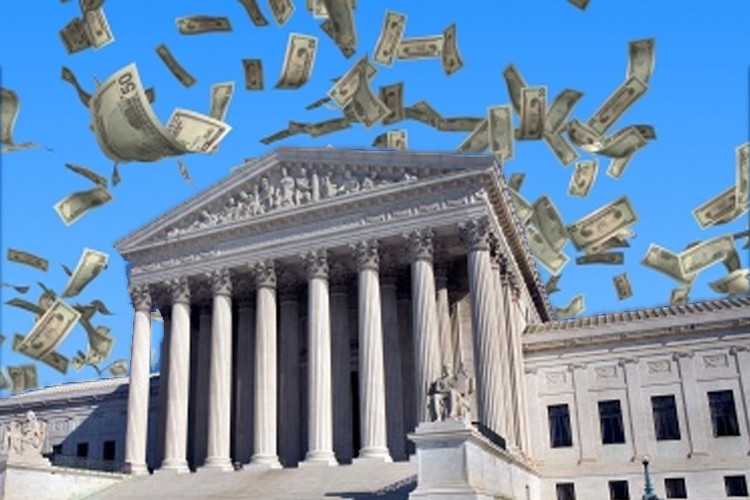

(updated below – Update II – Update III)
The Supreme Court yesterday, in a 5-4 decision, declared unconstitutional (on First Amendment grounds) campaign finance regulations which restrict the ability of corporations and unions to use funds from their general treasury for “electioneering” purposes. The case, Citizens United v. FEC, presents some very difficult free speech questions, and I’m deeply ambivalent about the court’s ruling. There are several dubious aspects of the majority’s opinion (principally its decision to invalidate the entire campaign finance scheme rather than exercising ”judicial restraint” through a narrower holding). Beyond that, I believe that corporate influence over our political process is easily one of the top sicknesses afflicting our political culture. But there are also very real First Amendment interests implicated by laws which bar entities from spending money to express political viewpoints.
I want to begin by examining several of the most common reactions among critics of this decision, none of which seems persuasive to me. Critics emphasize that the Court’s ruling will produce very bad outcomes: primarily that it will severely exacerbate the problem of corporate influence in our democracy. Even if this is true, it’s not really relevant. Either the First Amendment allows these speech restrictions or it doesn’t. In general, a law that violates the Constitution can’t be upheld because the law produces good outcomes (or because its invalidation would produce bad outcomes).
One of the central lessons of the Bush era should have been that illegal or unconstitutional actions — warrantless eavesdropping, torture, unilateral Presidential programs — can’t be justified because of the allegedly good results they produce (Protecting us from the Terrorists). The “rule of law” means we faithfully apply it in ways that produce outcomes we like and outcomes we don’t like. Denouncing court rulings because they invalidate laws one likes is what the Right often does (see how they reflexively and immediately protest every state court ruling invaliding opposite-sex-only marriage laws without bothering to even read about the binding precedents), and that behavior is irrational in the extreme. If the Constitution or other laws bar the government action in question, then that’s the end of the inquiry; whether those actions produce good results is really not germane. Thus, those who want to object to the Court’s ruling need to do so on First Amendment grounds. Except to the extent that some constitutional rights give way to so-called “compelling state interests,” that the Court’s decision will produce “bad results” is not really an argument.
More specifically, it’s often the case that banning certain kinds of speech would produce good outcomes, and conversely, allowing certain kinds of speech produces bad outcomes (that’s true for, say, White Supremacist or neo-Nazi speech, or speech advocating violence against civilians). The First Amendment is not and never has been outcome-dependent; the Government is barred from restricting speech — especially political speech — no matter the good results that would result from the restrictions. That’s the price we pay for having the liberty of free speech. And even on a utilitarian level, the long-term dangers of allowing the Government to restrict political speech invariably outweigh whatever benefits accrue from such restrictions.
I’m also quite skeptical of the apocalyptic claims about how this decision will radically transform and subvert our democracy by empowering corporate control over the political process. My skepticism is due to one principal fact: I really don’t see how things can get much worse in that regard. The reality is that our political institutions are already completely beholden to and controlled by large corporate interests (Dick Durbin: ”banks own” the Congress). Corporations find endless ways to circumvent current restrictions — their armies of PACs, lobbyists, media control, and revolving-door rewards flood Washington and currently ensure their stranglehold — and while this decision will make things marginally worse, I can’t imagine how it could worsen fundamentally. All of the hand-wringing sounds to me like someone expressing serious worry that a new law in North Korea will make the country more tyrannical. There’s not much room for our corporatist political system to get more corporatist. Does anyone believe that the ability of corporations to influence our political process was meaningfully limited before yesterday’s issuance of this ruling?
I’m even more unpersuaded by the argument — seen in today’s New York Times Editorial — that this decision will “ensure that Republican candidates will be at an enormous advantage in future elections.” What evidence is there for that? Over the past five years, corporate money has poured far more into the coffers of the Democratic Party than the GOP — and far more into Obama’s campaign coffers than McCain’s (especially from Wall Street). If anything, unlimited corporate money will be far more likely to strengthen incumbents than either of the two parties (and unlimited union spending, though dwarfed by corporate spending, will obviously benefit Democrats more). Besides, if it were the case that this law restricts the ability of Republicans far more than Democrats to raise money in election cycles, doesn’t that rather obviously intensify the First Amendment concerns?
Then there’s the always intellectually confused discussions of stare decisis and precedent. It’s absolutely true that the Citizens United majority cavalierly tossed aside decades of judicial opinions upholding the constitutionality of campaign finance restrictions. But what does that prove? Several of the liberals’ most cherished Supreme Court decisions did the same (Brown v. Bd. of Education rejected Plessy v. Ferguson; Lawrence v. Texas overruled Bowers v. Hardwick, etc.). Beyond that, the central principle which critics of this ruling find most offensive — that corporations possess “personhood” and are thus entitled to Constitutional (and First Amendment) rights — has also been affirmed by decades of Supreme Court jurisprudence; tossing that principle aside would require deviating from stare decisis every bit as much as the majority did here. If a settled proposition of law is sufficiently repugnant to the Constitution, then the Court is not only permitted, but required, to uproot it.
Ultimately, I think the free speech rights burdened by campaign finance laws are often significantly under-stated. I understand and sympathize with the argument that corporations are creatures of the state and should not enjoy the same rights as individuals. And one can’t help but note the vile irony that Muslim “War on Terror” detainees have been essentially declared by some courts not to be “persons” under the Constitution, whereas corporations are.
But the speech restrictions struck down by Citizens United do not only apply to Exxon and Halliburton; they also apply to non-profit advocacy corporations, such as, say, the ACLU and Planned Parenthood, as well as labor unions, which are genuinely burdened in their ability to express their views by these laws. I tend to take a more absolutist view of the First Amendment than many people, but laws which prohibit organized groups of people — which is what corporations are — from expressing political views goes right to the heart of free speech guarantees no matter how the First Amendment is understood. Does anyone doubt that the facts that gave rise to this case — namely, the government’s banning the release of a critical film about Hillary Clinton by Citizens United — is exactly what the First Amendment was designed to avoid? And does anyone doubt that the First Amendment bars the government from restricting the speech of organizations composed of like-minded citizens who band together in corporate form to work for a particular cause?
What is overlooked in virtually every discussion I’ve seen over the last 24 hours is how ineffective these campaign finance laws are. Large corporations employ teams of lawyers and lobbyists and easily circumvent these restrictions; wealthy individuals and well-funded unincorporated organizations are unlimited in what they can spend. It’s the smaller non-profit advocacy groups whose political speech tends to be most burdened by these laws. Campaign finance laws are a bit like gun control statutes: actual criminals continue to possess large stockpiles of weapons, but law-abiding citizens are disarmed.
In sum, there’s no question that the stranglehold corporations exert on our democracy is one of the most serious and pressing threats we face. I’ve written volumes on that very problem. Although I doubt it, this decision may very well worsen that problem in some substantial way. But on both pragmatic and Constitutional grounds, the issue of corporate influence — like virtually all issues — is not really solvable by restrictions on political speech. Isn’t it far more promising to have the Government try to equalize the playing field through serious public financing of campaigns than to try to slink around the First Amendment — or, worse, amend it — in order to limit political advocacy?
There are few features that are still extremely healthy and vibrant in the American political system; the First Amendment is one of them, and the last thing we should want is Congress trying to limit it through amendments or otherwise circumvent it in the name of elevating our elections. Meaningful public financing of campaigns would far more effectively achieve the ostensible objectives of campaign finance restrictions without any of the dangers or constitutional infirmities. If yesterday’s decision provides the impetus for that to be done, then it will have, on balance, achieved a very positive outcome, even though that was plainly not its intent.
UPDATE: I want to add one other point just to underscore how irrational, discriminatory and ineffective these political speech restrictions are. The invalidated statute at issue here exempted media corporations — such as Fox and MSNBC — from these restrictions, since the Government obviously can’t ban media figures from going on television and opining on elections (the way they do all other corporations). But as Eliot Spitzer noted when urging the Supreme Court to strike down this law (h/t David Sirota), what possible justification is there for allowing News Corp. and GE to say whatever they want about our elections while banning all other corporations (including non-profit advocacy groups) from doing so?
As an elected official who often tangled with wealthy corporations, I recognize that there is a superficial appeal in the prospect of being able to silence their political voices. Of course that is precisely why the First Amendment protects them and why I find myself sympathetic to the First Amendment absolutists in this case. What distinguishes what Citizens United did and what Bill O’Reilly on Fox News — Rachel Maddow on MSNBC — does every day? Fox and MSNBC are corporations bombarding the airwaves with political rhetoric, from the right and left, that is as close to “electioneering communications” as anything I can imagine. The McCain-Feingold statute excluded “media companies” from its limitations, a distinction that makes no logical sense. The constitutionality of Citizens United’s speech should have nothing to do with what else may or may not go on at the corporation it is part of.
That’s what restrictions on political speech almost always do: whether intended or not, they favor the views of certain factions while suppressing others. In this case, it allowed the views of News Corp., GE, and Viacom to flourish (through their ownership of media outlets) while preventing the ACLU and Planned Parenthood from speaking out. As Spitzer said: that is precisely why the First Amendment bars such government efforts to restrict political speech. It is virtually always best — and Constitutionally mandated — for the Government to stay out of the business of trying to restrict and regulate political advocacy.
UPDATE II: For those who believe that “money is not speech,” I’d be interested in your answers to these questions.
As for the question of whether corporations possess “personhood,” that’s an interesting issue and, as I said, I’m very sympathetic to the argument that they do not, but the majority’s ruling here did not really turn on that question. That’s because the First Amendment does not only vest rights in “persons.” It says nothing about “persons.” It simply bans Congress from making any laws abridging freedom of speech.
UPDATE III: A follow-up to the comment section discussion is here.
