

A newly leaked CIA report prepared earlier this month (.pdf) analyzes how the U.S. Government can best manipulate public opinion in Germany and France — in order to ensure that those countries continue to fight in Afghanistan. The Report celebrates the fact that the governments of those two nations continue to fight the war in defiance of overwhelming public opinion which opposes it — so much for all the recent veneration of “consent of the governed” — and it notes that this is possible due to lack of interest among their citizenry: “Public Apathy Enables Leaders to Ignore Voters,” proclaims the title of one section.
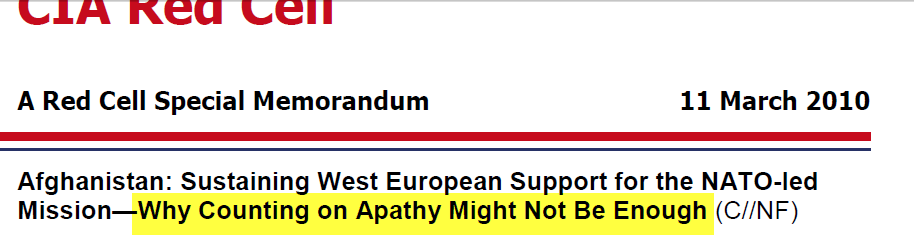
But the Report also cites the “fall of the Dutch Government over its troop commitment to Afghanistan” and worries that — particularly if the “bloody summer in Afghanistan” that many predict takes place — what happened to the Dutch will spread as a result of the “fragility of European support” for the war. As the truly creepy Report title puts it, the CIA’s concern is: “Why Counting on Apathy May Not Be Enough”:
The Report seeks to provide a back-up plan for “counting on apathy,” and provides ways that the U.S. Government can manipulate public opinion in these foreign countries. It explains that French sympathy for Afghan refugees means that exploiting Afghan women as pro-war messengers would be effective, while Germans would be more vulnerable to a fear-mongering campaign (failure in Afghanistan means the Terrorists will get you). The Report highlights the unique ability of Barack Obama to sell war to European populations (click on images to enlarge):

It’s both interesting and revealing that the CIA sees Obama as a valuable asset in putting a pretty face on our wars in the eyes of foreign populations. It is odious — though, of course, completely unsurprising — that the CIA plots ways to manipulate public opinion in foreign countries in order to sustain support for our wars. Now that this is a Democratic administration doing this and a Democratic war at issue, I doubt many people will object to any of this. But what is worth noting is how and why this classified Report was made publicly available: because it was leaked to and then posted by WikiLeaks.org, the site run by the non-profit group Sunshine Press, that is devoted to exposing suppressed government and corporate corruption by publicizing many of their most closely guarded secrets.
* * * * *
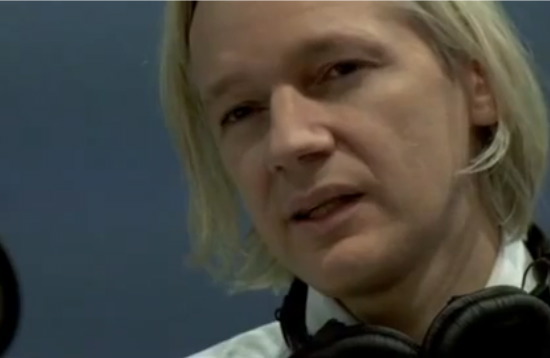
 I spoke this morning at length with Julian Assange, the Australian citizen who is WikiLeaks’ Editor, regarding the increasingly aggressive war being waged against WikiLeaks by numerous government agencies, including the Pentagon. Over the past several years, WikiLeaks — which aptly calls itself “the intelligence agency of the people” — has obtained and then published a wide array of secret, incriminating documents (similar to this CIA Report) that expose the activities of numerous governments and corporations. Among many others, they posted the Standard Operating Manual for Guantanamo, documents showing how corrupt offshore loans precipitated the economic collapse in Iceland, the notorious emails between climate scientists, documents showing toxic dumping off the coast of Africa, and many others. They have recently come into possession of classified videos relating to civilian causalities under the command of Gen. David Petraeus, as well as documentation relating to civilian-slaughtering airstrikes in Afghanistan which the U.S. military had agreed to release, only to change their mind.
All of this has made WikiLeaks an increasingly hated target of numerous government and economic elites around the world, including the U.S. Government. As The New York Times put it last week: ”To the list of the enemies threatening the security of the United States, the Pentagon has added WikiLeaks.org, a tiny online source of information and documents that governments and corporations around the world would prefer to keep secret.” In 2008, the U.S. Army Counterintelligence Center prepared a secret report — obtained and posted by WikiLeaks — devoted to this website and detailing, in a section entitled “Is it Free Speech or Illegal Speech?”, ways it would seek to destroy the organization. It discusses the possibility that, for some governments, not merely contributing to WikiLeaks, but “even accessing the website itself is a crime,” and outlines its proposal for WikiLeaks’ destruction as follows (click on images to enlarge):

As the Pentagon report put it: “the governments of China, Israel, North Korea, Russia, Vietnam and Zimbabwe” have all sought to block access to or otherwise impede the operations of WikiLeaks, and the U.S. Government now joins that illustrious list of transparency-loving countries in targeting them.
It’s not difficult to understand why the Pentagon wants to destroy WikiLeaks. Here’s how the Pentagon’s report describes some of the disclosures for which they are responsible: 
The Pentagon report also claims that WikiLeaks has disclosed documents that could expose U.S. military plans in Afghanistan and Iraq and endanger the military mission, though its discussion is purely hypothetical and no specifics are provided. Instead, the bulk of the Pentagon report focuses on documents which embarrass the U.S. Government: information which, as they put it, “could be manipulated to provide biased news reports or be used for conducting propaganda, disinformation, misinformation, perception management, or influence operations against the U.S. Army by a variety of domestic and foreign actors.” In other words, the Pentagon is furious that this exposing of its secrets might enable others to engage in exactly the type of “perception management” which the aforementioned CIA Report proposes the U.S. do with regard to the citizenry of our allied countries.
All of this is based in the same rationale invoked by President Obama and the Democratic Congress when they re-wrote the Freedom of Information Act last year in order to suppress America’s torture photos. It’s the same rationale used by all governments to conceal evidence of their wrongdoing: we need to suppress our activities for your own good. WikiLeaks is devoted to subverting that mentality and, relatively speaking, has been quite successful in doing so.
For that reason, numerous governments and private groups would like to see them destroyed. Corporations have sued to have the site shut down. And in addition to this 2008 Pentagon report, WikiLeaks has acquired, though not yet posted, other U.S. Government classified reports on its activities, including a U.S. Marine Intelligence Report and an analysis prepared by the U.S. military base in Germany, both of which speak of WikiLeaks as a threat. Moreover, the FBI has refused to provide any information about its investigations and other activities aimed at WikiLeaks, citing, in response to FOIA requests, national security and other excuses for concealing it.
* * * * *
In my interview this morning with Assange, he described multiple incidents that clearly signal a recent escalation of surveillance and other forms of harassment directed at WikiLeaks. Many of those events are detailed in an Editorial they just published, which, he explained, was part of an effort to publicize what is being done to them in order to provide some safety and buffer. A good summary of those events is provided by Gawker. As but one disturbing incident: a volunteer, a minor, who works with WikiLeaks was detained in Iceland last week and questioned extensively about an incriminating video WikiLeaks possesses relating to the actions of the U.S. military. During the course of the interrogation, the WikiLeaks volunteer was not only asked questions about the video based on non-public knowledge about its contents (i.e., information which only the U.S. military would have), but was also shown surveillance photos of Assange exiting a recent WikiLeaks meeting regarding the imminent posting of documents concerning the Pentagon.
That WikiLeaks is being targeted by the U.S. Government for surveillance and disruption is beyond doubt. And it underscores how vital their work is and why it’s such a threat.
WikiLeaks editors, including Assagne, have spent substantial time of late in Iceland because there is a pending bill in that country’s Parliament that would provide meaningful whistle blower protection for what they do, far greater than exists anywhere else. Why is Iceland a leading candidate to do that? Because, last year, that nation suffered full-scale economic collapse. It was then revealed that numerous nefarious causes (corrupt loans, off-shore transactions, concealed warning signs) were hidden completely from the public and even from policy-makers, preventing detection and avoidance. Worse, most of Iceland’s institutions — from its media to its legislative and regulatory bodies — completely failed to penetrate this wall of secrecy, allowing this corruption to fester until it brought about full-scale financial ruin. As a result, Iceland has become very receptive to the fact that the type of investigative exposure provided by WikiLeaks is a vital national good, and there is real political will to provide it with substantial protections.
If that doesn’t sound familiar to Americans, it should. At exactly the time when U.S. government secrecy is at an all-time high, the institutions ostensibly responsible for investigation, oversight and exposure have failed. The American media are largely co-opted, and their few remaining vestiges of real investigative journalism are crippled by financial constraints. The U.S. Congress is almost entirely impotent at providing meaningful oversight and is, in any event, controlled by the factions that maintain virtually complete secrecy. As I’ve documented before, some alternative means of investigative journalism have arisen — such as the ACLU’s tenacious FOIA litigations to pry documents showing “War on Terror” abuses and the reams of bloggers who sort through, analyze and publicize them — but that’s no match for the vast secrecy powers of the government and private corporations.
The need for independent leaks and whistle-blowing exposures is particularly acute now because, at exactly the same time that investigative journalism has collapsed, public and private efforts to manipulate public opinion have proliferated. This is exemplified by the type of public opinion management campaign detailed by the above-referenced CIA Report, the Pentagon’s TV propaganda program exposed in 2008, and the ways in which private interests covertly pay and control supposedly “independent political commentators” to participate in our public debates and shape public opinion.
Last month, I was on a panel at the New School’s Conference on how information is controlled in a democracy, and also on the panel were Daniel Ellsberg, who risked his liberty to leak the Pentagon Papers, and The New York Times‘ David Barstow, who won the Pulitzer Prize for exposing the Pentagon’s propaganda program. Ellsberg described how massive is the apparatus of secrecy in the National Security State, and Barstow made the vital point — which I summarized in the clip below when speaking later that day at NYU Law School — that the public and private means for manipulating public opinion are rapidly increasing at exactly the same time that checks on secrecy (such as investigative journalism) are vanishing:
Aside from the handful of organizations (the ACLU, the NYT) with the resources and will to engage in protracted FOIA litigations against the government, one of the last avenues to uncover government and other elite secrets are whistle blowers and organizations that enable them. WikiLeaks is one of the world’s most effective such groups, and it’s thus no surprise that they’re under such sustained attacks.
This is how Assange put it to me this morning in explaining why he believes his organization’s activities are so vital and why he’s willing to make himself a target in order to do it:
This information has reform potential. And the information which is concealed or suppressed is concealed or suppressed because the people who know it best understand that it has the ability to reform. So they engage in work to prevent that reform . . . .
There are reasons I do it that have to do with wanting to reform civilization, and selectively targeting information will do that — understanding that quality information is what every decision is based on, and all the decisions taken together is what “civilization” is, so if you want to improve civilization, you have to remove some of the basic constraints, which is the quality of information that civilization has at its disposal to make decisions. Of course, there’s a personal psychology to it, that I enjoy crushing bastards, I like a good challenge, so do a lot of the other people involved in WikiLeaks. We like the challenge.
The public and private organizations most eager to maintain complete secrecy around what they do — including numerous U.S. military and intelligence agencies — are obviously threatened by WikiLeaks’ activities, which is why they seek to harass and cripple them. There are numerous ways one can support WikiLeaks — donations, volunteer work, research, legal and technical assistance — and that can be done through their site. There aren’t many groups more besieged, or doing more important work, than they.
