
Global Warming
How to connect mining disasters and climate change
Massey Energy's CEO has a long record of pushing coal production at the expense of both workers and the world
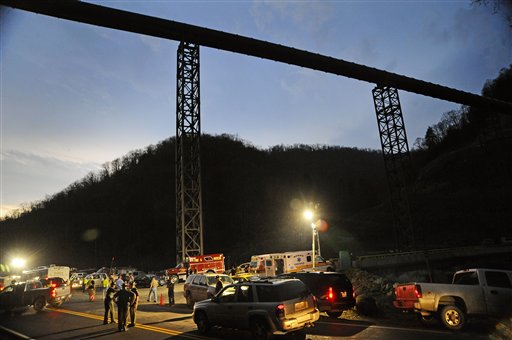
West Virginia State Police direct traffic at the entrance to Massey Energy's Upper Big Branch Coal Mine Monday, April 5, 2010 in Montcoal, W.Va. (AP Photo/Jeff Gentner)(Credit: AP) Immediately following the West Virginia coal mine disaster that killed — so far — 25 miners, the owner of the mine, Massey Energy, released a statement from CEO Don Blankenship that included the following sentence:
“Our top priority is the safety of our miners and the well-being of their families.”
Some residents of Central Appalachia could be excused for scoffing. As the L.A. Times reports, federal officials have “repeatedly cited” Massey for safety violations. In 2009, reports the New York Times, the mine registered 458 violations.
And then there’s the famous memo sent by Blankenship in October 2005 to all “Deep Mine Superintendents.”
SUBJECT: RUNNING COAL
If you have been asked by your group presidents, supervisors, engineers, to do anything else other than to run coal (i.e. – build overcasts, do construction jobs, or whatever) you need to ignore them and run coal. This memo is necessary only because we seem not to understand that the coal pays the bills.
Mine “overcasts” are critical to proper mine ventilation, and for many miners, Blankenship’s memo made it abundantly clear exactly what Massey’s “top priority” was, and is.
But it’s no news to anyone that the mining industry has historically resisted regulatory efforts that would increase safety but potentially reduce profits. Massey, as one of the nation’s largest coal operators, is a flash point of concern for this classic dynamic, but no different in principle from any other corporation that cuts corners in pursuit of profit.
But what might be more interesting is to connect the dots between Massey’s safety record, and CEO Blankenship’s positions on energy policy and climate change.
Blankenship has a Twitter account. He hasn’t tweeted in the last week, but it’s the real thing, and prior to late March, he, or someone acting on his behalf, was fairly active, addressing “issues broadly affecting the American economy, worker (sic) and environment.”
Here’s his last tweet, from March 26:
Here’s a list of 22 Senator who support higher taxes, higher electric bills and fewer American jobs. http://qorv.is/feb
If you follow that link you will find a letter addressed to Senate Majority Leader Harry Reid, signed by 22 senators, calling for “comprehensive clean energy and climate legislation this year with a renewed focus on jobs and reduced dependence on foreign oil.”
And so it goes. Judging from his tweets, Don Blankenship doesn’t believe humans are contributing to global warming — or even that global warming is happening. His tweet-stream offers a steady flow of climate skeptic talking points and slaps at Al Gore or any politician who supports cap-and-trade. His suggestion for encouraging job growth is to grant more mining permits. (Massey, incidentally, is a leader in the practice of mountaintop removal coal mining.)
Actually, I don’t know what Blankenship really believes. But Massey’s safety record and its CEO’s position on energy policy both intersect at one point — anything that threatens the profitability of “running coal” must be opposed, whether that’s the science of climate change or building the appropriate number of mine overcasts.
Environmentalists are often criticized by conservatives for embracing the science of climate change because it fits neatly with their ideological positions on conservation and sustainability. I think there is certainly some truth to that. But I’d argue that there is even more truth to the opposite position: Energy company executives and the politicians who carry their water reject science and oppose energy legislation because it conflicts with their ideological belief that anything that interferes with private profit-making is evil government intrustion.
The wonder of Massey’s Don Blankenship is how consistent he is. Whether the problem is properly ventilating a mine, or keeping the entire atmosphere of the globe stable, he’s sticking to his guns. If it will hurt his bottom dollar, he’s opposed.
Andrew Leonard is a staff writer at Salon. On Twitter, @koxinga21. More Andrew Leonard.
Republican climate folly
As temperatures break records, the GOP holds firm: The less we know about global warming, the better
Frank Gehrke, chief of snow surveys for the Department of Water Resources, stands in a snow-free meadow at Echo Summit, Calif. Warm spring weather, combined with lower then normal precipitation, caused the statewide snowpack water content to be only 40 percent of normal for this time of year. (Credit: AP/Rich Pedroncelli) Whatever adjective you choose — ironic? tragic? ludicrous? — the outcome of a series of budget votes held in the GOP-controlled House on Tuesday was definitely interesting. The chamber was wrangling over a series of amendments to an appropriations bill for the Departments of Commerce and Justice. The battle line was drawn between senior Republicans trying to resist further spending cuts, and young Turks looking to slash and burn.
In every case but one, the senior Republicans (with the help of Democrats) proved victorious. The lone exception? An amendment proposed by Maryland’s Andy Harris, cutting $542,000 in funding for a climate website at the National Oceanic and Atmospheric Administration.
Continue Reading Close
Andrew Leonard is a staff writer at Salon. On Twitter, @koxinga21. More Andrew Leonard.
Global warming hits home
After a year of freakish and destructive weather, Americans are finally waking up to the dangers of climate change
Houses were severely damaged after Hurricane Irene came through Bethel, Vt. on August 28, 2011 (Credit: U. S. Fish and Wildlife Service - Northeast Region / CC BY 2.0) The Williams River was so languid and lovely last Saturday morning that it was almost impossible to imagine the violence with which it must have been running on August 28, 2011. And yet the evidence was all around: sand piled high on its banks, trees still scattered as if by a giant’s fist, and most obvious of all, a utilitarian temporary bridge where for 140 years a graceful covered bridge had spanned the water.
The YouTube video of that bridge crashing into the raging river was Vermont’s iconic image from its worst disaster in memory, the record flooding that followed Hurricane Irene’s rampage through the state in August 2011. It claimed dozens of lives, as it cut more than a billion-dollar swath of destruction across the eastern United States.
Continue Reading CloseBill McKibben is the Schumann Distinguished Scholar at Middlebury College, and founder of the global climate campaign 350.org. His latest book is "Eaarth: Making a Life on a Tough New Planet.". More Bill McKibben.
Every country for itself
As American power wanes, we're being faced with a dangerous new power vacuum. An expert explains what's next
For the first time in nearly a century, the world doesn’t have a clear set of leaders. A generation ago, the G-7 – France, Germany, Italy, Japan, United Kingdom, United States and Canada – not only powered the global economy, they also, for better or worse, made the decisions that determined the outcome of the entire world. But over the last several years, the dynamic has changed.
According to a widely discussed 2010 report by London’s Standard Chartered Bank, the world has entered a new “‘super-cycle” in which traditional economic hierarchies are being upended. Ever since the financial crisis, the U.S. has lost the economic strength and force of will to be the world’s policeman. The number of Americans, for example, who believe the U.S. should “mind its own business internationally” has spiked to a level unseen since the 1950s. Meanwhile, new powers, like China, India and Brazil, have been unwilling to fill the power vacuum the U.S. has left behind. One could argue that this is a nice change from America’s aggressive past interventionism, but it has also helped create the global stalemate on everything from global warming to humanitarianism in Syria. And it’s a fact that has the potential to radically affect our future, both in positive and negative ways.
Continue Reading Close
Thomas Rogers is Salon's Arts Editor. More Thomas Rogers.
The Maldives’ ousted president on climate change and tyranny
Ousted in a February coup, Mohamed Nasheed talks global warming, Islamic radicals and "The Island President"
Mohamed Nasheed in "The Island President" It would be too optimistic to claim that the 2009 Copenhagen Summit represented a breakthrough or turning point in the battle against climate change. But it was the first moment when the United States, China and India — the world’s biggest polluters — all agreed in principle to reduce carbon emissions, and as symbolic statements go, that one was pretty big. Copenhagen also catapulted a most unlikely head of state to pop-star status, at least within the worldwide environmental movement. Mohamed Nasheed, who was then the president of the Maldives — Asia’s smallest country, both in area and population — emerged as the developing world’s most charismatic and dynamic spokesman on the causes, and the costs, of global warming.
Continue Reading CloseThe ugly delusions of the educated conservative
Better-educated Republicans are more likely to doubt global warming and believe Obama's a Muslim. Here's why
(Credit: AP Photo/Ross D. Franklin) I can still remember when I first realized how naïve I was in thinking—hoping—that laying out the “facts” would suffice to change politicized minds, and especially Republican ones. It was a typically wonkish, liberal revelation: One based on statistics and data. Only this time, the data were showing, rather awkwardly, that people ignore data and evidence—and often, knowledge and education only make the problem worse.
Someone had sent me a 2008 Pew report documenting the intense partisan divide in the U.S. over the reality of global warming.. It’s a divide that, maddeningly for scientists, has shown a paradoxical tendency to widen even as the basic facts about global warming have become more firmly established.
Chris Mooney is the author of four books, including "The Republican War on Science" (2005). His next book, "The Republican Brain: The Science of Why They Deny Science—and Reality," is due out in April. More Chris Mooney.
Page 1 of 107 in Global Warming