
Afghanistan
War propaganda from Afghanistan
The Battle of Kandahar is billed as "make-or-break," just like the Battle of Marjah was a mere two months ago
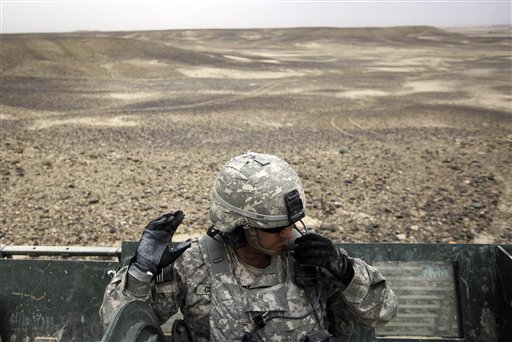
In this April 26, 2010, photo, U.S. Army Lt. David Cummings, of Raleigh, N.C., talks on the radio with soldiers from his platoon while out patrolling areas off of Highway 1 with A Troop, 2nd Battalion, 1st Infantry Regiment, 5th Stryker Brigade in the Kandahar province of Afghanistan. The American-led effort to wrest control of southern Afghanistan is off to a slow start and the political clock is ticking as U.S. troops head into what could be the bloodiest fight yet in the eight-year war. (AP Photo/Julie Jacobson)(Credit: AP) The New York Times yesterday excitedly declared that the imminent Battle of Kandahar “has become the make-or-break offensive of the eight-and-half-year [Afghanistan] war” and is “the pivotal test of President Obama’s Afghanistan strategy.” As Atrios suggests, there never is any such thing as “make-or-break” because we never leave no matter how completely our war and occupation efforts fail. That’s what led to the countless Friedman Units of the Iraq War: the endless proclamations that The Next Six Months will be Decisive, only to be repeated at the end of the six-month period of failure as though the prior one never happened.
Just consider what’s being said now about how the Kandahar offensive is the “make-or-break” battle of the war and the “pivotal test” for Obama’s war strategy by comparing it to what was said a mere two months ago about the now clearly failing assault on Marjah:
Times of London, February 13, 2010:
Allied troops launched a major offensive into Afghanistan’s most violent province last night, in a key part of President Obama’s push to seize control of the Taleban’s last big stronghold. . . . If it fails, many analysts believe that the war will be lost.
The Independent declared on February 9, 2010, that General McChrystal wants the Marjah offensive to “be one of the most significant in the country since the fall of the Taliban in 2001″ and, of Obama’s war strategy, said that “Marjah looks like being its first major — and possibly decisive — test.” The BBC quoted a NATO official who proclaimed that Marjah “was ‘probably the definitive operation’ of the counter-insurgency strategy” and “this operation could potentially define the tipping point, the crucial momentum aspect in the counter-insurgency.” Time helpfully informed us that “U.S. officials believe it will mark a turning point in the war.”
Now that that “make-or-break decisive test” has failed (or, at best, has produced very muddled outcomes), did the Government and media follow through and declare the war effort broken and the strategy a failure? No; they just pretend it never happened and declare the next, latest, glorious Battle the real “make-or-break decisive test” – until that one fails and the next one is portrayed that way, in an endless tidal wave of war propaganda intended to justify our staying for as long as we want, no matter how pointless and counter-productive it is.
* * * * *
Speaking of war propaganda, today is a very proud day for the U.S.: the military commission ordered by Eric Holder begins for Omar Khadr, a Canadian-born, Afghanistan-residing detainee encaged at Guantanamo for seven years — since he was 15 years old — on “war crimes” and “terrorism” charges that he was involved in a firefight with American military forces who, revealingly enough, were using a former Soviet military base as their outpost. Khadr was wounded in the battle, imprisoned at Bagram, then at Guantanamo, claims he was severely tortured into falsely confessing, and made worldwide news when a video of him weeping, begging for medical help, and crying for his mother during an interrogation was released. Apparently, if the U.S. Army invades a foreign country, anyone who fights against that invading force — including a 15-year-old boy — is a “war criminal” and a “Terrorist,” even the Worst of The Worst, which is, of course, all that we’re currently holding at Guantanamo. Now that’s some robust propaganda.
Follow Glenn Greenwald on Twitter: @ggreenwald. More Glenn Greenwald.
Memorial Day’s lessons in amnesia
If nothing else, the holiday allows us to reflect on our commitment to forgetting bloody conflicts
(Credit: Carly Rose Hennigan via Shutterstock) It’s the saddest reading around: the little announcements that dribble out of the Pentagon every day or two — those terse, relatively uninformative death notices: rank; name; age; small town, suburb, or second-level city of origin; means of death (“small arms fire,” “improvised explosive device,” “the result of gunshot wounds inflicted by an individual wearing an Afghan National Army uniform,” or sometimes something vaguer like “while conducting combat operations,” “supporting Operation Enduring Freedom,” or simply no explanation at all); and the unit the dead soldier belonged to. They are seldom 100 words, even with the usual opening line: “The Department of Defense announced today the death of a soldier who was supporting Operation Enduring Freedom.” Sometimes they include more than one death.
Continue Reading CloseTom Engelhardt, co-founder of the American Empire Project, runs the Nation Institute's TomDispatch.com. His latest book, "The United States of Fear" (Haymarket Books), has just been published. More Tom Engelhardt.
Where the wounded are
Wars don't just cause casualties among soldiers, they drain medical staff. I traveled to see the costs firsthand
A soldier is prepared for an operation at Landstuhl Regional Medical Center. (Credit: Reuters/Kai Pfaffenbach) The weather’s getting warmer in Afghanistan and the war there is heating up again. That means – as it has meant every year for more than a decade — that the pace will quicken at the Landstuhl Regional Medical Center in Germany. More casualties will be brought to this largest American military hospital outside the United States. The Critical Care Air Transport teams and their C-17 Globemasters will fly in from “downrange,” as they call the Afghan battleground, and the injured will be brought by ambulance bus from nearby Ramstein Air Force Base to the hospital front door.
Continue Reading CloseMichael Winship is senior writing fellow at Demos and a senior writer of the new series, Moyers & Company, airing on public television. More Michael Winship.
NATO invites Pakistan to summit
A sign that Islamabad is ready to reopen its western border to NATO troops on their way to Afghanistan
Oil tankers, which were used to transport NATO fuel supplies to Afghanistan, are parked at a compound in Karachi, Pakistan, Tuesday, May 15, 2012. NATO on Tuesday invited Pakistani President Asif Ali Zardari to the alliance's summit in Chicago, after signs that the country could be moving to reopen its Afghan border to NATO military supplies. (AP Photo/Shakil Adil)(Credit: AP) ISLAMABAD (AP) — NATO on Tuesday invited Pakistan’s president to the upcoming Chicago summit on Afghanistan, the strongest sign yet that Islamabad is ready to reopen its western border to U.S. and NATO military supplies heading to the war in the neighboring country.
Pakistan blocked the routes in November after American airstrikes killed 24 of its troops on the Afghan border. The attack sent ties between Washington and Islamabad to new lows, threatening regional cooperation needed for negotiating an end to the Afghan war.
Continue Reading CloseAfghanistan, I can’t quit you
My mom pushed me to join the Marines. Now that she's gone, I'm still drawn to war zones
A child flies a kite in Kabul on Tuesday Mar. 27, 2012. (Credit: Geoffrey Ingersoll) The heat. That’s what I remember most. Shimmery and bright. Blinding. Stifling. Heeee-eeaat.
The kind that’s not just on you, wrapped around you, but balled up and pulsing inside you — a desert blanket with teeth. It’s a type of heat that makes your skin cry and your eyeballs sweat, even in the shade; heat like a predator you can’t run away from.
I notice it right as I get off the plane — not just the degrees but also the dust. Dust you can smell, kicked up by a thousand years of struggle. In a region this old, I’m sure each breath carries a dose of unintended history: Inhale, Alexander the Great; exhale, the Ottoman Empire; inhale, the USSR; exhale, the Taliban.
Continue Reading CloseGeoffrey Ingersoll is a freelance journalist, documentarian, writer, photographer, and veteran of Operation Iraqi Freedom. He is the recipient of the Sam Stavisky Award for Combat Reporting. More Geoffrey Ingersoll.
What Obama didn’t mention in Kabul
Just outside the Afghan capital, the Taliban is in control and preparing for a wider war
President Barack Obama addresses troops at Bagram Air Field, Afghanistan, Wednesday, May 2, 2012. (AP Photo/Charles Dharapak)(Credit: AP) MAHMUD RAQI, Afghanistan — The office of Kapisa’s governor sits high on a hilltop overlooking the provincial capital, Mahmud Raqi. It has a beautiful view of the river below and the mountains, trees and fields that stretch into the distance.
Beneath the tranquil surface, however, lies a grim truth. Just outside town roadside bombs are planted to target NATO convoys.
Page 1 of 122 in Afghanistan
