
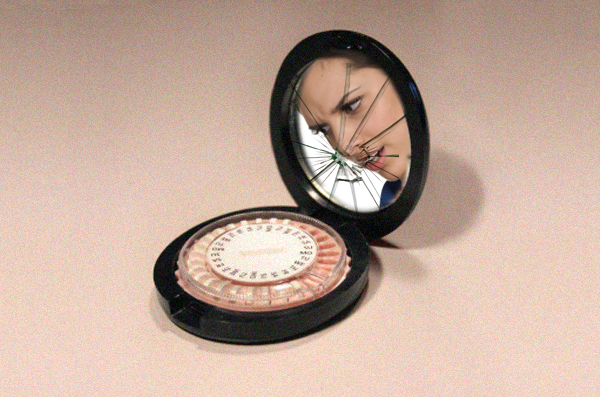

This month marks the 50th anniversary of the pill’s introduction in the United States, a milestone that has inspired a raft of retrospective, largely celebratory media coverage. A Time cover story credited the pill with “rearranging the furniture of human relations.” A New York Times Op-Ed by historian Elaine Tyler May hailed the oral contraceptive as “a tool for women’s emancipation.” All true. For millions of women who use the pill daily without intolerable side effects, who enjoy lighter, less painful and more regular periods, spontaneous sex, lowered risk of endometrial and ovarian cancers and zit-free skin, the birth control revolution has been fulfilled.
Then there’s me.
I hate the pill. Hormonal contraception, which covers birth control pills and nearly every other highly effective method on the market, murders my libido. I say that with as much certainty as I can, given the murky, multi-variate thing that is the human sex drive. I’ve experimented with several pills, hoping that any slight variation in hormonal ingredients would yield a contraceptive that worked without neutering me. Each doused my interest in sex as completely as the other. Although a libido-destroying pill does wonders to lower your pregnancy risk, it’s also done a number on my relationships, self-esteem and emotional well-being.
About a year into using the pill in my mid-20s, I first noticed a ratcheting down in sexual thoughts and daydreams. My interest in sex was cooling, even as I started a new, exciting relationship. I felt flat, with no detectable mid-cycle hormonal surge. Eventually, my libido dissipated so that just the thought of sex repulsed me, which left me confused, depressed and cut off from myself and my partner. Yes, there were other problems in our relationship that may have contributed, as well as stress about work and bills. So many physical, emotional and life factors can affect libido. But what I figured out was this: On the pill, I felt as turned off as a burned-out bulb, and off the pill, I did not.
Doctors who treat sexual disorders have long recognized the pill’s potential for dampening sex drive in some women. And researchers have a good grasp on why it happens: Oral contraceptives lower levels of available testosterone, a key to libido. “If you play around with sex steroid hormones, you play around with sexual function,” says Irwin Goldstein, M.D., director of San Diego Sexual Medicine at Alvarado Hospital, who has been involved with sexual dysfunction research for decades. But exactly how many pill users suffer negative sexual consequences needs further study.
——
There is a widely held misconception that in 2010 women enjoy a plethora of contraceptive choices. Or as a recent Wall Street Journal article pegged to the pill anniversary said, “Nowadays, women can choose from a bevy of birth-control options, including pills, patches and rings … implants and intrauterine devices (IUDs).” This does not a bevy make. There are essentially two categories of contraceptives: the hormonal kind, which includes nearly every pill and device available. And then the non-hormonal kind, including the copper IUD and less reliable barrier methods such as the diaphragm, cervical cap, sponge and male and female condoms. I discovered this when searching for birth control that wouldn’t wreck my libido.
After my nightmare with the pill, I tried the NuvaRing, a hormone-diffusing jelly bracelet you stick in your vagina. Perhaps a more localized administration of estrogen and progestin wouldn’t have the same libido-zapping effect as the pill, my OB-GYN theorized. While I did appreciate not needing to take a pill every day, keeping the rubbery ring inside of me didn’t seem ideal, either. During my period, I’d slide a tampon up there, too, marveling that I had more belongings in my vagina than I did in my purse. (Perhaps I could stick my lip gloss up there and just leave the handbag at home!) I could have handled the traffic jam in my nethers if only the damn ring didn’t kill my sex drive, but it did.
The failed NuvaRing experiment was my last attempt to use hormonal birth control — I’d spent years living with an impaired libido and wasn’t willing to do it anymore. When I was younger, when an unplanned pregnancy would have had a much higher cost, a sputtering sex drive may have been worth the years I gained in education, opportunity and growth unfettered by a baby I hadn’t expected or the difficult choice of having an abortion. And a significant part of me is, of course, relieved to have escaped those things. But I’m also pretty pissed about what I lost, and that I had to figure all of this out on my own.
After ruling out hormonal birth control, my first stop was the copper IUD. (Newsweek recently reported that since 2005, when the FDA first approved it for women who had never given birth, IUD usage has jumped 161 percent and climbing, perhaps driven in part by women like me.) When lodged in the uterus, the copper device creates a hostile environment for sperm. Akin to sterilization in effectiveness, good for up to 10 years and minus the hormonal side effects of the pill, the copper IUD can be the answer to many women’s prayers. The most commonly cited downside is heavier bleeding and more painful periods, but if it works for you, hallelujah.
Unfortunately, it didn’t work for me. Within 24 hours, the 1 3/8-inch long device started poking out of my cervix, which my boyfriend discovered to his horror during sex. (Cue the vagina dentata jokes.) Despite my gynecologist’s attempt to shove the IUD back in, my uterus was deemed too petite to house the device (by .5 freaking cm), a complication that can occur in as many as one in 10 women who’ve never given birth.
With all hormonal contraception and the copper IUD now out of the question, I was “stuck between a rock and a hard place,” as Dr. Cindy Basinski, an obstetrician-gynecologist in Evansville, Ind., describes it. “For women in your position, it’s barrier methods until you’re ready for permanent birth control or until they come along with a male contraceptive. You don’t have a lot of options left.”
A few days after my OB-GYN removed the IUD, I was fitted for a diaphragm. Picking one up from his desk, the doctor twirled it around his pointer finger, saying, “Birth control activists went to jail for bringing this to the United States. It’s the same technology.” It didn’t make me feel better to know that perhaps my only contraceptive hope was this archaic device straight out of the era of suffragettes.
I wasn’t looking forward to using the diaphragm — it felt like a hula hoop pressed against my vaginal walls — but I needn’t have worried. Two years later, my diaphragm prescription sits in a file at the pharmacy down the block from my apartment, unfilled. So few women use diaphragms, I was told, my size has been back-ordered (and back-ordered, apparently). Frankly, I am so unmotivated to use the thing that I’m happy to believe the pharmacy gods decided this one for me.
Moving on to my ever-dwindling options, I briefly used the sponge, but that temporarily disappeared in 2008 as it had in the “Seinfeld” era (inspiring the “spongeworthy” episode, for which the spermicidal foam is best known). Upon hearing the sponge was going off the market again, I was a one-woman stampede down to the Times Square Duane Reade. I bought up a bulging bag-ful, leaving a box for the poor pill refugee I imagined coming close behind. The sponge is back now, but at about $15 for a box of three, not exactly budget-friendly if you’re sexually active. And even in New York, it’s still hard to find on drugstore shelves.
I may be paying the cervical cap a visit one of these days and also would like to try the Fertility Awareness Method, which involves monitoring morning body temperature and changes in cervical position and mucus to figure out when ovulation is taking place, if only to learn more about my body and cycle. But for now, I rely on condoms. Not infrequently, I have felt a little freakish and a lot bewildered about my predicament. Those happy women in the gauzy, ubiquitous Yaz ads make birth control look so darn easy — what is wrong with me? How is it possible that 50 years after the advent of the birth control pill, I am still dependent on a concept that may date back to 1000 B.C. when Egyptian men wrapped their units in linen sheaths? (Ow.)
It turns out that I am not, after all, so freakish.
Millions of women go without birth control at any given time, often because they can’t or don’t want to use the methods available to them. When the Alan Guttmacher Institute recently asked women how they felt about contraception, four in 10 said they were dissatisfied with their current method, citing bad physical side effects, diminished sex drive and difficulty of use, among other complaints. Almost two-fifths chose their current method mostly because they didn’t like any other available option. And those who weren’t happy with their method were about three times more likely to have unprotected sex for at least one month of the year.
In my own life, female friends and acquaintances have abandoned hormonal birth control for a variety of reasons. It made them nauseous, moody or depressed, caused unacceptable weight gain, paralyzing migraines or breakthrough bleeding, put them at risk of blood clots, or drove their blood pressure to dangerous heights. Or they were just damned sick of taking pills every day. “I was a crazy woman on birth control,” says Dr. Basinski, who’s had her own personal battles with the pill over the years. “Out of control emotional. I used it on and off for 13 years and really struggled with it.” In her practice, Basinski sees patient after patient who want off their pills. “Many women just don’t feel good on them,” she says.
Of course, many women do — millions of them. There’s no denying that the pill and its hormonal siblings, such as the ring, patch, injectibles and the like, work brilliantly for so many women. That point is underscored for me when I talk to women who’ve used the pill without incident for years. One close girlfriend was mystified to hear my pill-libido saga; she’d never even heard of such a side effect. And why would she have? To not give birth control another thought is a luxury the pill affords. Now we just need more alternatives for the rest of us. While many pill-defectors can take refuge in the copper IUD, condoms plus a barrier method or FAM, together, those methods are clearly not enough to meet the vast demand.
Our lack of options isn’t just annoying or inconvenient. It’s a serious public health matter, and one that prevents millions of women from truly being in control of their reproductive lives. There are still nearly as many unplanned pregnancies in the United States every year as planned ones. Of the 3 million unplanned pregnancies, slightly more than half involve women who were not using any birth control.
For many women around the world, the lack of access to affordable, effective contraception is a matter of life and death. According to the Global Health Council, there were 700,000 maternal deaths between 1995 and 2000, mostly related to unintended pregnancies. With greater birth control options, those lives may have been saved. Such lack of power over our bodies and, ultimately, our destinies is exactly what the birth control revolution was supposed to prevent. The development of new methods, including non-hormonal ones, “would make a huge improvement in the lives of women in many developing countries who don’t have access to contraception,” says Michael J.K. Harper, a longtime researcher at CONRAD, a contraceptive R&D program at Eastern Virginia Medical School. And ideally, the birth control of the future would provide protection from HIV, unlike most current methods.
If you’re like me, you assume that someone, somewhere is figuring all of this out — that there will be a new kind birth control discovered or invented at some point because that’s just how human progress rolls on. I mean, they’re already working on another iPad. Surely, some lab rat is putting the finishing touches on the next breakthrough in contraception.
Yeah, no. The truth is that the development of innovative birth control methods has virtually come to a standstill. According to a 2008 report by Harper and several colleagues, public and private funds for contraceptive research have dried up in recent years. Most pharmaceutical companies have withdrawn from investing in contraceptive R&D, perhaps due to fears of costly personal injury litigation. And those fears aren’t necessarily unfounded. A reported 1,100 lawsuits have been filed in the United States against Bayer HealthCare alone, mostly by women claiming health problems such as blood clots, strokes, heart attacks and gall bladder disease after taking the popular pills Yaz and Yasmin.
Harper might have been the one to lead successful development of better, safer and more acceptable contraceptive technologies. In 1995, he became director of the Consortium for Industrial Collaboration in Contraceptive Research, a project CONRAD established to breathe life into Big Pharma’s commitment to developing new contraceptives. The plan was to reduce investment risk by cost sharing: CICCR would float a research project until a certain stage in clinical trials, when industry would take over. For about 10 years, the program hummed along, flush with funds and interest from the public and private sectors. “Unfortunately, over the years, donor fatigue set in,” Harper says. Getting a new contraceptive to clinical trials can take up to 15 to 20 years and cost $100 million or more. “That’s not a great sales pitch,” Harper says. With his program basically broke, Harper, co-discoverer of the breast cancer drug tamoxifen, plans to retire this summer. Still, he hasn’t completely given up on contraceptive development, pointing to the Gates Foundation, with its deep pockets and solid commitment to global health, as a promising benefactor. “Hope springs eternal,” he said.
Indeed. The birth control pill didn’t just magically appear in women’s medicine chests one day. Its creation was a hard-won victory for women, by women, specifically, Margaret Sanger and Katharine McCormick, the activist duo most responsible for its development. As Elaine Tyler May describes in her new book “America and the Pill,” these heroines began their fight in the early 20th century against the same sexist forces that once prevented women from voting, as well as conventional wisdom that equated birth control with vice and immorality, but ultimately managed to get the pill introduced here decades later.
The pill has enabled tremendous progress in the last 50 years, allowing many women to pursue education and job opportunities without the burden of unexpected or unwanted childbearing. But we can’t stop there. Until there’s overwhelming public demand for a new contraceptive that can serve as an alternative to the pill for the millions of women around the world who need it, we may never see the next generation of birth control options. To achieve true reproductive choice and freedom for all women, we need to start having a more realistic discussion about the pill, acknowledging its shortcomings as well as its achievements, what’s left to accomplish as well as how far we’ve come. The birth control revolution isn’t over yet — for so many of us, there’s a ways to go.
Geraldine Sealey, former news and opinion editor at Salon, is an articles editor at Glamour.
