
Celebrity
Drunk driving celebrities: What’s the lesson?
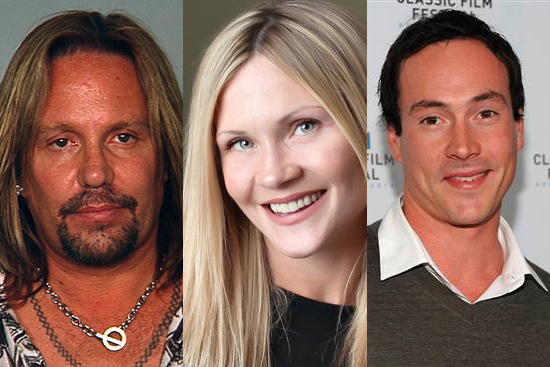
The arrests of Chris Klein, Amy Locane and Vince Neil remind us that it's not just texting at the wheel that kills
Vince Neil, Amy Locane and Chris Klein If you thought texting while driving had become the new drinking and driving, think again. The arrests Monday of Vince Neil for drunk driving and Melrose Place alum Amy Locane for a drunken vehicular homicide, both one day before Chris Klein’s Tuesday arraignment on a drunk driving charge, make it clear that getting loaded and getting behind the wheel is still a thing. In fact, alcohol is still responsible for 31% of all vehicular fatalities — which puts it ahead of those none-too-shabby “distracted driving” stats. Twenty-seven years after the AdCouncil advised that “Friends Don’t Let Friends Drive Drunk,” people are still doing exactly that. They’re just also additionally doing it when their pals chat away on their cell phones and text on the freeway.
While the mug shots of all three public figures painted a particularly faith in humanity kicking picture this week, it was the image of Neil out partying hours before his arrest, flanked by buds, that was even more depressing. Sure, many of us — particularly those of the generations that came of age with MADD and dire PSAs embedded in our psyches — know how to designate a driver, call a cab, or even not get too messed up in the first place. But did anyone say anything to Locane, who admitted to having several glasses of wine Sunday night before she drove off and plowed into the passenger side of another car? Did Neil’s comrades express concern about his state when the man who’s already done jail time for a drunk driving incident that left Hanoi Rocks drummer Nicholas “Razzle” Dingley dead headed toward his vehicle that night as well?
We can unhesitatingly toss out a crib at the mention of a recall. We can hand over our tubes of toothpaste and our shoes before stepping on a plane in the name of safety. We can even make condoms a non-negotiable part of sex and smoking uncool. But actually stopping someone else from getting on the road, whatever the reason may be? Taking away somebody’s keys? Saying no? That’s a tougher thing to do. Social inhibition kicks in — the desire to not seem like a scold. It’s been several years since I got in a car with someone I even suspected drinking too much, but sitting next to someone who’s texting? Happens all the time, even when I’ve been silently scared out of my mind. Given that 77% of drivers admit to texting and emailing while driving, you probably have too. And that’s why, despite the horror of their crimes, despite the irrefutable fact that Neil, Klein, Locane and every other reckless driver makes his or her own fateful decisions, it’s the complicity of us, their peers, that unnerves so deeply.
Mary Elizabeth Williams is a staff writer for Salon and the author of "Gimme Shelter: My Three Years Searching for the American Dream." Follow her on Twitter: @embeedub. More Mary Elizabeth Williams.
Even Justin Bieber has a dark side
An alleged brawl with a photographer spells no more Mister Nice Guy for the teen sensation
Justin Bieber (Credit: Reuters/Eric Gaillard) When you think of Justin Bieber, the first thing that leaps to mind probably isn’t “spoiling for a fight, international fugitive.” But this weekend, the doe-eyed, blow-dried young idol startled his fans – and at least one paparazzo who underestimated him – by allegedly taking a swing at a photographer at a Calabasas shopping mall.
The lensman claims Bieber hit him as he was taking photos of the singer with his girlfriend Selena Gomez. After complaining of pain, the photographer was taken to the hospital and released shortly after. TMZ reports that witnesses say the man was blocking Bieber’s car and that after the scuffle, a person identifying himself as a lawyer approached the photographer and suggested he call an ambulance and file a police report. Sheriff’s department spokesperson Lillian Peck refused to comment on the case, but if a report has been filed, Bieber, who left the scene after the incident, would now be the subject of a police investigation.
Continue Reading Close
Mary Elizabeth Williams is a staff writer for Salon and the author of "Gimme Shelter: My Three Years Searching for the American Dream." Follow her on Twitter: @embeedub. More Mary Elizabeth Williams.
Travolta’s florid lawsuit
A sexual assault claim against the star is one of the most spectacular legal documents in ages
John Travolta (Credit: Reuters/Thomas Peter) On the spectrum of Hollywood bombshells, the news Monday that John Travolta has been slapped with a lawsuit involving an alleged gay sexual overture ranks about as shocking as Lindsay Lohan getting picked up for violating parole. Whether or not the allegations can be proven true, the suit is just the most public acknowledgment of rumors that have floated around Travolta for years. So persistent and pervasive are the stories about his proclivities that back in 2009, Carrie Fisher famously boasted that “We don’t really care that John Travolta is gay.” But it turns out the most surprising thing about the whole dust-up is how fantastic a document the lawsuit itself is.
Continue Reading Close
Mary Elizabeth Williams is a staff writer for Salon and the author of "Gimme Shelter: My Three Years Searching for the American Dream." Follow her on Twitter: @embeedub. More Mary Elizabeth Williams.
When Lindsay Lohan moved in
The actress turned my Venice Beach neighborhood into a media circus, but also brought us all together in a new way
Amid a stream of confetti, Lindsay Lohan arrives at court in Beverly Hills, Calif., on July 20, 2010. (Credit: AP/Jason Redmond) When Lindsay Lohan moved two doors down from me last year, I had briefly fantasized about some sort of feel-good neighborly encounter between us. This happened on the night when I spotted the first of many satellite vans that would defiantly park in the red zone in front of my house. The van, coupled with the all-male paparazzi contingent prowling the alley behind my garage with an abundance of video equipment, provided me with a fresh understanding of what it means to live under siege.
And so, hunkered down inside my house, I had imagined the following scenario: The actress, fleeing down the alley from these men and unable to enter her own home, would accept my offer of temporary shelter. I’d quickly usher her into my living room where I’d offer her a non-alcoholic beverage. My cats, who normally hate strangers, would allow her to pet them and she would feel inspired to reveal some shard of a more authentic self that existed beneath her celebrity train wreck veneer. She would confide her secret fears, gripes and vulnerabilities and I would nod with empathy.
Continue Reading CloseSusan Josephs is a Los Angeles-based writer. She frequently writes about dance for the Los Angeles Times and is at work on a new play. More Susan Josephs.
Ryan Seacrest’s bland ambition
He's an asexual icon for traditional cultural conservatism, boring his way into the hearts of millions
(Credit: Fox/Benjamin Wheelock) Imagine, for a moment, that Dick Clark had died in 2002 instead of 2012. How would his obituaries have been different? In most ways, there would have been little change. In the last decade, Clark has continued with the ventures he’d been known for, hosting and producing a New Year’s Eve broadcast, various radio programs, game shows and TV specials. But there would have been two big differences. The first thing was Clark’s 2004 stroke, and his courageous return to public life despite a speech impediment modulating his famous voice.
Continue Reading CloseMichael Barthel is a PhD candidate in the communication department at the University of Washington. He has written about pop music for the Awl, Idolator, and the Village Voice. More Michael Barthel.
Hollywood’s new era of ensemble
The power posse of "Friends With Kids" proves there's strength in numbers VIDEO
Adam Scott and Jennifer Westfeldt in "Friends with Kids" We are living in a cinematic golden age. Exhibit A: that new Megan Fox movie.
The history of film is strewn with enterprising multi-hyphenates who knew how to rock a repertory. Orson Welles had pulled together a formidable troupe of regulars by the time he’d barely cut his wisdom teeth. Fellini and Hitchcock were known for their stock companies of familiar faces. But in recent years, strengthened by the talent pools of ensembles like the Groundlings and Upright Citizens Brigade, the power posse has become the norm — and it’s changing movies and television for the better.
Continue Reading Close
Mary Elizabeth Williams is a staff writer for Salon and the author of "Gimme Shelter: My Three Years Searching for the American Dream." Follow her on Twitter: @embeedub. More Mary Elizabeth Williams.
Page 1 of 182 in Celebrity