
Afghanistan
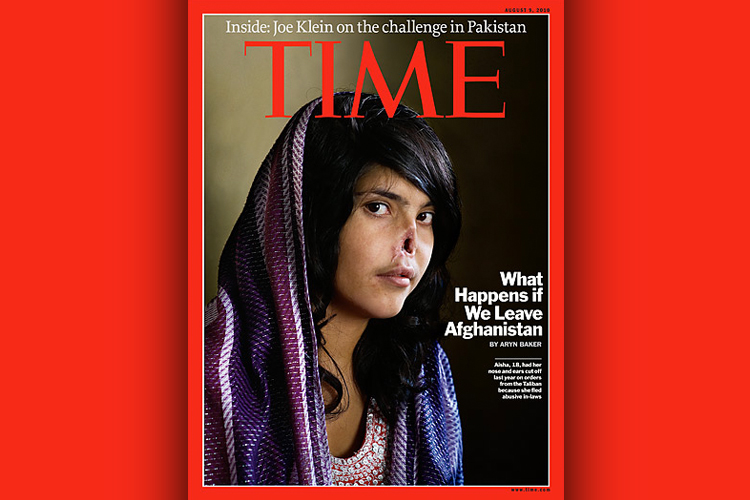
Time’s brutal, brutally effective new cover image
The shocking picture of a mutilated Afghan woman may be a struggling magazine's plea for attention -- but it works
iShe looks in many ways eerily similar to the girl who graced one of National Geographic’s most famous covers back in 1985. Like her, she is young, beautiful and Afghan. She looks at us slightly sideways, her bold gaze a contrast to her modestly covered hair. But 18-year-old Aisha, the arresting figure on the cover of the new issue of Time, is very different. After attempting to flee her abusive in-laws, Aisha was sentenced by the Taliban to become a cautionary tale to other girls in her village. While her brother-in-law held her down, her husband cut off her nose and ears. The provocative coverline? “What Happens If We Leave Afghanistan.”
The use of incendiary imagery is a popular and reliably attention-getting journalistic gambit. It’s also one fraught with conflict. Which takes precedence: the right for the public to know or its desire to not be offended? Is the dissemination of photos from Abu Ghraib or a video of Neda Agha-Soltan taking her last breath responsible journalism or exploitation? And, for the rest of us, is seeing them a duty or an uninvited intrusion?
In his online editorial on the cover story, Time managing editor Richard Stengel says, “I thought long and hard about whether to put this image on the cover of TIME … I would rather confront readers with the Taliban’s treatment of women than ignore it. I would rather people know that reality as they make up their minds about what the U.S. and its allies should do in Afghanistan.”
Jodie Bieber’s stunning images of wives, mothers, prisoners, widows and one ravaged burn victim — along with Aryn Baker’s accompanying story on the plight of women living under the Taliban — are unforgettable. But as traditional newsstand magazines face declining sales, and just one day after All Things Digital reported on Time Inc’s frustration in getting iPad subscriptions off the ground, it’s reasonable to wonder if Aisha represents not just the brutality of the Taliban but the desperation of old media.
That cover image is an unforgettable depiction of a horrible crime. It’s also a reminder. When was the last time your newsstand had anything on it that could stop you in your tracks, could make you feel something — horror, outrage, disgust? When was the last time you gave a damn about any magazine cover that didn’t feature Brooklyn Decker? Time is the publication that, earlier this month, put Thomas Edison on the cover, for Pete’s sake. In a news media dominated by nip slips and shocking death (“Caught on tape!”) those magazines your parents still get in their mailboxes have remained decorously safe.
So has Time swung too far in the other direction now, with a cover that prompted Stengel to butt-coveringly write, “I apologize to readers who find the image too strong, and invite you to comment on the image’s impact”? Given the overwhelming support for it in the comments so far, with readers calling it “compelling,” “what photojournalism is all about” and “the best cover out of Afghanistan war,” the answer would seem to be an passionate no.
But this isn’t quite photojournalism. Aisha, who is currently living in hiding and heading soon to the States for reconstructive surgery, posed for a portrait. She wasn’t captured in a Robert Capa moment. She chose to be part of a story, one that is based on the headline, that certainly has a clear-cut perspective.
That journalism is without bias is a myth. And whether it’s an artfully posed portrait or a Viet Cong prisoner with a gun to his temple, the act of documenting and selectively presenting an image imbues it chock-full of agenda.
Does the picture of a young girl, savagely mutilated by her own husband, tell us something real and important? I believe it does, more than a score of stories on the subject. But whether we can bear to look at a pelican flailing in oil or Beijing man standing in front of tank doesn’t necessarily change what happens to them. And I wonder if the mere act of looking instills in some of us the comforting sense that we’ve done our part, simply by experiencing the cathartic moment. To look or look away isn’t itself a moral choice. It’s what happens next that matters. And we can applaud Time for getting out of its comfort zone and doing something bold and still feel uneasy at the amount of business calculation that might have gone into the decision to do so. Aisha is a survivor of atrocity. She’s a tool of persuasion. And she’s a hell of a photograph.
Mary Elizabeth Williams is a staff writer for Salon and the author of "Gimme Shelter: My Three Years Searching for the American Dream." Follow her on Twitter: @embeedub. More Mary Elizabeth Williams.
Memorial Day’s lessons in amnesia
If nothing else, the holiday allows us to reflect on our commitment to forgetting bloody conflicts
(Credit: Carly Rose Hennigan via Shutterstock) It’s the saddest reading around: the little announcements that dribble out of the Pentagon every day or two — those terse, relatively uninformative death notices: rank; name; age; small town, suburb, or second-level city of origin; means of death (“small arms fire,” “improvised explosive device,” “the result of gunshot wounds inflicted by an individual wearing an Afghan National Army uniform,” or sometimes something vaguer like “while conducting combat operations,” “supporting Operation Enduring Freedom,” or simply no explanation at all); and the unit the dead soldier belonged to. They are seldom 100 words, even with the usual opening line: “The Department of Defense announced today the death of a soldier who was supporting Operation Enduring Freedom.” Sometimes they include more than one death.
Continue Reading CloseTom Engelhardt, co-founder of the American Empire Project, runs the Nation Institute's TomDispatch.com. His latest book, "The United States of Fear" (Haymarket Books), has just been published. More Tom Engelhardt.
Where the wounded are
Wars don't just cause casualties among soldiers, they drain medical staff. I traveled to see the costs firsthand
A soldier is prepared for an operation at Landstuhl Regional Medical Center. (Credit: Reuters/Kai Pfaffenbach) The weather’s getting warmer in Afghanistan and the war there is heating up again. That means – as it has meant every year for more than a decade — that the pace will quicken at the Landstuhl Regional Medical Center in Germany. More casualties will be brought to this largest American military hospital outside the United States. The Critical Care Air Transport teams and their C-17 Globemasters will fly in from “downrange,” as they call the Afghan battleground, and the injured will be brought by ambulance bus from nearby Ramstein Air Force Base to the hospital front door.
Continue Reading CloseMichael Winship is senior writing fellow at Demos and a senior writer of the new series, Moyers & Company, airing on public television. More Michael Winship.
NATO invites Pakistan to summit
A sign that Islamabad is ready to reopen its western border to NATO troops on their way to Afghanistan
Oil tankers, which were used to transport NATO fuel supplies to Afghanistan, are parked at a compound in Karachi, Pakistan, Tuesday, May 15, 2012. NATO on Tuesday invited Pakistani President Asif Ali Zardari to the alliance's summit in Chicago, after signs that the country could be moving to reopen its Afghan border to NATO military supplies. (AP Photo/Shakil Adil)(Credit: AP) ISLAMABAD (AP) — NATO on Tuesday invited Pakistan’s president to the upcoming Chicago summit on Afghanistan, the strongest sign yet that Islamabad is ready to reopen its western border to U.S. and NATO military supplies heading to the war in the neighboring country.
Pakistan blocked the routes in November after American airstrikes killed 24 of its troops on the Afghan border. The attack sent ties between Washington and Islamabad to new lows, threatening regional cooperation needed for negotiating an end to the Afghan war.
Continue Reading CloseAfghanistan, I can’t quit you
My mom pushed me to join the Marines. Now that she's gone, I'm still drawn to war zones
A child flies a kite in Kabul on Tuesday Mar. 27, 2012. (Credit: Geoffrey Ingersoll) The heat. That’s what I remember most. Shimmery and bright. Blinding. Stifling. Heeee-eeaat.
The kind that’s not just on you, wrapped around you, but balled up and pulsing inside you — a desert blanket with teeth. It’s a type of heat that makes your skin cry and your eyeballs sweat, even in the shade; heat like a predator you can’t run away from.
I notice it right as I get off the plane — not just the degrees but also the dust. Dust you can smell, kicked up by a thousand years of struggle. In a region this old, I’m sure each breath carries a dose of unintended history: Inhale, Alexander the Great; exhale, the Ottoman Empire; inhale, the USSR; exhale, the Taliban.
Continue Reading CloseGeoffrey Ingersoll is a freelance journalist, documentarian, writer, photographer, and veteran of Operation Iraqi Freedom. He is the recipient of the Sam Stavisky Award for Combat Reporting. More Geoffrey Ingersoll.
What Obama didn’t mention in Kabul
Just outside the Afghan capital, the Taliban is in control and preparing for a wider war
President Barack Obama addresses troops at Bagram Air Field, Afghanistan, Wednesday, May 2, 2012. (AP Photo/Charles Dharapak)(Credit: AP) MAHMUD RAQI, Afghanistan — The office of Kapisa’s governor sits high on a hilltop overlooking the provincial capital, Mahmud Raqi. It has a beautiful view of the river below and the mountains, trees and fields that stretch into the distance.
Beneath the tranquil surface, however, lies a grim truth. Just outside town roadside bombs are planted to target NATO convoys.
Page 1 of 122 in Afghanistan