
Taylor Swift

Kanye West finally apologizes to Taylor Swift, writes her a song

The rapper takes to Twitter to makes amends with the country singer, wants her to sing over his music

  • more
    • All Share Services

Topics: ,

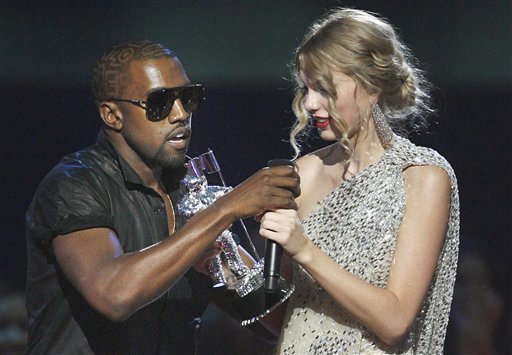
Kanye West finally apologizes to Taylor Swift, writes her a songFILE - In this Sept. 13, 2009 file photo, singer Kanye West takes the microphone from singer Taylor Swift as she accepts the "Best Female Video" award during the MTV Video Music Awards in New York. West is still feeling the pain over his trophy grab from Taylor Swift last year, and he’s expressing his pain all over Twitter. West has unleashed a torrent of emotions on his official Twitter on Saturday, Sept. 4, 2010, acknowledging he was wrong for taking an award from the country sweetheart at the MTV Video Music Awards. But he says he "bled hard." He says he had to cancel his tour with Lady Gaga and even lost employees. (AP Photo/Jason DeCrow, File)(Credit: AP)

Kanye West apologized to Taylor Swift over the weekend on Twitter. The apology was, of course, for his drunken ambushing of Swift’s acceptance speech at the 2009 MTV Video Music Awards, sullying the spotlight of the industry’s preeminent sweetheart. And though the act of remorse is about a year too late, West offset what he lacks in timing with persistence and a heartfelt gesture — or, as heartfelt a gesture as possible via a social media website.

“I’m sorry Taylor,” West wrote early Saturday.

It was simple, to the point, and that alone probably would’ve sufficed … but the floodgates were open, baby, and West kept going and going. “I’ve hurt, I’ve bled, I’ve learned. I only want to do good. I am passionate, I am human, I am real. I wish I could meet every hater,” West went on.

He didn’t stop there. “If you google Asshole my face may very well pop up 2 pages into the search.” At least he wasn’t so hard on himself as to say he’d be the top result.

But even falling on his own sword wasn’t enough. The rapper-producer then did what he does best — create music — and crafted a track over which, at West’s wishes, the country pop star would sing. “I wrote a song for Taylor Swift that’s so beautiful and I want her to have it,” West wrote. “If she won’t take it then I’ll perform it for her.”

It was a surprising moment of humility for a musician known for his arrogance. But anyone who’s heard West’s last album “808s & heartbreak” knows he’s always been a romantic at heart, a gentle soul beneath a jagged exterior, and this proves it. MTV News seems equally impressed by West’s effusive admission, ranking him alongside Chris Brown, Justin Timberlake and feces-dumping Dave Matthews Band on the list of Best Musician Apologies.

But let’s be honest here: a Kanye West and Taylor Swift collaboration? How would West’s predominantly hip-hop beats mesh with Swift’s distinctive Nashville twang?  Entertainment Weekly takes a guess at how it would sound, but we can only hope it’s as pleasant as West’s newfound humility.

Continue Reading Close

“Hunger Games,” Taylor Swift reinvent soundtracks

With songs by Taylor Swift, Arcade Fire and Neko Case, "Hunger Games" may create something rare -- a #1 soundtrack

  • more
    • All Share Services

Topics: , ,

Taylor Swift, left, and Jennifer Lawrence in "The Hunger Games" (Credit: AP/Lionsgate)

Clad in a modest dress and made up to look like she’s not made up, Taylor Swift wanders pensively through a bare wilderness in her new video for “Safe & Sound.” It’s the first single from the upcoming “Hunger Games: Songs from District 12 and Beyond” and a rarity in today’s pop landscape: a true soundtrack hit. The clip, which was directed by Philip Andelman, strives for Post-Apocalyptic Rural; you almost expect to see zombies off in the mist, lumbering toward brains. But nothing attacks Swift on her walk through the wilderness, and the only activity she encounters are fires off in the distance — an omen of storms and doom approaching.

Nothing much happens in the video, but its muted color palette, patient pace, and most of all that looming threat make it unusually effective. With its piercing guitar theme and the subdued production courtesy of T Bone Burnett, the song reflects that mood, even as it gives so much time over to lyric-less passages. Swift may be better casting than even Jennifer Lawrence, who plays the heroine Katniss Everdeen in the film adaptation of Suzanne Collins’ young-adult novel. The 22-year-old singer-songwriter is arguably the most successful musician of the moment, and her two songs — “Safe and Sound” and “Eyes Open” — will ensure that the “Hunger Games” soundtrack will sell very well.

More than that, however, it makes sense to get an artist whose primary subject has been adolescence to soundtrack a movie about adolescents. Swift has written evocatively and knowingly about teenage conflicts and confusions — the intensity of young love, the reassurances of friendship, the stormy passage of adulthood — which are issues addressed by scores of young-adult novelists, who lately have been turning them into metaphors involving werewolves, vampires and other supernatural phenomena. Few novelists are quite so ambitious in this undertaking as Collins, who sets the three “Hunger Games” books within a post-apocalyptic totalitarian state where teenagers are forced to fight each other in the name of entertainment and political oppression. Swift’s music may be apolitical, but she knows how the metaphor works and, more important, why it’s proved so popular with young readers.

But in 2012, “The Hunger Games” seems a bit old-fashioned for investing so much in a blockbuster soundtrack. Produced by Burnett, it includes new songs from the Arcade Fire, the Decemberists, Miranda Lambert with the Pistol Annies, Maroon 5, Kid Cudi and the Civil Wars, among others. Very few contemporary soundtracks prove quite so ambitious, not only because consumers have stopped buying them but also because studios and labels are no longer producing these tie-in albums.

Film has always enjoyed a close relationship to pop music, as each bolstered the popularity of the other. The first talkie, of course, was a musical: In 1927, “The Jazz Singer” employed a synchronized soundtrack that not only made dialogue audible but provided sound for iconic hits like “My Mammy” and “Toot Toot Tootsie Goodbye.” Three decades later, “The Blackboard Jungle” made a smash hit of Bill Haley & the Comets’ “Rock Around the Clock,” helping to launch the rock and roll explosion. Studios and labels worked together to sell films with soundtracks and soundtracks with films, a trend that peaked in the 1980s with a string of multi-platinum tie-in albums, including “Top Gun,” “Beverly Hills Cop,” “The Big Chill,” “Footloose,” “Purple Rain,” “Pretty in Pink” and “Dirty Dancing.”

During the next decade, that trend abated somewhat. “The Bodyguard” and “Titanic” sold well, “Singles” shone a spotlight on the then-burgeoning Seattle scene, and “Pulp Fiction” and “Natural Born Killers” innovated the genre by including not just carefully chosen older tunes but also sound snippets and bits of dialogue. A soundtrack could sell well based solely on one song: Take “Benny & Joon,” the 1993 Johnny Depp vehicle that packaged the Proclaimers’ “I’m Gonna Be (500 Miles)” with Rachel Portman’s nondescript score. That album’s success would be unthinkable in the digital era, when you could simply download the single (or grumble that the label had made it a soundtrack exclusive).

Perhaps the soundtrack’s last real hurrah was “O Brother Where Art Thou?” at the turn of this century. Despite the Coen Brothers’ tongue-in-cheek depiction of the Depression-era South, the album’s straight-faced revival of old rural blues, folk and gospel songs struck a mighty chord with listeners. Produced by Burnett and featuring a raft of artists who were far from mainstream (Gillian Welch, Ralph Stanley), the release sold millions and even won the Grammy for Album of the Year in 2001. More impressively, its influence still ripples through the industry, as acts like the Avett Brothers and Trampled by Turtles continue to draw from and update these same traditions.

But the days when every summer action movie or franchise entry had a hit album or single attached are long over. With the rise of file sharing and downloading, not to mention the downfall of MTV and other music video channels, most movies forego the expense of a star-studded soundtrack, placing less and less emphasis on pop music in movies. That trend seemed to reach a head this year when only two songs qualified for the Best Original Song Oscar. On the other hand, many films are putting renewed emphasis on composed scores, which has produced adventurous work by Trent Reznor and Michael Giacchino.

If anything can reverse this trend, it’s the young adult novel adaptation. When “Twilight” hit theaters in 2008, its tie-in album debuted at No. 1 on the Billboard album charts — the first soundtrack to do so since 2002. Other collections followed with each sequel, and while none sold quite so well as that first installment, they did prove especially successful by corralling indie-rock acts like Bon Iver, Lykke Li, Sea Wolf and Florence + the Machine. It was a boon to struggling musicians who could fund tours or albums based on the royalties.

The songs on the “Twilight” soundtrack were written and recorded specifically for the movies, usually to express a character’s emotions or side with Team Edward or Team Jacob, but aside from general moodiness, there’s no particular aesthetic unifying any of these albums into a whole. They could be mixtapes made by a lovesick teen with a particularly adventurous iTunes library. “The Hunger Games: Songs from District 12 and Beyond,” on the other hand, is “O Brother” for the tween set, and not only because it’s also produced by Burnett. More crucially, the soundtrack uses pop music to reflect the film’s setting and cultural/political themes. The heroine Katniss Everdeen hails from District 12, a rural outlier in what’s left of the United States following an ecological disaster and a bloody civil war. As Katniss observes in the first book in the series, District 12 is located in what used to be known as Appalachia, and its residents still mine coal hundreds of years later.

The soundtrack relies heavily on artists well versed in traditional Appalachian music to evoke this setting, which means bluegrass-fusion experts the Punch Brothers and African American string band Carolina Chocolate Drops rub elbows with the likes of rapper Kid Cudi and Maroon 5. The stark acoustic music represents District 12; the heavier, busier songs evoke the hyper-modernized Capitol. Sure, it divides the music into easy groupings, where spare and acoustic equals pure and good while electronic connotes urban and shallow. But at least “The Hunger Games” is even thinking about such differences rather than just throwing everything together in a hasty tracklist. No dry history lesson in old-time folk, it works more as an album than as a souvenir of a moviegoing experience. Which is exactly what any good soundtrack ought to do.

Continue Reading Close

National Review contributor declares Taylor Swift winner of GOP debate

Being governor and running for president at the same time must be hard, and other insights from K-Lo

  • more
    • All Share Services

Topics: , , , , ,

National Review contributor declares Taylor Swift winner of GOP debateTaylor Swift and Rick Perry (Credit: AP)

Let’s check in with National Review’s Kathryn Jean Lopez, shall we? Lopez, the world’s greatest political blogger, has made two very compelling points about last night’s Republican debate. The first, made shortly after it ended:

In all seriousness, it cannot be easy to be governor of Texas and run for president at the same time.

That is the entirety of the post. (Commenter “motherofthetroops”: “K-Lo, I say this in Christian love: what Perry is to debaters, you are to Corner commentators.” People who preface things with “I say this in Christian love” are people who are about to say something awful to you, usually.)

This morning, she published a longer reaction to last night’s debate, informed by a night of careful consideration. “These candidates aren’t half bad,” she declares. “I do wish Santorum would have his moment,” she sighs, wistfully, imagining herself chastely holding hands with the former senator on a lovely spring day as they block the entrance of a Planned Parenthood clinic.

Her conclusion:

The winner of the night was the delightfully talented young Taylor Swift, though, who just won the Country Music Awards “Entertainer of the Year” award. Who scheduled country-music awards the same night as a Republican party debate? CNBC wins for ending the debate in time for the Glen Campbell tribute.

As I said: World’s greatest political blogger.

(The commenters are similarly unimpressed with this item, or at least many of them don’t really understand what Taylor Swift has to do with anything. AndrewTP: “For some reason you seem to have been brainwashed into believing that Taylor represents your side in a culture war, a belief for which there is no evidence.” Uh oh, they’re catching on! Quick, Rich Lowry, write a post about how you heard a liberal New Yorker disrespect NASCAR or something!)

Continue Reading Close
Alex Pareene

Alex Pareene writes about politics for Salon and is the author of "The Rude Guide to Mitt." Email him at apareene@salon.com and follow him on Twitter @pareene

Justin Bieber wins country music award

Never say never, especially in the case of a young Canadian pop star becoming a CMT crossover artist

  • more
    • All Share Services

Topics: , , , ,

Justin Bieber wins country music awardIs Bieber country strong?

Justin Bieber won a CMT Music Award last night. Why not? If Gwyneth Paltrow gets to perform at the CMA awards (which is different than the CMT Music Awards, but not really), why shouldn’t little Bieber get a statue? At this point, Hollywood has so infiltrated the country music scene – we can thank Nicole Kidman pairing up with Keith Urban for that one – and vice-versa (Lady Antebellum sweeping the Grammys this year, Taylor Swift, etc.), that it’s difficult to claim that country music isn’t already mainstream music.

Still though, is Justin Bieber country music? His award came in the form of Collaborative Video of the Year for his song ‘That Should Be Me,” featuring Rascal Flatts. Does it fit the specifications required of country music? Hard to say.

Why “That Should Be Me” may be a country song:

1) It’s about breaking up

2) “Women are bitches” mentality

3) Chords sound vaguely ballad-ish

4) The appearance of Rascal Flatts

5) Sounds like something Taylor Swift would write about a recent break-up with a celebrity

Why “That Should Be Me” may not be a country song:

1) Rotoscoping

2) The line “Did you forget all the mem’s that we made” (Real country crooners would never try to shorten the word “memory”)

3) Too many appearances of malls, texting

4) Boy with long hair and girlish features pouting into camera hasn’t really worked for anyone in country music since Gram Parsons.

5) He’s Canadian (Though that can work both for and against him, as half of the “country” in “country music” actually refers to Canada. See also: Shania Twain)

I was surprised to see Justin show up and accept his award, since he was almost a no-show at the MTV Movie Awards on Sunday. But hey, maybe he is trying to be a crossover star. What do you think: Is “That Should be Me” country enough to win a CMT award?

Continue Reading Close

Drew Grant is a staff writer for Salon. Follow her on Twitter at @videodrew.

Taylor Swift’s “Mean” doesn’t equate to “It Gets Better”

The clip for her new song combines bluegrass music with an earnest message -- and gets it very wrong

  • more
    • All Share Services

Topics: , , , ,

Taylor Swift's Taylor Swift's "Mean."

Taylor Swift’s “Mean” might be interpreted as the country singer’s attempt at an “It Gets Better” song, especially since the video features a kid wearing purple who just wants to read a damn Vogue in peace. I’d advise against this reading, though, since the whole point of “It Gets Better” — or any anti-bullying message, really — is that someone from a place of authority is telling you that they’ve been there, they know how tough it can be.

Sorry, kids, Taylor Swift has not “been there,” as is clearly evidenced in her own fantastical bully scenario, which involves a guy dressed like Snidely Whiplash tying her to the train tracks. That is some damsel in distress imagery, which really doesn’t scream “It gets better,” so much as “I am the definition of heterosexual norms.” (Not to mention the somewhat offensive cutaway to the kid in purple when Taylor sings, “And you, picking on the weaker man.” Are gay kids inherently weak?)

From what Taylor shows us in the video, she is so far from ever having been bullied that she immediately equates it with some fairy-tale vision of evil.

But, hey, Taylor gave it a good shot in her own right, even if she’s living in La-la-land. As Kyle Buchanan of Vulture pointed out, “Its aspirational chorus, ‘Someday / I’ll be / livin’ in a big ol’ city,’ is practically a rebuke to small-town values,” which is probably as subversive as this country gal is ever going to get.

But perhaps more important than debating how sincere an anti-bullying message is from someone who has never been bullied is the fact that it’s the first Taylor Swift song I can think of that’s not about her last celebrity boyfriend. That is, unless Jake Gyllenhaal had a kinky fetish of tying her to the tracks of oncoming trains (while wearing a fake mustache) that we didn’t know about.

Continue Reading Close

Drew Grant is a staff writer for Salon. Follow her on Twitter at @videodrew.

10 year time capsule: The (re)branding of country music

A decade ago, the CMA tried to bring out patriotism in its fans, but what really changed everything was Sept. 11

  • more
    • All Share Services

Topics: , , , , ,

10 year time capsule: The (re)branding of country musicAlan Jackson gains credibility for his song "Where were you?"

Country music has enjoyed a resurgence in the past decade, and while it may be a little derivative to give all the credit to the surge of patriotism that Americans felt post-9/11, consider this: In May 2001, the Country Music Association took heat from its fans when it officially changed its slogan to “Admit it. You love us.”

The message was clear to anyone reading between the lines. If you liked country music back in the early part of the aughts, you hid that love, like a high-school girl who only listens to musicals. (Hey, I can relate.) The CMA even issued a statement, saying the quote was “a challenge to everyone who has ever connected with a country song or a specific artist but may not feel a current connection to the format as a whole or is reluctant to share their enjoyment of the music with others.” Yikes.

The attempt was part of a campaign by the CMA to “brand” its music, something that had never been tried before “as far as we can tell,” according to the CMA executive director Ed Benso. It wasn’t that country music had taken a nose dive, but the ’90s had been such a booming time for the genre that producers and music executives were loath to take a hit. Garth Brooks, Lyle Lovett and Billy Ray Cyrus had allowed the brand to go international and platinum in the space of a few short years, but it was still a struggle to find the right marketing techniques to sell Europe on the Country Music Television channel.

And then, Sept. 11. If country music benefited as a result of the twin towers falling, then it was a bittersweet victory. CMT garnered its highest ratings in October of 2001 after holding the “Freedom Concert,” which raised $5 million for the Salvation Army Disaster Relief Fund. Alan Jackson achieved a moment of fleeting worldwide fame when his single “Where Were You (When the World Stopped Turning)” became a symbol both of America’s pain and cynical attempts to cash in on the hurt. (See “South Park’s” takedown of Jackson in the episode “A Ladder to Heaven.“) The same went for Toby Keith’s “Courtesy of the Red, White & Blue (The Angry American),” which the country star had to be coaxed into playing after an initial bout of discomfort with the material.

But as a USA Today article in 2002 aptly pointed out, this discomfort did not affect the listeners of the music:

“… if country songwriters have been reluctant to talk, country fans have been more than willing to listen … both Jackson’s and Keith’s records topped the Billboard country singles chart, Jackson’s for five weeks. Several similar records, ranging from generally patriotic numbers to songs written in direct response to the attacks, have made at least nominal showings.”

Not all performers were shy about tackling the tough issues post-September either. Steve Earle put out his response in the album “Jerusalem” in 2002, which included the song “John Walker’s Blues,” written “from the vantage point of ‘American Taliban’ John Walker Lindh.” The song was met with criticism from both sides, with some calling it “unpatriotic” and others claiming that it was too controversial a subject. Some performers were accused of cashing in on the attacks, like Bruce Springsteen, who released “The Rising.”

But the legacy of country music is bigger than the individual. Once the dust has settled, what will people see when they look back at country music in the aughts? Taylor Swift, the CMT Awards, the CMA Awards (completely different), Carrie Underwood, Lady Antebellum, Brad Paisley, Miranda Lambert, Keith Urban, Gwyneth Paltrow and “Country Strong”; just in the past year the popularity of the genre has allowed its stars to overtake the Grammys, both in nominees and interest in other music award shows.

Perhaps we can attribute the rise in popularity of country music as much to Swift, Underwood, Miley Cyrus and “American Idol” as we can to the attacks on Sept. 11. But I’d wager that these fresh faces in the industry flocked to country music specifically because it resonated with the first historical event they were alive to witness.

Continue Reading Close

Drew Grant is a staff writer for Salon. Follow her on Twitter at @videodrew.

Page 1 of 2 in Taylor Swift