
WikiLeaks

WikiLeaks reveals more than just government secrets

From bloodthirsty pols to kowtowing journalists, the strident reactions to the whistle-blower site reveal a lot

  • more
    • All Share Services

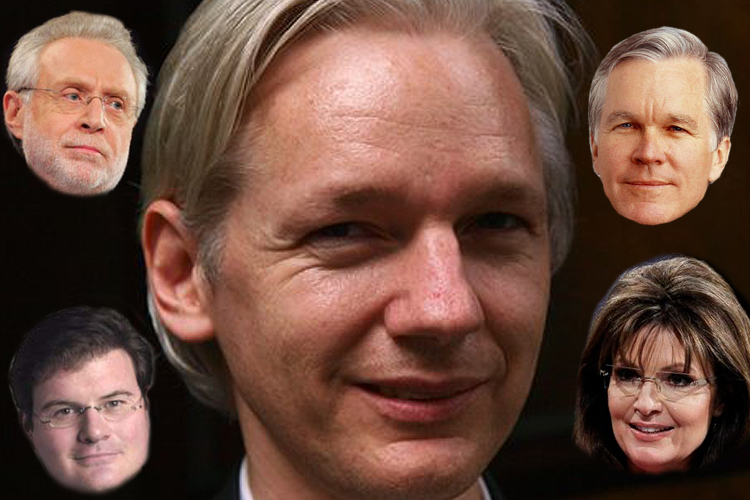
WikiLeaks reveals more than just government secretsClockwise from lower left: Jonah Goldberg, Wolf Blitzer, Julian Assange, Bill Keller and Sarah Palin

(updated below – Update II)

The WikiLeaks disclosure has revealed not only numerous government secrets, but also the driving mentality of major factions in our political and media class.  Simply put, there are few countries in the world with citizenries and especially media outlets more devoted to serving, protecting and venerating government authorities than the U.S.  Indeed, I don’t quite recall any entity producing as much bipartisan contempt across the American political spectrum as WikiLeaks has:  as usual, for authoritarian minds, those who expose secrets are far more hated than those in power who commit heinous acts using secrecy as their principal weapon.

First we have the group demanding that Julian Assange be murdered without any charges, trial or due process.  There was Sarah Palin on on Twitter illiterately accusing WikiLeaks — a stateless group run by an Australian citizen — of “treason”; she thereafter took to her Facebook page to object that Julian Assange was “not pursued with the same urgency we pursue al Qaeda and Taliban leaders” (she also lied by stating that he has “blood on his hands”:  a claim which even the Pentagon admits is untrue).  Townhall’s John Hawkins has a column this morning entitled ”5 Reasons The CIA Should Have Already Killed Julian Assange.”  That Assange should be treated as a “traitor” and murdered with no due process has been strongly suggested if not outright urged by the likes of Marc Thiessen, Seth Lipsky (with Jeffrey Goldberg posting Lipsky’s column and also illiterately accusing Assange of “treason”), Jonah Goldberg, Rep. Pete King, and, today, The Wall Street Journal.

The way in which so many political commentators so routinely and casually call for the eradication of human beings without a shred of due process is nothing short of demented.  Recall Palin/McCain adviser Michael Goldfarb’s recent complaint that the CIA failed to kill Ahmed Ghailani when he was in custody, or Glenn Reynolds’ morning demand — in between sips of coffee — that North Korea be destroyed with nuclear weapons (“I say nuke ‘em. And not with just a few bombs”).  Without exception, all of these people cheered on the attack on Iraq, which resulted in the deaths of more than 100,000 innocent human beings, yet their thirst for slaughter is literally insatiable.  After a decade’s worth of American invasions, bombings, occupations, checkpoint shootings, drone attacks, assassinations and civilian slaughter, the notion that the U.S. Government can and should murder whomever it wants is more frequent and unrestrained than ever.  

Those who demand that the U.S. Government take people’s lives with no oversight or due process as though they’re advocating changes in tax policy or mid-level personnel moves — eradicate him!, they bellow from their seats in the Colosseum — are just morally deranged barbarians.  There’s just no other accurate way to put it.  These are usually the same people, of course, who brand themselves “pro-life” and Crusaders for the Sanctity of Human Life and/or who deride Islamic extremists for their disregard for human life.  And the fact that this mindset is so widespread and mainstream is quite a reflection of how degraded America’s political culture is.  When WikiLeaks critics devote a fraction of their rage to this form of mainstream American thinking — which, unlike anything WikiLeaks has done, has actually resulted in piles upon piles of corpses — then their anti-WikiLeaks protestations should be taken more seriously, but not until then.


* * * * *

Then, with some exceptions, we have the group which — so very revealingly — is the angriest and most offended about the WikiLeaks disclosures:  the American media, Our Watchdogs over the Powerful and Crusaders for Transparency.  On CNN last night, Wolf Blitzer was beside himself with rage over the fact that the U.S. Government had failed to keep all these things secret from him:

Are they doing anything at all to make sure if some 23-year-old guy, allegedly, starts downloading hundreds of thousands of cables, hundreds of thousands of copies of sensitive information, that no one pays attention to that, no one in the security system of the United States government bothers to see someone is downloading all these millions — literally millions of documents? . . . at this point, you know, it — it’s amazing to me that the U.S. government security system is so lax that someone could allegedly do this kind of damage just by simply pretending to be listening to a Lady Gaga C.D. and at the same time downloading all these kinds of documents.

Then — like the Good Journalist he is — Blitzer demanded assurances that the Government has taken the necessary steps to prevent him, the media generally and the citizenry from finding out any more secrets:  “Do we know yet if they’ve [done] that fix? In other words, somebody right now who has top secret or secret security clearance can no longer download information onto a C.D. or a thumb drive? Has that been fixed already?”  The central concern of Blitzer — one of our nation’s most  honored “journalists” – is making sure that nobody learns what the U.S. Government is up to.

Then there’s the somewhat controversial claim that our major media stars are nothing more than Government spokespeople and major news outlets little more than glorified state-run media.  Blitzer’s CNN reporting provided the best illustration I’ve seen in awhile demonstrating how true that is.  Shortly before bringing on David Gergen to rail against WikiLeaks’ “contemptible behavior” (while, needless to say, not giving voice to any defenders of WikiLeaks), this is what was heard in the first several minutes of the CNN broadcast:

WOLF BLITZER, HOST: Brooke, thanks very much.

Happening now, a criminal investigation into the leak of U.S. diplomatic secrets. . . .  The White House says it would be an understatement to say that President Obama is not pleased about these leaks. The Justice Department says a criminal investigation is ongoing and the State Department is leading attempts at international damage control right now.

Our foreign affairs correspondent, Jill Dougherty, is over at the State Department working the story for us.

And there’s enormous potential damage for the United States in these — in these leaks, Jill.  I assume that’s what officials there are telling you.

JILL DOUGHERTY, CNN FOREIGN AFFAIRS CORRESPONDENT: They are, Wolf. They’re pretty overt about it. It could be very, very damaging. . . . The Secretary slammed the release of the cables, calling it an attack.

CLINTON: This is not just an attack on America’s foreign policy interests. It is an attack on the international community. . . .

ERIC HOLDER, ATTORNEY GENERAL: Let me be very clear, this is not saber rattling.

DOUGHERTY: The U.S. attorney general is not ruling out going after the WikiLeaks’ founder, Julian Assange, even though he is not an American citizen.

HOLDER: To the extent that we can find anybody who was involved in the breaking of American law and who has put at risk the assets and the people that I have described, they will be held responsible.

That’s CNN’s journalism:  uncritically passing on one government claim after the next — without any contradiction, challenge, or scrutiny.  Other than Blitzer’s anger over the Government’s failure to more effectively keep secrets from everyone, what would an overtly state-run media do differently?  Absolutely nothing.  It’s just so revealing that the sole criticism of the Government allowed to be heard is that they haven’t done enough to keep us all in the dark.

Then we have The New York Times, which was denied access to the documents by WikiLeaks this time but received them from The Guardian.  That paper’s Executive Editor, Bill Keller, appeared in a rather amazing BBC segment yesterday with Carne Ross, former British Ambassador to the U.N., who mocked and derided Keller for being guided by the U.S. Government’s directions on what should and should not be published (video below):

KELLER:  The charge the administration has made is directed at WikiLeaks: they’ve very carefully refrained from criticizing the press for the way we’ve handled this material . . . . We’ve redacted them to remove the names of confidential informants . . . and remove other material at the recommendation of the U.S. Government we were convinced could harm National Security . . .

HOST (incredulously):  Just to be clear, Bill Keller, are you saying that you sort of go to the Government in advance and say:  ”What about this, that and the other, is it all right to do this and all right to do that,” and you get clearance, then?

KELLER:  We are serially taking all of the cables we intend to post on our website to the administration, asking for their advice.  We haven’t agreed with everything they suggested to us, but some of their recommendations we have agreed to:  they convinced us that redacting certain information would be wise.

ROSS:  One thing that Bill Keller just said makes me think that one shouldn’t go to The New York Times for these telegrams — one should go straight to the WikiLeaks site.  It’s extraordinary that the New York Times is clearing what it says about this with the U.S. Government, but that says a lot about the politics here, where Left and Right have lined up to attack WikiLeaks – some have called it a “terrorist organization.”

It’s one thing for the Government to shield its conduct from public disclosure, but it’s another thing entirely for the U.S. media to be active participants in that concealment effort.  As The Guardian‘s Simon Jenkins put it in a superb column that I can’t recommend highly enough:  ”The job of the media is not to protect power from embarrassment. . . . Clearly, it is for governments, not journalists, to protect public secrets.”  But that’s just it:  the media does exactly what Jenkins says is not their job, which — along with envy over WikiLeaks’ superior access to confidential information — is what accounts for so much media hostility toward that group.  As the headline of John Kampfner’s column in The Independent put it:  ”Wikileaks shows up our media for their docility at the feet of authority.”

Most political journalists rely on their relationships with government officials and come to like them and both identify and empathize with them.  By contrast, WikiLeaks is truly adversarial to those powerful factions in exactly the way that these media figures are not:  hence, the widespread media hatred and contempt for what WikiLeaks does.  Just look at how important it was for Bill Keller to emphasize that the Government is criticizing WikiLeaks but not The New York Times; having the Government pleased with his behavior is his metric for assessing how good his “journalism” is.  If the Government is patting him on the head, then it’s proof that he acted “responsibly.”  That servile-to-power mentality is what gets exposed by the contrast Wikileaks provides.

* * * * *

Then we have the Good Citizens who are furious that WikiLeaks has shown them what their Government is doing and, conversely, prevented the Government from keeping things from them.  Joshua Foust — who says “he’s spent the vast majority of his adult life doing defense and intelligence consulting for the U.S. government” — has a private Twitter feed for various intelligence officials and reporters, behind which he’s been bravely railing against WikiLeaks defenders (including me) and hysterically blaming WikiLeaks disclosures for everything from Chinese cyber warfare to the next terrorist attackPlenty of other people are reciting anti-WikiLeaks condemnations from the same script.

It’s hardly surprising that people like Foust who work for the Government and depend upon staying in its good graces are screeching all sorts of fear-mongering claims (he’s apparently a DIA analyst under contract for Northrop Grumman, though he doesn’t disclose that to his readers).  That’s what the Government, its enablers and royal court hangers-on do:  you wind them up and they insist that any restraints on, or exposure of, the U.S. Government will help the Terrorists get us, and subject us to other scary dangers.  But what’s extraordinary is that these strident claims continue even after the U.S. Government’s prior “blood-on-their-hands” warnings have been exposed as wildly exaggerated.   As the pro-Obama, pro-National Security State New York Times Editorial Page put it today with great understatement:  ”The claim by [] Clinton that the leaks threaten national security seems exaggerated.”

Before setting forth why these WikiLeaks disclosures produce vastly more good than harm, I’ll state several caveats as clearly as I can.  Unlike the prior leaks of war documents, there are reasonable concerns about this latest leak (most particularly that impeding diplomacy makes war more likely).  Like all organizations, WikiLeaks has made mistakes in the past, including its failure to exercise enough care in redacting the names of Afghan informers.  Moreover, some documents are legitimately classified, probably including some among the documents that were just disclosed.

Nonetheless, our government and political culture is so far toward the extreme pole of excessive, improper secrecy that that is clearly the far more significant threat.  And few organizations besides WikiLeaks are doing anything to subvert that regime of secrecy, and none is close to its efficacy.  It’s staggering to watch anyone walk around acting as though the real threat is from excessive disclosures when the impenetrable, always-growing Wall of Secrecy is what has enabled virtually every abuse and transgression of the U.S. government over the last two decades at least. 

In sum, I seriously question the judgment of anyone who — in the face of the orgies of secrecy the U.S. Government enjoys and, more so, the abuses they have accomplished by operating behind it  — decides that the real threat is WikiLeaks for subverting that ability.  That’s why I said yesterday:  one’s reaction to WikiLeaks is largely shaped by whether or not one, on balance, supports what the U.S. has been covertly doing in the world by virtue of operating in the dark.  I concur wholeheartedly with Digby’s superb commentary on this point yesterday:

My personal feeling is that any allegedly democratic government that is so hubristic that it will lie blatantly to the entire world in order to invade a country it has long wanted to invade probably needs a self-correcting mechanism. There are times when it’s necessary that the powerful be shown that there are checks on its behavior, particularly when the systems normally designed to do that are breaking down. Now is one of those times. . . . .As for the substance of the revelations, I don’t know what the results will be. But in the world of diplomacy, embarrassment is meaningful and I’m not sure that it’s a bad thing for all these people to be embarrassed right now.  Puncturing a certain kind of self-importance — especially national self-importance — may be the most worthwhile thing they do. A little humility is long overdue.

The Economist‘s Democracy in America blog has an equally excellent analysis:

The careerists scattered about the world in America’s intelligence agencies, military, and consular offices largely operate behind a veil of secrecy executing policy which is itself largely secret. American citizens mostly have no idea what they are doing, or whether what they are doing is working out well. The actually-existing structure and strategy of the American empire remains a near-total mystery to those who foot the bill and whose children fight its wars. And that is the way the elite of America’s unelected permanent state, perhaps the most powerful class of people on Earth, like it.

As Scott Shane, the New York Times‘ national security reporter, puts it: “American taxpayers, American citizens pay for all these diplomatic operations overseas and you know, it is not a bad thing when Americans actually have a better understanding of those negotiations”.  Mr Shane goes on to suggest that “Perhaps if we had had more information on these secret internal deliberations of governments prior to the invasion of Iraq in 2003, we would have had a better understanding of the quality of the evidence that Saddam Hussein had weapons of mass destruction.”

I’d say providing that information certainly would have been a socially worthy activity, even if it came as part of a more-or-less indiscriminate dump of illegally obtained documents. I’m glad to see that the quality of discussion over possible US efforts to stymie Iran’s nuclear ambitions has already become more sophisticated and, well, better-informed due to the information provided by WikiLeaks.

If secrecy is necessary for national security and effective diplomacy, it is also inevitable that the prerogative of secrecy will be used to hide the misdeeds of the permanent state and its privileged agents. I suspect that there is no scheme of government oversight that will not eventually come under the indirect control of the generals, spies, and foreign-service officers it is meant to oversee. Organisations such as WikiLeaks, which are philosophically opposed to state secrecy and which operate as much as is possible outside the global nation-state system, may be the best we can hope for in the way of promoting the climate of transparency and accountability necessary for authentically liberal democracy.

The central goal of WikiLeaks is to prevent the world’s most powerful factions — including the sprawling, imperial U.S. Government — from continuing to operate in the dark and without restraints.  Most of the institutions which are supposed to perform that function — beginning with the U.S. Congress and the American media — not only fail to do so, but are active participants in maintaining the veil of secrecy.  WikiLeaks, whatever its flaws, is one of the very few entities shining a vitally needed light on all of this.  It’s hardly surprising, then, that those factions — and their hordes of spokespeople, followers and enablers — see WikiLeaks as a force for evil.  That’s evidence of how much good they are doing.

* * * * *

Two related items:  FAIR documents how severely and blatantly the New York Times reporting distorted some of these documents in order (as always) to demonize Iran and the “threat” it poses.  And Assange, in an interview with Forbes, says that the next leak will target a major U.S. bank.

And here is the above-referenced BBC segment with Bill Keller:


UPDATE:  Defense Secretary Robert Gates was asked today about the WikiLeaks disclosures and he said this:

“Now, I’ve heard the impact of these releases on our foreign policy described as a meltdown, as a game-changer, and so on. I think those descriptions are fairly significantly overwrought.  The fact is, governments deal with the United States because it’s in their interest, not because they like us, not because they trust us, and not because they believe we can keep secrets. . . .

“Is this embarrassing? Yes. Is it awkward? Yes. Consequences for U.S. foreign policy? I think fairly modest.’’

To recap:  warnings about the dangers from WikiLeaks are “significantly overwrought” and the impact on foreign policy:  ”fairly modest.”  So it appears that the political class and its eager enablers in the media world and foreign policy community have — as usual — severely exaggerated national security threats in order to manipulate the public and its emotional reactions.  Shocking, I know.


UPDATE II:  I was on Canada’s CBC earlier tonight talking about these issues; it can be seen here.  I’ll also be on MSNBC tomorrow, at roughly 10:00 a.m., on the same topic.

Glenn Greenwald

Follow Glenn Greenwald on Twitter: @ggreenwald.

From Watergate to WikiLeaks

A new book demolishes the myth of Deep Throat -- and the romance of heroic journalism

  • more
    • All Share Services

From Watergate to WikiLeaks (Credit: AP/Kirsty Wigglesworth/Salon)

In the movie “All the President’s Men,” the shadowy high-level source known only as Deep Throat tells Washington Post reporter Bob Woodward, “Follow the money.” The fact that this never happened — the words were invented by screenwriter William Goldman — detracted little from the scene’s power or the movie’s influence. It encapsulated a romantic myth of journalism: An intrepid reporter finds a wise whistle-blower who schools him in the abuse of power. In the movie and political memory, the top-level source enabled the crusading reporters to bring down a corrupt president.

That myth died in May 2005 when Vanity Fair revealed that Deep Throat was Mark Felt, a former acting deputy director of the FBI, who, it turns out, was quite comfortable with the abuse of power. After the Watergate saga, he was convicted of authorizing illegal break-ins. Now, Max Holland’s ingenious new book, “Leak: Why Mark Felt Became Deep Throat,” reconstructs how Felt used Woodward and the Post to advance his true agenda, which Holland argues convincingly was not doing justice but becoming director of the FBI.

At its best, this “dandy” book (critic Jack Shafer’s word) illuminates an underappreciated reality of Washington: journalism’s role in the clash of factions within the U.S. government. Holland sets the Watergate story in the context of what historian Stanley Kutler calls “the war of FBI succession.” This was the power struggle that erupted after the death of longtime FBI director J. Edgar Hoover in May 1972. When the Watergate burglars were arrested six weeks later, Felt started slipping tidbits of information to Woodward, a 30-year-old reporter in the Post Metro section who, by his own admission, had been sucking up to Felt for close to two years.

Felt, says Holland, aimed to discredit acting director L. Patrick Gray, and enhance his own prospects of eventually getting the top job. In other words, Felt wasn’t talking to Woodward to see justice done. He was trying to screw his rivals for the sake of getting a promotion.

Portraying Felt/Deep Throat as a factional power player, not a high-minded voice of truth, is a public service. But Holland goes too far in deprecating the accomplishments of Woodward and Carl Bernstein. He develops the argument first made by Edward Jay Epstein that the Post got too much credit for exposing the criminal conspiracy emanating from Nixon’s White House.

“Contrary to widely held perception that the Post uncovered Watergate,” Holland writes, “the newspaper essentially tracked the progress  of the FBI’s investigation with a time delay ranging from weeks to days, and published elements of the prosecutor’s case well in advance of the trial.” From the leisurely perspective of a historian that may be convincing. For  working journalists, the publication of a story days or weeks in advance of the government is the whole point.

Nevertheless, “All the President’s Men” embellished Woodward’s and Bernstein’s fine job to an act of moral heroism. The film reassured viewers that the good guys could win with the help of a wise man on the inside. Any young person who is inspired to do journalism by “All the President’s Men” should also read “Leak.” The romantic myth of journalism is dead and that’s a good thing.

But the need for good journalism is still dire, and the lessons of Holland’s book are as relevant as ever. Consider the ongoing struggle over U.S. policy toward Iran’s nuclear program and how its factions see the press as tools for power. One faction, centered in the White House and the Pentagon, favors diplomacy and sanctions. The other faction, strongest on Capitol Hill, favors the Israeli point of view that the time for military action is coming.

Both sides leak classified information — a National Intelligence Estimate here, a report from Iranian dissidents there — to justify and fortify the policy they favor. The leakers of this information seek to advance their favorite policy, while reporters seek to educate the public — or so they say.

The possibilities for corruption in this relationship of mutual exploitation are obvious. Conservatives and radicals note, with some justice, that liberal reporters who claim to stand independent of the power struggles they cover may merely be  serving the faction of their choice. Liberals note, with some justice, that conservative reporters are prone to that very same problem.

During the run-up to the Iraq war, the pro-war faction in the White House and Pentagon leaked closely held (and completely unfounded) information to New York Times reporter Judith Miller. Their purpose was not rhetorical but practical. Miller’s scoops were not only intended to influence public opinion; they were also intended to discredit the go-slow faction in the State Department and CIA and justify their case for war in the administration’s war councils. Some say Miller “fell in love” with her sources, though her subsequent move to the conservative think tank suggests that she may have aided the pro-war faction out of conviction.

Woodward faced similar criticism for his post-9/11 books “Bush at War” and “Plan of Attack.” While not as credulous about sources as Miller, Woodward did portray the Bush team in ways that now seem generous, if not misguided. A third book on the Bush administration, 2006′s “State of Denial,” was tougher, but the limitations of Washington journalism keyed to the thoughts of high-level sources never seemed more evident.

Not coincidentally, the spread of digital media has also undermined the romantic self-conception of journalism. It was no coincidence that the myth of Deep Throat was dying at the same time that WikiLeaks emerged as a journalistic force. For those interested in truth-telling, Julian Assange offered a whole different perspective on the clash of factions in Washington: a pox on all their houses. Journalists should not shuttle between policymakers talking sotte voce in pursuit of leaks, Assange said. They should oppose all factions within the secretive national security state and seek to disrupt their policies.

As the reach of the national security agencies grows so does the need for vigilance about their activities. WikiLeaks now describes itself as a news organization, a hub for hackers/reporters with new information about the inner workings of the government. And yet Julian Assange is now running for Senate in Australia. Journalism may change but the clash of factions is eternal.

Continue Reading Close
Jefferson Morley

Jefferson Morley is a staff writer for Salon in Washington and author of the forthcoming book, Snow-Storm in August: Washington City, Francis Scott Key, and the Forgotten Race Riot of 1835 (Nan Talese/Doubleday).

WikiLeaks’ new phase begins

How Julian Assange's partnership with Anonymous could change the landscape of hacktivism

  • more
    • All Share Services

WikiLeaks' new phase begins (Credit: Reuters/Tobias Schwarz/Stefan Wermuth)

Today has been a very big day for WikiLeaks. It just released 5 million internal documents stolen from the private intelligence firm Stratfor, allegedly obtained by hacktivist collective Anonymous in December. This is huge; it’s the first time Anonymous has ever cooperated with an aboveground entity, lending an unprecedented amount of political legitimacy to the often inscrutable group. But why? What do these strange bedfellows have to gain from collaboration? With this new collaboration, Anonymous has obtained new credibility, and WikiLeaks has obtained a hugely valuable new source. This potentially powerful alliance could point to the future of the leak economy, and this awkward symbiosis provides each party with exactly what they need to move forward. A new age of transparency activism may have just begun.

In the past, Julian Assange and other spokespeople at WikiLeaks have subtly distanced themselves from Anonymous as though it were an annoying little brother. WikiLeaks at least tries to operate within various global laws and seems to want nothing to do with a brand of hacktivism that’s also responsible for flooding Facebook with violent hardcore pornography, among other unsavory activities.

But this move comes at a good time for WikiLeaks. The organization has been brought to the brink of collapse over the last year due to internal strife and ever-rising legal bills. More broadly, WikiLeaks is a problematic system for acquiring and publishing leaks. It’s vulnerable to attacks from many sides: “patriotic” rival hackers and terrorists, legal attacks from governments, militaries and corporations. Perhaps worst of all, it has promoted the celebrity of its leader, Julian Assange, to the point where the focus of the media is no longer on the leaks themselves, but on the dramatic narrative of the organization’s most famous face.

WikiLeaks’ early success relied not on its ability to disseminate sensitive information, but from the lucky break it got in Bradley Manning, a U.S. military insider who could just as easily have directly leaked his info anonymously from a random Internet cafe. The ostensible value WikiLeaks provided to Manning was legal defense. And has it failed epically on that front. To put it bluntly, WikiLeaks is in crisis, and perhaps the only thing that can save it is a fresh, steady source of new leaks.

Meanwhile, Anonymous has risen from the sludge of geeky Web culture, first conceived as a catch-all term for online trolls who engaged in indiscriminate acts of online harassment, sometimes funny and sometimes horrific. Toward the end of 2007, a few of them realized that their ability to harness the power of thousands of bored geeks from across the globe would be put to better use against a perceived entrenched evil: the Church of Scientology. From there, Anonymous exploded into the mainstream media with physical protests and the now-ubiquitous Guy Fawkes mask. In December 2010, Anonymous targeted PayPal, Visa and Mastercard for refusing to process donations to WikiLeaks, bringing the websites of all three offline during Operation Payback. From there, the list of targets expanded to security contractors, media outlets, video game platforms and more. They’ve  successfully attacked dozens of targets, some of which are multinational corporations and government contractors.

Over the last six months, the Anonymous brand has been stretched to cover every possible countercultural endeavor. If it were a commercial brand, analysts would call this process a dilution of brand equity. Given the nebulous nature of Anonymous’ membership and leadership, if one can even use those words to describe the group, Anonymous has come to mean many things to many people. For some, it’s about attacking the Church of Scientology. For others, it’s a tool of the 99 percent. Others still would prefer that the group return to its trollish roots, terrorizing bratty 11-year-old girls on YouTube.

Meanwhile,  the media has reported a new Anonymous threat every few days, many of which never seem to come to fruition. When Anonymous claimed that it was going to “kill” Facebook and “erase” the NYSE from the Internet last fall, those threats were published by mainstream media outlets as though a world leader had declared war on a neighboring country.  And then came the retractions, the caveats, the general backpedaling. As it turned out, any member of Anonymous can whip up one of these creepy YouTube calls to action with the free moviemaking software that comes with your average home computer. Journalists realized that they couldn’t go around reporting every idle threat that popped up on Twitter, which has cost Anonymous much of its credibility.

Today, the media is significantly more hesitant to publish scoops that deal with Anonymous activity. Unless a journalist is willing to deeply embed herself into the underground culture of Anonymous (a process that would take months of serious research and relationship building), she really has no way of confirming the validity of any Anonymous attack until it’s been reported by the victim. On the other side, Anonymous has the opportunity to become a powerful publicity machine for activist causes, simply because the media is hungry to cover legitimate attacks. The group is perhaps more adept at “hacking” the media, generating a ton of interest around a specific issue, than pulling off actual network intrusions.

Which is why Anonymous’s latest “partnership” with WikiLeaks makes so much sense. Anonymous can get the goods for WikiLeaks because, cloaked by anonymity, it is willing and able to operate outside the law. Meanwhile, WikiLeaks provides  Anonymous with a powerful P.R. channel. The media trusts WikiLeaks. It has a mailing address and an official spokesman. It’s able to add a layer of credibility to any leak it publishes because it employs a paid staff.

WikiLeaks and Anonymous could prove to be powerful allies in their shared war against government and corporate corruption. WikiLeaks is desperately dependent on new leaks, and Anonymous is happy to oblige, with a new commitment to regularly scheduled hacks. A newly energized WikiLeaks is positioned to provide analytical resources to the leaks Anonymous uncovers so that they can be parsed in a thoughtful way for easy media consumption.

As much as Anonymous tries to present itself to the media as a legitimate source of leaked information, it’s always going to be doing so shoes untied, shirt untucked and fly down. Anonymous could just as easily dump 5GB of sensitive information onto a site like Pastebin, which hosts millions of anonymous text uploads, but in 2012, reporters are much less likely to find them, let alone trust them. For now, they need WikiLeaks as an intermediary, an older brother to tell Mom, “He’s telling the truth this time, I saw the whole thing — promise. ”

It remains to be seen if the leaked Stratfor emails will contain anything worth talking about. WikiLeaks will likely continue to distance itself from Anonymous, at least publicly, since any sociopath can claim to represent the group, Anonymous is too unpredictable, and WikiLeaks can’t handle any more bad press. If it’s working closely with Anonymous, WikiLeaks is going to downplay the relationship as much as possible to protect itself. Still, depending on Anonymous’ ability to dig up future dirt, the collaboration might represent a way forward for both entities.

Continue Reading Close

Cole Stryker is the author of "Epic Win for Anonymous" and is currently working on a book about anonymous activism and online privacy, due for a fall release from Overlook Press

Julian Assange prepares his next move

The WikiLeaks founder is doing TV, building a news organization and preparing his ultimate legal defense

  • more
    • All Share Services

Julian Assange prepares his next moveWikiLeaks founder Julian Assange (Credit: AP)

In a week or two, the U.K. Supreme Court will rule on the final appeal for Julian Assange, the editor in chief of WikiLeaks. If he loses, he will be extradited to Sweden to answer questions about alleged sexual misconduct. His legal team fears extradition to Sweden ultimately would mean extradition to the U.S., where Assange is the subject of a grand jury investigation in northern Virginia.

Meanwhile, the court martial process has begun for Pfc. Bradley Manning, a former U.S. Army intelligence analyst accused of leaking hundreds of thousands classified or otherwise restricted documents WikiLeaks published.  Assange’s London-based lawyer, Geoffrey Robertson, told a law and media seminar in Houston that he believes the humiliations and the nine months of solitary imposed on Manning were an effort to make him “falsely confess to being groomed by Assange.” (Robertson said Assange offered to answer the Swedish prosecutor’s questions by phone from the U.K., but she refused without further explanation.)

A U.S. prosecution of Assange, an Australian citizen, might involve charges of conspiring with Manning, perhaps under the 1917 Espionage Act. The law targets anyone who (or any conspiracy to) “communicates, delivers, transmits or causes to be communicated” to a “foreign” government, faction or person information “relating to the national defense which … could be used to the injury of the United States,” without proper authorization. It’s punishable by any number of years imprisonment or by death. The U.S. used the broadly written law to convict and execute the Rosenbergs for passing atomic secrets to the Soviets and to prosecute Daniel Ellsberg for leaking the Pentagon Papers. At Manning’s preliminary hearing, the prosecution argued Assange and Manning collaborated electronically to steal sensitive government information.

The prosecution has linked raw material its experts found on assorted equipment owned or used by Manning to several WikiLeaks publications. The Collateral Murder video shows a U.S. helicopter firing on several Iraqis, killing, among others, two Reuters journalists and a van driver who tried to rescue one of the pair. The classified reports of the Afghan War Diary and the Iraq War Logs detail several years of military action. Cablegate, with over a quarter-million secret State Department cables, showed U.S. Sens. John McCain, Joe Lieberman and others promising Libyan dictator Moammar Gadhafi military hardware. They captured Hillary Clinton instructing diplomats to swipe biometric data, passwords and credit card numbers from foreign dignitaries at the United Nations. They documented Canada’s covert promise of aid for the U.S.-led invasion of Iraq. The Gitmo Files are memoranda describing prisoners held by the U.S. Joint Task Force at Guantanamo.

Possible criminal prosecution over this material is just one battlefront before Assange. Since December 2010, Bank of America, Visa, MasterCard, PayPal and Western Union have blockaded donations to WikiLeaks, destroying, the organization says, 95 percent of its revenue. Kristinn Hrafnsson, an official WikiLeaks representative, said average monthly donations in the year before the blockade exceeded €100,000 (about $130,000) and then dropped to under €10,000 (about $13,000) afterward. In small ways, supporters have managed to maneuver past the blockade as just another pay wall, tipping WikiLeaks through the social micropayment service Flattr, purchasing official WikiLeaks T-shirts and coffee mugs, and using other creative tactics. But costs for WikiLeaks and Assange — legal fees, server upkeep and more — continue to mount.

Fighting back, DataCell, an Icelandic company that handled credit card donations destined for WikiLeaks, lodged an antitrust complaint against Visa and MasterCard in cooperation with WikiLeaks in July 2011. Visa and MasterCard, Hrafnsson said, control 97 percent of the European cardholder market. Sveinn Andri Sveinsson, a lawyer for DataCell, told me the European Commission has yet to reply, and that the Commission said in January that it needed more time. Assange has said donations bound for WikiLeaks and those for his legal defense are separate, and the organization’s website reflects this.

The separation reinforces the picture of WikiLeaks as a media organization and Assange as just one of its journalists, albeit the famous one. If the U.S. can break that picture and cast Assange as an electronic thief or as someone who solicited Manning for classified material, the nascent U.S. prosecution against him likely would have more strength. Lucy Dalglish, executive director of the Reporters Committee for Freedom of the Press, said at the seminar that the “U.S. government has shown the more you are acting like a journalist, the more they leave you alone. Assange putting himself in the position of a journalist puts him in a better position if he were to be charged in the United States.” (The First Amendment allows the press to publish leaks, though acts of leaking classified material may still be illegal.)

Robertson, in what seemed a forecast of Assange’s possible legal strategy, described three positions between journalists and sources. “First is that the journalist receives the information unknowingly such as through the traditional brown paper envelope or through the Internet. It seems no one would suggest the publisher should be liable.” A second involves intermediary contact between journalists and sources. “The source might say, ‘I’ve got information of importance; how can I get it to you?’” and “the journalist says, ‘Drop it in a certain place at midnight.’” This “arranging to receive information,” Robertson continued, “should not be criminal.” But a third position, where a “journalist contacts the source and persuades him or her to breach confidentiality of government or bribes him, then that is soliciting and that should fall under the scope of the Espionage Act.”

Assange’s electronic methods keep sources anonymous, Robertson said. “You could waterboard him for weeks, and he couldn’t name his source, because he wouldn’t know.”

Eric Schmitt, a New York Times reporter who worked with the Afghan War Diary and Iraq War Logs material alongside Assange, stated at the seminar the Times’ position that Assange was but a source for the paper. “It was impossible to know just what he’d done,” Schmitt said, and added that the Times “was not part of a crusade or the Musketeers or anything like that.”

Reporters from Der Spiegel, the Guardian and Le Monde worked with Assange and Schmitt to publish stories based on the documents. Assange considers these and other news outlets media partners, arguing that an attack on WikiLeaks becomes an attack on all free press.

In January, Assange announced a move into a more traditional medium. He’ll host a TV show titled “The World Tomorrow,” 10 weekly episodes of half-hour conversations with “key political players, thinkers, and revolutionaries from around the world,” according to a WikiLeaks press release. He’s filming the show from house arrest in England with Quick Roll Productions, whose origins are unclear. (Quick Roll Productions hasn’t replied to my request for information.)

Russia Today, rebranded to the more neutral-sounding RT in 2009, licensed the show, giving Assange an audience of over 430 million worldwide. Since the Kremlin funds RT, the licensing has drawn loud criticism. Julia Ioffe in the Columbia Journalism Review describes RT as the Kremlin’s “soft-power tool to improve Russia’s image abroad” and as often just a way for Russia “to stick it to the U.S. from behind the facade of legitimate newsgathering.” Legitimate or not, RT’s Alyona Minkovski certainly criticizes the U.S. and takes a pro-WikiLeaks position. The young hostess has given sympathetic airtime to hackers hitting American companies over the WikiLeaks banking blockade, for example. WikiLeaks says its show “is independently produced and Assange has control” and that WikiLeaks offers a “Broadcasters license, only”; RT’s chief editor said Assange is “not an empolyee [sic]. We bought the show.” The RT deal, then, may just be a profitable way for him to get a gigantic retweet.

Though the sale might help Assange fight the banking blockade, it also fuels the narrative that he’s a glutton for personal attention. But his background is that of an intellectual activist for whom public relations is just another war zone. Victory for Assange consists in advancing “scientific journalism“ — an emphasis on primary sources — and making conspiracies distrust their internal communications due to leaks. He reasoned toward these aims while steeped in the cypherpunk scene — discussions with other brainy, computer-programming subversives who advocated social change through the cryptographic protection of individual privacy.

As a cypherpunk, Assange wrote a deniable encryption file system that’s indicative of his mind-set. It’s named Marutukku after an Akkadian protective spirit. Imagine a “Rubberhose squad”: accusers wielding rubber hoses demand a defendant hand over his incriminating files. In his password-protected files, the defendant is hiding incriminating information along with unimportant data. If he’s using Marutukku, he can’t prove he’s surrendered all his passwords. Therefore, Assange reasons, the defendant shouldn’t reveal any of them or, depending on the squad’s psychology, just a few of the unimportant ones. Surrendering anything incriminating would encourage the squad only to beat more passwords out of him, so he has no incentive to cooperate or to sell out confederates. Once the squad understands this, they can decide between giving up or beating him just to see him suffer.

Similar logic underpins WikiLeaks: If Robertson is right, Assange can’t prove who his sources are. If Assange winds up on the witness stand, the world likely will watch him deploy with steely calm algorithms he developed years in advance for an end game just like this.

It wouldn’t delay his extradition, but Assange can make an application to the European Court of Human Rights if the U.K. Supreme Court decides against him. A U.K. Supreme Court win would leave him at risk of U.S. extradition from England. Regardless, he still might have an ace up his sleeve. In 2010 WikiLeaks released a file named insurance.aes256 and on Wednesday released another “insurance” file with an “aes” name.  AES-256, a currently unbreakable encryption scheme, appears to keep the files scrambled until a password is published. Assange has said little about them, but he did say “insurance files” would be released in a certain scenario: “if something happens to me or to WikiLeaks.”

Continue Reading Close

Douglas Lucas is a writer in Texas. His website, www.douglaslucas.com, offers free fiction. Follow him @douglaslucas.

Obama’s unprecedented war on whistleblowers

From Manning to Kiriakou, critics are aggressively targeted as the White House turns a blind eye to abuses

  • more
    • All Share Services

Obama's unprecedented war on whistleblowers Former CIA officer John Kiriakou and Bradley Manning (Credit: AP)
This originally appeared on TomDispatch.

On January 23rd, the Obama administration charged former CIA officer John Kiriakou under the Espionage Act for disclosing classified information to journalists about the waterboarding of al-Qaida suspects. His is just the latest prosecution in an unprecedented assault on government whistleblowers and leakers of every sort.

Kiriakou’s plight will clearly be but one more battle in a broader war to ensure that government actions and sunshine policies don’t go together. By now, there can be little doubt that government retaliation against whistleblowers is not an isolated event, nor even an agency-by-agency practice. The number of cases in play suggests an organized strategy to deprive Americans of knowledge of the more disreputable things that their government does. How it plays out in court and elsewhere will significantly affect our democracy.

Punish the Whistleblowers

The Obama administration has already charged more people — six — under the Espionage Act for alleged mishandling of classified information than all past presidencies combined. (Prior to Obama, there were only three such cases in American history.)

Kiriakou, in particular, is accused of giving information about the CIA’s torture programs to reporters two years ago. Like the other five whistleblowers, he has been charged under the draconian World War I-era Espionage Act.

That Act has a sordid history, having once been used against the government’s political opponents. Targets included labor leaders and radicals like Eugene V. Debs, Bill Haywood, Philip Randolph, Victor Berger, John Reed, Max Eastman and Emma Goldman. Debs, a union leader and socialist candidate for the presidency, was, in fact, sentenced to 10 years in jail for a speech attacking the Espionage Act itself. The Nixon administration infamously (and unsuccessfully) invoked the Act to bar the New York Times from continuing to publish the classified Pentagon Papers.

Yet, extreme as use of the Espionage Act against government insiders and whistleblowers may be, it’s only one part of the Obama administration’s attempt to sideline, if not always put away, those it wants to silence. Increasingly, federal agencies or departments intent on punishing a whistleblower are also resorting to extra-legal means. They are, for instance, manipulating personnel rules that cannot be easily challenged and do not require the production of evidence. And sometimes, they are moving beyond traditional notions of “punishment” and simply seeking to destroy the lives of those who dissent.

The well-reported case of Thomas Drake is an example. As an employee, Drake revealed to the press that the National Security Agency (NSA) spent $1.2 billion on a contract for a data collection program called Trailblazer when the work could have been done in-house for $3 million. The NSA’s response? Drake’s home was raided at gunpoint and the agency forced him out of his job.

“The government convinced themselves I was a bad guy, an enemy of the state, and went after me with everything they had seeking to destroy my life, my livelihood and my person — the politics of personal destruction, while also engaging in abject, cutthroat character assassination and complete fabrication and frame up,” Drake told Antiwar.com. “Marriages are strained, and spouses’ professional lives suffer as much as their personal lives. Too often, whistleblowers end up broken, blacklisted and bankrupted,” said the attorney who represents Drake.

In Kiriakou’s case, the CIA found an excuse to fire his wife, also employed by the Agency, while she was on maternity leave. Whistleblower Bradley Manning, accused of leaking Army and State Department documents to the website WikiLeaks, spent more than a year in the worst of punitive conditions in a U.S. Marine prison and was denied the chance even to appear in court to defend himself until almost two years after his arrest. Former chief military prosecutor at Guantanamo Morris Davis lost his career as a researcher at the Library of Congress for writing a critical op-ed for the Wall Street Journal and a letter to the editor at the Washington Post on double standards at the infamous prison, as did Robert MacClean for blowing the whistle on the Transportation Security Administration.

Four employees of the Air Force Mortuary in Dover, Delaware, attempted to address shortcomings at the facility, which handles the remains of all American service members who die overseas. Retaliation against them included firings, the placing of employees on indefinite administrative leave, and the imposition of five-day suspensions. The story repeats itself in the context of whistleblowers now suing the Food and Drug Administration for electronically spying on them when they tried to alert Congress about misconduct at the agency. We are waiting to see the Army’s reaction to whistleblower Lieutenant Colonel Daniel Davis, who documented publicly this week that senior leaders of the Department of Defense intentionally and consistently misled the American people and Congress on the conduct and progress of the Afghan War.

And this remains the most partial of lists, when it comes to recent examples of non-judicial government retaliation against whistleblowers.

Government bureaucrats know that this sort of slow-drip intimidation keeps people in line. It may, in the end, be less about disciplining a troublemaker than offering visible warning to other employees. They are meant to see what’s happening and say, “Not me, not my mortgage, not my family!” — and remain silent. Of course, creative, thoughtful people also see this and simply avoid government service.

In this way, such a system can become a self-fulfilling mechanism in which ever more of the “right kind” of people chose government service, while future “troublemakers” self-select out — a system in which the punishment of leakers becomes the pre-censorship of potential leakers. At the moment, in fact, the Obama administration might as well translate the famed aphorism “all that is necessary for evil to triumph is for good people to remain silent” into Latin and carve it into the stone walls of the CIA’s headquarters in Langley, Virginia, or NSA headquarters at Fort Meade, or the main office of the State Department at Foggy Bottom where I still fight to keep my job.

Silent State

I am told that, in its 223 years of existence, I am the only Foreign Service Officer ever to have written a critical book about the State Department while still employed there. “We Meant Well: How I Helped Lose the Battle for the Hearts and Minds of the Iraqi People“ exposed what State did not want people to know: that they had wasted enormous amounts of money in Iraq, mostly due to ignorance and a desire for short-term successes that could be trumpeted back home. For the crime of writing this book and maintaining a blog that occasionally embarrasses, State Department officials destroyed my career, even as they confirm my thesis, and their own failure, by reducing the Baghdad Embassy to half its size in the face of Iraq’s unraveling.

“The State Department was aware of Mr. Van Buren’s book long prior to its release,” explains attorney Jesslyn Radack, who now represents me. “Yet instead of addressing the ample evidence of fraud, waste and abuse in the book, State targeted the whistleblower. The State Department’s retaliatory actions are a transparent attempt to intimidate and silence an employee whose critique of fraudulent, wasteful and mismanaged U.S. reconstruction efforts in Iraq embarrassed the agency.”

Without allowing any rebuttal or defense, State suspended my security clearance, claiming my blogging was an example of “poor judgment,” transferred me from a substantive job into a meaningless telework position, threatened felony conviction over alleged disclosure of classified information, illegally banned me from entering the building where I supposedly work, and continues to try to harass and intimidate me.

My travel vouchers from as far back as the law allows have come under “routine” re-examination. My Internet activity is the subject of daily reports. My credit reports have been examined for who knows what. Department friends who email me on topical issues have been questioned by agents of Diplomatic Security, the State Department’s internal police. My Freedom of Information Act request for documents to help defend myself and force State to explain its actions has been buried.

Without a security clearance, and with my Diplomatic Passport impounded, I will never serve overseas again, the lifeblood of being a Foreign Service Officer (FSO). A career that typically would extend another 10 years will be cut short in retaliation for my attempt to tell the truth about how taxpayer money was squandered in Iraq.

All of this has taken place in such a way that I cannot challenge it (except by writing and speaking about it in public — at additional risk). The State Department has standard disciplinary procedures that it could have invoked against me, but those leave room for public challenges and, in some cases, would allow me to force documents into the open that State would rather not share with you.

Hall Walkers: Ghosts in the Machine

Before “telework” existed as an option that allowed undesirable employees to be sent home and into a kind of benign house arrest, people like me at State were called “hall walkers.” They were the ones whom the Department no longer wanted as employees, but who could not be fired due to lack of evidence. So they would have their security clearances suspended without recourse, be removed from their assignments, and yet told that, to get paid, they needed to be physically present in the main State building eight hours a day.

Since they were not assigned to an office, State was wholly unconcerned about how they occupied themselves during those long empty days. And though as a “teleworker” I am not one, the hall walkers are still with us.

The main State building is enormous, with literally miles and miles of corridors, and the hall walker might wander them, kill time at the library, have a long lunch, stop in to chat with former colleagues still willing to be seen in his or her company. Even in the first FSO training course called A-100, young diplomats are advised that the most ignominious end to a career is not failing at your job, but being thrown into the purgatory of hall walking — still on the payroll but no longer a member of the tribe. Disowned, shunned, exiled in the ancient Greek tradition.

Hall walking is a far cry from being dragged through a trial or spending two years in solitary, but it exists on the same continuum. No one at State will say how many employees still exist in the shadow world of hall walking, but at least dozens is a reasonable guess.

I am told as well that State Department officials are increasingly moving to suspend security clearances for acts wholly outside the realm of security, like blogging they find offensive. One State Department Human Resources employee confided to me that this has, in fact, become the go-to strategy for winnowing out unwanted employees in the too-hard-to-fire category, a sad evolution, given the sorry history of the State Department in the McCarthy era.

Fighting Back

For a government employee being punished extra-legally by an agency ignoring its own rules, there is still one recourse: the Office of the Special Counsel. Created in 1979, it was to be an ombudsman meant to keep an eye on governmental nastiness and ensure the implementation of the Whistleblower Protection Act. Empowered, among other things, to investigate and “make right” instances of federal retaliation against legitimate whistleblowers, the office was sidelined through several administrations.

Under George W. Bush, it was embroiled in scandal when its head, Special Counsel Scott Bloch, instead purged its staff of lawyers who disagreed with him and announced that he would not follow up on cases of discrimination based on sexual orientation. Last summer, Bloch pleaded guilty to deleting evidence from his computer while under investigation for retaliating against his own staff.

At a moment when government extra-legal retaliation against whistleblowers and leakers is on the rise, call it ironic, but the Office of the Special Counsel has seen a rebirth under its current head, Obama appointee Carolyn Lerner. As the Washington Post recently described her, Lerner has “gone to the mat and tried to expand the boundaries of the law’s protections for whistleblowers. She has lifted long-sagging morale at an agency that, instead of behaving as an independent watchdog, has treaded water for much of its existence.”

Specifically, Lerner reassignedstaff members to review a backlog of cases against whistleblowers facing reprisals, including “veterans’ hospital staff members reporting poor lab procedures [and] air traffic controllers claiming flight-pattern dangers.” She has enforced a 60-day limit on responses from federal agencies. The Office seems to have re-embraced its mission. “She’s a pit bull,” saysTom Devine, legal director of the Government Accountability Project, which defends whistleblowers.

There are other signs of resistance in Washington to the urge to cloak the government in silence. For example, Senator Charles Grassley (R-IA) launchedan investigation into the Food and Drug Administration’s secret email monitoring of scientists warning that unsafe medical devices were being approved over their objections. Whistleblowers, said Grassley, often are treated “like skunks at a picnic.”

The Senator demanded that FDA Commissioner Margaret Hamburg disclose who authorized the monitoring, how many employees were targeted, and whether the agency obtained passwords to personal email accounts, allowing communications on private computers to be intercepted. He also wants to know whether the agency’s two-year surveillance campaign is still ongoing.

In another recent case, the Office of the Special Counsel formally asked the Air Force to take harsher disciplinary action against supervisors at the Dover mortuary who had tried to fire two whistleblowers who raised accusations about the mishandling of soldiers’ remains.

The Government Accountability Project has filed a complaint on my behalf with the Office of the Special Counsel demanding that the State Department cease its retaliatory personnel practices against me. The Department is particularly vulnerable, given its drumbeat of support for the rights of bloggers and other dissidents in the Middle East and China. State has already been forced to readmit me to the building and return my access badge.  I remain an optimist, believing that my complaint will succeed and that, someday, I will return to work at a State Department where employees can talk openly about the bad as well as the good.

It Matters

Americans, who elect and pay for their government in Washington, deserve to know exactly what it does there — and elsewhere around the world — with their dollars. As in my case in Iraq, such information often is only available if some insider, shocked or disturbed by what he or she has seen, decides to speak out, either directly, in front of Congress, or through a journalist.

The Obama administration, which arrived in Washington promoting “sunshine” in government, turned out to be committed to silence and the censoring of less-than-positive news about its workings. While it has pursued no prosecutions against CIA torturers, senior leaders responsible for Abu Ghraib or other war crimes, or anyone connected with the illegal surveillance of American citizens, it has gone after whistleblowers and leakers with ever increasing fierceness, both in court and inside the halls of various government agencies.

There is a barely visible but still significant war raging between a government obsessed with secrecy and whistleblowers seeking to expose waste, fraud and wrongdoing. Right now, it is a largely one-sided struggle and the jobs of those of us who are experiencing retaliation are the least of what’s at stake.

Think of those victims of retaliatory personnel practices and imprisoned whistleblowers as the canaries in the deep mineshaft of federal Washington, clear evidence of a government that serves its people poorly and has no interest in being held accountable for that fact. This administration fears the noise of democracy, preferring the silence of compliance.

[Disclaimer: The views expressed here are solely those of the author in his private capacity and do not in any way represent the views of the Department of State, the Department of Defense or any other entity of the U.S. government. The Department of State most certainly does not approve, endorse or authorize this article.]

To stay on top of important articles like these, sign up to receive the latest updates from TomDispatch.com here.

Continue Reading Close

Peter Van Buren spent a year in Iraq as a State Department Foreign Service Officer serving as Team Leader for two Provincial Reconstruction Teams (PRTs). Now in Washington, he writes about Iraq and the Middle East at his blog, We Meant Well. His book, We Meant Well: How I Helped Lose the Battle for the Hearts and Minds of the Iraqi People (The American Empire Project, Metropolitan Books), will be published this September.

When a WikiLeaks lawyer runs into Eric Holder

During a chance encounter at Sundance, I pressed the attorney general about his plans for Assange -- and his legacy

  • more
    • All Share Services

When a WikiLeaks lawyer runs into Eric HolderEric Holder (Credit: AP)

“Slavery by Another Name,” a documentary based on the 2009 Pulitzer Prize-winning book by Douglas Blackmon, premiered this year at the Sundance Film Festival. The story was new to me: Between the Emancipation Proclamation and the beginning of World War II, tens of thousands of African-Americans were arrested on phony charges, slapped with massive fines they could not pay, and then sold into labor to some of the biggest industries in the country to work off their debt. I didn’t expect to learn that slavery essentially continued for decades after the Civil War. And I also didn’t expect – on vacation from my legal work advising WikiLeaks and Julian Assange — to bump into Attorney General Eric Holder. Having spent the week before Christmas at Fort Meade, Md., attending the Pvt. Bradley Manning hearing – Manning is charged with passing classified material to WikiLeaks — I knew what I had to ask him.

As the last of the audience settled into their seats, the woman in front of me turned and took photos of people behind me. It was subtle, but others looked their way and smiled, nodding in acknowledgment. Not subtle enough. I turned too. I noticed a smiling, handsome African-American couple two rows back. On many occasions, I’ve been asked in interviews to respond to Holder’s public statements about the U.S. government’s criminal investigation into Assange and WikiLeaks. But there he was, in person, just steps away. I could not pass up this opportunity.

In November 2010, Holder announced a full criminal investigation into WikiLeaks, aimed at prosecuting Assange over the release of thousands of cables that embarrassed the U.S. government by revealing candid discussions among diplomats and corruption and human rights abuse around the world. Since that time, we learned of a secret grand jury investigation in Virginia. WikiLeaks supporters’ Twitter accounts have been subpoenaed. Media reports have long speculated about Assange’s imminent indictment in the U.S., possibly under the Espionage Act. (Assange is currently under house arrest in the U.K. pending his appeal of a decision that he be extradited to Sweden to face sexual assault charges.) A key concern is the threat of onward extradition from Sweden to the U.S. where Assange – based on Holder’s earlier announcements – risks being prosecuted for his work as editor and publisher of WikiLeaks, activity that we believe is protected by the First Amendment.

Holder has refrained from making public comments about WikiLeaks of late, leading many to believe the U.S. might not prosecute Assange. But it was apparent during the Manning hearing that concerns about the U.S. seeking Assange’s extradition are justified. Repeated references were made to the relationship between the Manning proceedings and the Justice Department’s ongoing criminal investigation into Assange and WikiLeaks. Manning’s defense counsel stated explicitly that the Justice Department had an interest in plea-bargaining with Manning in order to get him to implicate Assange, and argued that the number of charges against Manning (particularly those carrying life imprisonment) was designed to pressure him into making a deal. Government officials seated behind the prosecution were suspected of involvement in the grand jury process, but refused to identify themselves to us or to journalists. One was later identified as the Justice Department lawyer responsible for the WikiLeaks-related Twitter subpoenas.

The grand jury is secret. Government lawyers at the Manning proceedings – a public hearing – refused to identify themselves or state their interest. Our appeals to military courts for full access to the Manning proceedings, the court documents and the evidence have been denied.  The Australian government claims to have no information from the U.S. as to whether they will prosecute Assange and seek his extradition, but it does not appear to have asked for that information or sought any diplomatic assurances from the U.K., Sweden or the U.S. that Assange be able to travel home to Australia after the Sweden case is resolved.

WikiLeaks, the world’s most famous/infamous source of information, and its lawyers are, ironically, short on necessary information. Who better to ask for that information than the attorney general himself?

As the lights dimmed and the film began, I wondered: How could I speak to Eric Holder?

Soon, however, I was overwhelmed by Pollard’s compelling film. Casting a light on the murky period between the end of the Civil War and the beginning of the modern civil rights movement, the film documents how the practices of convict labor rendered the 13th Amendment’s protections meaningless for millions of African-Americans living in the South.

These facts come alive through Pollard’s interviews with the ancestors of African-Americans who suffered during this period, emphasizing how these practices are part of living memory. Among them is Dr. Sharon Malone, the attorney general’s wife. She speaks eloquently about her uncle, who was born nearly 30 years after slavery ostensibly ended, but was one of the thousands pulled back into the forced labor system. Her testimony is powerful, and makes clear that every Southerner’s life is touched by this history, whether black or white.

What struck me most watching the film was the shameful inaction of the federal government and, specifically, the Justice Department, in failing to prosecute those responsible or taking action to end these practices, which continued for more than 80 years after the supposed abolition of slavery. While considering the historical legacy of that shameful inaction, I began to think about Eric Holder’s legacy — and the irony of his support for a film about the need to look back in order to look forward. After all, the film laments government inaction on slavery at the turn of the century. Today we lament Holder’s inaction on torture.

Holder insists on looking “forward, not back” when it comes to accountability for torture, dropping all cases of alleged illegal treatment of post-9/11 detainees by the CIA and its contractors. (Interesting that Holder, the same man advocating a forward-looking approach, said in 2010 that if the Justice Department could not identify a law under which to prosecute Assange, they would create one.)

While CIA torturers receive immunity from prosecution, Holder just announced that the Justice Department has charged a former CIA agent, John Kiriakou, for allegedly disclosing information to journalists about a CIA agent who engaged in waterboarding during interrogations.

Holder does not prosecute U.S. torturers; he prosecutes those who speak out about U.S. torture. Will Julian Assange be next?

“Slavery by Another Name” received a standing ovation from the Sundance audience, and deservedly so. As the crowd filed out, I made my way over to Eric Holder. A young woman requested a photo with him, and I was asked by one of his Secret Service detail to take it. I did as requested.

Then I took the opportunity to ask the attorney general a few questions.

“Mr. Holder, I just wanted to say how powerful I thought your wife’s contribution was to the film and how great it is to see you here, as attorney general, supporting it.” My praise was genuine.

“Thank you, I am a very lucky man,” he responded, warmly and sincerely. I agreed.

I then explained that what struck me about the movie was the government’s unwillingness to take action. “What came through most for me was this sense of historical legacy.” I said. “As attorney general, do you ever think about how your time in office will be remembered?”

“Of course,” he replied, adding he is very conscious of the historical legacy he’s creating.

“That’s interesting,” I responded, “because I am a lawyer for WikiLeaks and Julian Assange.” Slightly taken aback, a flicker of recognition crossed his face. “How do you think history will reflect upon your treatment of WikiLeaks and Assange?”

The young woman who requested the photo gasped audibly, whispering, “Whoa, this is major,” to the person next to her. Others gathered closer to listen.

“Eric” instantly becomes Holder, and responds in the professional manner of a politician. “The release of confidential information is a very serious matter, and we have to draw the line somewhere.” As he spoke, I recalled a conversation at the Manning hearing in December with a senior national security reporter who admitted he felt the news media would be at risk if Assange were prosecuted. One wonders where Holder’s line will be drawn — and what it will mean for journalism globally.

Holder continued to emphasize the grave harm he believes the leaked cables caused to U.S. national interests and “even to countries that [Assange] would likely support,” but that he “cannot get into the detail of the harm caused.” These blanket but unspecified allegations about harm allegedly caused by WikiLeaks’ publications (and those by the New York Times, the Guardian, Der Spiegel, Le Monde, El Pais and numerous other newspapers worldwide) have been common in U.S. government statements.

“Then will the Department of Justice state publicly whether or not you intend to prosecute Julian?” I asked.

Holder’s answer was short as he walked away: “We will see.”

Continue Reading Close

Jennifer Robinson is a London-based media and human rights lawyer who advises Julian Assange and WikiLeaks. Follow her on twitter @suigenerisjen

Page 1 of 41 in WikiLeaks