
WikiLeaks
What U.S. “justice” signifies around the world
Why is the possibility of ending up in American custody a cognizable ground for resisting extradition?
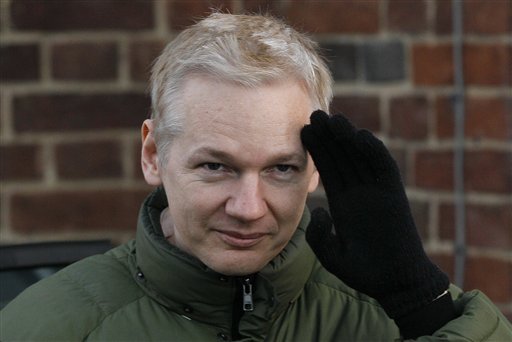
Julian Assange head of WikiLeaks gestures as he gets back into a car at Beccles Police Station in Suffolk, England, Friday, Dec. 17, 2010 after complying with bail conditions. Assange said he feared that the United States is getting ready to indict him, saying Friday that he believed that a grand jury was meeting to consider charges against him. He has repeatedly voiced concerns that American authorities were getting ready to press charges over WikiLeaks' release of some 250,000 secret State Department cables, which have angered and embarrassed officials in Washington. (AP Photo/Kirsty Wigglesworth)(Credit: AP) In London this morning, a British court held a procedural hearing regarding Sweden’s attempt to extradite Julian Assange in order to question him about sex crimes accusations. Afterward, Assange’s lawyers released an outline of the arguments they intend to make in opposition to extradition. Most of them centered around the impermissibility of extraditing someone who has not been charged with a crime — i.e., merely to interrogate them — but one of the featured arguments focused on the danger that if Assange were sent to Sweden, that country would then extradite him to the U.S., where Assange would be subjected to grave injustices:
Julian Assange, the founder of WikiLeaks, could be at “real risk” of the death penalty or detention in Guantánamo Bay if he is extradited to Sweden on accusations of rape and sexual assault, his lawyers claim.
In a skeleton summary of their defence against attempts by the Swedish director of public prosecutions to extradite him, released today, Assange’s legal team argue that there is a similar likelihood that the US would subsequently seek his extradition “and/or illegal rendition”, “where there will be a real risk of him being detained at Guantánamo Bay or elsewhere”.
Paragraphs 92-99 of the outline detail Sweden’s history of violating the Convention Against Torture by rendering War on Terror suspects to Egypt to be tortured, and concludes: “based on its record as condemned by the United Nations Committee against Torture and the Human Rights Committee, Sweden would bow to US pressure and/or rely naively on diplomatic assurances from the USA that Mr. Assange would not be mistreated, with the consequence that he would be deported/expelled to the USA, where he would suffer serious ill-treatment.” This danger is legally relevant because the governing Extradition Act bars the expulsion of a prisoner where “extradition would be [in]compatible with the Convention rights within the meaning of the Human Rights Act 1998.” The outline also cited vigilante calls from leading right-wing figures for Assange’s murder (yesterday, it was discovered that a prominent right-wing blogger, Melissa Clouthier, had registered the website JulianAssangeMustDie.com).
It’s quite notable that the mere threat of ending up in American custody is considered (at least by Assange’s lawyers) to be a viable basis for contesting extradition on human rights grounds. Indeed, this argument is not unusual. Numerous countries often demand, as a condition for extradition to the U.S., assurances from the U.S. Government that the death penalty will not be applied. Similarly, there are currently cases pending in EU courts contesting the extradition of War on Terror detainees to the U.S. on the ground that they will be treated inhumanely by virtue of the type of prolonged, intensive solitary confinement to which Bradley Manning — and thousands of other actual convicts — are subjected.
And now we have the spectacle of Julian Assange’s lawyers citing the Obama administration’s policies of rendition and indefinite detention at Guantanamo as a reason why human rights treaties bar his extradition to any country (such as Sweden) which might transfer him to American custody. Indeed, almost every person with whom I’ve spoken who has or had anything to do with WikiLeaks expresses one fear above all others: the possibility that they will end up in American custody and subjected to its lawless War on Terror “justice system.” Americans still like to think of themselves as “leaders of the free world,” but in the eyes of many, it’s exactly the “free world” to which American policies are so antithetical and threatening.
* * * * *
Speaking of American justice, ondelette, over at FDL, raises an interesting point: for those who believe that leading right-wing figures are inspiring violence (whether of the kind that just occurred in Arizona, things like this, or even calls for Assange’s murder), shouldn’t they be treated the same way American citizen Anwar al-Awlaki is: i.e., targeted by the U.S. Government with due-process-free assassination for inciting violence? Doesn’t the mentality justifying Obama’s assassination program necessarily extend to other Americans accused of “inciting” violence with their political speech? While it’s true that American officials — once the assassination efforts were leaked — began passing claims to journalists that Awlaki had an “operational role” in Terrorist plots, there has been no evidence presented of that, and the concern overwhelmingly with Awlaki is that he inspires violence with his political speech. If presidentially-decreed assassination is justified against him, why not other American leaders accused of inciting violence? Shouldn’t the President order them taken out, too?
Follow Glenn Greenwald on Twitter: @ggreenwald. More Glenn Greenwald.
From Watergate to WikiLeaks
A new book demolishes the myth of Deep Throat -- and the romance of heroic journalism
(Credit: AP/Kirsty Wigglesworth/Salon) In the movie “All the President’s Men,” the shadowy high-level source known only as Deep Throat tells Washington Post reporter Bob Woodward, “Follow the money.” The fact that this never happened — the words were invented by screenwriter William Goldman — detracted little from the scene’s power or the movie’s influence. It encapsulated a romantic myth of journalism: An intrepid reporter finds a wise whistle-blower who schools him in the abuse of power. In the movie and political memory, the top-level source enabled the crusading reporters to bring down a corrupt president.
Continue Reading Close
Jefferson Morley is a staff writer for Salon in Washington and author of the forthcoming book, Snow-Storm in August: Washington City, Francis Scott Key, and the Forgotten Race Riot of 1835 (Nan Talese/Doubleday). More Jefferson Morley.
WikiLeaks’ new phase begins
How Julian Assange's partnership with Anonymous could change the landscape of hacktivism
(Credit: Reuters/Tobias Schwarz/Stefan Wermuth) Today has been a very big day for WikiLeaks. It just released 5 million internal documents stolen from the private intelligence firm Stratfor, allegedly obtained by hacktivist collective Anonymous in December. This is huge; it’s the first time Anonymous has ever cooperated with an aboveground entity, lending an unprecedented amount of political legitimacy to the often inscrutable group. But why? What do these strange bedfellows have to gain from collaboration? With this new collaboration, Anonymous has obtained new credibility, and WikiLeaks has obtained a hugely valuable new source. This potentially powerful alliance could point to the future of the leak economy, and this awkward symbiosis provides each party with exactly what they need to move forward. A new age of transparency activism may have just begun.
Continue Reading CloseCole Stryker is the author of "Epic Win for Anonymous" and is currently working on a book about anonymous activism and online privacy, due for a fall release from Overlook Press More Cole Stryker.
Julian Assange prepares his next move
The WikiLeaks founder is doing TV, building a news organization and preparing his ultimate legal defense
WikiLeaks founder Julian Assange (Credit: AP) In a week or two, the U.K. Supreme Court will rule on the final appeal for Julian Assange, the editor in chief of WikiLeaks. If he loses, he will be extradited to Sweden to answer questions about alleged sexual misconduct. His legal team fears extradition to Sweden ultimately would mean extradition to the U.S., where Assange is the subject of a grand jury investigation in northern Virginia.
Continue Reading CloseDouglas Lucas is a writer in Texas. His website, www.douglaslucas.com, offers free fiction. Follow him @douglaslucas. More Douglas Lucas.
Obama’s unprecedented war on whistleblowers
From Manning to Kiriakou, critics are aggressively targeted as the White House turns a blind eye to abuses
Former CIA officer John Kiriakou and Bradley Manning (Credit: AP) On January 23rd, the Obama administration charged former CIA officer John Kiriakou under the Espionage Act for disclosing classified information to journalists about the waterboarding of al-Qaida suspects. His is just the latest prosecution in an unprecedented assault on government whistleblowers and leakers of every sort.
Kiriakou’s plight will clearly be but one more battle in a broader war to ensure that government actions and sunshine policies don’t go together. By now, there can be little doubt that government retaliation against whistleblowers is not an isolated event, nor even an agency-by-agency practice. The number of cases in play suggests an organized strategy to deprive Americans of knowledge of the more disreputable things that their government does. How it plays out in court and elsewhere will significantly affect our democracy.
Continue Reading ClosePeter Van Buren spent a year in Iraq as a State Department Foreign Service Officer serving as Team Leader for two Provincial Reconstruction Teams (PRTs). Now in Washington, he writes about Iraq and the Middle East at his blog, We Meant Well. His book, We Meant Well: How I Helped Lose the Battle for the Hearts and Minds of the Iraqi People (The American Empire Project, Metropolitan Books), will be published this September. More Peter Van Buren.
When a WikiLeaks lawyer runs into Eric Holder
During a chance encounter at Sundance, I pressed the attorney general about his plans for Assange -- and his legacy
Eric Holder (Credit: AP) “Slavery by Another Name,” a documentary based on the 2009 Pulitzer Prize-winning book by Douglas Blackmon, premiered this year at the Sundance Film Festival. The story was new to me: Between the Emancipation Proclamation and the beginning of World War II, tens of thousands of African-Americans were arrested on phony charges, slapped with massive fines they could not pay, and then sold into labor to some of the biggest industries in the country to work off their debt. I didn’t expect to learn that slavery essentially continued for decades after the Civil War. And I also didn’t expect – on vacation from my legal work advising WikiLeaks and Julian Assange — to bump into Attorney General Eric Holder. Having spent the week before Christmas at Fort Meade, Md., attending the Pvt. Bradley Manning hearing – Manning is charged with passing classified material to WikiLeaks — I knew what I had to ask him.
Continue Reading CloseJennifer Robinson is a London-based media and human rights lawyer who advises Julian Assange and WikiLeaks. Follow her on twitter @suigenerisjen More Jennifer Robinson.
Page 1 of 41 in WikiLeaks