The divisive underbelly of Reagan’s sunny optimism
It wasn't all patriotic homilies: Just ask the "welfare queens," "radicals" and "filthy speech advocates"
By Matthew DallekTopics: The Real Reagan, Ronald Reagan, War Room, Politics News
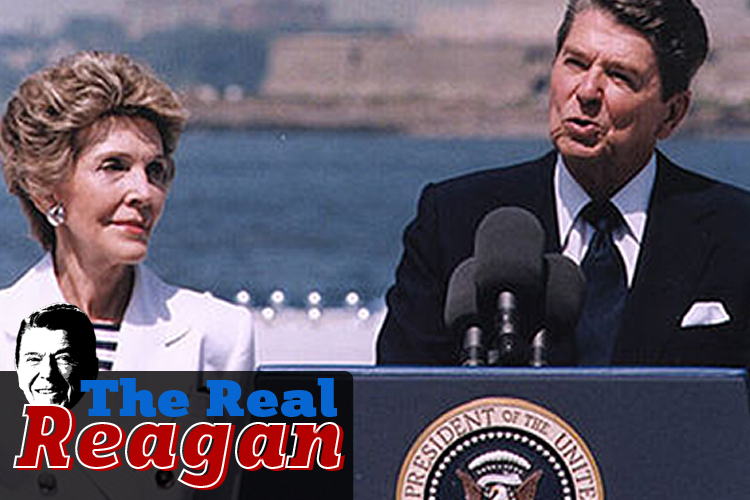
Ronald Reagan was an avuncular statesman whose unswerving faith in America’s destiny indelibly changed the course of American society for the better. That’s one way Reagan is remembered today, 100 years after he was born, and 22 years since his presidency ended. His optimistic streak is so ingrained in the popular mind, and so intricately associated with Reaganism, that Republican presidential hopefuls routinely invoke his spirit. Even Barack Obama’s recent State of the Union address was likened to Reagan’s gauzy, sanguinary rhetorical style.
Reagan the optimist is everywhere. It’s become a common refrain among not only Reagan’s defenders but also among a wider and less politicized audience: He revived Americans’ faith in their country and, deploying his “city on a hill” rhetoric, restored patriotic pride after the twin traumas of Vietnam and Watergate. This narrative isn’t entirely misplaced, of course.
Reagan was armed with speeches, dramatic backdrops, wit, good looks and an unpretentious disposition, which he used to communicate to Americans that he believed in the country’s fundamental decency and its capacity to promote the cause of liberty and justice worldwide. Reagan, Lou Cannon has written, was an “unabashed sentimentalist.”
Indeed, Reagan’s famous 1984 tribute at Normandy to the Allied soldiers who stormed the beaches in World War II captures his sentimental side — and his American creed. He told the assembled guests, including D-Day veterans, that they embodied American ideals of freedom and liberty: “You all knew that some things are worth dying for. One’s country is worth dying for, and democracy is worth dying for, because it’s the most deeply honorable form of government ever devised by man.”
But the absence of doubt in so much of Reagan’s repertoire — the Manichaean streak he routinely displayed — applied to other, darker aspects of his rhetorical legacy. Perhaps Reagan “delivered America from fear and loathing,” as historian John Patrick Diggins once said. But it’s also fair to point out that he sometimes adopted a raw, vitriolic approach to politics, and his capacity for tapping people’s anger should be remembered as an aspect of his legacy, too.
He skillfully channeled the surging 1960s-to-1980s-era national antipathy toward liberal reformers, the welfare state and student protesters, among other demons. He had an uncanny, almost instinctual feel for the electorate’s mood. Throughout his three decades in political life, he repeatedly seized on people’s hopes, but also found their anger and played on their fears. In Reagan’s lexicon, optimism competed with anger.
For instance, while he spoke of unleashing Californians’ individual initiative during his first 1966 gubernatorial campaign, he also tapped voters’ fears that the social order was beginning to crumble and that liberals and their allies had caused the crumbling. He campaigned by charging that “a small minority of beatniks, radicals and filthy speech advocates” had “brought shame” to the University of California at Berkeley, an elite, publicly funded school in the state’s higher education system. Describing California’s city streets as “jungle paths after dark” and college campuses as hotbeds of sexual licentiousness and immoral behavior, Reagan rode to power by depicting California as an overly liberal, permissive society. He vowed to crack down as one of his first priorities in the governor’s mansion. Appropriately, he had a sign in his capitol office that said: “Obey the rules, or get out.”
Nor was Reagan above using the hot-button social issue of race to further his political agenda by tacking rightward. At one news conference during his campaign for the 1968 Republican presidential nomination, Reagan refused to criticize Alabama Gov. George Wallace, who had become a leading symbol of segregation and white Southern resistance to the civil rights revolution of the mid-1960s.
As president, Reagan mocked “welfare queens,” implying that African-American women on public assistance habitually cheated taxpayers out of their hard-earned money. President Reagan also defended segregation academies such as Bob Jones University (where interracial dating wasn’t allowed), and, most infamously, praised the cause of “states’ rights” in a 1980 campaign address in Philadelphia, Miss., where three civil rights workers had been slain 16 years earlier.
Enemies lurked in Reagan’s often heated rhetoric about international threats to the United States. These enemies helped him to bolster his strong anti-communist credentials. While challenging incumbent Gerald Ford for the 1976 nomination, Reagan accused the president and other moderates of failing to defend America over the disputed Panama Canal. Reagan thundered on the stump that “[W]e built it, we paid for it, it’s ours and … we are going to keep it.” His rhetoric in that campaign, said historian Sean Wilentz, was “a throwback to the early 1950s, when Republicans attacked the Truman administration by caricaturing its ‘striped pants’ diplomats as effete, un-American, and soft on communism, and accusing these diplomats of having stabbed the country in the back.”
Reagan’s 1983 “evil empire” address is well-known, but it came in the context of decades of shrill broadsides against communist forces supposedly threatening to overrun the free world. Calling the Soviet Union “the focus of evil in the modern world” in that speech, President Reagan walked a fine line. He decried the Soviet system while also sometimes issuing more temperate calls for nuclear disarmament and arms control agreements between the two superpowers.
Another theme favored by Reagan — one that reigns in contemporary politics — is that the source of impending disaster within the United States was attributable to the growth of big government. A bloated, out-of-control Washington establishment bore the brunt of Reagan’s attacks. Washington wasn’t a city of public service, according to his worldview; it was home to legions of inept bureaucrats, corrupt government officials, and a leviathan central government bent on enlarging its own authority at the expense of state sovereignty and individual rights. The federal government squelched entrepreneurial energy, and undercut the guiding spirit of America — freedom.
If there was truth to his broadsides, there was also a hyperbolic quality. Just as Reagan buoyed a nation beset by two decades of internal strife, he also deepened the coarse nature of American politics. Far from hovering above the fray, he was very much enmeshed in the most contentious debates of his times, and any historical assessment of his legacy during this commemorative week should take into account his darker rhetoric and angrier public persona — and how they benefited him politically.
Matthew Dallek, an associate academic director at the University of California Washington Center, is the author of "The Right Moment: Ronald Reagan’s First Victory and the Decisive Turning Point in American Politics" More Matthew Dallek.
Related Stories
More Related Stories
-
Obstruction will ruin GOP
-
The real IRS scandal
-
Krist Novoselic: My plan to fix Congress, curb obstruction
-
RNC Chair: Don't call for impeachment without evidence
-
Power tool industry too powerful to regulate?
-
Will a GOP aide be fired over Benghazi email changes?
-
Is safe fracking possible?
-
How a fight with Rick Santorum made an IRS commissioner
-
Cornel West: "You can get killed out here trying to tell the truth!"
-
Berlusconi's parties featured women dressed as Obama
-
Human Rights Watch: Syrian government practiced torture
-
Allen West lands a gig at Fox News
-
Deficit reduction can't save us
-
ABC's Benghazi problem festers
-
10 ridiculous Christian Right prophesies
-
Obama pledges to end "scourge" of sexual assault in the military
-
Pentagon officials: Drone War on Terror is endless
-
Poll: Mostly Republicans are following IRS, Benghazi scandals
-
Bipartisan House group comes to tentative immigration agreement
-
Report: GOP mischaracterized Benghazi emails
-
Kinsley loves austerity because it is "spinach"
Featured Slide Shows
The week in 10 pics
close X- Share on Twitter
- Share on Facebook
- Thumbnails
- Fullscreen
- 1 of 11
- Previous
- Next
-
A missing poster hangs on a tree outside the Cleveland home of Amanda Berry Wednesday. Berry and two other women, Michelle Knight and Gina DeJesus, made a daring escape this week after being held captive for more than a decade.
Credit: AP/Tony Dejak -
Elvis Rafael Rodriguez and Emir Yasser Yeje offer their best impression of Eric B. & Rakim. On Thursday, New York prosecutors identified the pair as members of an international gang that robbed $45 million in a matter of hours by hacking into a database of prepaid debit cards and draining ATM machines around the world.
Credit: AP -
New Jersey Gov. Chris Christie walks to a podium during the groundbreaking ceremony for the Technology Enhanced Accelerated Learning Center at Essex County Newark Tech in Newark, N.J., Tuesday. Christie made less flattering headlines this week after undergoing a secret stomach surgery to curb his weight.
Credit: AP/Julio Cortez -
Workers stand outside the Tung Hai Sweater Ltd. factory in Dhaka, Bangladesh, Thursday after a fire broke out in its 11-story building. Eight people were killed in the blaze.
Credit: AP/Ismail Ferdous -
Workers rescue a woman trapped for 17 days in the rubble of a garment factory building in Saver, Bangladesh, Friday. The building's collapse was the worst industrial disaster in the country's history, killing more than 1,000 people.
Credit: AP -
Former South Carolina Gov. Mark Sanford gives his victory speech Tuesday in Mt. Pleasant, S.C., after winning back his old congressional seat in the state's first district.
Credit: AP/Rainier Ehrhardt -
Jodi Arias reacts in Maricopa Country Superior Court Wednesday after being found guilty of first-degree murder in the gruesome killing of her one-time boyfriend, Travis Alexander. Arias has subsequently said she wants the death penalty, claiming she'd "prefer to die sooner than later."
Credit: AP/The Arizona Republic/Rob Schumacher -
Ariel Castro stands for his mug shot Thursday at the Cuyahoga County Corrections Center, where he is being held on $8 million bail. The former bus driver is accused of imprisoning three young women and beating them repeatedly over a period of 10 years.
Credit: AP/Cuyahoga County -
Charles Ramsey addresses the media Monday after helping rescue three women held captive in Cleveland for more than a decade. Ramsey's hero portraiture has been complicated by revelations of his own domestic violence record.
Credit: AP/The Plain Dealer/Scott Shaw -
Michael B. Donley, Secretary of the Air Force, testifies during a Senate Appropriations Defense Subcommittee hearing on Capitol Hill Wednesday. The military branch was rocked this week after its chief sexual assault prevention officer was charged with sexual battery.
Credit: AP/Carolyn Kaster -
Recent Slide Shows
-
The week in 10 pics
-
Mobile Entertainment: 9 Amazing Drive-In Movie Theaters Still Standing
-
The week in 10 pics
-
The week in 10 pics
-
- Share on Twitter
- Share on Facebook
- Thumbnails
- Fullscreen
- 1 of 11
- Previous
- Next
-
Mobile Entertainment: 9 Amazing Drive-In Movie Theaters Still Standing
-
The week in 10 pics
-
The week in 10 pics
-
The week in 10 pics
-
The week in 10 pics
-
Netflix's April Fools' Day categories
-
The week in 10 pics
-
The week in 10 pics
-
The week in 10 pics
-
The week in 10 pics
-
The week in 10 pics
-
Slideshow: Nerd Obama
Related Videos
There is much to appreciate and even like about America's 40th president, and his two terms in office were not without significant achievements. But Ronald Reagan and his presidency are also badly misunderstood. To mark the 100th anniversary of his birth, we are offering what we hope will be a
respite from the hagiography that has taken hold elsewhere -- a critical, but fair and respectful, exploration of the real Ronald Reagan. Read the intro.
» The divisive underbelly of Reagan's sunny optimism by Matthew Dallek
» The "Southern Strategy," fulfilled by Steve Kornacki
» The scandal that almost destroyed Ronald Reagan by Robert Busby
» We fought a war on lies, and lies won by Joan Walsh
» The era of big spending and massive deficits by Andrew Leonard
» Ronald Reagan cared more about UFOs than AIDS by Alex Pareene
» Reagan's embrace of apartheid South Africa by Justin Elliott
» When Reagan was (much) less popular than Carter by Steve Kornacki
Related Stories
» Um, yeah, about Ronald Reagan's popularity ...
» Ron Reagan talks about his father's Alzheimer's
» About that Palin-Reagan comparison
» This week in baseless Reagan hagiography
» Mondale on Obama, and how he could've beaten Reagan
» Watch Reagan and the GOP get crushed in a midterm
» Goodbye, Ulysses; Hello, Ronnie
» What Sarah Palin forgets (or never knew) about Ronald Reagan
Most Read
-
Jaron Lanier: The Internet destroyed the middle class
Scott Timberg
-
When the IRS targeted liberals
Alex Seitz-Wald
-
Revenge, ego and the corruption of Wikipedia
Andrew Leonard
-
The man behind Abercrombie & Fitch
Benoit Denizet-Lewis
-
Pat Robertson: Husbands won't cheat if the wife makes the home "wonderful"
Jillian Rayfield
-
White House trolls Republicans over Obamacare hashtag
Jillian Rayfield
-
Is Reddit censoring openly racist users?
Fidel Martinez, The Daily Dot
-
Report: Millennials don't like Abercrombie & Fitch
Katie Mcdonough
-
Cannes: The 10 hottest movies
Andrew O'Hehir
-
My "truly remarkable" cancer breakthrough
Mary Elizabeth Williams


French President Hollande Signs Marriage Equality Bill
Obama Group Braces For Progressive Backlash Over Keystone
Republican Lawmakers Took IRS Union Campaign Cash
Comments
88 Comments