
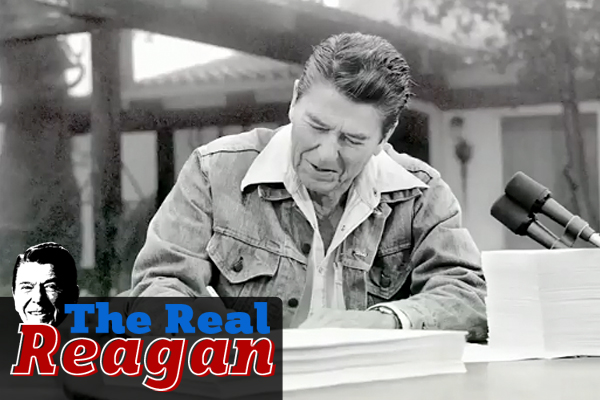

It is difficult to think of any single person more qualified to trace the roots of today’s massive budget deficits, Republican tax cut fundamentalism, and overall dysfunctional government than David Stockman, Ronald Reagan’s first budget director.
Stockman arrived at the White House in 1981, part of a new administration ferociously determined to cut taxes and cut spending in pursuit of the “Reagan revolution’s” primal goal of smaller government. But as reported in William Greider’s legendary 1981 Atlantic magazine profile, “The Education of David Stockman,” nothing quite proceeded according to plan. Reagan cut taxes while boosting spending, and we’ve been living with the consequences ever since.
Stockman is currently working on a book about the financial crisis, and on Thursday he spoke with Salon about what happened in the 1980s, and how the economic decisions made during the Reagan era connect directly with where we are today. To provide some context for the interview, he also provided his own short written analysis of the Reagan economic record, which Salon is including here in abridged form.
The Reagan Revolution was a Lincoln Day Dinner speech. It never happened in the real world of fiscal policy. During the 1980’s, Big Government got bigger and the Federal tax burden was just shuffled, not reduced. The main fiscal legacy of the Reagan era is that the Federal debt was raised from $1 trillion to $3 trillion. Unfortunately, when the economy rebounded after Federal Reserve Chairman Paul Volcker’s conquest of runaway inflation, Republicans embraced the dangerous shibboleth that deficit-financed tax cuts are good for growth.
The reason spending went up is that there was no reform of the big entitlements like Social Security and Medicare and not a single department or function of government was eliminated…. Further, many of the initial cuts in discretionary programs were restored over the years, and the cost of interest on the ballooning Federal debt rose significantly.
The tax burden rose during the Reagan era as well. Specifically, when Reagan left office Federal taxes accounted for 18.4 percent of GDP — a figure slightly higher than the 1960-80 average of 18.0 percent. More importantly, nearly half of the massive 1981 tax reduction — festooned as it was with every manner of special interest tax breaks that K-Street lobbyists could conjure — was recouped during the next four years in a series of annual deficit reduction bills that a bi-partisan majority was able to persuade the President to sign.
At the end of the day, during the 1980s income tax rates were lowered, the tax base was broadened through loop-hole closing and the 1986 tax reform act and the payroll tax was raised by a full percentage point of GDP as part of the 1982 Social Security rescue plan. On net, however, there was no reduction in the total Federal tax burden during the Reagan era. What survived was an anti-tax religious catechism which has left the country with two free lunch parties and no prospect of responsible fiscal governance.
I wasn’t sure what a “Lincoln Day Dinner” was so I did some Googling and discovered that it is an annual Republican event that in some regions has now been renamed Reagan Day. The rebranding seems to fit nicely into your metaphor: Reagan is remembered as the president who said government was the problem, and he pledged to cut both taxes and spending, but at the end of his term government was bigger, and the national debt had exploded. Given the facts, what explains the persistence of Reagan’s legacy?
Political rhetoric can last for decades, notwithstanding a dramatic change in the underlying facts. To go to the other party, there are a lot of Democrats who are still talking about the glories of the New Deal or the Great Society, and neither of those rhetorical formulations are relevant to 2011 or the decade ahead either. It’s only when there is some dramatic change in circumstances that a new formulation or a new creed appears. That hasn’t happened yet but it will, because I think the next decade is going to be about continuous fiscal crises and it’s going to be about a continuous effort to raise taxes to close this gap, which will be highly uncomfortable for both parties but soon will be unavoidable.
Unavoidable? How so? Except for one short period during the Clinton administration, Congress and the White House have been very successful at avoiding any such reckoning — a habit that dates at least as far back as the Reagan administration. What makes the present any different?
One of these days, the global bond market is going to react pretty negatively to the continued fiscal excesses in the United States. When that happens the market vigilantes will impose the same discipline as the state level constitutions that require balanced budgets are imposing today at the local level.
But why hasn’t that happened yet? Economists like Paul Krugman argue that the bond market is more worried about the slow economy than it is about the debt, so it makes sense to take advantage of low borrowing costs and stimulate the economy in the short term.
I think that is sheer dreaming. The reason that the crisis has not yet come is that the Fed’s policy for the last two or three decades has been to stimulate U.S. consumption beyond what we could pay for in our production and earnings. That created an equal and opposite imbalance among the mercantilist Asian exporters, who wanted to rapidly grow their economies by building up their export industries. We had nothing to pay for their shipments with, and so they loaned us the money. The fact that China today has $2.9 trillion worth of reserves is just a measure of how sick and distorted the system is.
At some point that system is going to break down, and I think it’s near that point now. In fact the largest owner of U.S. debt is no longer China, it is the Federal Reserve, which now owns 11 percent of all Treasury debt — about $1.1 trillion worth. To stimulate the economy the Fed is buying $8 billion or $10 billion of Treasury debt every business day — that’s as much as is being issued — and it is keeping interest rates inordinately low. The negative thing about all this is that it has given a terrible signal to the politicians, who believe that new debt is essentially free. Why are you going to make any tough, painful choices when it seems like you can just fund the government like that, and it’s not going to cost anything? I think that’s an illusory signal and a prescription for disaster. When the debt costs start rising, the cost of carrying all the debt you’ve accumulated starts to soar, and and we’re walking right into the trap.
You keep making references to a time scale of “two or three decades.” In an Op-Ed you wrote for the New York Times last year, you called the easy money era “a 30-year period of phony prosperity.” You’ve also said that the “insidious doctrine that deficits don’t matter if they result from tax cuts” dates back three decades. Doesn’t that place responsibility for the political failure to balance our books and pursue a responsible monetary policy squarely within the eight years of the Reagan administration?
The wrong lesson was taken from the 1980s. We didn’t cut back government at all; government got bigger. We didn’t reduce the tax burden, we just avoided increases. But the conclusion was drawn that there was a great prosperity in the 1980s due to the Reagan tax cut. I don’t believe that at all. I believe that the expansion that we had for a few years was due to the fact that Paul Volcker’s Fed crushed inflation. Had we stayed on a disciplined monetary track, the subsequent decades might have turned out better. But instead in 1985, we had the Plaza Accord, in which we trashed the dollar to boost our own exports. I think that was a purely unilateral nationalistic policy designed to stimulate the U.S. economy, regardless of the impact on the world monetary system or on our trading partners. It began a process that lasted for 25 years. The Fed became the underwriter of prosperity that wasn’t real.
Who do you blame for that? The White House? Congress?
I blame the White House in the mid-’80s. Volcker was running decent monetary policy, but he was forced into backing the Plaza Accord.
Does President Reagan deserve any of the blame?
Well, I don’t think so, really. To the extent that Reagan focused on monetary policy, he believed in the gold standard, if anything. So I can’t fault him for easy money. But I can say that his advisors, particularly James Baker, when he went to Treasury, had sort of a Texas attitude toward money, and that is you can never have low enough interest rates.
I was in college during Reagan’s first term, and coming from a very liberal family I was predisposed to be critical, and I was driven a little crazy by the gap between Reagan’s rhetoric and the political reality on the ground. But looking at Congress today …?
That was a small gap compared to today. Rhetoric has become utterly detached from the facts and reality. Republicans think they can solve the $1.5 trillion deficit problem with spending cuts when they can’t even come up with $50 billion in cuts that they are willing to make.
And you think the only cure for this detachment from reality will come from the bond market?
I think there will be massive dislocations. There won’t be just one. It will be chronic. The world bond market will become increasingly unstable, and there will be a persistent trend toward higher and higher interest rates. There will be crises from time to time that will require emergency fiscal action. Congress will paper together grudging measures to restrain spending and raise new revenue, but it will never be enough, and another episode will follow. That’s baked into the cake for the next 10 years.
You’ve written that the Wall Street bailout “in essence repudiated the entire Reagan revolution.” What do you think about the thesis that the deregulatory impulses that received such a huge boost under Reagan contributed to Wall Street’s recklessness … and laid the groundwork for the financial crisis?
The only thing that was seriously deregulated during the Reagan era was banks, and that was the wrong thing to deregulate. Surface transport deregulation was started by Carter and we finished it, airline deregulation was already done by the time we came in. And those were the right things to do. But in the case of financial institutions, banks are not free enterprise businesses, they are wards of states, they have the right to create money out of thin air. They have to be regulated, and they have to be kept out of the speculative use of deposits that are guaranteed by the taxpayer, by the FDIC. And in the ’90s, the Clinton administration joined in on this, with the elimination of Glass-Steagall and all of the other remaining restraints on the banking system. That was a tragic, terrible error; it was a confusion of the free market with a set of institutions that are inherently dangerous. And as a result of bad monetary policy interacting with the deregulation of depository banking you created a witches’ brew that ended up predictably in the meltdown of 2008.
Sounds like we’ve just stumbled on the thesis of the book you are writing about the financial crisis.
Yes.
What do you think about the comparisons that pundits like to make between Obama and Reagan?
I think it’s inappropriate. Reagan was an optimist by nature, it was built into his temperament. But he also was a man of deep conviction, who had built up certain fundamental beliefs about public policy over decades, going all the way back to his college days in the 1920s. If there was any fault, it was an unwillingness to recognize that these great convictions were not being implemented. And that’s very different from Obama. I can’t see the man has a single principle. I think he is an utter opportunist, a pragmatist. The only change you can believe in is that he changes his mind every day and every week. If he believes that the upper 5 percent has way too much income and wealth — which, frankly, I agree with — then he should have dug in his heels and said, “I am not going to sign a bill to extend the tax cuts for the top tax bracket.” What did he do? He folded like a lawn chair within two days. So I don’t think there’s any comparison at all. I thought his State of the Union speech was dreadful — I called it a “ponderous procession of pieties and platitudes.” He didn’t ask the American public for one sacrifice, didn’t warn us of one dark cloud on the horizon, and simply gave a lot of cheerleading hoopla that had almost no connection with the real choices that, unfortunately, we face.
