
Guantanamo
Guantanamo death highlights U.S. detention policy
A 48-year-old Afghan citizen dies at the camp after 9 years in a cage and no charges filed against him
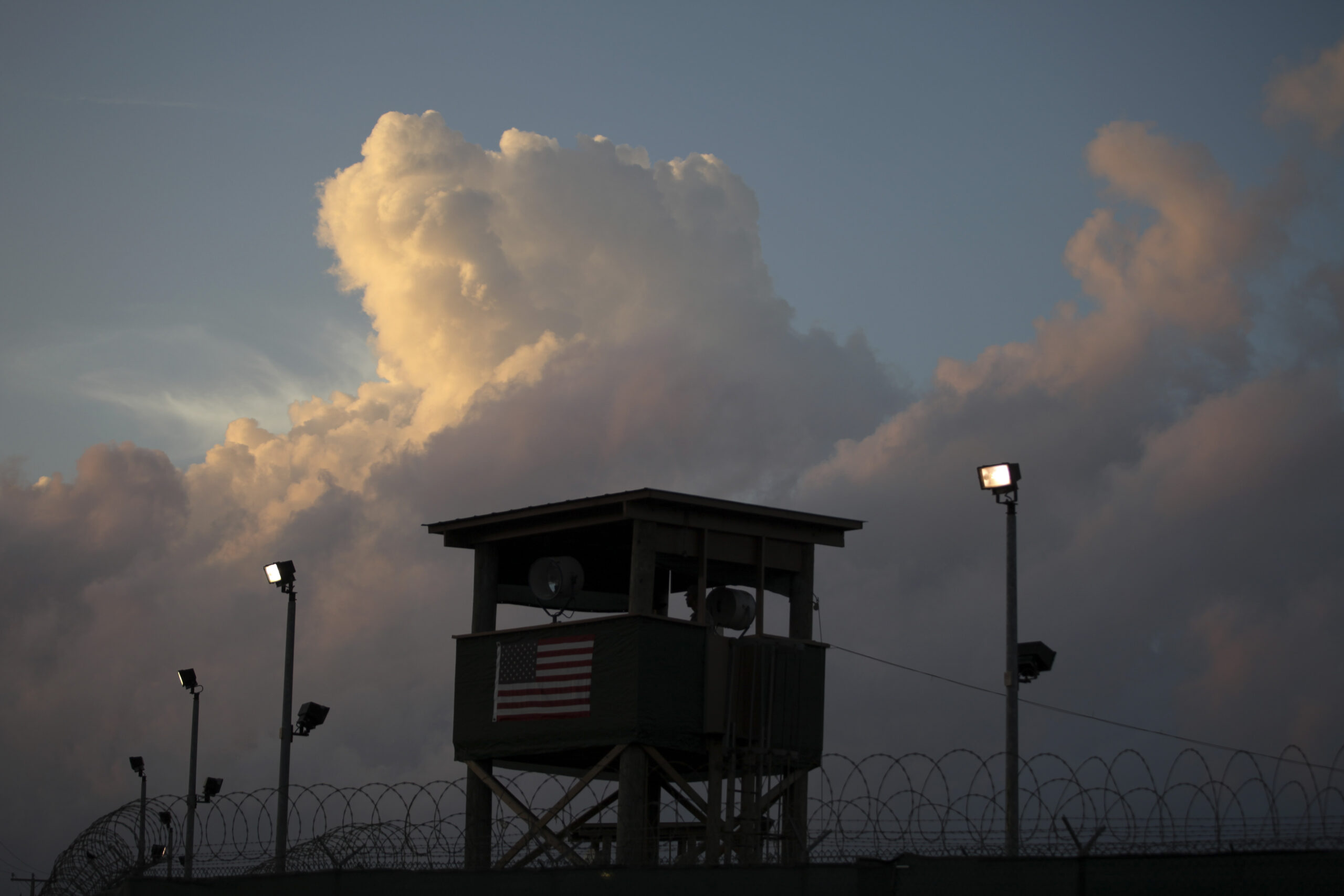
A guard looks out from a tower in front of the detention facility on Guantanamo Bay U.S. Naval Base in Cuba. (Credit: Associated Press) A 48-year-old Afghan citizen and Guantanamo detainee, Awal Gul, died on Tuesday of an apparent heart attack. Gul, a father of 18 children, had been kept in a cage by the U.S. for more than 9 years — since late 2001 when he was abducted in Afghanistan — without ever having been charged with a crime. While the U.S. claims he was a Taliban commander, Gul has long insisted that he quit the Taliban a year before the 9/11 attack because, as his lawyer put it, “he was disgusted by the Taliban’s growing penchant for corruption and abuse.” His death means those conflicting claims will never be resolved; said his lawyer: ”it is shame that the government will finally fly him home not in handcuffs and a hood, but in a casket.” This episode illustrates that the U.S. Government’s detention policy — still — amounts to imposing life sentences on people without bothering to prove they did anything wrong.
This episode also demonstrates the absurdity of those who claim that President Obama has been oh-so-eagerly trying to close Guantanamo only to be thwarted by a recalcitrant Congress. The Obama administration has sought to “close” the camp only in the most meaningless sense of that word: by moving its defining injustice — indefinite, due-process-free detention — a few thousand miles north onto U.S. soil. But the crux of the Guantanamo travesty — indefinite detention — is something the Obama administration has long planned to preserve, and that has nothing to do with what Congress has or has not done. Indeed, Gul was one of the 50 detainees designated by Obama for that repressive measure. Thus, had Gul survived, the Obama administration would have sought to keep him imprisoned indefinitely without any pretense of charging him with a crime — neither in a military commission nor a real court. Instead, they would have simply continued the Bush/Cheney policy of imprisoning him indefinitely without any charges.
There’s one other aspect of this episode that warrants attention. In its 2008 Boumediene decision, the Supreme Court struck down the provision of the Military Commissions Act which denied habeas corpus review to all detainees, and ruled that Guantanamo detainees at least have the right to a one-time review by a federal court as to whether there is credible evidence to justify their detention (a far less rigorous standard than the one that applies if they’re charged with a crime and the state has to prove their guilt beyond a reasonable doubt). Gul had filed a habeas petition and it was fully argued before a federal court back in March – 11 months ago. The federal judge never got around to issuing a ruling.
This happens quite frequently in our court system: judges simply fail to act within anything resembling a reasonable period of time. Gul was imprisoned for 8 years without a shred of due process (outside of internal Bush Pentagon “administrative reviews”) and finally had his Constitutional right to obtain habeas review affirmed by the Supreme Court in 2008. His habeas petition was fully submitted and orally argued almost a full year ago, yet even in the face of his prolonged, due-process-free imprisonment, the federal judge presiding over the case just never bothered to rule on his claims. There’s a well-known legal maxim that “justice delayed is justice denied,” but this goes well beyond merely violating that. Taking almost a full year — at least — to decide a habeas petition for someone who is languishing in indefinite detention for their ninth year is simply inexcusable.
Gul’s death — and what turned out to be his due-process-free life sentence — is an important reminder of the heinous detention policies of the U.S.: not as a matter of the Bush/Cheney past, but very much the current U.S. posture as well. The only difference is that there is no more partisan gain to be squeezed from the controversy, so it has blissfully disappeared into the harmonious dead zone of bipartisan consensus.
* * * * *
All of this finds a nice symbolic parallel in the Obama administration’s apparent efforts to install Omar Suleiman as interim Egyptian leader; Suleiman is not only steadfastly pro-American and pro-Israeli, but was long the U.S.’s point man for renditions and the severe torture which accompanied it. This is what is meant when we hear repeatedly about what a stalwart “ally” the Mubarak government been in the ”War on Terror”: they’ve dutifully detained and brutalized anyone we wanted.
Follow Glenn Greenwald on Twitter: @ggreenwald. More Glenn Greenwald.
Memorial for America’s conscience
On this holiday, Americans should confront a grim fact about our country: We are torturers
In this Oct. 9, 2007 file photo US military personnel inspect each occupied cell on a two-minute cycle at Camp 5 maximum-security facility on Guantanamo Bay U.S. Naval Base in Cuba. (Credit: AP Photo/Brennan Linsley, file) Facing the truth is hard to do, especially the truth about ourselves. So Americans have been sorely pressed to come to terms with the fact that after 9/11 our government began to torture people, and did so in defiance of domestic and international law. Most of us haven’t come to terms with what that meant, or means today, but we must reckon with torture, the torture done in our name, allegedly for our safety.
It’s no secret such cruelty occurred; it’s just the truth we’d rather not think about. But Memorial Day is a good time to make the effort. Because if we really want to honor the Americans in uniform who gave their lives fighting for their country, we’ll redouble our efforts to make sure we’re worthy of their sacrifice; we’ll renew our commitment to the rule of law, for the rule of law is essential to any civilization worth dying for.
Continue Reading CloseBill Moyers is managing editor of the new weekly public affairs program, "Moyers & Company," airing on public television. Check local airtimes or comment at www.BillMoyers.com. More Bill Moyers.
Michael Winship is senior writing fellow at Demos and a senior writer of the new series, Moyers & Company, airing on public television. More Michael Winship.
Khalid Sheikh Mohammed gets his way
Obama officials insisted the terror mastermind receive a military tribunal this week, but their arguments are bunk
Detainees at Guantanamo Bay (Credit: Reuters) A military guard will be on each arm of Khalid Sheikh Mohammed as he is led into a courtroom on Saturday to be arraigned for a second time before a military commission at Guantanamo Bay. He went through the same process in the same courtroom on nearly the same charges almost four years ago in the closing months of the Bush administration. The fact that President Obama chooses now, six months before voters choose between him and Mitt Romney, to restart what some have dubbed “the trial of the century,” using a second-rate system of justice he had ordered stopped at a facility he had ordered closed, makes an unflattering statement about the timidity of his leadership and the malleability of his principles.
Continue Reading CloseMorris Davis was chief prosecutor for the military commission at Guantanamo Bay, Cuba, from 2005-2007. He is a retired U.S. Air Force colonel and a member of the faculty at the Howard University School of Law in Washington, D.C. More Morris Davis.
Guantanamo’s deepening failure
The secretive military system for prosecuting accused terrorists is a travesty, says the man who once ran it
Morris Davis (Credit: AP/Reuters/Yuri Gripas) The U.S. Defense Department specializes in euphemism. “Limited kinetic action” is a polite way of saying “war,” and “collateral damage” does not sound as blunt as “dead children.” When I was chief prosecutor for the military commissions at Guantanamo Bay during the Bush administration, I was told not to say publicly that a detainee had “attempted suicide.” The government-approved term for the act was “self-injurious behavior.” I could not say “torture,” or as some called it, the “T-word.” Instead, I had to say “enhanced interrogation techniques.”
Continue Reading CloseMorris Davis was chief prosecutor for the military commission at Guantanamo Bay, Cuba, from 2005-2007. He is a retired U.S. Air Force colonel and a member of the faculty at the Howard University School of Law in Washington, D.C. More Morris Davis.
Guantanamo’s system of injustice
The first trial of an accused terrorist exposes the flaws of "reformed" military commissions
Camp Delta, the military-run prison, at the Guantanamo Naval Base in Cuba (Credit: AP) Brig. Gen. Mark Martins, chief prosecutor for the Office of Military Commissions, has lately appeared at bar association conferences promoting “reformed military commissions” at Guantanamo. Speaking to the New York City bar association on January 11, Martins said the military commissions were “comparable to federal courts in their incorporation of all of the fundamental guarantees of a fair and just trial demanded by our values.” Indeed, a new masthead on the military commission website, put up after Martins took over, reads: “Fairness, Transparency, Justice.”
Continue Reading CloseLaura Pitter is counterterrorism advisor in Human Rights Watch’s US Program. More Laura Pitter.
Jon Stewart blasts Congress, Obama over terror bill
The Comedy Central host voices amazement at the government's newest encroachments on civil liberties VIDEO
If you’re a stickler for civil liberties, then you probably find the National Defense Authorization Act to be somewhat troubling. The annual defense appropriations bill, which received the seal of approval from Congress last week, contains provisions that would allow the government to detain terror suspects (and associates thereof) for an indefinite period of time, without a trial.
The Obama administration has suggested that it’s open to a veto of the bill — a move that would appear consistent with his opposition to indefinite detentions when he was running for president. The only problem — as Jon Stewart pointed out on “The Daily Show” last night — is that the President Obama would veto the bill not because it runs counter our conception of liberty … but because it doesn’t go far enough.
Continue Reading ClosePage 1 of 26 in Guantanamo