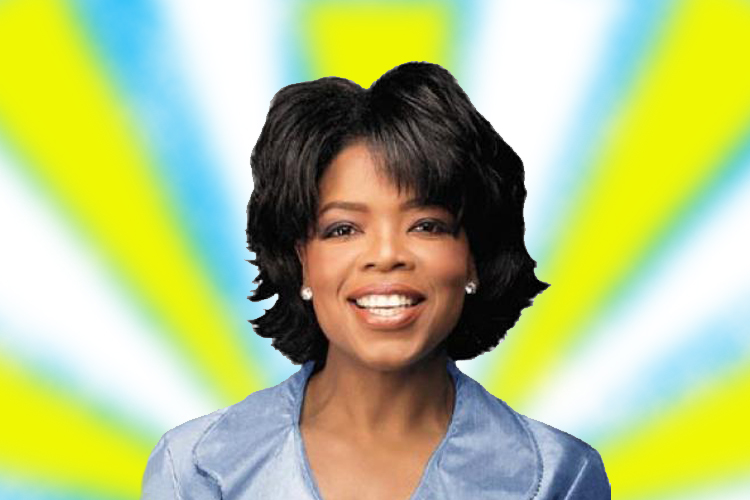

Oprah Winfrey

“Oprah: Gospel of an Icon”: Worshipping at the church of Oprah Winfrey

The talk show host is a preacher for a country increasingly skeptical of organized religion, explains an expert

  • more
    • All Share Services

In the past quarter-century Oprah has become shorthand for self-help: a spiritual guide, a confessor and a warm shoulder for her adoring American public. Now in the final season of her revolutionary daytime talk show, Oprah’s pronouncements have become the Word to live by for a staggeringly diverse audience. In fact, you could argue she is a religious leader for an America increasingly skeptical about organized religion.

It’s an idea that Kathryn Lofton explores in “Oprah: The Gospel of an Icon.” Assistant professor of American studies and religious studies at Yale, Lofton sees religious preaching methods in the way Oprah hosts her show, as well as a formulaic, sermon-like approach to every topic — whether it’s healing the wounds of sexual abuse or what new exfoliating cream you should buy. Oh Oprah, who art on television, tell us how to live a good life.

Salon spoke to Lofton over the phone about Oprah’s message, the daytime guru’s own skeptical views of religion, and what our love of Oprah tells us about the American hunger for help and guidance.

What was it about Oprah that made you think of her in the context of American religious history?

Within these very corporate formats of daytime television, extraordinary forms of suffering were being confessed to and described. There’s a great book about Oprah by Eva Illouz, “Oprah Winfrey and the Glamour of Misery,” and Illouz points out something that I dig into, and that is the strange way in which the extremity of human despair — not merely estranged spouses, we’re talking stories of people coming home and seeing that their spouse has murdered all their kids and then themselves — are being dealt with in the same way as these topics that are seemingly shallow. Good glasses for a spring party, best new strategies for boyfriend wear. This exposure of human need at 4 p.m. on a weekday afternoon made me think, “What is this thing?” We’re so accustomed now to reality programming and a whole spate of shows spun off from Oprah, but, as a scholar of a religion, I think it’s one of our jobs to be cued into how people manage pain, and the idea of evil, or whether or not we live in a just world.

What is Oprah’s religious background?

Oprah talks about a Baptist church that her grandmother took her to in Mississippi. She tells an anecdote about how she was a successful young churchgoer and was asked to preach in front of that audience and was a very good girl who memorized scriptural passages. Then in her adulthood, she has some criticism of male figures in the church and the dominance of male authorities and it seems that by the time we get to the ’90s, it’s circulating that she’s no longer a member of the church but she continues to use Christian idioms in her conversational speech. She says, “Jesus lives.” She’ll say, “Amen.” She’ll occasionally sing lines from obviously Protestant hymns, but she claims now that she’s no longer interested in organizational religion, and she’s more interested in a personal relationship with God. Indeed, she has around her a large collection of spiritual purveyors of a wide variety: Buddhist, Hindu, Unity Church. Every flavor of the contemporary, spiritual rainbow is welcomed into her studio.

What does our reverence for Oprah say about our culture and religion in America today?

I think it says that most Americans see very little that is contradictory about connecting consumption and spirituality. I think it also shows that no matter how anti-establishment, or anti-authoritarian, or freedom-hungry Americans claim to be, they are also, always, hungry for help. Hungry for recognition. Hungry for guidance in the mad excesses of the American material world. Hungry for someone to limit their choices a little, and offer some discriminating preferences on your behalf.

If Oprah is a preacher, what is she telling us? What is her gospel?

Her gospel — her good news — is you. The good news is that if you take hold of your life; if you discover (as she says) your best life, anything is possible. Of course, this good news is translated not only through her exhibition of you — you through her audience members, guests, columnists, message board commentators — but also through the unending rehearsal of her. The good news is her revelations about her best life — lived, she says, in service to you.

Why do you think so many people who shun religion are comfortable looking to Oprah for “spiritual guidance”?

Precisely because she says she doesn’t seem typical in her authority. Because she represents — in her race and gender and origins — being utterly outside established power. Also, she isn’t preaching to sell you something singular. She says, over and over: I am here to let you be you. My answers are mine, and they made my struggling life something fantastic to share. You’re not joining a group, you’re just finding your inner fabulous. This is appealing to people who associate religion with controlling authority, rigid dogma or social adherence. This is a religion for those who don’t want to be religious, but want to feel revelation.

You connect Oprah to early traditions in American evangelical preaching. Not just her charisma and eloquent speaking ability, but less obvious connections. Can you explain that?

I connect her to two figures — George Whitefield, a prominent 18th century minister, and Charles Finney, a 19th century minister — who weren’t merely interested in spreading the gospel but also eliciting conversion. There’s an idea that a gospel is true if the purveyor is willing to talk about how it’s made. Oprah does that every time she does a show about “Oprah without makeup” or a confession about her weight gain — this is her showing the strings of her own construction.

The other tradition I connect her to is the emergence of women as evangelical preachers, who always had to be conscious that they were being somewhat insurrectionist to the Word by even being out in the public. Oprah tries to appeal to an audience that wants to see a successful and capable woman without being too perfect. She can’t be too obnoxious in the face of the conservative domestic idea that we still have for women. So Oprah isn’t married nor does she have children because if she had those things and was also trying to be Oprah, her audience would be uncomfortable. That she is free to minister only to them and is not responsible to a domestic life actually puts her in a long line of preachers with similarly ambiguous lives.

What do you think of Oprah after spending so much time scrutinizing her?

I think that I’d be doing a great disservice to her work if I don’t emphasize that her viewers take from her inordinate comfort and a life that they describe as asking too much of them. The second thing that I think about is the extraordinary American fact of her. She talks about this a lot too, and this is where she becomes a great subject for me. She is an indication of the American dream. I’m interested in how that dream is unbelievable, extraordinarily powerful, and possibly corrupt.

Genevieve Walker is an editorial fellow at Salon.

NBC comedy stars keep themselves relevant after finales

Alec Baldwin and John Krasinski shill baseball hats in viral ads, "Community" character gives Emmy picks, and more

  • more
    • All Share Services

NBC comedy stars keep themselves relevant after finalesYankees vs. Red Sox, Baldwin vs. Krasinski, or "30 Rock" vs. "The Office": who is your favorite?

What do the stars of NBC’s Thursday night comedy lineup do during their summer vacation? Keep themselves fresh, of course. Sometimes it’s a little hard to tell if these guys can separate themselves from their characters, but who’s complaining if there’s a real Ron Swanson or Jack Donaghy walking around?

“30 Rock’s” Alec Baldwin and “The Office’s” John Krasinski have figured out what they’re doing with their off-season, and that’s punching each other in the face about baseball. No, seriously. In this series for New Era Caps, Baldwin goes head to head with Jim Halpert over their Red Sox/Yankees rivalry. So far there have been three spots, and if you play them in succession it’s kind of like watching a crossover episode between the two shows.

Meanwhile, Amy Poehler isn’t the only cast member of “Parks and Recreation” keeping herself in the spotlight. While the comedian is off giving speeches at Harvard, her costar Nick Offerman (who plays her boss and meat-lover Ron Swanson) has been wooing Oprah to come play his first ex-wife next season.  As he told the Huffington Post:

“I think Oprah would be the only, she’s the only person we can think of that might be intimidating to Megan Mullally. It would be so good.”

He then added, “I can assure you if it’s not Oprah, I will quit.”

And while that’s doubtful, Oprah should actually consider it. She did cameo on “30 Rock,” so it’s only fair.

Rounding out the news cycle is Danny Pudi, who plays Abed on “Community.” Anyone who still thinks that show isn’t being taken seriously should check out Variety right now, where “Abed” has been given a column in-character for Emmy season. He’s predicting who will win the awards based solely on his extensive knowledge of television and film (despite never having seen the shows in question), as well as his more savant-like tendencies:

I sort the last four into two groups: a) shows that have won an Emmy, so it seems like they’ll win again, and b) shows that haven’t won yet, so it seems like their turn. Sorting every winner since “I Love Lucy” in 1953:

 B A B B A B A B B AA B B AB B A A B B AA A B A A B B A B B A B AB                              A A B B A A A A B B B B B B A B B A A B

The “ABBA” pattern emerges soon and repeats often, as people’s urge to shake up a system always results in systemic shaking. I totally get it: I once missed a week of school by trying not to touch my chin 7,000 times. The stretches of non-ABBA you see are “cable scares,” like when we just kept giving Emmys to “Frasier” until “Larry Sanders” went away. Think of TV as Rain Man getting through HBO’s smoke alarm by chanting “I like the guy from Cheers.”

The whole article is amazing, and by far my favorite post-finale offering from an NBC comedy actor. Then again, I’m a little biased.

Continue Reading Close

Drew Grant is a staff writer for Salon. Follow her on Twitter at @videodrew.

Pop Torn: 10 pieces of culture we’re feeling iffy about

From "True Blood" to Mark Zuckerberg killing a goat to a purse made out of jerky, this week is all about meat

  • more
    • All Share Services

Pop Torn: 10 pieces of culture we're feeling iffy about

Memorial Day weekend, you guys! I know that I will be happy to wear all my white clothing again, because nothing says “I’ve been to a summer barbeque” like visible condiment sauce all over my clothing.

And with this warm weather comes tons of pop culture news stories that are just to the right of funky. We’ve rounded up some of the stranger stuff that we missed this week, and leave it up to you to decide if maybe being raptured wasn’t such a bad idea.

1. People who think the Onion’s headlines are real: Oh, it happens. And now it’s a Tumblr. (Expect a book deal in the near future.)

2. Abed from “Community” shows up on “Cougar Town”:

Easter egg for the super fans and the people who love Subway.

3. OWN picks up new series, “Don’t Tell the Bride“: Groom and future wife are separated for a month before the wedding; he has to make all the decisions about planning the event. Hope she likes nachos and a boob-shaped cake.

4. Student makes Chanel bag out of beef jerky:

(Photo by Nancy Wu)

Oh what? It’s all cowhide, no matter which way you look at it. Calm down and take a bite.

5. Museum-going men are happier than their counterparts: That 2 percent of the male population must be having a blast.

6. This mommy kitten is hugging her baby kitten:

Yes, dear, it’s very, very cute. Please let me go back to bed now, I have work in the morning. Well, if it’s so great, take a video of it! I’ll watch it later.

7. “Pop-Up Video” is coming back to VH1: Though now it’s just called “tweeting during music videos.”

8. “Jersey Shore’s” Ronnie and the Situation get into a fistfight in Florence: Really, guys? Really? Italy was ready to boot you out before you even showed up, and this is how you show your good behavior?

9. Mark Zuckerberg, woodsman: The Facebook CEO will only eat food he kills himself. His private message to friends on FB just read: “I just killed a pig and a goat.” And not on FarmVille.

10. “True Blood’s” fourth season trailer:Oh great, now I have to deal with witches?

Our thoughts exactly.

Continue Reading Close

Drew Grant is a staff writer for Salon. Follow her on Twitter at @videodrew.

Conan’s Oprah fan taxonomy

O'Brien's guide to Oprah's audience rounds up familiar types, from "The Weeper" to "The Man Who Rocks and Claps"

  • more
    • All Share Services

Conan's Oprah fan taxonomy

Last night, Conan O’Brien celebrated Oprah Winfrey’s final show by honoring “the people who made the The Oprah Show truly special” over the years: her audience members. His team compiled a jokey Oprah-fan classification, encompassing all sorts — from “The Jumping Clapper” and “The Face Fanner” to “The Extremely Alarmed Grandma” and “The Man Who Rocks and Claps.”


Continue Reading Close

Emma Mustich is a Salon contributor. Follow her on Twitter: @emustich.

Oprah’s warm, funny, self-aggrandizing goodbye

Winfrey ends her show with a 42-minute monologue that encapsulates her many baffling contradictions

  • more
    • All Share Services

Oprah's warm, funny, self-aggrandizing goodbye

Oprah Winfrey’s final show summed up everything she’s been about for a quarter century. It was funny, warm, sweet and informative, and felt easygoing even though it was clearly written and rehearsed within a millimeter of its life. The episode had sharing and oversharing, confessions and anecdotes, photographs of Oprah in unfortunate clothes and hairstyles, and callbacks to shows and guests that made a big impression on the host during her journey toward self-knowledge — which, she assured us, was what her boundary-breaking, influential, astoundingly popular stint on daytime was truly about, anyway.

No, wait, scratch that. Her show wasn’t truly about Oprah at all. It was about you. All of you. But especially you, the individual sitting there watching her “every day,” as she said.

She had a message for you, the individual. Several messages, actually — and they were all intertwined: Take responsibility for your life. Be honest with yourself and others. Be responsible for the energy you put out in the world, because that energy comes back around eventually. Also: There is a God, or a life force, and you should get to know him/her/it, because he/she/it can improve your judgment and guide your life.

There was a clip reel of people admitting things on TV that they had never told close friends and family members. They said they were alcoholics or drug addicts, that they had HIV, that they had endured or inflicted spousal abuse. The confessions had a snowball effect and became collectively cathartic, Oprah said: “Little by little, we started to release the shame.”

One of the clips was of Oprah herself circa 1986, revealing that she herself had been sexually abused as a child. Another clip referenced the recent broadcast in which actor-director Tyler Perry said he’d been sexually abused as a child, then led an audience of 200 fellow sexual abuse survivors, all men, while they stood together holding pictures of themselves as kids.

Long sections of Oprah’s final syndicated broadcast, which amounted to a 42-minute monologue interspersed with video clips, suggested a church service, though precisely what kind varied from moment to moment.

Sometimes it felt like Sunday school for kids. Other times it felt like a sermon, or the opening remarks of a self-help group leader opening a meeting in a church basement.  “Don’t wait for anybody else to fix you, to save you or complete you,” she said. “‘Jerry Maguire’ was just a movie. [But] no one completes you. We have seen that with guest after guest. When you accept that you are responsible for your life, you…get….free.”

Still other times the broadcast evoked the famous sequence in “The Adventures of Tom Sawyer” where Tom Sawyer and Huck Finn, presumed dead, attend their own funeral service and hear themselves eulogized. But here was Oprah doing the eulogizing. In an especially unfortunate moment, she suggested that God was responsible for the meeting of her father’s sperm and her mother’s egg. That may very well be true, but if so, it’s true for every other human being as well — and when you put it in the words that Oprah chose, it can’t help but sound oddly messianic.

Oprah’s last words before exiting stage left were, “to God be the glory.”

She talked about how, deep down, she really wanted to be a teacher, and near the end of the broadcast, she introduced her very first mentor, her fourth grade teacher Mrs. Mary Alice Duncan, who was sitting there in the audience, tearing up and grinning.

She said that her guests taught her that there was “no need to feel superior to anybody” because “there is a common thread that runs through all of our pain and all of our suffering, and that is unworthiness, not feeling worthy enough to own the life that you were created for…Your being here, your being alive, makes worthiness your birthright. You alone are enough.”

She said that within each person, no matter what his or her race, creed, color or life experience, is a little voice that asks, “Do you see me? Do you hear me? Does what I say mean anything to you?” That voice, Oprah said, was what she hoped to answer, encourage and embrace over the course of 25 years and 4,561 shows.

It would have been nice if, at some point during the telecast, even a single audience member had been permitted to utter one syllable. There was no dialogue, only monologue interspersed by cheers, laughter and applause. The key to Oprah’s success, she assured us, is that she knows that deep down, everyone wants to be heard. But in this last broadcast, nobody else got a word in edgewise.

It was a final summation in a career which, judged in terms of social good and emotional healing, required no defense. Oprah is a force for good, period. She may inspire love, loathing, bafflement, amusement, irritation, you name it, but there is no possible way to evalute the sum total of her career on TV without concluding that the world is a somewhat better place because she was in it. And yet here she was making a case for herself, Oprah Winfrey for the defense, as if she wasn’t worthy of all this attention and acclaim. As if she didn’t get her own memo. It was poignant in ways she herself probably didn’t intend.

She left her stage, her classroom, her pulpit, unfinished. A work in progress.

Continue Reading Close

Celebrities flock to Oprah’s penultimate show

From Jamie Foxx to Maria Shriver, the stars turn out to celebrate and honor daytime's favorite talk show host

  • more
    • All Share Services

Celebrities flock to Oprah's penultimate showOprah and Maria Shriver.

Oprah Winfrey’s final show airs tomorrow, and today’s second part of her “Farewell Spectacular” saw celebrities turn out in full force, a touching tribute to the woman who has been America’s best friend for 25 years.

Oddly enough, Oprah spent most of her show not trending on Twitter, though “surprise” guests like Tom Hanks, Michael Jordan, Maya Angelou, Jerry Seinfeld, Jamie Foxx, Stedman and Gayle all did. I use quotation marks because there are no surprise guests for Oprah … if Obama himself had taken the stage to wish her well, it would not have been that unexpected.

So perhaps the biggest surprise of today was a heartfelt speech by Oprah’s silent partner Stedman Graham. Looking nervous, Stedman said that he didn’t know of anyone else who could change so many people’s lives and also bring a bagged lunch to work.

Meanwhile, Dr. Maya Angelou’s contribution to the ceremony was a new poem, which she read accompanied by Alicia Keyes on the piano:

“Unplanned and unrehearsed, this big-eyed black girl from Mississippi, showed the world how to look at itself … She listened to the rich and the poor, the famous and the infamous … For 25 years she listened. … She said, ‘Be strong, be kind, and call me Oprah.’ I can. I will. And I shall. Be Oprah. I am. Oprah. Oprah. Oprah.”

Of course, not everyone took the same approach to honoring the living legend. Jerry Seinfeld used his five minutes to complain about his marriage, women in general, and how it’s Oprah’s fault that ladies mock their husbands. Then Jerry took his seat, directly next to Oprah, because they are best friends anyway.

Simon Cowell introduced a musical number where Rosie O’Donnell sang a reworked version of “Fever,” with special appearances by Dr. Phil, Nate Berkus and Dr. Oz (the last of which said Oprah’s gift to the world was teaching everyone about S-shaped poop). Usher, Kristin Chenoweth and Aretha Franklin filled out the non-ironic singing portion of the show.

The oddest moment of the episode was when Maria Shriver joined Oprah onstage with Gayle King to thank her friend for “giving me  … the most important gift of all … telling me the truth.” It was a loaded moment, though if Arnold was watching, the camera didn’t cut to him. This was Oprah’s day, after all.

Continue Reading Close

Drew Grant is a staff writer for Salon. Follow her on Twitter at @videodrew.

Page 1 of 24 in Oprah Winfrey