
Internet Culture
Tackling the humor of gay stereotyping online
Two Web shows take a stab at our culture's portrayal of homosexual men and their invariably sassy character traits
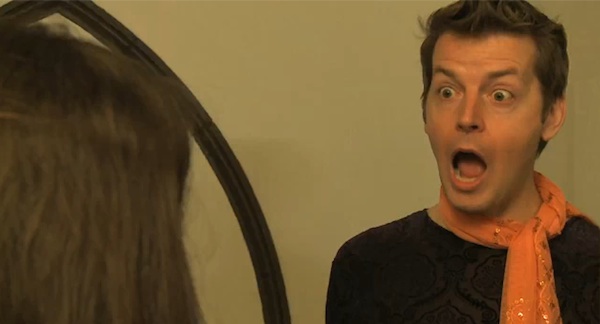
Sassy Gay Friend: Insulting or funny? Do you have a gay best friend who gives you fashion advice and tells you when you’re being a stupid bitch? Well, why not? Gay men have been the hottest accessories for straight women ever since “Will and Grace” made neutered homosexuals safe for prime time, and according to a Web series by Chicago’s comedy troupe Second City, some of the most famous women in literature would have been better off with their own Sassy Gay Friend.
The Sassy Gay Friend is a character played by comedian Brian Gallivan who pops up in the lives of Shakespearean characters like Ophelia, Juliet and Lady MacBeth (and more recently, Nina from “Black Swan”) to save them from their impending doom with his signature catchphrase, “What, what, what are you doing?” (His exit line is also the same in every episode, chiding the woman that she is “a stupid bitch.”)
Here he is, saving Juliet from killing herself by telling her, “I think you’re 14 and you’re an idiot. You took a roofie from a priest”:
And here, talking the Giving Tree out of her “abusive” relationship with the boy:
While these videos are funny (really, really funny, actually), they exist in an uncomfortable space where you aren’t sure if the character of the Sassy Gay Friend is a commentary on how our modern culture views homosexual men and their fag hags by contextualizing it in a historical setting, or if they were just banking on a gay stereotype to get laughs, like Jack from “Will and Grace.” As Thomas Rogers wrote in his article “Ladies: I’m Not Your Gay Boyfriend,” this secondary form of humor doesn’t embrace gay culture as much as laugh at it:
It’s ["Will and Grace"] turned what was once a special relationship between two cultural outsiders — gay men and the straight women who love them — into an eye-rolling cliché.
…In the past decade, gay men have become less defined and ghettoized by our sexuality than ever before, making terms like “fag hag” feel as retrograde as, well, “Will & Grace.”
Gallivan responded to criticisms of stereotyping from the LGBT community in an article for Edge Philadelphia:
I guess it depends on what part of the stereotype is detrimental to the gay community. Is it the way Sassy Gay Friend talks and his mannerisms? I know many wonderful gay men who talk and move like Sassy Gay Friend, and would anyone say those actual men are detrimental to the LGBT community? I hope not. Sassy Gay Friend is smart, fun, and loyal. And he tries his best to help his ladies. However, I will say that if anyone thinks his orange, beaded scarf is detrimental to the LGBT community, I might just have to agree. That scarf is pretty bad. And may prevent us from obtaining the right to marry.
But Gilbert’s argument doesn’t touch on perhaps the biggest problem with the stereotype: Many gay men just are not outlandish “La Cage Aux Folles”-types.
Meanwhile, a similarly titled new Web show is out there subverting all those traits defined by Gilbert’s character. “Disappointing Gay Best Friend,” created by Tyler Coates and Mikala Bierma, portrays the relationship between a woman and a much different kind of homosexual man:
In “Disappointing,” it is the woman (who represents all those “Sex and the City”-styled, self-declared fag hags that Thomas refers to in his article) whose expectations clash with the reality of her friend’s true persona. She bought into our culture’s portrayal of gay men as fun-loving party monsters so wholeheartedly that she’s blinded to her friend’s barely concealed disdain and disapproval for all the markers that make up that stereotype: He’s not into fashion, doesn’t want to go out and dance because he’s just ordered Thai food, and couldn’t give a crap about Lady Gaga. Essentially, the Disappointing Gay Best Friend is only disappointing because he’s not gay enough, and thus indistinguishable from a straight guy. And hey, if a girl wanted someone whose only comment about her outfit was that “it doesn’t make you look fat,” she may as well get a boyfriend. Right, ladies?
Drew Grant is a staff writer for Salon. Follow her on Twitter at @videodrew. More Drew Grant.
“Tubes”: What the Internet is made of
If you think your data lives in the cloud and flies through the air, you're wrong
Andrew Blum The title of Andrew Blum’s “Tubes: A Journey to the Center of the Internet” is a ricocheting joke. When Alaskan Sen. Ted Stevens described the Internet as a “series of tubes” back in 2006, he was roundly mocked for not understanding the online world despite being chairman of the Commerce, Science and Transportation Committee and therefore instrumental in overseeing it. Stevens may not have known what he was talking about, Blum (a correspondent for Wired magazine) acknowledges, but he wasn’t wrong, either. In writing this account of “the Internet’s physical infrastructure,” Blum found that “one thing [the Internet] most certainly is, nearly everywhere, is, in fact, a series of tubes.”
Continue Reading Close
Laura Miller is a senior writer for Salon. She is the author of "The Magician's Book: A Skeptic's Adventures in Narnia" and has a Web site, magiciansbook.com. More Laura Miller.
Internet doomsday, explained
According to media reports, July 9 will be our online apocalypse. The better story is how this crazy rumor started
The apocalyptic story line was once reserved for truly apocalyptic events. Nuclear war. The return of Christ. Environmental or economic collapse. But it’s 2012, and the apocalypse has become the basis for everything from Super Bowl commercials to summer romantic comedies – and no media story is too small to have an apocalyptic moniker attached to it. (Remember Snowmageddon?) If you want to get the world’s attention, simply proclaim that the world will soon end — or the Internet. Just read coverage of the so-called Internet Doomsday virus, which will supposedly strike and shut down the Web on July 9.
Continue Reading CloseMathew Gross is considered one of America's top new-media strategists. Together with Mel Gilles he is the author of "The Last Myth". More Mathew Gross.
Mel Gilles is a writer and a former advocate for victims of domestic abuse. Her essay, "The Politics of Victimization," went viral in 2004, reaching more than 2 million readers. More Mel Gilles.
Nobody ever calls me anymore
I feel like the last person who still likes talking on the phone. Why did we give it up, and should we reconsider?
(Credit: Anatema via Shutterstock) As a teenager, my friend Jennifer used to sneak into her mother’s room after bedtime and steal the phone. She would call the boy she was dating, or “going with,” or whatever we called it back then, and they would talk all night, sometimes till 4 a.m.
But something shifted a few years ago. She became afraid of talking on the phone. Just hearing it ring could provoke panic. Maybe it was the suffocation of carrying her cellphone all day long. (“There are these tentacles in you all the time,” she said.) But she rarely answered the phone, preferring to text message, and the voice mail piled up like unopened bills dumped in a desk drawer – frightening and unknown and ever present — until she couldn’t bear it anymore, and in a rush of guilt she would delete dozens of messages that had been left for her without even listening to them.
Continue Reading CloseSarah Hepola is an editor at Salon. More Sarah Hepola.
Who owns the cloud?
Google claims users retain intellectual property rights, but the terms of service tell a more complex story
(Credit: winul via Shutterstock) When you hear the phrase “property rights,” you probably think of farmers fighting environmental regulators and homeowners arguing with oil drillers. But in the Information Age, you should also be thinking about your computer – and asking, how much of you is really yours? It’s not a navel-gazing rumination from a college Intro to Existentialism class – it’s an increasingly pressing question in the brave new world of social networking and cloud computing.
Last week’s big technology announcement spotlighted the thorny issue. As the Los Angeles Times reported, Google’s announcement of its “Google Drive” came with the promise that users will “retain ownership of any intellectual property rights that you hold in that content.” But when you save files to Google’s new hard-drive folder in the cloud, the terms of service you are required to agree to gives Google “a worldwide license to use, host, store, reproduce, modify, create derivative works, communicate, publish, publicly perform, publicly display and distribute (your) content” as the company sees fit.
Continue Reading Close
David Sirota is a best-selling author of the new book "Back to Our Future: How the 1980s Explain the World We Live In Now." He hosts the morning show on AM760 in Colorado. E-mail him at ds@davidsirota.com, follow him on Twitter @davidsirota or visit his website at www.davidsirota.com. More David Sirota.
Lessons of a baby bucket list
Avery Lynn Canahuati accomplished a lot in her six months of life. Imagine what the rest of us can do in a lifetime
Avery Lynn Canahuati (Credit: http://averycan.blogspot.com/) What have you accomplished since November? What dreams have you fulfilled? In that time, Avery Lynn Canahuati threw out the first pitch at a baseball game, got a letter from the president and dressed up like a troll doll. She experienced deep love, and changed the lives of her family and friends. And that’s just what Canahuati got done in the first six months of her life. They were also the last.
Canahuati was born in Texas on Nov. 11. This past Good Friday, she was diagnosed with spinal muscular atrophy (SMA), a group of rare neuromuscular diseases that, in her case, were terminal. “We asked our doctors specifically if there is anything. Is there trial drugs, anything out of the country?” her mother, Linda, told CNN this week. So after “sitting around for two days crying and being devastated, since there is no cure and there is nothing we can do,” her father, Mike, decided to make the most of what was left of his daughter’s cruelly brief expected lifespan. Writing in Avery’s voice, he created a blog — and set a few goals.
Continue Reading Close
Mary Elizabeth Williams is a staff writer for Salon and the author of "Gimme Shelter: My Three Years Searching for the American Dream." Follow her on Twitter: @embeedub. More Mary Elizabeth Williams.
Page 1 of 55 in Internet Culture