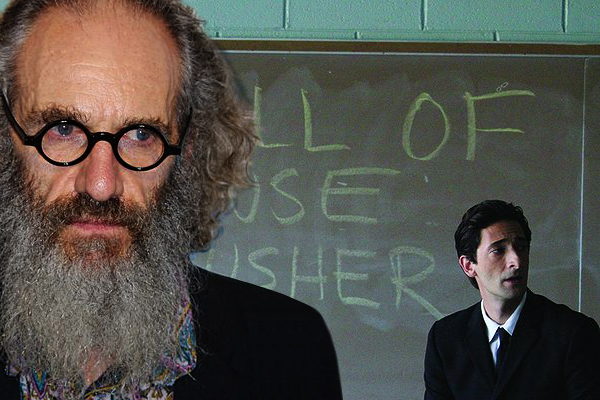

The turning point in Tony Kaye’s new movie, “Detachment” — which, despite many nameable flaws, is a wrenching and powerful achievement — comes when Lucy Liu, playing a high school guidance counselor, suffers a major breakdown in front of a student. It’s easy to be callous, she shrieks at the bored and bewildered girl in front of her, easy not to give a shit. What takes courage is actually caring about yourself and the world. Sure, you can call that a hackneyed sentiment, and some people won’t get past the fact that “Detachment” is delivering a familiar message in a familiar setting. But two things redeem the scene, at least for me: 1) What Liu says is absolutely true, and it is one of the central problems in contemporary life, and 2) she’s not saying it from some position of cool, removed wisdom; she’s pissed off, filled with rage, and completely losing her shit at a girl whose only crime was announcing that she doesn’t care about school and wants to be a model.
“Detachment” might be the biggest conversation piece I’ve seen so far at this year’s Tribeca Film Festival. It’s a scattershot, melodramatic would-be epic set in and around a New York high school, with a tremendous cast headed by Oscar-winner Adrien Brody as a substitute teacher struggling with his own barren emotional life. (It also stars Christina Hendricks of “Mad Men,” James Caan, Marcia Gay Harden, Blythe Danner and Liu.) It’s an everything-including-the-kitchen-sink kind of movie with a Fellini level of ambition. Kaye blends animated sequences along with dreams, memories and fantasies, mini-interviews with real-life teachers, dogmatic lectures about the failings of our society, and quotations from Albert Camus and Edgar Allan Poe. Carl Lund’s screenplay hits a lot of flat notes and the acting is uneven, but ultimately I didn’t much care — I was swept along by the spectacular visual journey and the wrenching emotional experience. People will either love “Detachment” or hate it, and either way it provides powerful testimony to the unrivaled passion and undiminished craft of director Kaye, whose notoriety in the film industry is matched by his near-total invisibility to the general public.
If you’ve heard of Kaye at all, it’s almost certainly because of his 1998 debut feature “American History X,” which is now a revered cult film but was a historic flop on its initial release, plagued by an entertaining and highly public three-way feud between Kaye, star Edward Norton Jr. and distributor New Line Cinema. Kaye tried to get his name taken off the film and replaced with the credit “Humpty Dumpty” (even threatening to legally change his name to that effect). He reportedly suggested — after the film was shot, edited and in the can — commissioning a new script from Caribbean poet Derek Walcott and starting over again from scratch.
Indeed, once you start with the Tony Kaye stories, you don’t want to stop. He spent $100,000 of his own money on ads in the Hollywood trade papers abusing Norton and the film’s producers, which I guess echoes the time when — as a nearly unknown advertising director — he bought an ad in a London broadsheet announcing that “Tony Kaye Is the Greatest English Director Since Hitchcock.” He once shot more film for a 30-second Volvo commercial than Woody Allen had used in making “Hannah and Her Sisters.” At the peak of his advertising success in the mid-’90s, he used to buy one of every item in the seasonal Comme des Garçons catalog. As he told a British interviewer a few years ago, “I did a lot of very insane things. A lot of very, very, very insane things.”
With his filmmaking career in ruins after the “American History X” debacle, Kaye briefly came under the wing of Marlon Brando, who hired him to film a series of seminars Brando was leading with Michael Jackson, Sean Penn and Jon Voight. (Of all the unfinished Kaye projects, that one may be the strangest.) But Kaye’s penchant for showing up at Los Angeles nightclubs dressed as Osama bin Laden — in the fall of 2001 — succeeded in alienating even the legendarily antisocial Brando, who died before the two could manage any reconciliation. So began Kaye’s period in the outer wilderness of the entertainment industry, before he began to work his way back by actually completing his memorably gruesome 2007 abortion documentary “Lake of Fire,” most of which had been shot during the Clinton administration.
I’m not Tony Kaye’s shrink and I’m not sure it’s worth speculating about why he did all the crazy things he did; when I interviewed him at the time “Lake of Fire” was released, he explained it all as a kind of act, in emulation of idols like Erich von Stroheim or Francis Ford Coppola. “All the work of the directors I really liked,” he said, “those directors seemed to be tyrannical, egotistical, arrogant, mad. They were my gods, so I thought, ‘Well, I’d better be like that.’ I’m not really like that.” That sounds like clear-sighted rearview analysis, but I’m not sure it’s adequate. When I ran into Kaye the other day in the Tribeca press room, I didn’t recognize him. When we met in 2007 he was bald, but he now has a Rasputin beard and non-haircut, and was approaching journalists with a hand-lettered paper sign that read, “I HAVE A SPEECH PROBLEM. MY NAME IS TONY KAYE (‘American History X’). I WANT TO TALK TO YOU ABOUT MY MOVIE ‘DETACHMENT.’” (Kaye did have a speech impediment in childhood and says he avoids talking on the phone, but you’d never notice it in ordinary conversation.)
Yes, it would be great if we could talk about “Detachment,” because the other side of the Tony Kaye story is that he’s such an intriguing and irresistible character that he throws his own movies into the shade, and that’s not serving his interests or anybody else’s. The thing is, in announcing himself as the greatest English director since Hitchcock back in 1980-whatever, Kaye was being an arrogant jackass, but his insight into his own potential wasn’t necessarily wrong. In some alternate universe a few ticks away from ours, things went a little differently before or during or after “American History X” and Kaye is now widely seen as one of the greatest living filmmakers, along with Scorsese and the Coens and Darren Aronofsky and whomever else you’d like to nominate.
But that universe isn’t this one, and it’s anybody’s guess how much of a comeback Tony Kaye can mount at age 58, with the manner of a 19th-century European anarchist and a heavily allegorical high school drama that’s going to sound, the more I describe it to you, like about seven (or 17) other movies you’ve already seen. It’s got a terrific central performance from Brody, maybe his best since “The Pianist,” but many of the other elements — the sympathetic fellow teacher he starts dating (Hendricks), the hardass but well-meaning principal (Harden), the teen hooker he adopts off the street (newcomer Sami Gayle) — seem like stock archetypes, at least until you actually sit down and watch the film.
Some distributor is going to have to take a chance on “Detachment” and endure a certain amount of critical derision. It’s probably worth it, partly because Tony Kaye still has cinematic talent to burn, but even more because of what he can do with it, even in a highly imperfect movie that uses the pointless but noble struggle of high school to stand in for lots of other pointless and noble forms of struggle, like making movies and being alive. What I take away from Tony Kaye’s struggle is that he may have been a difficult personality — and may still be one — and expended way too much energy early in his career on behaving like an asshole, but he has never, ever, surrendered to cynicism or callousness. He cares passionately and prodigiously about everything he’s ever done, arguably too much. If he has thrown away a once-promising career as a result, then his failure is better than most people’s success.
A dry, sweet, dirty-minded tale set in a nowheresville Norwegian town, “Turn Me On, Goddammit” testifies to the continuing strength — not to mention strangeness — of Scandinavian cinema. Some American distributor will likely give this a whirl following its world premiere at the Tribeca Film Festival, in hopes of an offbeat, “Let the Right One In”-scale hit. This yarn about an innocent-looking but desperately horny teenage girl might not have that much commercial upside, but its bittersweet, faintly depressed brand of Nordic humor is definitely enjoyable.
When we first meet Alma (Helene Bergsholm), an angelic blonde of 15 or 16, she’s sprawled out on the kitchen floor with her hand down her pants, eagerly responding to the instructions of a phone-sex interlocutor called Stig. Sadly, that’s as hot as things get for Alma in her sleepy fjord-side village (I’m not even going to try to spell it); she’s got Stig on the horn and she’s got elaborate nightly fantasies about Artur (Matias Myren), a sleepy-eyed local dreamboat who seems to like her, but not quite enough or not quite that way. If you’re about to sniff that you can’t imagine a teenage girl actually resorting to phone sex, that’s not the point; despite the veneer of downscale European realism in “Turn Me On, Goddammit,” writer-director Jannicke Systad Jacobsen is definitely leading us into the realm of farce.
Things don’t improve for Alma after Artur either does or does not reveal his glorious throbbing manhood to her in an intimate moment amid the ruined outdoor furniture behind the local youth center. Her friends don’t believe her, and Alma becomes a social pariah and the subject of bathroom graffiti. Given that she’s endlessly distracted by sexual fantasies anyway — involving her boss at the convenience store, her best friend’s bitchy sister and pretty much anyone and everyone else — Alma herself can’t be entirely sure what happened.
Shot in bleached-out picture-postcard colors with a few intriguing fillips — sequences told via black-and-white stills; semi-animated letters written to Texas death-row inmates (I really can’t explain it) — “Turn Me On” is fundamentally a wry, affectionate small-town movie, but one that sneaks up on a genuine feminist issue. Boys Alma’s age are expected to be sex-obsessed, but a girl who yearns for action is relentlessly stigmatized, even in the context of a supposedly nurturing and tolerant social democracy. Alma escapes (very briefly) to the bohemian freedom of the big city and scores a modest victory against repression and hypocrisy, but it’s one female libertines everywhere (and their companions) can embrace.
Continue Reading
Close
If you haven’t spent some of your life in a former British Empire nation — I mean, one besides the United States — then you probably don’t know much about cricket, the Anglocentric sport that’s cousin and/or ancestor to baseball. (I actually played both as a kid, enjoy both as a spectator, and resolutely refuse to take sides on this ancient and symbolic divide.) But Stevan Riley’s documentary “Fire in Babylon” — which had its North American premiere last weekend at the Tribeca Film Festival — is so much fun that you don’t really have to understand much about the nuances of cricketing to get the point.
Sure, “Fire in Babylon” is a sports movie, one of the best in Tribeca’s ESPN-sponsored sports film festival, but also one that understands sport as an expression of culture and politics. Mixing file footage, contemporary interviews and exciting musical performances ranging from reggae to calypso, soca and Caribbean rap, Riley tells the story of how the West Indies cricket team of the late ’70s and ’80s transformed the sport, and became a lightning rod for black pride and the black-power movement around the world. Led by captain Clive Lloyd, superstar batsman Viv Richards — who’s something like the Babe Ruth and Jackie Robinson of cricket, rolled into one — and an intimidating quartet of “fast bowlers” (the equivalent of Randy Johnson-style fastball pitchers), that West Indies team recorded historic victories in England and Australia and went undefeated in top-level international competition for 15 years, a record unmatched by any team in any sport.
As the team members and other observers recount, it absolutely was no coincidence that all this happened in the aftermath of the American civil-rights movement, in the same era when Caribbean nationalism was swelling, Bob Marley was becoming an international superstar and immigration and racial strife were transforming British society. (When the Windies played England in London, almost half the crowd was rooting for the visitors.) Traditionally, West Indian “calypso cricket” had been viewed through a distinctly racist scrim: The team was full of talented players who were perceived as careless and happy-go-lucky, and always found a way to lose.
When the Lloyd-Richards squad began to play a more aggressive, athletic style and dominate opponents, those stereotypes were turned on their head, and the Caribbean players were described as brutal, unsportsmanlike and worse. The symbolic nature of the conflict was obvious to everyone; while the English batsmen who were bruised and battered by the lethal fast bowling of Malcolm Marshall and Colin Croft were not personally responsible for the “Babylon system” of colonialism and discrimination, the entire Afro-Caribbean population delighted in seeing them take a beating. But in the end “Fire in Babylon” is more a story of redemption than revenge — during its long domination of the sport, the West Indian team became a huge draw around the world, and a widely admired and emulated opponent.
Cricket has moved on — may I say that I mostly hate the new-school, soccer-meets-baseball uniforms? — and West Indian supremacy has faded (India and Australia are generally seen as the world’s top cricketing nations.) “Fire in Babylon” recalls an exceptionally dramatic period in sports culture and is a must-see for cricket buffs and the cricket-curious, providing a lot of the sport’s thrills without forcing you to endure the five-day televisual slog of a test match. It opens in British cinemas next month, where it will surely attract a large audience. For Americans, it’s more likely to be a DVD or VOD curiosity, but one well worth seeking out.
Continue Reading
Close
If you polled Israelis about what their country needs most, I’m guessing “horror movies” might rank pretty low on the list, somewhere down below “a peaceful settlement of the Palestinian question” and “Appletinis.” But all boundaries were made to be broken, and any observer of Israel’s inventive and intelligent cinema scene would agree that when the Jewish state finally got around to making a horror flick, it’d be a pisser. And so we have “Rabies,” the debut of writing-directing duo Aharon Keshales and Navot Papushado, which takes the standard stupid-kids-in-the-woods formula and inverts it to delicious, hilarious and extremely mean effect. It premiered this past weekend at the Tribeca Film Festival, and looks like a prospective indie-horror hit if I’ve ever seen one.
The mere existence of a movie like “Rabies” might give rise to various not-funny jokes (like the one I made some years back about “The Last Man,” a quite interesting movie about a serial killer on the loose in Beirut: How is anybody supposed to tell?), or sober-sided reflections about the fact that Israel’s founding generation probably lacked much appetite for violent entertainment. Keshales and Papushado aren’t giving in to any of that: They’ve got horny guys in tennis whites, girls in short skirts, a pair of easily distracted and/or sadistic cops and a psycho with a whole bunch of scary hardware, and they’re determined to make you jump.
That might not sound easy, or even possible, given that set of ingredients — and I don’t want to give away anything much about a film that’s probably months away from release. Let’s just say that the directors keep the plot twisting and the action humming, so that the characters constantly collide in unexpected ways, and that almost none of the numerous killings in “Rabies” occur where and when you expect them to. We begin with an adult brother and sister running away from their family (yeah, it’s what you’re thinking) who stumble into a trap set by the psycho killer in an off-season fox-hunting preserve. But Mr. Maniac disappears from the story for much of what follows — and it’s as if his homicidal energy spreads through the rest of the cast.
Keshales and Papushado have assembled a sharp ensemble of young Israeli talent, all of whom get that the line between horror and comedy barely exists, and that both require exquisite timing. There’s a shambling, lovable park ranger (Menashe Noy), a pair of tennis-playing dimwits (Ran Danker and Ofer Shechter) who are hot for blond, leggy Shir (Yael Grobglas) and mostly don’t notice her pint-size brunette friend, Tali (Liat Harlev). Best of all, perhaps, are lovelorn cop Danny (Lior Ashkenazi) and his leering, power-mad partner Yuval (Danny Geva), who — like all cops in horror movies — are determined to make a precarious and dangerous situation much worse. Don’t get too attached to any of these people, because “Rabies” is a horror fan’s horror movie. Just when you think you know what it’s up to, it’s actually sneaking up behind you with a heavy rock, a pair of wire snips and an evil little giggle.
Continue Reading
Close
Here’s the only thing I need to say about Greg Barker’s documentary “Koran by Heart,” which premiered this past weekend at the Tribeca Film Festival, at least after I tell you the title: It’s a movie about the International Holy Quran Competition, held every year in Cairo, where students from all over the Muslim world show up to demonstrate their total recall of Islam’s gospel, all 600 pages of it. It’s “Spellbound” plus a poetry slam. Plus Islamic fundamentalism. Exactly: OMG. (I’m sorry about the variant spellings, by the way, but there’s no consistent standard for transliterating Arabic into English. The movie uses “Koran” and Salon uses Associated Press style, which is “Quran.” At least it’s not as bad as Gadhafi/Gaddafi/Qaddafi/Khadafy etc.)
And here’s the second thing about “Koran by Heart”: It’s a colorful and dramatic saga of human competition, with a fascinating setting and utterly irresistible pint-sized heroes, but it doesn’t soft-pedal the things about 21st-century Islam that are likely to make at least some Western viewers uncomfortable. One of our stars is a 10-year-old kid from Tajikistan named Nabiollah, an angelic, big-eyed moppet who can recite the entire Quran from memory in an astonishingly pure boyish soprano, with remarkable command of melody and intonation. He’s like the Justin Bieber of Quran recitation, and judges at the Cairo event seize on him as an amazing gift from Allah. But memorizing the Quran (in Arabic, which he does not otherwise speak or read) at a rural madrassa has nearly been Nabiollah’s entire education; he is functionally illiterate in Tajik, his own language.
You can’t say that about Rifdha, also 10, a cuddly, sparkling child from the Maldives (an archipelago nation in the Indian Ocean) who seems younger than her age but is something close to a prodigy. She excels at Quran recitation, but it’s clear she would excel at anything she pursued. She studies advanced science and math, speaks several languages and yearns to be an undersea explorer and researcher. Her mother is fully supportive, but her father, a calm and thoughtful man with the untrimmed beard that indicates a certain stream of fundamentalism, insists that Rifdha must receive a strict Islamic education — perhaps in Yemen, rather than the relatively liberal Maldives — and become a housewife.
Perhaps most affecting of the film’s three 10-year-olds, however, is Djamil, an earnest imam’s son from an impoverished village in Senegal who travels to Cairo all by himself as a representative of an entire nation on the outer fringes of the Islamic world. Barker filmed the 2009 competition (when Egyptian president Hosni Mubarak, seen in the film, was still in power), which featured 110 contestants ranging in age from 7 to about 20, including a few from Western nations: a teenage girl from Italy, a 10-year-old Australian boy.
Whatever assumptions you might have about a Quran-recital competition, they’re likely to be wrong. It’s a high-tech affair held in a luxurious meeting hall, with a touch-screen interface and electronic scoring. (The finals are broadcast on live TV around the Arab world.) Although the contest is fierce and the atmosphere solemn, the judges are affectionate and supportive. Girls are not only not forbidden but encouraged; lead organizer Salem Abdel-Galil, an Egyptian government minister, is particularly excited about Rifdha, and eagerly explains that Islam sees men and women as equals. (Take it up with him, not with me!) A youthful and charismatic imam and TV personality, Abdel-Galil further elaborates that the annual competition was meant as a counterweight to extremism, as evidence that young Muslims can embrace the Quran in highly literal fashion without rejecting modernity or supporting violence.
I don’t assume for a moment that those who are anxious about Islam in general or Western Muslims in particular will be mollified by “Koran by Heart,” although you’d have to be hard-hearted indeed not to develop a rooting interest (Team Rifdha!) or a fascination with the impenetrable-to-outsiders rules and rituals of Quran recitation. But what looks and sounds to me like a purely aesthetic or musical event of course carries a more profound significance to believers. Muslims understand each individual recitation as an act of divine revelation, almost as potent as the initial revelation by the angel Gabriel to the Prophet Muhammad.
So if you want to see the Quran contest as a cynical P.R. event designed to paint a friendly face on a sinister global conspiracy, or a celebration of the coming world Caliphate, then carry on. But if you’re open to the possibility that Islam in practice is an incredibly diverse spiritual and social movement that embraces 1.6 billion human beings and a lot of internal discussion and disagreement, and that the more we know about it the better, then “Koran by Heart” is a movie you’ve got to see. (The film will probably play on HBO later in the year, and theatrical distribution is also possible.)
Continue Reading
Close
Fans of Michael Cuesta’s 2001 indie classic “L.I.E.,” which features Brian Cox as the only semi-sympathetic pedophile character in the history of popular media (at least post-Humbert Humbert) — it’s time to celebrate, kind of. And by celebrate I mean have a beer at 10 o’clock in the morning and wear the same clothes four days in a row. If you thought the portrait of downscale, dysfunctional Long Island suburbia in “L.I.E.” was depressing, wait till you see Ron Eldard as the eponymous hero of “Roadie,” playing a 40something guy who gets fired by Blue Öyster Cult (!) after 26 years of shlepping their gear (!!), and winds up back home in Queens doing way too much coke with a couple he knew a long time ago.
After “L.I.E.,” Cuesta made a gritty and compelling tween-angst saga called “Twelve and Holding” in the mid-2000s, which failed to generate any buzz, and since then he’s largely made a living directing TV episodes (most notably for “Six Feet Under” and “Dexter”). “Roadie,” which premiered on Saturday night to a packed and supportive crowd at the Tribeca Film Festival, is clearly a longtime labor of love, and I simultaneously want to endorse its ambition and nerve and report that it’s a very mixed bag. Actually, let’s call it a labor of love-hate, since it’s not entirely clear what’s been the worst thing about the misshapen life of Jimmy Testagross (Eldard’s character, aka “Jimmy Testicles”): Spending half a lifetime as a low-wage flunkey for an over-the-hill metal band, or growing up in the middle-class cultural backwater of Forest Hills, Queens. (Don’t be offended, don’t be offended, I know: Simon and Garfunkel, Donna Karan, Geraldine Ferraro, Candy Darling. Notice that they all got the hell out of there.)
Let me say this for Cuesta, for starters: He captures the outer-outer-boroughness of New York City like nobody else. Fifteen minutes into Jimmy’s return to his childhood home, where his addled mother (Lois Smith) views him with ancient and weary skepticism and the meddlesome couple next door are simultaneously decrepit and terrifying, and you’re like: Man, no wonder the Ramones — perhaps Forest Hills’ most famous rock ‘n’ roll escapees — sniffed so much glue. Let me add further that Jimmy Testicles’ extended soliloquy on the cultural importance of BÖC, the “thinking man’s metal band,” and the greatness of Buck Dharma’s guitar solo on “Dominance and Submission” almost made me a believer — and I pretty much hate metal, and never had any time for that band. (I mean, “(Don’t Fear) the Reaper,” yeah. Of course.) Fans of Long Island’s rock tradition, which I also am not, will delight in a tribute to the quasi-legendary Good Rats, which Cuesta throws in just for the hell of it.
If the first awkward half-hour or so of “Roadie” made me want to claw my own skin off with claustrophobia and impatience, Cuesta shifts into an entirely different gear when Jimmy reconnects with a high-school nemesis, Randy (Bobby Cannavale, in his finest abrasive-asshole mode), who turns out to have married Nikki (Jill Hennessy, pitch-perfect in too-tight designer jeans and a bit too much eyeliner), Jimmy’s lost flame. Jimmy halfway convinces these two that he’s actually a music industry big shot, rather than a penniless middle-aged failure who makes them look like Brangelina in comparison, and somehow they end up in a motel room on Woodhaven Boulevard with a bunch of cocaine and tequila and Wild Turkey, with Jimmy air-drumming to BÖC and Randy lying on the bed half passed out and mumbling, “If you’re gonna fuck my wife, get on with it.”
It’s tough to say what the commercial prospects for this flawed but audacious picture might be — except, wait, no it’s not. The indie-film take on pop culture is supposed to be overwhelmingly positive, assuring us that it’s a redemptive and nurturing force, and “Roadie” is in some ways closer to the malicious spirit of the Chilean disco-horror flick “Tony Manero.” Movies about rock culture in its dotage are also supposed to be funny — but there’s too much pain and desperation in Eldard’s beefy, sideburned visage to be flat-out amusing. What did Jimmy Testicles get from 20-odd years on the road with the Cult, and can he build something approaching a new life in the aftermath? (He doesn’t know how to fold laundry, or make a pot of coffee.) “I don’t know” and “maybe” are not exactly comforting answers, but Cuesta is too honest, or too ruthless, to offer much more than that.
Continue Reading
Close